Soil Fertility and Soil Productivity
 Call Kai
 Learn
Learn Practice Test
 Spaced Repetition
 Match
Match Flashcards
 Knowt Play
1/35

There's no tags or description
Looks like no tags are added yet.
Name | Mastery | Learn | Test | Matching | Spaced | Call with Kai |
|---|
No analytics yet
Send a link to your students to track their progress
36 Terms
Soil Fertility
the ability of soil to provide nutrients in proper quantities and in a balanced way for the growth of plants. Fertile soil should have the proper proportion of nutrients and optimum pH.
Soil Productivity
the capacity of soil, in its normal environment, to support plant growth. It is affected by factors other than soil fertility, such as weeds and farming methods.
Factors affecting Soil Fertility
Infiltration of water
Soil structure
Active soil life
Content of organic matter
Minerals present in soil
Soil pH
Water retention capacity of soil
Water draining ability of soil
Nutrient release capability
Parent soil characteristics
Ground water
Exploitable depth of the soil
Leaching
loss of water-soluble plant nutrients in soil
Leaching
common with nutrients that are highly soluble such as N. These nutrients are carried to lower areas, far beyond the reach of many plant roots. Soil with many leached nutrients are infertile.
Soil Capping
occurs when soil is covered (capped) with an impervious material which prevents.
Soil Capping
• the penetration of rainwater into soil,
• which leads to surface runoff.
• decreases moisture content and increases erosion
Soil Erosion
occurs when the top fertile soil is carried away by moving water and/or wind
Soil Erosion
Leads to loss of topsoil and plant nutrients
Monocropping
practice of growing one type of crop on a piece of land for long periods of time.
Monocropping
Crops grown use only the nutrients they need while others remain unused → leads to exhaustion of nutrients
Monocropping
Also increases the likelihood of buildup of pests and diseases, which may be passed on from residues of the former crop → leads to low yield • Also leads to decrease in biodiversity 7
Monocropping
Also leads to decrease in biodiversity
Accumulation of Salts
mineral salts come from decomposition of parent rock or decomposition of organic matter.
Accumulation of Salts
Under normal conditions, salts are washed away by rainwater. However, in arid
and semi-arid areas, rainfall is irregular and not enough to remove salts from
soil
Change in pH
inappropriate use of fertilizers may change soil pH
Change in pH
Use of acidic fertilizer over long periods of time can decrease soil pH, which may affect the activity of soil microorganisms and availability of nutrients
Burning of Vegetation
when vegetation is burned, organic matter is destroyed
Burning of Vegetation
• Affects the activities of microorganisms such as N fixation and decomposition of organic matter
• Soil is exposed to agents of erosion such as wind and water
• Accumulation of resulting ash also causes imbalance of nutrients in soil
Fertilizer
a chemical or natural substance added to soil to increase its fertility
Chemical Fertilizer Manufacturers
must guarantee the analysis of all fertilizers.
Three Main Macronutrients
N
P
K
N
promotes leaf growth
P
enhances development of roots, flowers, seeds, fruits
K
strong stem growth, movement of water in plants, promotion of flowering and fruiting
Secondary Macronutrients
Ca, Mg, S
Micronutrients
Cu, Fe, Mn, Mo, Zn, B
Occasionally Significant
Si, Co, V
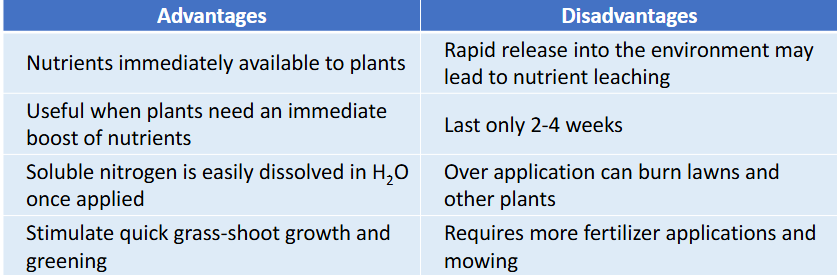
Quick Release Fertilizers
made from water soluble compounds; derived from synthetic nutrients
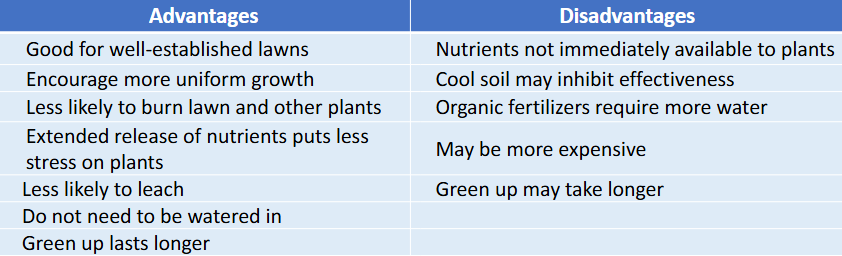
Slow Release Fertilizers
made from natural materials; release nutrients at a slower rate, based on moisture and temperature
SLOW RELEASE FERTILIZERS
QUICK RELEASE FERTILIZERS
Pollutants
are leached off to the bodies of water
Point-Source Contamination
can be traced to specific points of discharge from wastewater treatment plants and factories or from combined sewers.
Air Pollution
spreads across the landscape and is often overlooked as a major nonpoint source of pollution. Airborne nutrients and pesticides can be transported far from their area of origin.
Eroded Soil and Sediment
can transport considerable amounts of some nutrients, such as organic nitrogen and phosphorus, and some pesticides, such as DDT, to rivers and streams.

