Text Classification – Text Typology (English Linguistics II)
 Studied by 0 people
 Call Kai
 Learn
Learn Practice Test
 Spaced Repetition
 Match
Match Flashcards
 Knowt Play
1/19

Earn XP
Description and Tags
Vocabulary flashcards covering key terms from the lecture notes on text classification and text typology.
Name | Mastery | Learn | Test | Matching | Spaced | Call with Kai |
|---|
No analytics yet
Send a link to your students to track their progress
20 Terms
Text classification
he process of organizing texts by identifying features that show their differences and similarities. It helps us recognize and better understand various discourse types.
In text-‐linguistics, discourse types have been given different names:
1 REGISTER:A type of text or language use shaped by the situation or context (e.g., formal vs. informal, scientific vs. everyday). Registers link the situation with typical language features that serve a clear purpose in the text.
2 GENRE: Genres are primarily determined by the communicative functions they perform, e.g. warn, persuade, inform etc. They are characterized by their internal structure (‘stages’) and salient linguistic features
3 TEXT TYPE/CLASS OF TEXT: Text types are large groups of texts defined on the basis of typical content, text structure and linguistic style features. (e.g. descriptive, argumentative)
Text Production Competence
Our ability to produce typical exemplars of a genre (e.g. letter of complaint, application, abstract, blog entry, text message, diary entry etc.)
Text Reception Competence
Our ability to recognize and correctly interpret exemplars of a genre including mixes, parodies etc. Both skills presuppose linguistic knowledge of text types.
Text-Typological Competence
The ability of language users to recognize and work with different types of texts. This skill develops naturally over time through reading and writing, making it easy to identify text types in real life.
Genre Recognition
>> ability to give names to the genres we encounter by recognizing: a) their social func2on, 2) their internal structure, 3) their linguistic make-‐up
>> ability to see through mixes/hybrids of genres (e.g. advertorial)
Sense of Appropriateness
>> ability to judge the suitability of linguis2c means for a genre or discourse type both produc2vely and recep2vely
Original Ideas of Register + 3 things
how language varies across contexts, highlighting the conventions and styles typical of a given situation or genre.
Field: What is the topic/ content of the text? Which kind of social action are the communicators engaged in? e.g. technical/everyday
Tenor: Who communicates with whom and what is the social relationship between the communicative partners? e.g. friends/strangers; public/private; formal/ informal
Mode: Which medium and what technology is used in communication? How are the texts structured? e.g. speech/writing; faceto-face/radio/TV
Modern Ideas of Register : definition+ 3 components
a variety of language linked to a specific situation of use and communicative purpose. According to Biber & Conrad (2009), the description of a register includes three main components:
Situational Context: (who, where, why communication happens)
e.g. direct interaction, ‘sharedness’ of time/place, ‘keep talking’
Linguistic Feature: (words, grammar, style typical of that situation)
e.g. 1./2nd person pronouns & questions highly frequent (pervasive)
The Functional Relationship (between the two): (how those language features serve the purpose of the situation).need to interact, address one another and talk about one’s own concerns motivates the linguistic features
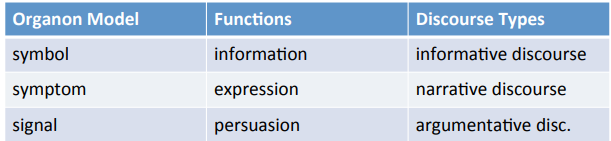
BÜHLER’s ORGANON MODEL AS A POINT OF DEPARTURE
According to Bühler’s model, language has three main aspects, each linked to a function:
Symbol (reference to reality) → Function: information / transmission of facts.
Symptom (expression of the speaker) → Function: expression / feelings / creativity (e.g. poetry, stories).
Signal (influence on the hearer) → Function: persuasion / appeal (e.g. argument, advertisement).
JAKOBSON’S MODEL OF LANGUAGE FUNCTIONS
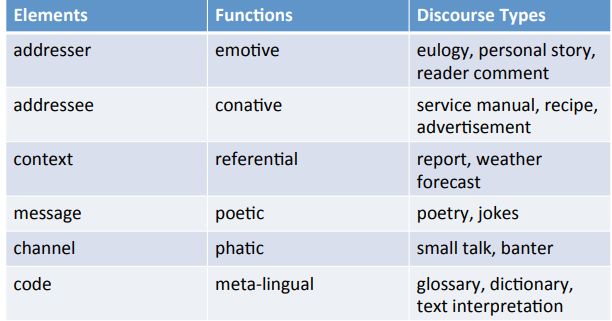
Jakobson expanded Bühler’s model by identifying six functions of language, each linked to one element of communication:
Referential → focuses on the context → function: to inform / describe reality.
Emotive (expressive) → focuses on the speaker → function: to express feelings or attitudes.
Conative → focuses on the addressee → function: to persuade / request / command.
Phatic → focuses on the contact/channel → function: to establish, maintain, or check communication (e.g. “Hello?”, “Can you hear me?”).
Metalingual → focuses on the code → function: to talk about language itself (e.g. “What does this word mean?”).
Poetic → focuses on the message itself → function: to highlight form, style, or aesthetics (e.g. rhyme, wordplay, slogans).
Text Classification based on Text Functions 5
INFORMATION (Representative)
Purpose: Convey knowledge or facts about the world.
Speech acts: state, claim, predict, explain, describe, report.
Genres: news, report, description, diagnosis, textbook.
APPEAL (Directive)
Purpose: Get the addressee to change thoughts/behavior or perform an action.
Speech acts: request, order, recommend, instruct, apply.
Genres: recipe, manual/instruction, advertisement.
OBLIGATION (Commissive)
Purpose: Producer commits themselves to future action/behavior.
Speech acts: intend, plan, promise.
Genres: oath, guarantee, job offer, legal contract.
CONTACT (Expressive)
Purpose: Express feelings or strengthen relationship with the addressee.
Speech acts: thank, apologize, congratulate, complain, swear.
Genres: postcard, love letter, condolence/complaint letter, small talk.
DECLARATION (Declarative)
Purpose: Create a new reality/fact for the addressee.
Speech acts: certify, appoint, declare.
Genres: will/testament, certificates, wedding ceremony.
Media and Communicative Forms
Five media:
Comminicative Forms:
FIVE MEDIA: 1 face-‐to-‐face, 2 telephone, 3 radio, 4 TV, 5 writing COMMUNICATIVE FORMS: Lener, Book, Printed Press, Audiobook, Cinema, Theatre, Tex2ng, Skype, Blog, Chat, Twiner, E-‐mail, Packaging, Poster etc.
Communicative Form
DIRECTIONALITY of comm. – monologic VS. dialogic
CONTACT in space/time – space-‐time shared VS. not shared
ON/OFF-‐OPTION – yes (interactive) VS. no (one-‐way)
MEDIAL VARIANT of language – spoken VS. wrinen
DOMAIN of use – public / official / private (dt. ‚Handlungsbereich‘)
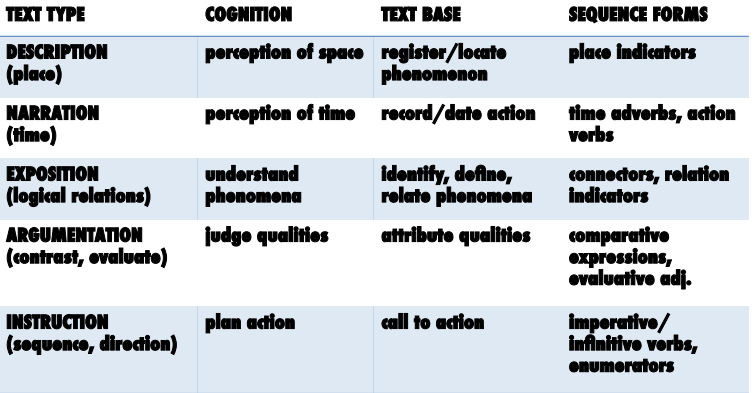
Text Type: definition + 5 types
An idealized model of how texts are structured. It provides a set of rules and elements that guide how a writer or speaker expresses experiences linguistically.
Description
Narration
Exposition
Argumentation
Instruction
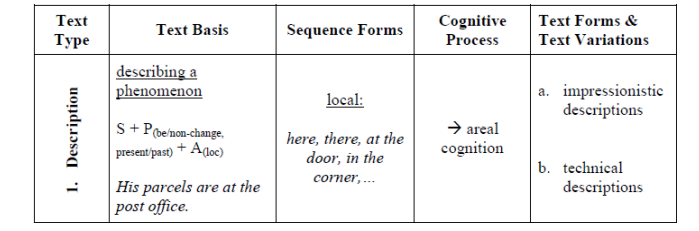
Descriptive Texts( Text types)
exts that describe places, objects, or phenomena, focusing on spatial details and features.
e.g. The DeepView 66 is a fourth-generation autonomous acrylic-hulled tourist submarine.”
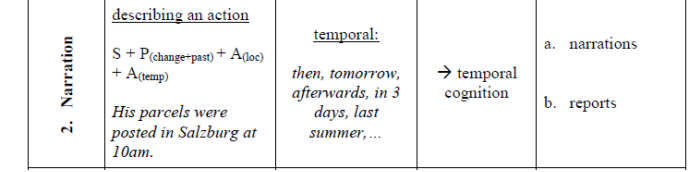
Narrative Text ( text types)
Texts that tell a sequence of events, often focusing on time order and actions.
Tell events in chronological order, showing actions and experiences.
e.g. “Billy Weaver had travelled down from London on the slow afternoon train with a change at Swindon on the way, and by the time he got to Bath it was about nine o’clock in the evening and the moon was coming out of a clear starry sky over the houses opposite the station entrance.” (The Landlady, Roald Dahl)
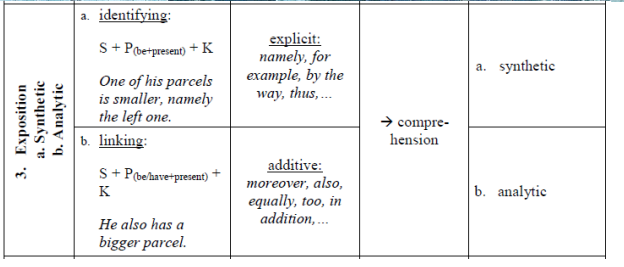
Explanatory Text (text types)( exposition)
Texts that explain ideas, concepts, or phenomena, showing causal or logical relationships.
Explain how or why something happens, often using examples or logical reasoning.
e.g. “The cellular and genetic changes that drive most brain disorders aren’t well known. But new technologies are making it possible to understand these changes, which could help scientists identify new drugs or treatments. For example, scientists can grow a patient’s neurons in a petri dish and examine them for changes in appearance or function. Scientists can also test drugs on these neurons (…)”
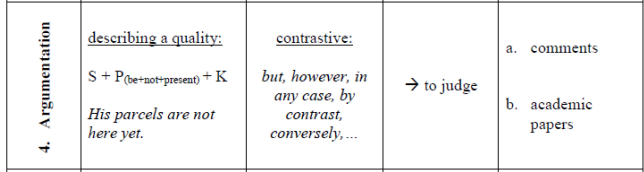
Argumentative Text (text types)
Texts that present and support a point of view, aiming to persuade or convince the reader using reasoning, evidence, or evaluation.
Make a claim and support it with reasons, evidence, or evaluation.
e.g. “It's risky — almost premature — heaping five-star praise on a debut album. However, the Naked and Famous are different, because in the two years since forming they've proved themselves in many ways (…). So it would have been a let-down if Passive Me, Aggressive You didn't live up to the band's early promise. It's an accomplished, unique, and visionary record that's laced with searing doses of noise, spasms of guitar distortion, and electronic discord, while still rooted in a jaunty, poppy and thrilling intensity.”
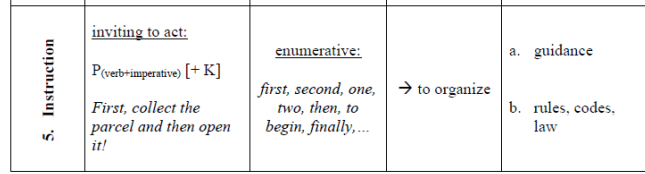
Instructional Texts (text types)
Texts that give directions or steps to achieve a goal or complete a task.
e.g. “Cover steamer bottom with water and bring to a boil. Place about half of the bag’s contents in the steamer tray. Cover and steam 8–10 minutes or to desired tenderness. Season before serving.”
Genre
A structured, goal-oriented type of text in a social context, with typical patterns, purposes, and stages.
Genre Analysis
The study of different text genres to understand their structures, purposes, and the ways they function within specific contexts. It involves examining conventions, styles, and the social contexts in which genres emerge.
Function: inform/instruct/warn consumer about drug
Social Setting/ Context: commercial context, situa2on of poten2al use
Linguistic Style: a) questions/imperatives (direct address); b) short/fragmentary sentences (economy); c) no linking of sentences (enumerative); d) some technical language (field: medicine), otherwise very simple diction
Typical Structure : STAGE 1: describe function; STAGE 2: instruct for use; STAGE 3: warn of dangers; STAGE 4: state brand/product trademark; STAGE 5: give codified info
Genre Analysis 7
Participants:producer/recipient social characteristics
Relations:social roles, shared knowledge, inter-‐ activeness
Channel: mode, medium of communica2on (technology, material)
Setting:place/2me of communica2on (public, private)
Purpose:comm. func2on, amtude to content, stance, factuality
Topic:thema2c domain, specific subject
Production Circumstances:way in which text is produced (e.g. real-‐ 2me, scripted etc.)
Structure/Stages: the specific language features and stylistic choices that characterize the text
Linguistic style: the specific language and stylistic elements that define how a text communicates and appeals to its audience.

 Note
Note  Flashcards (223)