Week 3 - Prejudice
 Studied by 0 people
 Call Kai
 Learn
Learn Practice Test
 Spaced Repetition
 Match
Match Flashcards
 Knowt Play
1/18

There's no tags or description
Looks like no tags are added yet.
Name | Mastery | Learn | Test | Matching | Spaced | Call with Kai |
|---|
No analytics yet
Send a link to your students to track their progress
19 Terms
Component of Prejudice - Tripartite model of group antagonism (Allport, 1954)
prejudice consists of cognitive (stereotypes), affective (feelings), and behavioural (discrimination/intention) components.
e.g. believing immigrants are “lazy” (cognitive), feeling hostility (affective), refusing to hire them (behavioural).
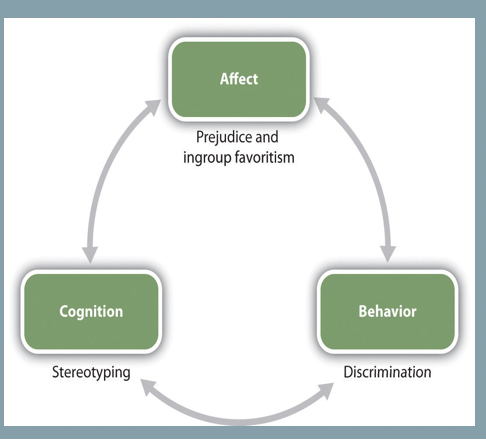
Tripartite model of group antagonism - Cognitive component - Stereotype
beliefs about the attributes of a group (attitude object)
Tripartite model of group antagonism - Cognitive component - Social categorisation
automatic mental process of sorting people into groups (“us” vs “them”), making group stereotypes more likely.
Example: immediately classifying someone by gender/race.
Tripartite model of group antagonism - Cognitive component - Katz & Braly (1933)
early classic research documenting strong racial stereotypes; showed widespread consensus around negative stereotypes.
Example: participants consistently associated particular negative traits with certain racial groups.
Tripartite model of group antagonism - Cognitive component - Priest et al. (2018)
study showing white adults working with children held negative stereotypes about BAME young people.
Example: associating BAME youth with trouble or aggression.
Tripartite model of group antagonism - Affective component
emotional reactions (like/dislike, fear, disgust) towards a group.
Example: fear of Muslims due to Islamophobia.
Tripartite model of group antagonism - Behavioral component
actions taken toward a group, especially unequal or harmful behaviour.
Example: refusing service to minority customers.
Tripartite model of group antagonism - Behavioral component - discrimination
Definition: unequal treatment based on group membership (not personal merit).
Example: racial profiling.
Tripartite model of group antagonism - Behavioral component - conation
behavioural intentions or motivation to act in a certain way toward a group.
Example: intending to avoid working with LGBTQ+ people.
Theories of Prejudice - Psychodynamic approaches
prejudice explained through unconscious motives, ego defence, and emotional conflict.
Example: using prejudice to manage anxiety or insecurity.
Psychodynamic approaches - Prejudice as ego defence / displaced aggression
people want a protective sense of superiority
when angry/frustrated but cannot attack the real source, aggression can be displaced onto a substitute (scapegoating)
Example:
hardship and lynching patterns (Hovland & Sears, 1940)
Intergroup competition theories
prejudice results from conflict over resources/status/power between social groups.
Example: hostility toward migrants seen as job competition.
Intergroup competition theories - Realistic Conflict Theory
competition over scarce resources leads to intergroup hostility and prejudice.
Example: resentment when two groups compete for housing.
Intergroup competition theories - Relative Deprivation Theory
prejudice stems from perceived unfair disadvantage compared to another group; believing “they get more benefits than we do.”
e.g. riots in 1960s Black ghettos (Sears & McConahay, 1973) - argue that 1960s urban riots were not random acts of lawlessness but a "political rebellion" by a new generation of Black Americans using violence as a functional tool to demand systemic change.
Intergroup competition theories - Sense of Group Position
prejudice arises from dominant group’s belief in entitlement to higher status; challenge to dominance provokes prejudice
Later work (Bobo & Hutchings, 1996) gives key features:
belief dominant group is superior
belief subordinate group is “different”
assumption dominant group has a legitimate claim to privilege
feeling threatened by subordinate group’s advancement
Intergroup competition theories - Social Dominance Theory (Sidanius & Pratto, 1999)
societies form hierarchies; prejudice and discrimination maintain group-based inequality.
Social Dominance Theory (Sidanius & Pratto, 1999) - trimorphic hierarchy
SDT argues that hierarchies tend to form in 3 recurring systems:
Age system (adults dominate children)
Gender system (men dominate women)
Arbitrary-set system (socially constructed groups like race, class, religion, ethnicity)
Social Dominance Theory (Sidanius & Pratto, 1999) - Legitimising myths (Kluegel, 1990)
Cultural beliefs/narratives that justify inequality as:
natural
deserved
beneficial
inevitable
e.g. “poor people are lazy”, “men are natural leaders”
 Note
Note  Flashcards (39)