OCR GCSE Classics - Young Women
 Studied by 0 people
 Call Kai
 Learn
Learn Practice Test
 Spaced Repetition
 Match
Match Flashcards
 Knowt Play
1/39

There's no tags or description
Looks like no tags are added yet.
Name | Mastery | Learn | Test | Matching | Spaced | Call with Kai |
|---|
No analytics yet
Send a link to your students to track their progress
40 Terms
What is the Kyrios/Kyria?
Male/female head of a household
What is the oikos?
A greek househould
What was exposure?
When the Kyrios decided whether the baby would be welcomed to the home or left in the wild to die
Why were girls at a greater risk of exposure than boys? (4)
-Girls cannot carry the family lineage
-Girls are inable to inherit or work in the family business
-Girls are a drain of resources (food, dowry)
-Girls are not given citizenship
What would girls and boys be taught?
Boys would be taught numeracy, literacy, music and PE, while girls would learn practical skills to help her become a good Kyria in the future
What skills are expected of a Kyria? (5)
-Weaving
-Cooking
-Managing the slaves
-Cleaning
-Taking care of children
In Plato's 'The Republic', what does he say about girls and boys?
He proposed for girls and boys to have the same education, but women were still generally inferior to men
What quote tells us about the purpose of women in marriage?
'I give you this girl for the ploughing of legitimate children'
Girls could get betrothed as young as 5, why? (3)
-Business arrangements could be made sooner
-To ensure the girl is chaste
-To ensure the girl doesn't drain the family resources any longer
What was a dowry?
A sum of money, around 5-20% of the kyrios' money, given to the husband
Day 1 of Athenian wedding:
-Feast
-Sacrifices a lock of hair and toys to Artemis
-Sacrifices to Hera and Aphrodite
Day 2 of Athenian wedding:
-Ritual bath at the Kallirhoe (foot of the Acropolis) using loutrophoros
-Dressed in finest clothes and jewellery
-Veil representing modesty
-Kyrios' feast
What happened on the night on Day 2?
Torchlight Procession:
-Go to husband's house
-Burn axel of cart
-Men sing songs
-Women throw fruit, nuts dates
-CONSUMMATION
Day 3 of Athenian wedding:
-Bride's female attendants and male guests still outside after banging on door
-Give gifts to bride
Who decided if a baby were to be exposed in Sparta? Why?
Spartan Elders in order to decide if the baby was deemed to be strong or not
Where can we see girls engaged in Spartan life?
Spartan thigh-flasher
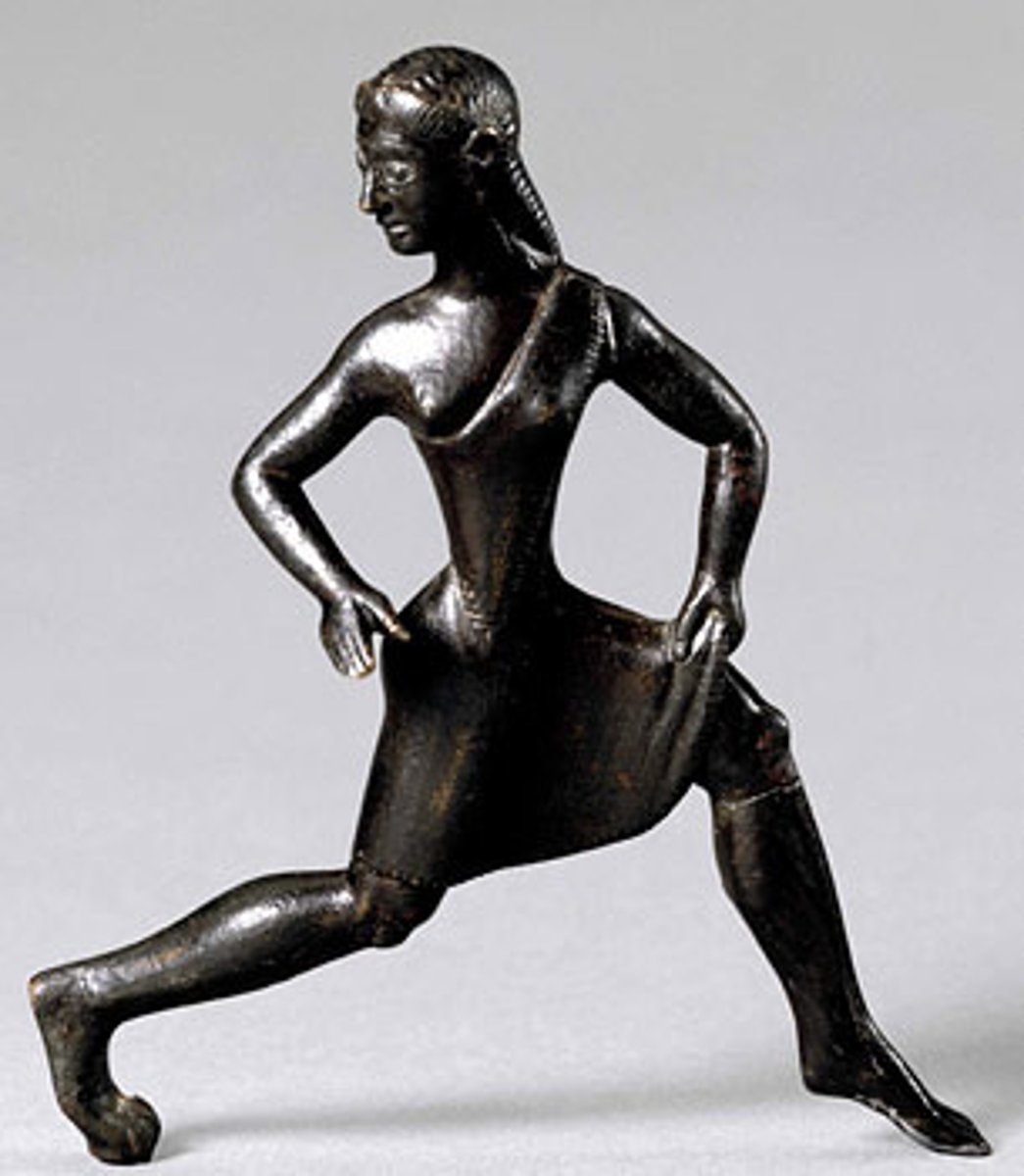
What was Spartan society focused on?
Strength and physical prowess
How did Spartans matchmake?
Boys and girls were allowed to interact, and girls were even encouraged to heckle boys as they trained; it is unlikely the partners were unknown but we do not know how Spartan marriages were arranged
What was the Spartan wedding like?
-The bride would cut her hair short, dress as a man, and lie on the floor
-The groom would sneak out of his syssition to the bride's house and have sex
What did Spartans believe about sex?
More energetic and vigorous sex would result in healthy offspring
When would a Spartan man retire?
30 years old
Who was Cynisca?
The first woman to be a victor at the ancient Olympic Games,
she got around the rule that only men could compete by entering the games as a horse trainer
What is the male head of the household known as? What power did he have?
Paterfamilias, patria potestas
How would a baby girl be welcomed?
By placing a couch out for Juno to watch over the baby at its weakest stage
What was the naming ceremony like?
On the baby's 8th day, she would be named a female version of her father's name. The family would make offerings and give gifts, such as a bulla to ward off evil.
How were Roman girls taught?
By a litterator who would teach them reading, writing and arithmetic
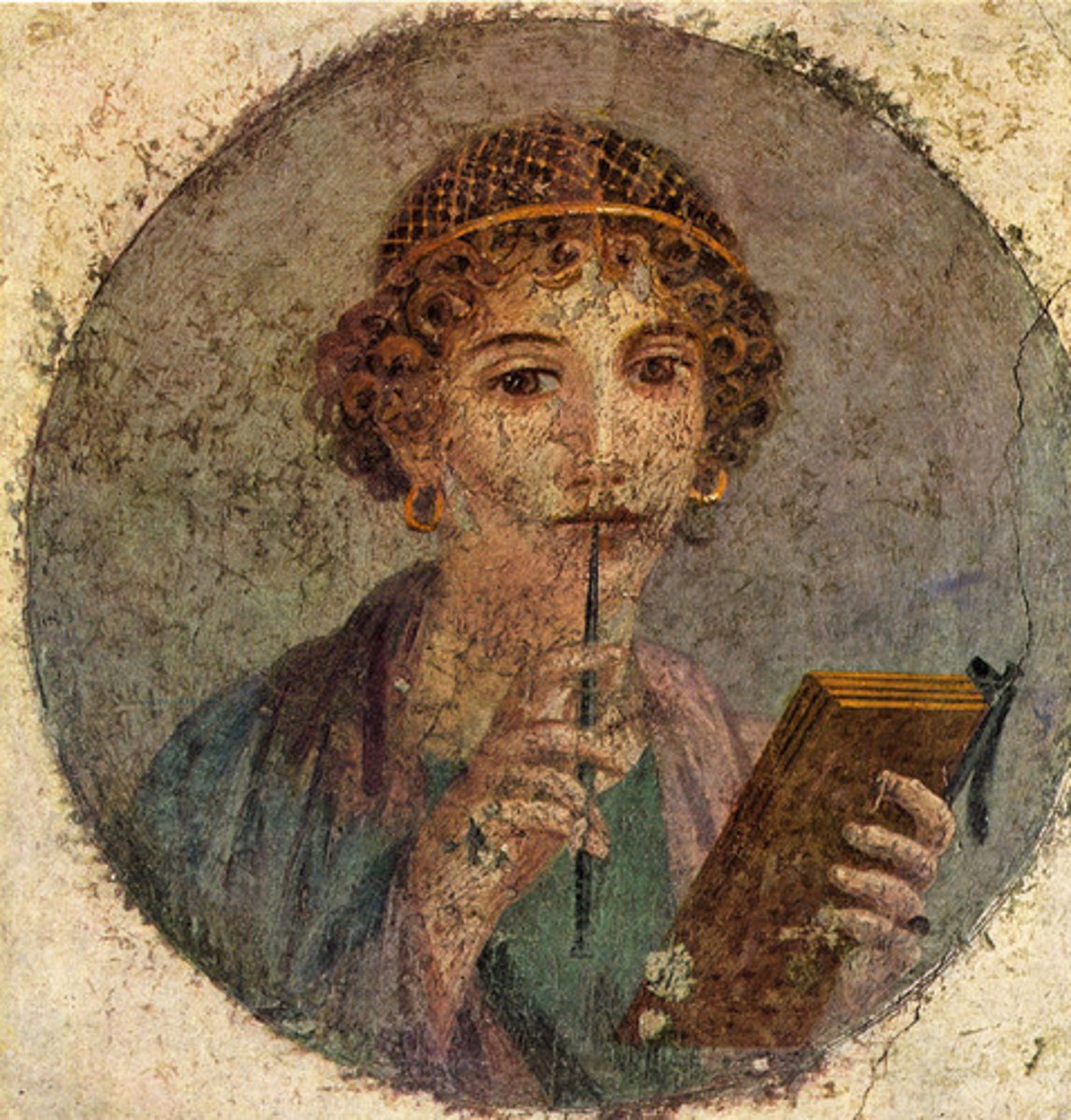
What source shows women as educated? What does it show?
Sappho Fresco, an upper-class educated woman; it shows how men could be proud of their women being educated as she acts as an asset to the house
What did Maesia do?
She successfully defended herself in the law courts due to her public speaking skills, known as rhetoric. She was even nicknamed 'Androgyne' because it was thought that she had the spirit of a man.
What was the purpose of Roman marriage? (3)
-To solidify business or political relations between families
-To improve social standing
-As a financial gain for the groom
What happened at the betrothal? What rights did a woman have?
The dowry would be agreed on and the woman had the right to turn down a partner if she could prove his bad qualities which was difficult
What is the Roman engagement ceremony?
The sponsalia, the couple would exchange rings to be worn on the ring finger
What was cum manu and sine manu?
Cum Manu: 'with hand' , a marriage where the wife is legally transferred to the husbands family and could inherit, children belong to both parents
Sine Manu: 'without hand', a marriage where the wife is under legal control of her original paterfamilias, children belong to the father
What was coemptio ceremony?
(CUM MANU)
The bride was symbolically sold to her new husband by placing a single coin on a banking scale, representing the dowry
What was the confarreatio ceremony?
(CUM MANU)
Usually held by patricians, a ceremonial cake would be offered to Jupiter in the presence of the Pontifex Maximus and 10 witnesses. Then, the pronuba would join the couple's hands, known as 'dextrarum iunctio' and the bride would repeat 'Where you are Gaius, I am Gaia'
What was the usus ceremony?
(SINE MANU)
The couple simply declared they were married and lived together, every year she had to stay 3 consecutive nights at her own home
What would the the bride do and wear at her wedding? Why?
-Make sacrifice of her bulla and toys to the Lares
-Wore a plain white wedding dress and a woolen belt that only her husband could untie
-Wore yellow shoes, flame coloured veil and 6 separate locks of hair as a symbol of the Vestal Virgins
-The couple each wear a flower wreath
What would the procession consist of?
After a lavish feast, the groom would dramatically grab the bride from her mother (Sabines) and the couple would be escorted while celebrants sang hymns and shouted rude jokes
What did the bride carry during the procession and why?
The bride carried 3 coins; one was dropped during the procession as an offering to Janus, one was for her husband to symbolise dowry, and one was offered to the Lares of the new home
What were the household gods? What was their shrine?
Lares, Lararium
What happened at the groom's house?
The bride would wrap wool around door posts and would be carried across the threshold by the groom (to prevent bad omens if she tripped) to the hearth, then they would be left alone in their bed after undoing the knot
 Note
Note  Flashcards (30)