ITM exam
 Studied by 0 people
 Call Kai
 Learn
Learn Practice Test
 Spaced Repetition
 Match
Match Flashcards
 Knowt Play
1/74

There's no tags or description
Looks like no tags are added yet.
Name | Mastery | Learn | Test | Matching | Spaced | Call with Kai |
|---|
No analytics yet
Send a link to your students to track their progress
75 Terms
database
well designed, organized, and carefully managed collection of data
data
raw facts
information
collection of organized and processed data and has additional value beyond the value of individual facts
knowledge
provides awareness and understanding of a set of information, and shows how information can support a specific task or be used to reach a decision
high-quality data
accessible, accurate, complete, economical, relevant, reliable
benefits gained from high quality data
improved decision making, increase of costumer satisfaction, increase in sales, innovation improvement, raises productivity, ensures compliance
accessible data
information should be easily accessible by authorized users so they can obtain it in the right format and at the right time to meet their needs
accurate data
error free and in some cases, inaccurate information is generated because inaccurate data is fed into the transformation process from data to information. called garbage in, garbage out.
complete data
contains all the important facts. for example, an investment report that does not include all important costs is not complete.
economical data
should also be relatively economical to produce. decision makers must always balance the value of information with the cost of producing it
relevant data
important to the decision maker. information showing that lumber prices might drop is probably not relevant to a computer chip manufacturer
reliable data
can be trusted by users. in cases the reliability of the information depends on the reliability of the data-collection method. a rumor from an unknown source that oil prices might go up may not be reliable.
timely data
delivered when it is needed. knowing last week’s weather conditions will not help when trying to
decide what coat to wear today
verifiable data
you can check it to make sure it is correct, perhaps by checking many sources for the same information.
data hierarchy - entity
person, place, or thing for which data is collected, stored and maintaine
data hierarchy - file
collection of entities
data hierarchy - attribute
characteristic of an entity
data hierarchy - domain
range of allowable values for a data attribute
data hierarchy - data item
specific value of a data attribute
data hierarchy - record
collection of attributes about a specific entity
data hierarchy - primary key
attribute or set of attributes that uniquely identifies the record
data hierarchy - foreign key
attribute in one table that refers to the primary key in another table
database management system
a group of programs provided by the DBMS supplier, programs used to access and manage a database, and provides an interface between the database and its users and other application programs
schema
a description that defines the databases’ logical and physical structure, and identifies the tables and the attributes in each table, also identifies the relationships between attributes and tables, DBMS can reference a schema
relational database
data is organized into relations, rows are entities, columns are attributes
selecting
eliminating rows according to certain criteria
projecting
eliminating columns in a table
joining
combining two or more tables through data attributes to create a new table
data normalization
eliminates data redundancy
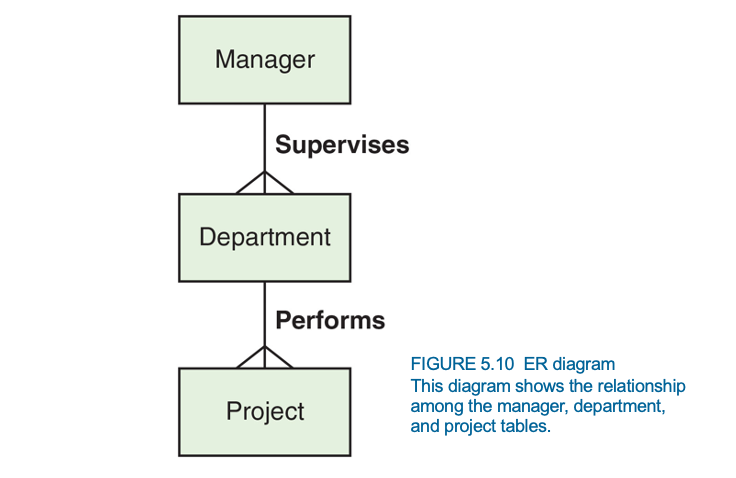
relational database MODEL
the manager supervises, the department proforms, and it ends in the project
SQL
special purpose programming language used for accessing and manipulating relational database data
SQL database
conform to ACID properties
SELECT ClientName, Debt FROM Client WHERE Debt > 1000
displays clients (ClientName) and the amount they owe the company (Debt) from a database table called Client; the query would only display clients who owe the company more than $1,000 (WHERE Debt > 1000).
data management
integrated set of functions that defines the processes by which data is obtained. certified fit for use, stored, secured and processed.
database administrator
skilled and trained IS professional that holds discussions with business users and defines their data needs
data steward
a non IS employee that manages critical date entities or attributes
database lifecycle management (DLM)
a policy based approach, manages enterprises data flow
concurrency control
the process of coordinating multiple transactions to make sure they are executed properly
transaction processing system
captures and processes detailed data to update records about fundamental business operations
batch processing system
business transactions are accumulated over a period of time and prepared for processing as a single unit or batch
online transaction processing (OLTP)
each transaction is processed immediately and data in an online system reflects current status
expectations of TPSs
capture, process and updates databased, make sure they’re accurate, avoid fraudulent transactions and produce timely user responses and reports
TPS systems
order processing systems, accounting systems and purchasing systems
transaction processing cycle
data collection, data editing, data correction, data processing, data storage, document production
enterprise system
central to individuals and organizations of all sizes and ensures information can be shared across all business functions and all levels of management to support running and managing of a business
reliance of enterprise systems
sales and marketing, HR, product supply and distribution, manufacturing, taxation, accounting
enterprise resource planning
set of integrated programs that manage a company’s vital business operations for an entire organization
business process
set of coordinated and related activities that takes one or more kinds of input and creates an output of a value to the costumer of that process
enterprise planning advantages
improved access to quality data, AI generated insights, eliminated of costly legacy systems and improvement of work processes
costumer relationship management
helps a company manage all aspects of customer encounters such as marketing, sales, distribution, accounting and costumer service
product lifecycle management
enterprise business strat. that creates a common repository of product information and processes
product lifestyle management software
provides a means for managing data and processes associated with various phases of the lifecycle of a product
computer aided design
use of software to assist in the creation, analysis, and modification of the design of a component or product
computer-aided engineering
use of software to analyze the robustness and performance of components and assemblies
computer-aided manufacturing
use of software to control tools and machinery in manufacture of components and products
discrete manufacturing
production of distant items (autos,airplanes,furniture, or toys) that can be decomposed into their basic components
process manufacturing
production of products that are the result of a chemical process (gas and drugs) that cannot be easily decomposed
MIS (management information system)
a computer based system that collects, processes and stores data to help managers make informed decisions to improve their organizational efficiency
DDS (decision support system)
computer based system that analyzes data to help managers make informed decisions and have support for that
KMS (knowledge management system)
helps organizations capture, organized, store and share their collective knowledge to improve efficiency and decision making
artificial intelligence
computers with the ability to mimic or duplicate the functions of the human brain
artificial intelligence systems
include people, procedures, hardware, software, data and knowledge needed to develop computer systems to simulate human intelligence processes
the turing test
a test that sees a machines ability to exhibit intelligent behavior equivalent to or indistiguishable from a human, not yet passed by a computer
augmented reality
a technology that superimposes a computer generated image on a users view of the real world, eg. a furniture store app
virtual reality
a computer generated simulation of a three-dimensional image or enviorment that can be interacted with
artificial neural network
a computer system that can recognize and act on patterns trends that it detects in large sets of data
artificial neural network model
training, input, recognition, result
machine learning
ability of a computer to learn without having a programmer change the software for every scenario
natural language processing
involves the computer understanding, analyzing, manipulating and/or generating natural language for processing and is widely used in search engines
brain computer interface
interacts with a humans neural structure and translates the information into activity, heavily used in the medical field
robotics
technology using a combination of mechanical engineering, computer science, and machine learning to create a device that can preform tasks with a high degree of precision
industrial robots
designed for speed, accuracy, and safety
impact of AI on employees and careers
organizations need to strategically plan for a potential impact on future employment
genetic algorithm
evolutionary algorithms that solve optimization problems by mimicking natural selection
advanced vision system
hardware and software that permit computers to capture, store and manipulate visual images and pictures
 Note
Note  Flashcards (24)