NTRN 201 | Ch. 1 - Food Choices + Human Health
 Studied by 1 person
 Call with Kai
 Learn
Learn Practice Test
 Spaced Repetition
 Match
Match Flashcards
 Knowt Play
1/106

There's no tags or description
Looks like no tags are added yet.
Name | Mastery | Learn | Test | Matching | Spaced | Call with Kai |
|---|
No study sessions yet.
107 Terms
Nutrition
the science + study of how food nourishes the body and impacts health (dietary choices, nutritional needs, and metabolic processes)
Diet
the food + beverages a person usually consumes
chosen foods exert cumulative effects on the body (good or poor health)
What do healthier food choices do?
Support your body’s growth + maintenance
Nutrient Density
A measure of the nutrients provided per calorie of food, indicating how nutritious a food is.
Malnutrition
A condition resulting from an imbalance of nutrients, which may include deficiencies, excesses, or imbalances.
What is the Diet-Health connection?
Lifestyle choices and dietary patterns significantly impact overall health, disease risk, and quality of life.
What are examples of lifestyle habits?
Smoking and tobacco use, alcohol, diet, sleep, stress, and physical activity
What are the leading causes of death linked with?
Diet and alcohol (heart disease)
Genetics
The study of heredity and the variation of inherited characteristics that can influence disease development.
Chronic Diseases
Long-term health conditions often related to lifestyle choices, such as heart disease, diabetes, and certain cancers.
True or False: All diseases are equally influenced by diet
False
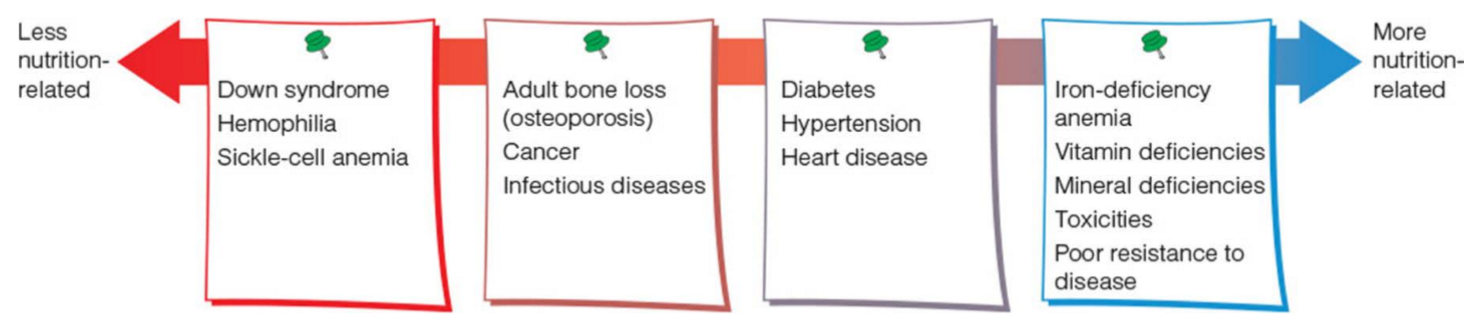
This is an image showing a range of diseases based on how nutrition-related they are.
(I don’t think we need to know this but I put this in the card deck for reference)
99.9% of the human genome is…
the same in all people
0.01% of the human genome is…
responsible for variances
Personalized nutrition
tailors dietary advice, products, or services to an individual's unique biology, lifestyle, and goals
What does food provide?
Energy and six classes of nutrients
What are the six classes of nutrients?
Carbohydrate, fat, protein, vitamins, minerals, water
What are the elements in carbohydrates?
Carbon, oxygen, hydrogen
What are the elements in fats?
C, O, H
What are the elements in proteins?
C, O, H, N, minerals (S)
What are the elements in vitamins?
C, O, H, some contain N, some contain minerals (S and cobalt)
What are the elements in water?
Oxygen, hydrogen, minerals
Calories
the units used to measure the energy in foods
True or False: Alcohol is not a nutrient
True
Macronutrients
The nutrients that provide energy: carbohydrates, fats, and proteins.
Micronutrients
vitamins (organic) and minerals (inorganic); they do not provide energy directly but are vital for metabolism and other bodily functions
Where does the energy a person consumes daily come from?
Carbs, fats, proteins, and sometimes alcohol
How much energy do carbs contribute?
4 cal/g
How much energy do fats (lipids) contribute?
9 cal/g
How much energy do proteins contribute?
4 cal/g
How much energy does alcohol contribute?
7 cal/g
True or False: Foods and people contain the same components
True, because they are both made of the six classes of nutrients
Dietary supplements
pills, liquids, or powders that contain purified nutrients or other ingredients
Elemental diets
a pre-digested liquid meal replacement providing complete nutrition as simple building blocks (amino acids, simple sugars, short-chain fats) that are easily absorbed in the upper gut, allowing the digestive system to rest and heal
What are the benefits of food?
digestive health and phytochemicals
phytochemicals
natural compounds in plants, fruits, vegetables, grains, and drinks like tea, responsible for their colors, flavors, and smells (ex: carotenoids, flavonoids, and polyphenols)
What are categories that determine nutrient density/which foods are most nutritious?
Energy, calcium, iron, Vitamin A, and Vitamin C
Whole Foods
Foods that are minimally processed and are free from additives or artificial substances; form the basis of a nutrious diet; aka unprocessed, natural, or farm foods
Ex: fruits, vegetables, meats, milk and grains
How much of the population does not consume enough fruits and vegetables daily?
80%
What is the most common chosen vegetable?
Potatoes (as french fries)
Staple foods
inexpensive, frequently eaten foods that form the foundation of a diet, supplying most of a population's energy and nutrients, like carbohydrates, proteins, and fats,
Ex: grains (rice, wheat, corn), tubers (potatoes, cassava), and legumes (beans, lentils)
Behavior Change Stages
The six stages people go through when changing a health behavior: Precontemplation, Contemplation, Preparation, Action, Maintenance, and Adoption.
Nutrition Science
The study of how food affects health, wellness, and growth, including dietary practices and nutrient requirements.
Food Choices
Decisions made about what to eat, influenced by personal preferences, cultural beliefs, availability, and health considerations.
Nutritional Claims
Statements about the health benefits of food products that may be misleading or inaccurate, often found in media and advertising.
Personalized Nutrition
Tailoring dietary recommendations based on individual genetic profiles and health needs.
Health Promotion
Strategies to enhance health and prevent diseases through diet, exercise, and lifestyle choices.
Enriched/Fortified Foods
Foods to which nutrients have been added. If the starting material is a whole, basic food such as milk or whole grain, the result may be highly nutritious. If the starting material is a concentrated form of sugar or fat, the result is less nutritious.
Fast Foods
Restaurant foods that are available within minutes after customers order them–traditionally, hamburgers, French fries, and milkshakes; more recently, salads and other vegetable dishes as well. These foods may or may not meet people’s nutrient needs, depending on the selections provided and on the energy allowances and nutrient needs of the eaters.
Functional Foods
A term for foods that contain bioactive food components believed to provide health benefits beyond the benefits that their nutrients confer
Medical Foods
Foods specially manufactured for use by people with medical disorders
Natural Foods
A term that has no legal definition but is often used to imply wholesomeness
Organic Foods
Understood to mean foods grown without synthetic pesticides or fertilizers. In chemistry, however, all foods are made mostly of organic (carbon-containing) compounds.
Processed Foods
Foods subjected to any process, such as milling, alteration of texture, addition of additives, cooking, or others. Depending on the starting material and the process, a processed food may or may not be nutritious.
Staple Foods
Foods used frequently or daily–for example, rice (in East and Southeast Asia) or potatoes (in Ireland). Many of these foods are sufficiently nutritious to provide a foundation for a healthful diet.
Ultra-processed foods and Beverages
Highly palatable manufactured food and beverage products often high ingredients such as sugars, refined starches, modified protein, hydrogenated fats, salt, and additives intended to disguise or improve undesirable sensory qualities of the final product.
Additives may include colorants, flavoring, moisturizers, sweeteners, and many others.
Ex: sugary refined breakfast cereals, candies, cookies, fried chicken nuggets, liquid nutritional supplements, potato "tots,” snack chips and cakes, and soft drinks.
Whole/Basic Foods
Dairy products; meats and similar foods such as fish and poultry; vegetables, including dried beans and peas; fruits; and grains. These foods are generally considered to form the basis of a nutritious diet.
What is the difference between processed foods and ultraprocessed foods?
Processed foods are foods that have been altered from their original form for safety, convenience, or preservation. This can include washing, freezing, canning, cooking, fermenting, or adding a small number of ingredients like salt, oil, or sugar. Examples include frozen vegetables, canned beans, plain yogurt, cheese, and whole-grain bread. These foods can still retain most of their nutritional value and often help make healthy eating more accessible and affordable.
Ultra-processed foods (UPFs), on the other hand, are industrial formulations made mostly from refined ingredients and additives, with little to no intact whole food. They often contain added sugars, refined starches, unhealthy fats, artificial flavors, colors, emulsifiers, and preservatives designed to enhance taste, texture, and shelf life. Examples include chips, sugary cereals, instant noodles, soda, packaged snack cakes, and many ready-to-eat meals.
Why is some degree of processing acceptable?
Some processing is not only acceptable but beneficial. It can:
Improve food safety (e.g., pasteurization kills harmful bacteria)
Increase shelf life, reducing food waste
Enhance convenience, making it easier to meet nutritional needs
Improve nutrient availability (e.g., cooking tomatoes increases lycopene absorption)
Support food access, especially for people with limited time or resources
Without processing, it would be difficult for many people to consistently eat a balanced diet.
At what point does processing become unhealthy?
Processing tends to become unhealthy when foods are:
Highly refined and stripped of fiber and micronutrients
High in added sugars, sodium, and saturated or trans fats
Designed to be hyper-palatable, encouraging overeating
Low in satiety and nutritional density
Ultra-processed foods are associated with increased risk of obesity, cardiovascular disease, type 2 diabetes, and other chronic conditions, especially when they make up a large portion of the diet.
Processing exists on a spectrum. Minimally and moderately processed foods can be part of a healthy diet, while ultra-processed foods should be limited. The key distinction is whether processing supports nutrition and health—or primarily enhances convenience, taste, and profit at the expense of nutritional quality.
Nutritious Diet
Dietary pattern with five common characteristics: adequacy, balance, calorie control, moderation, and variety
Adequacy
Consuming enough essential nutrients and energy to support health and normal body functions.
Balance
Eating foods from different food groups in appropriate proportions.
Calorie control
Managing energy intake to maintain a healthy body weight.
Moderation
Limiting foods high in added sugars, saturated fat, sodium, or calories.
Variety
Eating a wide range of foods within and across food groups.
Factors That Influence Eating
Personal preference, genetics, taste
Cultural traditions, values, beliefs
Availability, cost, region of country
Advertising, social norms, positive/negative associations
Emotional comfort, habit, weight
Nutrition and health benefits
True or False: Nutrition is a relatively young science compared to astronomy and physics
True
True or False: The first vitamin was identified in 1997, and the first protein structure was fully described in the 1950s.
False; the 1st vitamin was identified in 1897, and the first protein structure was fully described in the 1940s
True or False: Nutrition is an active, changing, growing body of knowledge
True
True or False: Nutrition facts come from repeated testing yielding consistent results
True
What are the types of studies?
Case study, epidemiological study, intervention study, and laboratory study
“This person eats too little of nutrient X and has illness Y.”
Case study
“This country’s food supply contains more nutrient X, and these people suffer less illness Y.”
Epidemiological study
“Let’s add foods containing nutrient X to some people’s food supply and compare their rates of illness Y with the rates of others who don’t receive the nutrient.”
Intervention study
“Now let’s see if a nutrient X deficiency causes illness Y by inducing a deficiency in these rats.”
Laboratory study
Case Study
Study of a single individual. When in clinical settings, researchers can observe treatments and their apparent effects. To prove that a treatment has produced an effect requires simultaneous observation of an untreated similar subject (a case control).
Epidemiological Study
Studies of populations; often used in nutrition to search for correlations between dietary habits and disease incidence; a first step in seeking nutrition-related causes of diseases.
Intervention Study
Studies of populations in which observation is accompanies by experimental manipulation of some population members–for example, a study in which half of the subjects (the experimental subjects) follow diet advice to reduce fat intakes, while the other half (the control subjects) do not, and both groups’ heart health is monitored.
Labratory Study
Studies that are performed under tightly controlled conditions and are designed to pinpoint causes and effects. Such studies often use animals as subjects.
Correlation
The simultaneous change of two factors (positive or direct, negative or inverse)
Ex: the increase of weight with increasing height (a direct of positive ___) or the decrease of cancer incidence with increasing fiber intake (an inverse or negative ___).
A ____ between two factors suggests that one may cause the other but does not rule out the possibility that both may be caused by chance or by a third factor.
Controlled Clinical Trial
An experiment in which one group of subjects (the experimental group) receives a treatment and a comparable group (the control group) receives an imitation treatment and outcomes for the two are compared.
Ideally, neither subjects nor researchers know who received the treatment and who gets the placebo (a double-blind study).
Experimental Group
The people or animals participating in an experiment who receive the treatment under investigation. Also called experimental subjects.
Control Group
A group of individuals who are similar in all possible respects to the group being treated in an experiment but who receive a sham treatment instead of the real on. Also called control subjects.
Placebo
A sham treatment often used in scientific studies; an inert, harmless medication. The placebo effect is the healing effect that the act of treatment, rather than the treatment itself, often has.
Blind Experiment
An experiment in which the subjects do not know wether they are members of the experimental group of the control group. In a double-blind experiment, neither the subjects not the researchers know to which group the members belong until the end of the experiment.
Meta-analysis
A computer-driven statistical summary of evidence gathered from multiple previous studies.
Nutrition in the Media
Nutrition research findings often make headlines
media sensationalism
scientists are trend watchers
national nutrition data sources
What are national nutrition data sources?
National Health and Nutrition Examination Survey (NHANES)
asks people what they eat
records health measures
Healthy People 2030
What are the nutrition research and policy agencies?
agencies actively engaged in nutrition policy development, research, and monitoring
CDC (centers for disease control and prevention), USDA (US department of agriculture), DHHS (department of health and human services), FDA (food and drug administration)
Stages of Behavior Change
Precontemplation, Contemplation, Preparation, Action, Maintenance, Adoption/Moving On
Precontemplation
Characteristics: Not considering a change; have no intention of changing; see no problems with current behavior
Actions: Collect information about health effects of current behavior and potential benefits of change.
Contemplation
Characteristics: Admit that change may be needed; weigh pros and cons of changing and not changing
Actions: Commit to making a change and set a date to start
Preparation
Characteristics: Preparing to change a specific behavior, taking initial steps, and setting some goals
Actions: Write and action plan, spelling out specific parts of the change. Set small-step goals; tell others about the plan
Action
Characteristics: Committing time and energy to making a change; following a plan set for a specific behavior change
Actions: Perform the new behavior. Manage emotional and physical reactions to the change
Maintenance
Characteristics: Striving to integrate the new behavior into daily life and striving to make it permanent
Actions: Persevere through lapses. Teach others and help them achieve their own goals. (This stage can last for years)
Adoption/Moving On
Characteristics: The former behavior is gone, and the new behavior is routine
Actions: After months of a year of maintenance without lapses, move on to other goals
What are the challenges people face in choosing a health-promoting diet?
False claims and information; Fradulent health claims divert billions of consumers’ dollars from legitimate health care each year. Most go to the internet, popular magazines or books, or television for answers. Many sources pretend to inform but are primarily trying to sell products (advertorials, infomercials, anecdotal evidence, urban legends)
What are true nutrition experts?
Registered dietitian nutritionist (RDN), Nutrition and dietetics technician, registered (NDTR), Certified Specialist in Sports Dietetics (CSSD)
Diploma Mills
Places to print out diplomas for making fraudulent qualifications
 Note
Note  Flashcards (23)