Mechanical behavior of materials in class quiz 3
 Call Kai
 Learn
Learn Practice Test
 Spaced Repetition
 Match
Match Flashcards
 Knowt Play
1/51

There's no tags or description
Looks like no tags are added yet.
Name | Mastery | Learn | Test | Matching | Spaced | Call with Kai |
|---|
No analytics yet
Send a link to your students to track their progress
52 Terms
Strengthening mechanism where plastic deformation is suppressed by elastic ’surrounding’ material
constraint
In constraint strengthening, higher stresses must be applied in constrained area for yielding to occur when _____ criterion is met.
von mises
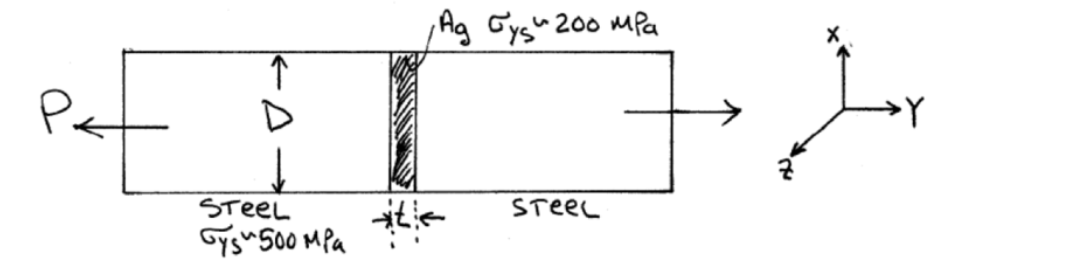
constraint is dependent on what factor from this problem? does constraint increase or decrease as this factor goes to zero?
t/D, increase
is notch strengthening applicable to ductile or brittle materials?
ductile
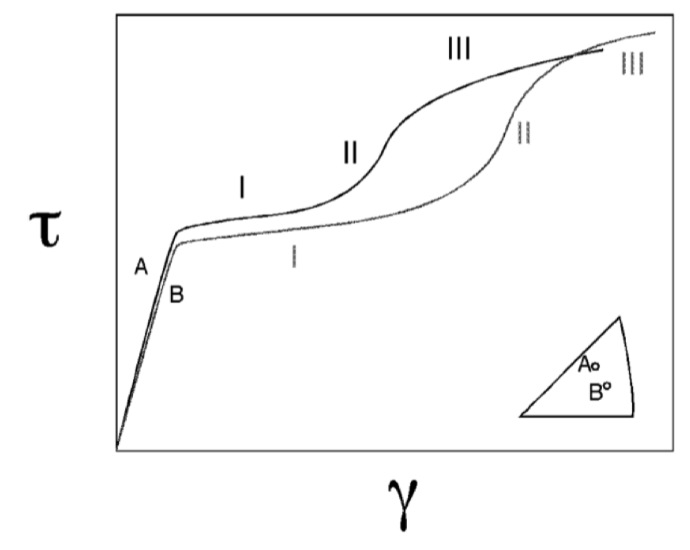
Identify the stage on the single crystal shear stress-strain curve:
Easy glide region, work hardening rate is low, single slip system operates, long slip distances without dislocation-barrier interactions.
Stage 1
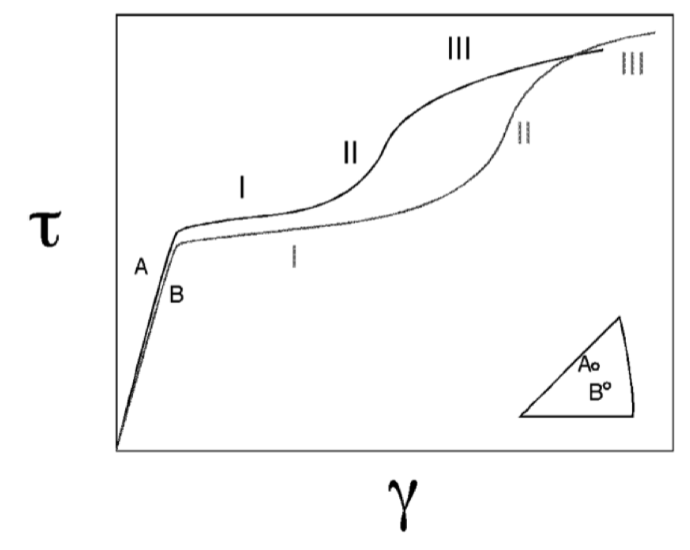
Identify the stage on the single crystal shear stress-strain curve:
Linear hardening region, work hardening rate is high and constant with increasing strain, primary slip dominant but secondary slip occurs, dislocation multiplication and interactions reduce slip length as density increases.
Stage 2
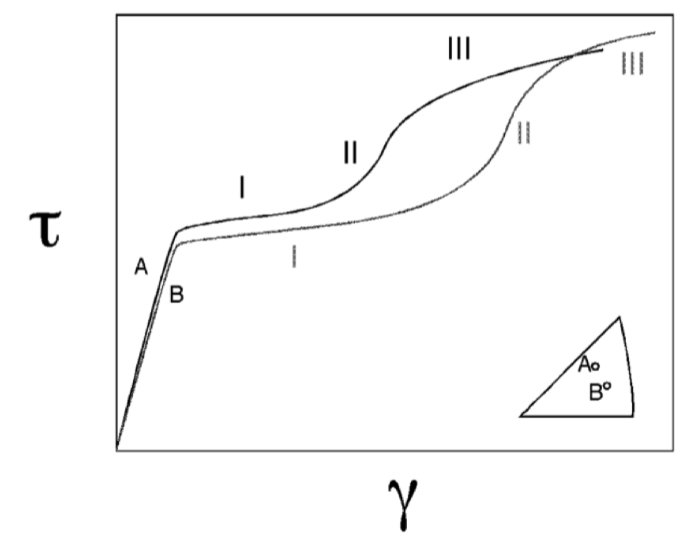
Identify the stage on the single crystal shear stress-strain curve:
Parabolic hardening region, onset depends on ease of cross-slip and temperature, decreasing work hardening with increasing strain
Stage 3
In work hardening, the stress required for continued material plastic flow _____ with increasing plastic strain, effects can be eliminated by subsequent ____, and resistance to plastic flow has a complex dependence on _____ density.
increases, annealing, dislocation
self-organized arrangements of dislocations that minimize strain energy during deformation
LEDS (Low-energy dislocation structures)
As stage 2 progresses in a single crystal stress-strain curve, the _____ of LEDS does not change, but ____ does.
character, size
At _____ dislocation density, LEDS are not energetically favorable to form.
low
The LEDS structures eventually reaches a lower bound size, which gives _____ hardening behavior
parabolic
____ ____ energy affects the onset of stage 3. LEDS theory explains this phenomenon - cross-slip easier → ____ LEDS formation → lower shear strain onset of stage 3
stacking fault, increased
Is the temperature dependence of the work hardening behavior well captured by the LEDS mechanism?
yes
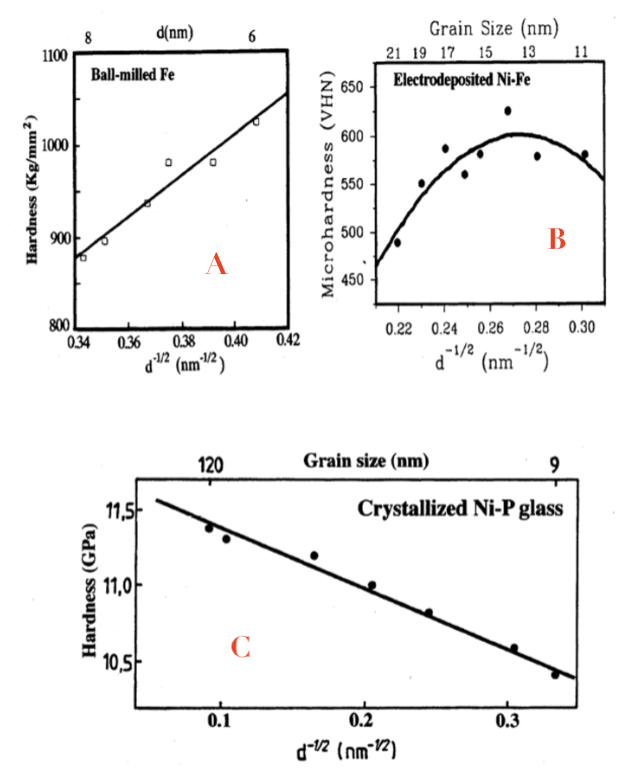
Does the Hall-Petch relation work for these nano-scale grains? Answer in order of A, B, C
yes, maybe, no
For most metals, yield strength and hardness _____ as grain size decreases. What type of strengthening mechanism is this?
increase, grain boundary
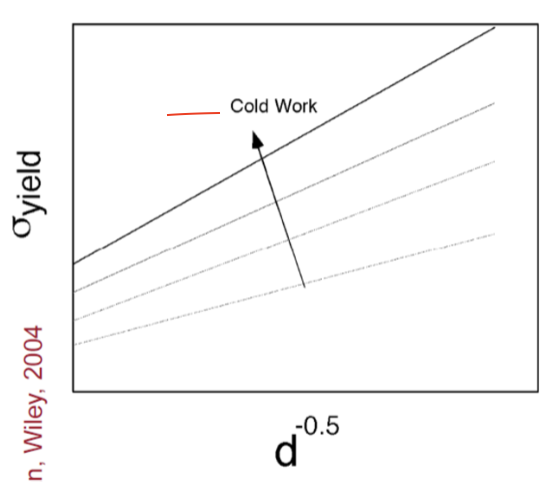
is this increasing or decreasing CW?
increasing
After mechanical shaping and “annealing” of alloy with solute particles in microstructure are large and widely spaced. Ineffective in “pinning” dislocations, so strength is low… what two critical aspects of the precipitates can be changed with aging time/temperature?
distribution/character, nature (how it slows down dislocation)
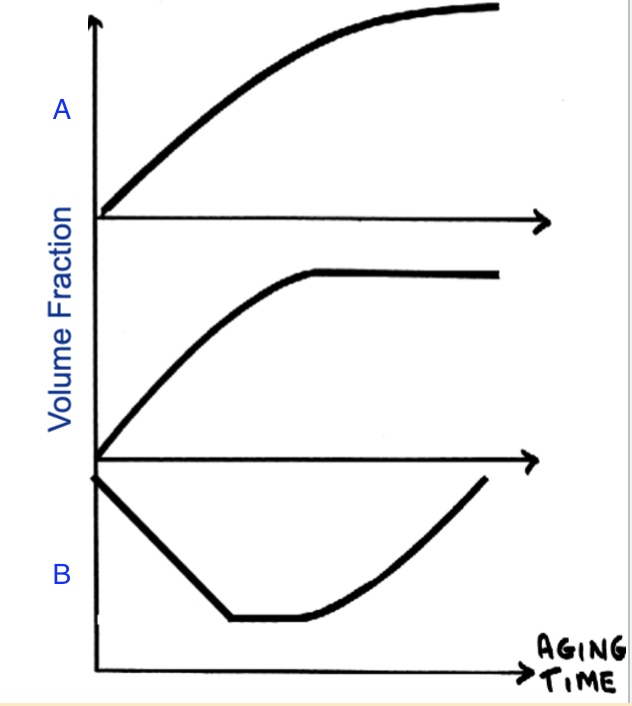
in precipitate hardening, identify the y axis for graphs A and B.
precipitate size, precipitate spacing
Initially during aging precipitate spacing decreases because more precipitates are ____, what phenomenon explains why eventually this decrease levels out and spacing begins to increase?
nucleating, ostwald ripening
small precipitates (often), cause ____ misfit strains, since easy for dislocation transmission from matrix into precipitate → leads to ____ _____ as primary means of continued dislocation motion on slip plane
high, particle shearing
large precipitates (often), cause ____ misfit strains, have no particle shearing so continued dislocation motion occurs through ____ looping
low, orowan
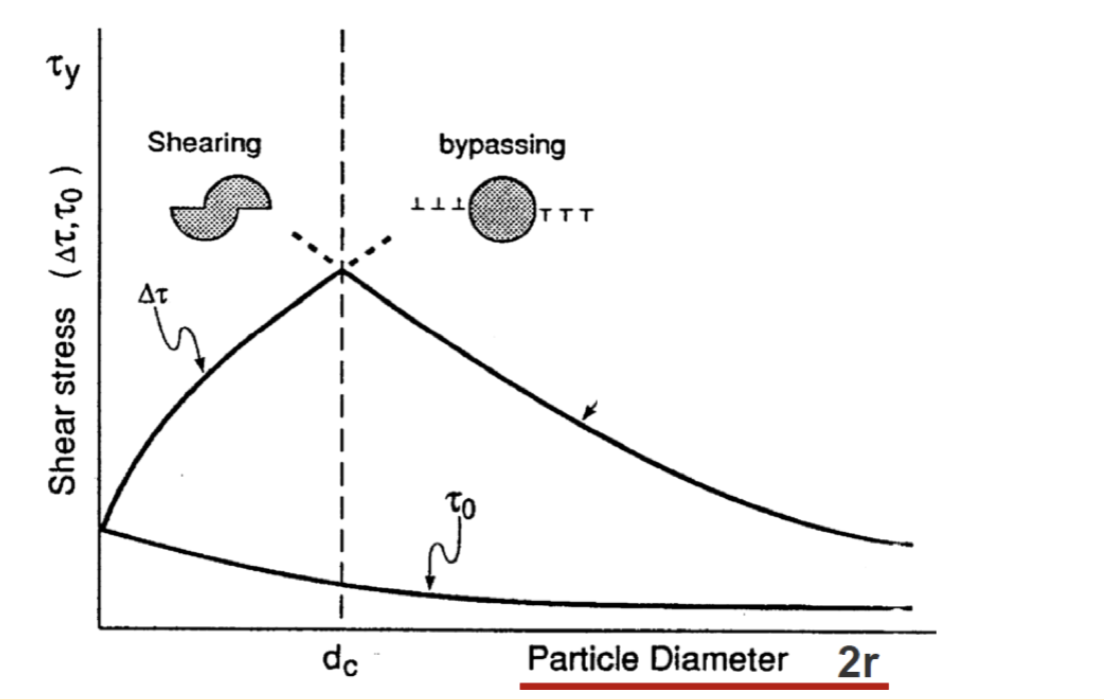
There is a critical transition point in particle diameter! Increased resistance to shearing with ____ size, increasing size _____ looping because of ostwald ripening
increasing, decreases
Metal is strengthened by addition of solute atoms dissolved in solvent lattice, impedance of dislocation line motion by interaction with solute atoms on/above/below slip plane. What mechanism of strengthening is this?
solid solution
What three factors govern magnitude of solute hardening?
solubility, atomic size difference, solute strain field details
Does interaction and strengthening (in solid solution strengthening) occur between like or unlike stress-strain field characteristics?
like
what are the stress fields associated with common types of solute (dilation = ___, shear = ___) ? (1) substitutional (d/s) (2) interstitial symmetric (d/s) (3) interstitial asymmetric (d/s), (4) complex (d/s)
edge, screw, d, d, d+s, d+s
Breakdown of hall-petch relationship typically occurs at grain diameters below _____ but becomes very apparent on the nanometer scale because dislocation pile-ups ____ form in very small grains
one micron, cannot
in aging, peak aging time is achieved when there is a balance in what three factors of the microstructure?
precipitate size, density, and coherency
overaging occurs when particles grow too large and ____ coherency, ___ interfacial energy
lose, lowering
what ratio of T/Tm for metals is the temperature considered elevated or high homologous
.35
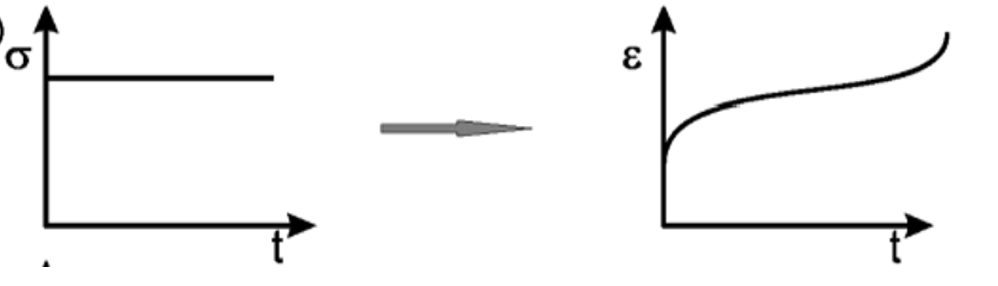
what is this strain behavior at constant stress called?
creep
transient strain accumulation at a declining creep rate, decreases with increasing time and plastic strain. dislocation cell structure develops to cause LEDS hardening, what stage of creep is this?
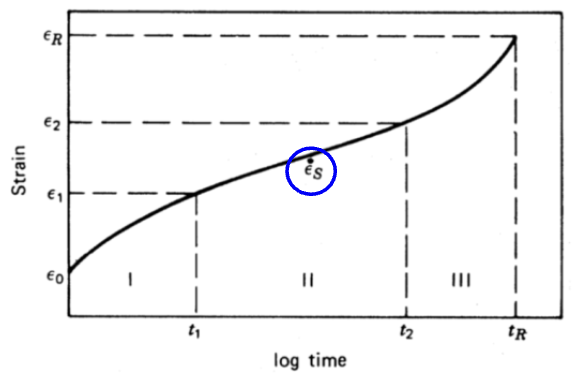
primary
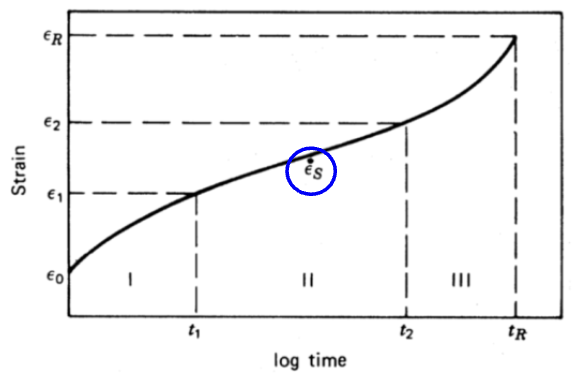
Constant rate of creep strain accumulation, ____ steady state rate. what stage of creep is this?
minimum, secondary
When steady-state creep rate is achieved, dislocation structure hardening is balanced by dynamic recovery-softening (dislocation ___ ___ and diffusion ____)
cross slip, climb
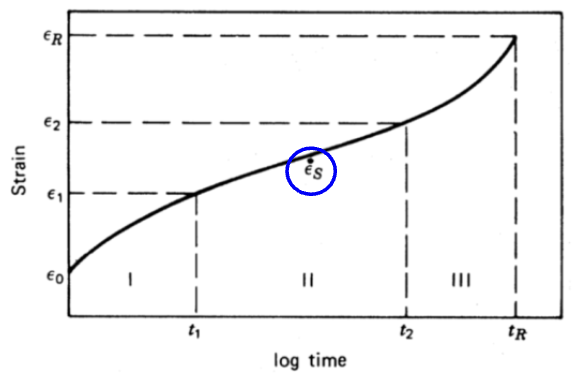
Accelerating creep strain rate to rupture at time tR. Microstructure instability (precipitate coarsening, recrystallization) and microscopic cavity formation leads to fracture. what stage of creep is this?
tertiary
During creep, increasing stress or temperature causes a ____ in time of stage 1 and 2, steady state creep rate ____, and time and strain to failure fall
reduction, increases
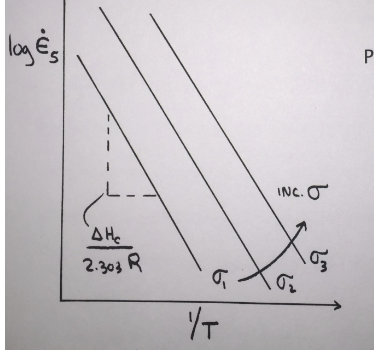
the fact that these lines are parallel means what in terms of the microstructure and mechanism? if these lines are non-linear, then the microstructure changes with ____ and/or _____, the creep mechanism changes, or ____ creep mechanisms operate
they don’t change, temperature, stress, multiple
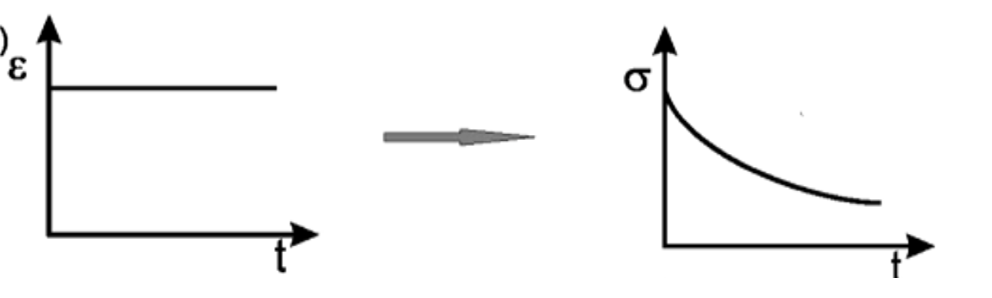
what is this phenomenon called when strain is held constant?
stress relaxation
During stress relaxation, the stressed material _____ deforms at stress below yield stress to fixed displacement. Stored elastic energy drives creep if temperature is sufficient to enable _____ ______ plasticity.
elastically, thermally activated
When T/Tm > 0.5 and the activation energy for creep is constant, then the single-general process controlling creep is ___ _______
self diffusion
Self-diffusion creep is good for high temperatures but breaks down at other stresses and materials because factors associated with dislocation _____ and _____ are not included but critical to the controlling mechanism.
structure, mobility
In dislocation slip (time-temperature dependent plastic deformation), strength decreases with ____ temperature but is time independent, so not technically creep? What range of T/Tm ratio and stress level is this typically active.
increasing, .35-.5, higher
In dislocation or power law creep (time-temperature dependent plastic deformation), it is typically active at T/Tm > ___ and ____ to ____ stresses. This describes the additional recovery mechanisms that become possible.
.6, moderate, high
A recovery mechanism possible described by dislocation creep, “solute drag”, describes how at higher T solute atoms are mobile, if the dislocation velocity is ___ and the solute diffusion rate is ___ then they can move together (typically at low creep rates).
Factors influencing dislocation velocity for drag:
solute atom diffusivity is higher then ___ drag, misfit parameter between dislocation and solute is higher then ___ drag, solute concentration higher then __ drag.
low, high, less, more, more
A recovery mechanism possible described by dislocation creep, “glide-climb”, time-dependent atom (vacancy) diffusion enables dislocation escape from blocking particles and plastic deformation, another mechanism occurs here instead! At T/Tm > 0.6 _____ diffusion occurs but at lower T ___ ____ diffusion occurs.
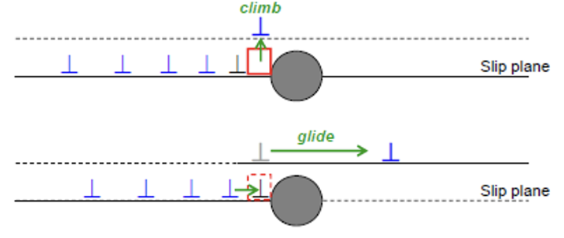
lattice, dislocation core
A recovery mechanism possible described by dislocation creep, “diffusional creep”, describes creep strain accumulation governed by diffusional mass transport and not dislocation movement. There are two means of diffusion, labeled as Coble and Nabarro-Herring, which correlates to lattice and grain boundary diffusion respectively? It is typically active at T/Tm > 0.6 and __ stress
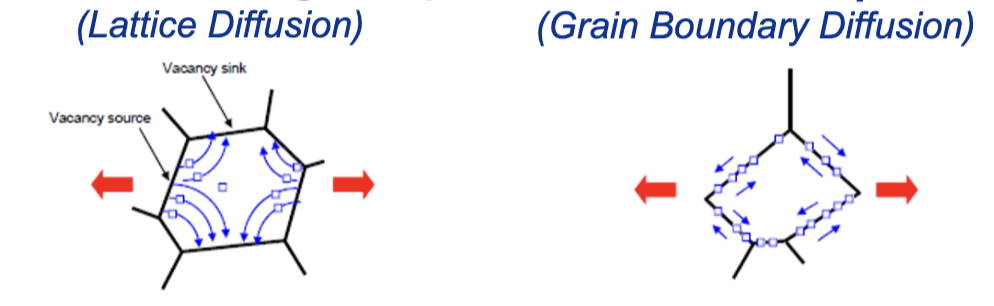
Nabarro-Herring, Coble, low
to accomodate diffusional mass transport during high temperature deformation and avoid micro voids/cracks at grain boundaries, you have grain boundary ____
sliding
vacancies flow by diffusion from areas of high concentration (under _____) to areas of low concentration (under _____)
tension, compression
which creep occurs more rapidly, Coble (lattice) or Nabarro-Herring (grain boundary)?
Coble
How will we know if Nabarro-Herring or Coble Creep dominates? Remember grain-boundary diffusion is faster at ____ temperatures while lattice diffusion is faster at ____ temperatures.
lower, higher, faster creep rate dominates
On a deformation map, the boundaries represent what?
where each mechanism produces the same creep strain rate

