CH 3 : Child Witnesses
 Studied by 0 people
 Call Kai
 Learn
Learn Practice Test
 Spaced Repetition
 Match
Match Flashcards
 Knowt Play
1/39

There's no tags or description
Looks like no tags are added yet.
Name | Mastery | Learn | Test | Matching | Spaced | Call with Kai |
|---|
No analytics yet
Send a link to your students to track their progress
40 Terms
Daycare Sex Abuse Scandals (1980s–1990s)
Surge of daycare/preschool sex abuse allegations in the 1980s–early 1990s.
including Martensville (SK).
4 accused, 180 counts, 24 victims
Many allegations were later found to be unfounded.
R v. Sterling (1995) – Martensville
Case involving coercive and suggestive interviewing of children.
Aspects:
Multiple interviews
Rewards for disclosure
Telling children others had disclosed
These tactics led to bizarre allegations thus the court of Appeal quashed most convictions.
Why Daycare Abuse Allegations Seemed Believable
Sexual abuse can be bizarre
Many alleged victims
Abusers can hide acts for long periods
Parents noticed no warning signs
Little or no physical evidence was present.
Three Factors Affecting Child Testimony
Memory, suggestibility, and truthfulness.
Children’s Memory Development
Children have less developed memory processes, including: encoding, storage, and retrieval.
Autobiographical Memory & Infantile Amnesia
Infantile amnesia refers to limited recall of early childhood events
Early theories suggested memory-related brain regions develop later.
Accuracy of Young Children’s Memories
Young children are less likely to volunteer information, but when they do recall events, their memories are generally accurate and coherent.
Repeated Events & Memory Scripts
Repeated victimization can form 1cognitive scripts
1mental frameworks that organize knowledge about events that happen repeatedly. They represent what usually happens.
however scripts increase risk of source-monitoring errors.
Memory for Repeated Events research findings
Memory improves when details are consistent across events
inconsistent details leads children to experience source confusion and intrusion errors.
False Memory
it is a quintessential episodic memory phenomena of remembering events as having occurred when they did not.
False memories can feel vivid and detailed.
Creating False Memories in the Lab
Parental misinformation paradigm involves presenting true and false childhood events and encouraging recall, often leading to false memories.
photos increase credibility.
ex. Lost in a mall, hospital visits, weddings, traumatic events, ect.
Children’s Suggestibility
Children are more suggestible than adults, including about central and body-related details.
Why Children Are More Suggestible
Social pressure to please adult
Immature cognitive systems
Difficulty distinguishing real from imagined events.
When do children start lying
Lying emerges in early childhood and increases with cognitive and social development.
Don’t Peek (Temptation Resistance) Paradigm
Children are told not to peek while alone; used to study lying when rules are broken.
Results: Shows that children often deny wrongdoing after breaking rules, with lying emerging in early childhood and becoming more sophisticated as cognitive and social abilities develop
Why Children Lie
To protect others’ feelings
To avoid punishment
To comply with requests
self-deception
To harm others.
Development of Lying by Age
Ages 2–3: primary lies: Lies are unsophisticated and easily exposed.
Ages 4–6: secondary lies: Lies are more plausible but fragile.
Ages 7–8: tertiary lies with consistency: sophisticated and can maintain consistency in the lies.
Sophistication of Lies
With age, children produce more plausible lies, adjust stories when evidence or witnesses are present, and maintain consistency.
Coaching Children to Lie
Adult coaching increases lying
Children’s suggestibility raises concerns about testimony reliability.
Lying to Protect a Stranger
Young children may lie by omission to protect adults but the likelihood of lying decreases with age.
Increasing Honesty in Children
Moral discussions do not reduce lying, but enforcing promises to tell the truth significantly decreases dishonest responses.
Importance of Proper Child Interviews
Bad interviews can:
Traumatize children
Contaminate evidence
Create false memories
Jeopardize prosecutions.
it is the interviewers responsibility to provide children with the best opportunity to give evidence easily.
Child Interviewing Protocols
Stepwise Interview: Gradual, structured interview that builds rapport and encourages recall.
Narrative Elaboration: Prompts children to add detail without leading.
Cognitive Interview: Uses memory techniques to increase recall.
NICHD Protocol: Standardized, open-ended interview focused on accuracy.
NICHD Interview Prompts
Facilitator: Neutral encouragement to continue talking.
Invitation: Open-ended request for free recall.
Cued Invitation: Expands on something the child already mentioned.
Directive: Specific follow-up question about stated details.
How Interviews Go Wrong
Leading questions: Questions that suggest an answer or introduce details the child did not provide.
Implying others disclosed: Telling the child others have already reported information, creating pressure to agree.
Rewards or punishments: Using praise, approval, or criticism to influence a child’s responses.
Repeated questioning: Asking the same question multiple times, causing children to doubt and change answers.
Inviting speculation: Asking children to guess or imagine rather than recall actual events.
Courtroom Requirements for Child Witnesses
Post-2006, (children are presumed competent)
For children < 14 to testify:
Questions asked to show they can respond on topic
asked to promise to tell the truth
No assessment of understating of the concept of an oath
Impact of Court Involvement on Children
Repeated testimony predicts (even after 12 years) poorer mental health & adjustment
Number of testimonies is the strongest predictor.
Why are testimonial aids and courtroom accommodations used for child witnesses?
Research shows that children experience higher anxiety and recall less information when testifying in courtrooms, so laws allow child witnesses under 18 to use testimonial aids to reduce trauma and improve testimony quality.
Testimonial Aids for Child Witnesses
Shield
CCTVs
Support persons/animals,
Prerecorded interviews
Hearsay exceptions
Closed courtroom
limits on cross-examination.
The different modalities might have different impact on jury decisions.
R v. Levogiannis (1993)
held that courtroom accommodations for child witnesses balance Charter rights:
Right to face accuser in trials and made a defense
Right to a fair trial by impartial jury
by protecting children without infringing the accused’s right to a fair trial or cross-examination.
Types of Child Maltreatment
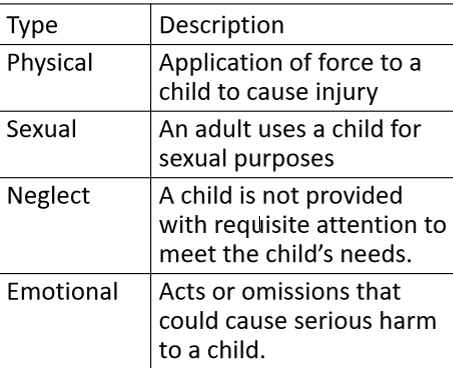
What does “child in need of protection” mean in Canada?
In Canada, suspected child maltreatment must be reported to authorities; a child is considered in need of protection when separation from a caregiver is required due to maltreatment or when the caregiver is unwilling or unable to prevent abuse by a third party.
Prevalence of Child Maltreatment
Only about 47% of child maltreatment investigations are substantiated, but substantiated cases increased 125% between 1998–2003
Largely due to changes in:
Substantiation practices
Better identification of victimized siblings
Increased awareness of emotional maltreatment and exposure to domestic violence.
Corporal Punishment in Canada
Canadian law allows very limited physical force by parents on children aged 3–12, and bans striking young children, teens, or using objects.
Prohibits corporal punishment in schools
Risk Factors for Physical Abuse
family and caregiver characteristics that are statistically associated with a higher risk of physical child abuse
Physical abuse risk rises when caregivers are stressed, isolated, impaired, exposed to violence, and lacking support.
Risk Factors for Sexual Abuse
Risk factors involve family composition.
Living without a biological parent
Presence of a stepfather
Poor parental relationships
Weak child–parent bonds.
Consequences of Maltreatment ( for the victim)
Maltreatment leads to short- and long-term physical, psychological, academic, and relational problems.
The ‘typical‘ victim in child sexual abuse cases
Abuse cases showed that the typical victim is:
female
abuse starts ages 5–13
accused usually male and known to child;
abuse often repeated over years.
The ‘Typical’ accused in child sexual abuse cases
The typical accused is male, in his early 30s when abuse begins
usually known to the child (most often a parent or relative)
with abuse lasting several years and involving multiple offences
while stranger abuse is rare.
The ‘ Typical’ offence in a sexual abuse case
The typical offence involves repeated abuse lasting several years, usually without explicit threats, although when threats are present they are often directed at the physical safety of the child or the child’s family.
 Note
Note  Flashcards (46)