Level 3 (Exam 4)- Spinal Cord Injury
 Call Kai
 Learn
Learn Practice Test
 Spaced Repetition
 Match
Match Flashcards
 Knowt Play
1/11

There's no tags or description
Looks like no tags are added yet.
Name | Mastery | Learn | Test | Matching | Spaced | Call with Kai |
|---|
No analytics yet
Send a link to your students to track their progress
12 Terms
Pathophysiology
what vertebra are mostly involved in spinal cord injuries
C1-C5
T12
L1
Pathophysiology
What are the two types of spinal cord injuries
Rationale
primary
secondary
Rationale:
Primary- is direct physical trauma to the spinal cord
secondary- after a primary injury, the injury becomes on going and progressive
Manifestation
what are the symptoms of a spinal cord injury that develops into spinal shock
↓ DTR
Spinal reflex and sensation
flaccid apparency below the level of injury
Nurse intervention
A nurse is caring for a patient who has
HR: 54
TEMP: 97 at 11 am , 99 11:30 am, 100 at 12 pm
BP: systolic of 87
How should should the nurse interpret these findings and what should she do
Rationale:
these are signs of neurogenic shock and should contact the HCP
Pathophysiology
Why is a secondary spinal cord injury dangerous
Rationale:
edema can form within 24 hours and create permeant tissue damage
Which action should the nurse recognize has the highest priority for a patient who was admitted 16 hours earlier with a C5 spinal cord injury?
Assessment of respiratory rate and effort
Cardiac monitoring for bradycardia
Administration of low-molecular-weight heparin
Application of pneumatic compression devices to legs
Assessment of respiratory rate and effort
Edema around the area of injury may lead to damage above the C4 level, so the highest priority is assessment of the patient’s respiratory function
Manifestations
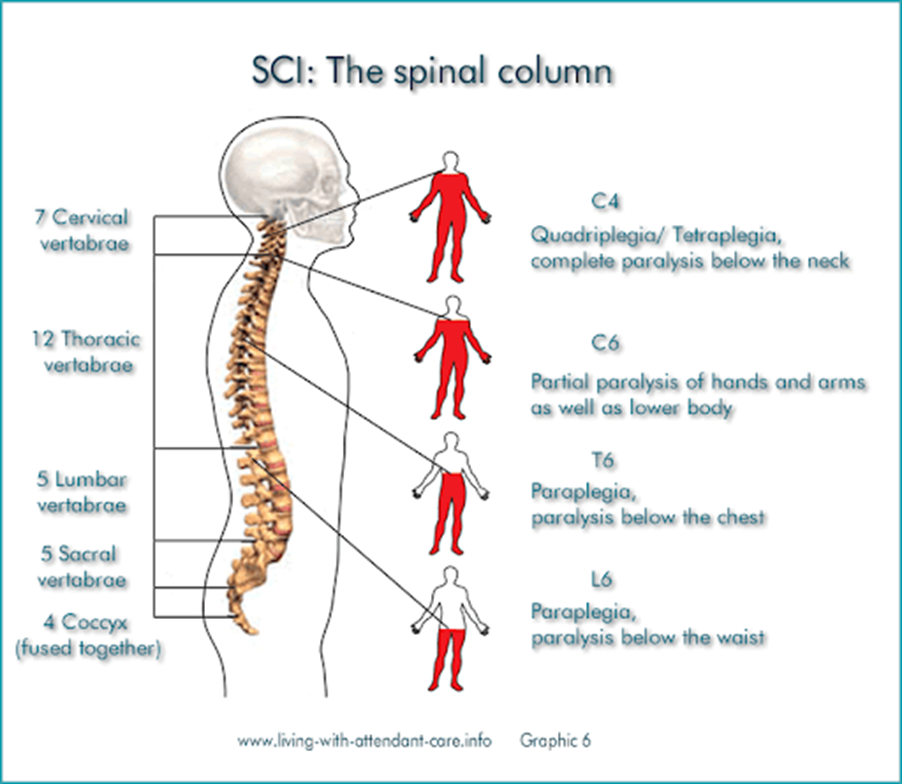
What type of paralysis can be noted if there is damage C4. C6, T6 areas of the spinal cord
C4 = complete paralysis below the neck
C6 = partial paralysis of hand and arms
T6 = paralysis below the neck
Treatment
What medications can be given to pts who have low HR and low RR and have a spinal cord injury
atropine
Nurse Interventions
A nurse is caring for a spinal cord injury patient and is using a Halo Brace. What should the nurse to reduce the risk of infection
provide pin care everyday
Rationale:
the screws are entering the skull via the skin. Break in skin and bone integrity can lead to infections. Care is needed to prevent this
Pathophysiology
what is autonomic dysreflexia
a life threatening condition that can result from spinal cord injuries that affect T6 or higher
Risk Factor
Why is damage to the T6 area of the spinal cord important to understand the triggers of autonomic dysreflexia
Rationale:
T6 is the area of the CNS the sends and receives info to signal to the body of full bladders or bowel impactions.
Rationale:
Damage to the T6 causes the body to not feel when the bladder is full or the bowels are impacted. Full bladder or bowels is the biggest trigger for autonomic dysreflexia
Nurse Interventions
A nurse is caring for a patient who has a T6 spinal cord injury. The nurse take a BP of 160/ 88, HR of 34 and assess the patients bladder- the bladder is hard and distended upon palpation. What is the primary intervention (3 steps)
Rationale:
raise the HOB 45'
Contact the HCP
Do a straight catherization
Rationale:
Damage to the T6 causes the body to not feel when the bladder is full or the bowels are impacted. Full bladder or bowels is the biggest trigger for autonomic dysreflexia. A straight catherization with remove the built up urine reducing the risk that comes with a full bladder.
A BP of 20-40 mm Hg above the baseline + bradycardia (30-40 bpm) + full bladder = autonomic dysreflexia S/S
Explore top notes

