Lecture 26 - Coryza, Chlamydia, Campylobacter, and Coccidia
 Studied by 0 people
 Call Kai
 Learn
Learn Practice Test
 Spaced Repetition
 Match
Match Flashcards
 Knowt Play
1/48

There's no tags or description
Looks like no tags are added yet.
Name | Mastery | Learn | Test | Matching | Spaced | Call with Kai |
|---|
No analytics yet
Send a link to your students to track their progress
49 Terms
Infectious Coryza
What condition is an acute respiratory disease of chickens characterized by nasal discharge, sneezing, and swelling of the face under the eyes? It is caused by Avibacterium paragallinarum, a gram-negative rod, which is grouped into serotypes A, B, and C.
A. paragallinarum
What bacterial species is the causative agent of infectious coryza? It is found worldwide, is of considerable importance in the US, mainly infects pullets and layers, is more common in young chickens in developing countries, and uses chickens as its natural host.
Chicken
Which animal is the natural host for infectious coryza?
No
Does A. paragallinarum get transmitted through eggs? It can be spread through direct contact, airborne droplets, and contaminated drinking water.
Yes
Has infectious coryza been largely eradicated in commercial US farms?
Low
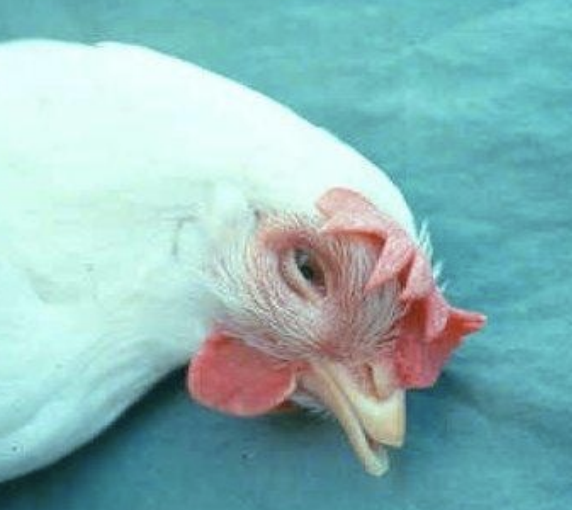
While morbidity for infectious coryza is high, is mortality low or high? All ages are susceptible, it is less severe in juvenile birds, has rapid spread, produces serous/mucus discharge from nostrils, foul odor, and swelling of infra-orbital sinuses, facial edema, and closed eyes.
24-28
After inoculation of chickens, coryza-like lesions will appear within how many hours? ELISA, PCR, isolation, and history are all used in diagnosing this disease.
Carrier
While erythromycin, oxytetracycline, macrolides, and sulfonamides can be used to treat infectious coryza, they are not bactericidal, so the animal will remain a what? Depopulation and immunization are both used in preventing outbreaks.
Infraorbital
Swelling and discharge from which sinuses is very characteristic of infection with A. paragallinarum, or infectious coryza?
Chlamydiosis
What condition is an acute, subacute, or chronic disease of wild and domestic birds, characterized by respiratory, digestive, or systemic infection with Chlamydia psittaci, which has six serotypes?
C. psittaci
Which bacterial species is the causative agent of avian chlamydiosis? The disease is of economic importance mainly in pigeons, turkeys, and ducks, and less so in other birds. Wild birds are the reservoirs and the disease is a public health concern.
Virulent
Which strains of C. psittaci are isolated from turkeys, are characterized by high mortality (30%), are highly pathogenic to lab hosts, and can cause disease in humans?
Low Virulent
Which strains of C. psittaci are isolated from pigeons, ducks, and other birds, and cause slowly progressing disease, with under 5% mortality?
Inhalation, Ingestion
C. psittaci is mainly spread through what two routes, involving dust, excreta, feces, and nasal discharge?
Yes
While lesions of C. psittaci are mainly in the lungs, liver, spleen, and serous membranes, will the specific clinical signs vary with the age of the host and pathogenicity of the strain?
Turkeys
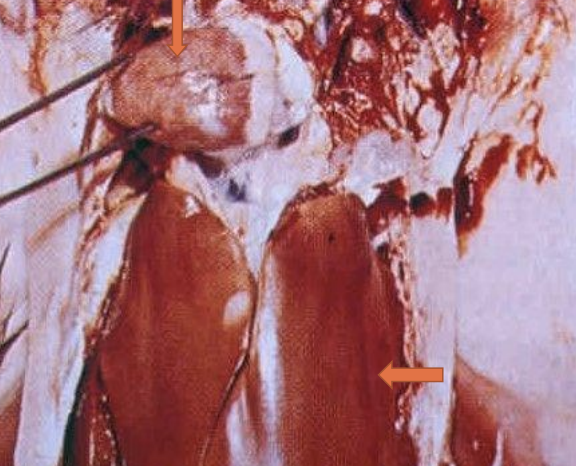
C. psittaci in which animals will be mainly virulent strains, causing fever and gelatinous yellow-green droppings? There will be a rapid drop in egg production, liver/spleen enlargement, necrosis, fibrinous exudate, and swelling of the head if the nasal glands are involved.
Ducks, Geese
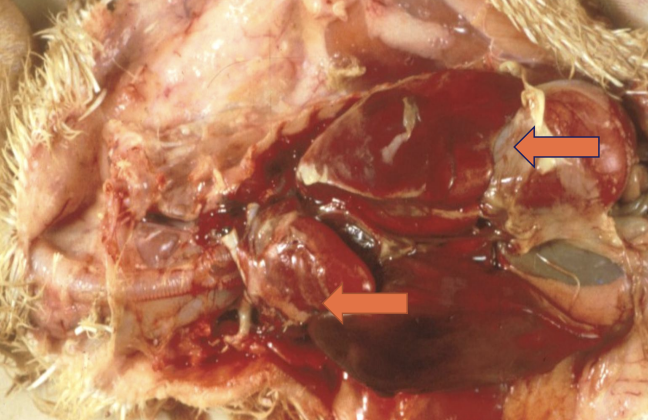
C. psittaci in which two animals will show signs like anorexia, unbalanced gait, green watery feces, and serous-purulent discharge from the eyes and nostrils? Lesions are similar to those in turkeys, including enlarged liver/spleen, necrosis, fibrinous exudate, and head swelling.
Pigeons
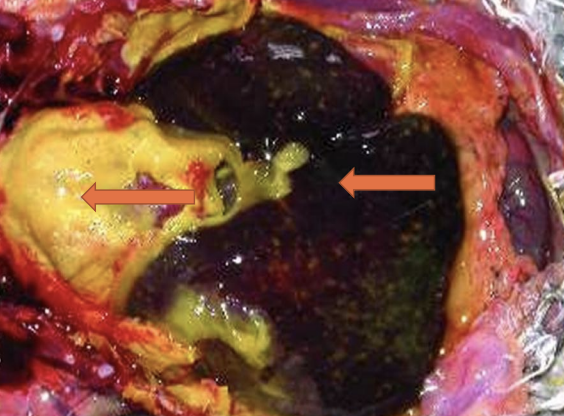
C. psittaci in which animals will show signs like conjunctivitis, swollen eyes, rhinitis, weakness, and rattling sounds during breathing, along with the signs seen in turkeys?
Mononuclear
C. psittaci will be observed in what cells obtained from smears in the exudate or organs? Serology, PCR, and tissue isolation are also used to diagnose it.
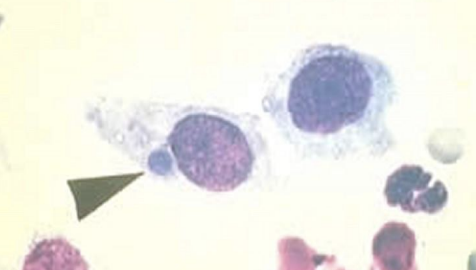
Tetracyclines
What antibiotics can be given in feed or water for 2 weeks to treat chlamydiosis? Pigeons will need repetition many times at intervals of 2 weeks to eliminate it.
No
Is there a vaccine available for C. psittaci?
Campylobacter
Which condition/bacteria is widely distributed in broilers, layers, ducks, and turkeys, and has various species? It has low incidence in the US, is found worldwide, and includes species like jejuni, lari, and coli. It can be zoonotic when obtained from broilers, causing gastroenteritis. 75% of broilers and 80% of processed meat are positive for it. There are no clinical signs in poultry, it is diagnosed using isolation, and lesions include distention of the intestines, watery/mucus content, and hemorrhages in the intestines and liver in toxigenic strains.
Feces
Transmission of campylobacter through what is most likely the main route? It may also be transmitted on or in the egg.
Guillan-Barre
What syndrome, abbreviated GBS, is an acute neuromuscular paralysis associated with inflammatory polyneuropathy caused by infection of campylobacter in humans?
Fisher’s
What syndrome is characterized by paralysis of eye muscles and absence of tendon reflexes and is caused by campylobacter infection of humans? It is a variant of GBS.
Reiter’s
What syndrome is a syndrome with a non-purulent reactive arthritis caused by campylobacter infection of humans?
No
Is there a vaccine available against campylobacter?
Pre-harvest
Which control method for campylobacter involves intensifying biosecurity, frequent collection/cleaning of eggs, water/feed from clean sources, and does not involve a vaccine?
Post-harvest
Which control method for campylobacter involves reduction of microbial contamination during processing, spray washers with chlorine, scalding immersion, antimicrobial addition in water, gamma irradiation, and freezing?
Coccidiosis
What condition is found worldwide, affects many bird species, is a major problem in birds living in deep litter, involves species of Eimeria, and is transmitted through the intestinal tract, except for the renal version seen in geese and ducks? Oocysts are shed in droppings and infection is by ingestion of these when they become sporulated.
Eimeria
Coccidiosis is caused by many species of what genus of protozoan?
Oocysts
Infection with coccidiosis is due to ingestion of sporulated what stage?
4-6
Disease from coccidiosis is most common between what weeks of age? Mortality varies from 1-40%, and outcomes depend on species, age, and immunity.
Chickens
Coccidiosis in which animals involves acute outbreaks, lack of eating/drinking, bloody droppings, fever, and high mortality? In chronic cases it involves gradual weakness, loss of weight, decreased feed intake, and lowered production. Lesions depend on the species involved.
Ceca
Lesions caused by coccidiosis from E. tenella will occur in what part of the GI tract?
Lower
Coccidiosis from E. brunetti will occur in which part of the SI?
Middle
Coccidiosis from E. necatrix and E. maxima will occur in which part of the SI?
Upper
Coccidiosis from E. acervulina will occur in which part of the SI?
Turkeys
Coccidiosis in which animals will occur due to the pathogenic species E. adenoiedes, E. dispersa, and E. meleagrimitis? Disease is most severe in poults up to 2 months old.
E. meleagrimitis
Which species of coccidia infects turkeys in the 2/3 of the anterior intestine, causing congestion and petechial hemorrhages?
E. dispersa
Which species of coccidia infects turkeys in the 1/3 of the middle intestine, causing dilation of intestine with yellowish mucoid content?
E. adenoiedes
Which species of coccidia infects turkeys in the lower 1/3 of the intestine and ceca, causing edema and swelling of the intestine?
E. truncata
Which coccidia in geese causes renal coccidiosis? In the US it has been seen as high as 87% and birds will be anorexic, weak, and have diarrhea with white feces.
E. anseris
Which coccidia in geese causes intestinal coccidiosis, producing diarrhea, weakness, and mortality with lesions of fibrinonecrotic enteritis in the middle and lower intestines?
Renal
What type of coccidiosis in ducks will be caused by E. boschadis?
Intestinal
What type of coccidiosis in ducks will be caused by Eimeria, Tyzzeria, and Wenyonella?
Serousal, Mucosal
Which two surfaces of the intestine are observed at postmortem to help diagnose coccidiosis?
Amprolium
What drug, along with sulfonamides, is given in drinking water to treat coccidiosis? Preventive medication is preferred.
Yes
Is it best to give coccidiosis vaccines and anticoccidial drugs both? The vaccine is given in water in the first 2 weeks of age and the drug can be given either as a single drug or in a shuttle/dual program.
 Note
Note  Flashcards (25)