Transport across membranes
 Studied by 0 people
 Call Kai
 Learn
Learn Practice Test
 Spaced Repetition
 Match
Match Flashcards
 Knowt Play
1/16

There's no tags or description
Looks like no tags are added yet.
Name | Mastery | Learn | Test | Matching | Spaced | Call with Kai |
|---|
No analytics yet
Send a link to your students to track their progress
17 Terms
Definition of diffusion
Diffiusion is the net movement of particles from an area of a higher concentration to an area of lower concentration
The molecules will move both ways but the net movement will be to the area of lower concentration until the particles are evenly distributed
Diffusion is a passive process
What is the concentration gradient?
The concentration gradient is the path from an area of higher concentration to an area of lower concentration. particles move down the concentration gradient
Whats simple diffusion?
Simple diffusion is when molecules can move directly through a membrane
What is facilitated diffusion? Why is it needed?
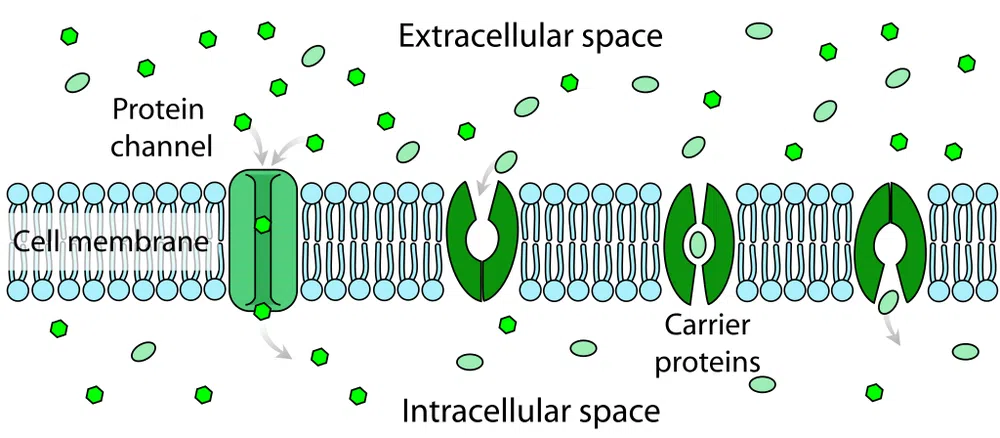
Facilitated diffusion is when large or charged particles through carrier proteins or channel proteins in the membrane instead, and this is a passive process which does not use energy
it is needed as some larger molecules would diffuse extremely slowly through the phospholipid bilayer due to their size
What do carrier proteins do?
Carrier proteins move large molecules across membranes down their concentration gradient. Different carrier proteins facilitate the diffusion of different molecules
The steps of carrier proteins -
first a large molecule attatches to a carrier protein in the membrane
secondly the protein changes shape
this releases the large molecule on the opposite side of the membrane
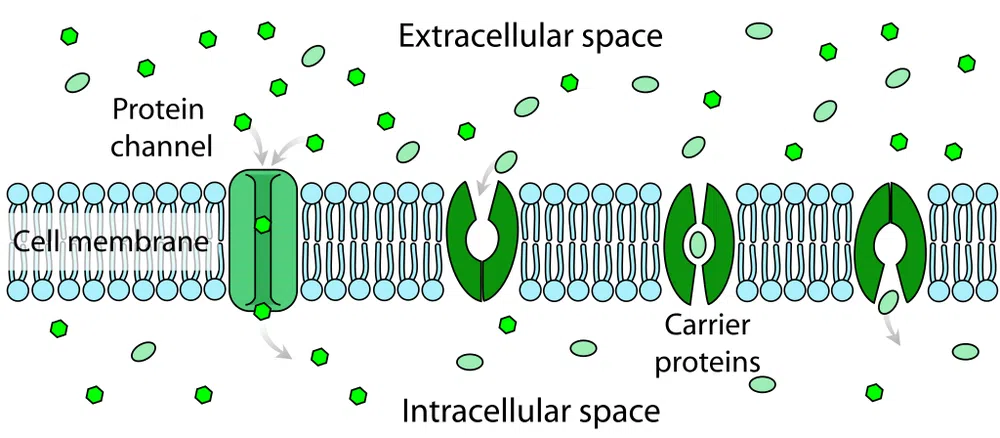
What do channel proteins do?
Channel proteins form pores in the membrane for charged particles to diffuse through down their concentration gradient
Different channel proteins facilitate the diffusion of different charged particles
What factors does the rate of diffusion depend on?
The concentration gradient- the higher the concentration gradient the faster the rate of facilitated diffusion
The number of channel or carrier proteins - once all the proteins in a membrane are in use, facilitated diffusion cant happen anymore even if you maximise the number of concentration gradient
What are aquaporins
Aquaporins are special channel proteins that allow facilitated diffusion of water through the cell membrane. some kidney cells are adapted to have lots of aquaporins which allow the cell to reabsorb a lot of water that would otherwise be excreted from the body
Osmosis
Osmosis is diffusion of water molecules across a partially permeable membrane from an area of high water potential to an area of low water potential
What is the water potential
Water potential is the potential of water molecules to diffuse out or into a solution
What does the rate of osmosis depend on
The rate of osmosis depends on the water potential gradient with the higher the water potential gradient, the faster the rate of osmosis. As osmosis takes place the difference in water potential decreases until both sides are the same
How do solutions of different concentrations made up?
Say we want to make 15cm³ of a solution of 0.4M sucrose
we start with a solution of known concentration such as 1M
Find the scale factor by dividing the concentration of the solution by the concentration of the solution you want to make eg. 1M/0.4M = 2.5M
This means you have to make the solution 2.5 times weaker, and you do that by having 2.5 x less of the solution.
so 15 / 2.5 = 6
15-6=9
and then add the remaining 6m³ with distilled water
Osmosis practical
Use a cork borer to cut potatoes into identically sized chips about 1cm³
Divide the chips into groups of three and measure the mass of each group using a mass balance
Place one group into each of your sucrose solutions
Leave the chips on the solution for at least 20 minutes
(making sure that they all are in for the same amount of time
Remove the chips and dry gently with a paper towel
Calculate the percentage change in mass for each group
Use the result to make a calibration curve showing change in mass against sucrose concentration
Find the concentration at this point then look up the water potential for that conentration for sicrose solution at the point the curve crosses the X axis
What is active transport?
Active transport uses energy to move molecules and ions across membranes, usually against a concentration gradient
The process is relatively similar to facilitated diffusion where a molecule attatches to the carrier protein, the carrier protein changes shape and this moves the molecules acro
What is the difference between Active transport and facilitated diffusion?
Active transport requires energy, facilitated diffusion does not
ATP is a common source ofn energy in the cell and is produced by respiration. It undergoes hydrolysis produces ADP and Pi which releases energy so molecules can be transported
What are co-transporters?
Co-transporters bind to two molecules at a time and the concentration gradient of one of the molecules is used to move the other molecule acros the concentration gradient
Co-transport
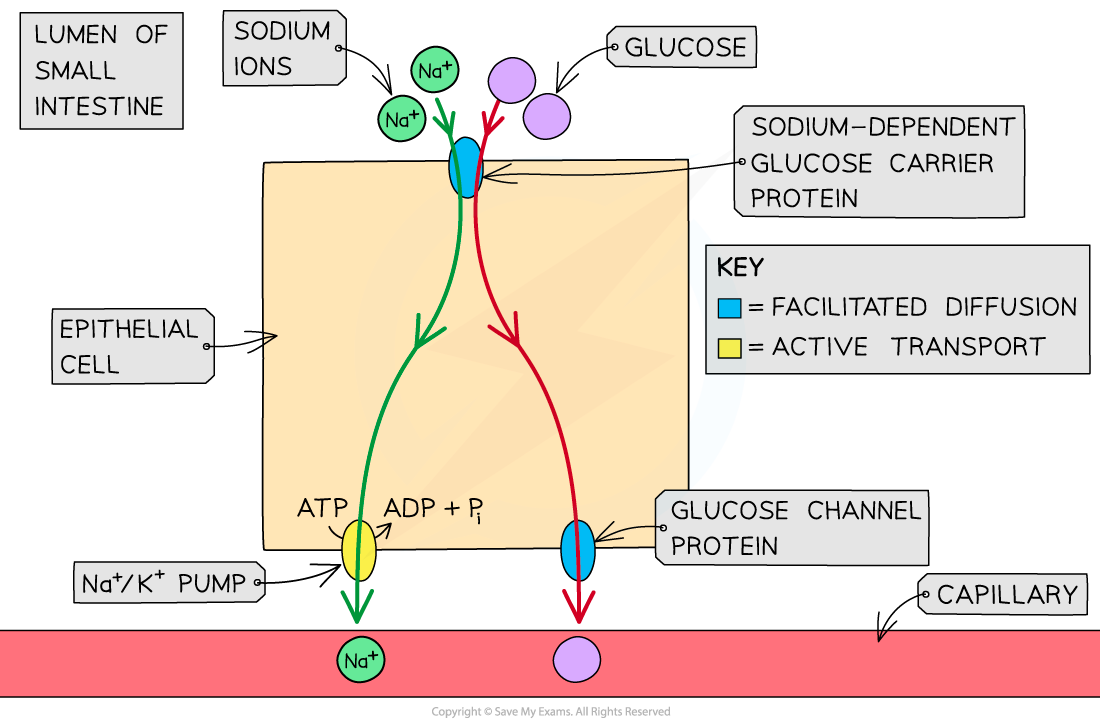
Glucose is absorbed into tthe bloodstream in the small intestine
In the ileum the concentration of glucose is too low for glucose to diffuse into the blood. So glucose is absorbed from the lumen of the ileum by co-transport
Sodium ions are actively transported out of the ileum epithelial cell into the blood by the sodium potassium pump. This creates a concentration gradient - there’s now a higher concentration of sodium ions in the lumen of the ileum than inside the cell
This causes sodium ions to diffuse from the lumen of the ileum into the epithileal cell down their concentration gradient via the sodium glucose co-transporter proteins
The co-transporter contains glucose into the cell with the sodium
as a result the concentration of glucose inside the cell increases
Glucose diffuses out of the cell, into the blood, down its concentration gradient through a protein channel
 Note
Note  Flashcards (96)