SOCIOL 3MH3 Post Midterm 2
 Call Kai
 Learn
Learn Practice Test
 Spaced Repetition
 Match
Match Flashcards
 Knowt Play
1/194

There's no tags or description
Looks like no tags are added yet.
Name | Mastery | Learn | Test | Matching | Spaced | Call with Kai |
|---|
No analytics yet
Send a link to your students to track their progress
195 Terms
Psychological resources
The internal or interpersonal assets or strengths that individuals can draw upon to cope with stress, navigate challenges, and maintain or enhance their mental health and well being
mediating/moderating resources in stress process model
integral to managing stress and achieving positive outcomes despite challenges
self and identity (Thiots, 2013): stress theory
defines mental disorders as arising from external challenges and threats
self and identity (Thiots, 2013): how is self conception closely linked to psychological state
stressors affecting self-concepts predict emotional problems
self and identity (Thiots, 2013): coping resources
High self esteem and perception of social support
How is self esteem a coping resource
gives confidence to problem solve and persistence
how does perception of social support function as coping resource
Helps sustain self worth and mattering to others
Self, Identity and Stress theory: 4 ways of influencing stress
Stress appraisal, stress mediation, stress moderation, socal support and coping resources
Self, Identity and Stress theory: stress appraisal
peoples emotional reactions to objective events are highly variable, it depends in the meaning to the individual
stress appraisal: what is more distressing perception of threat or actual threat
perception
stress mediation
direct harmful effects on peoples self conceptions
stress mediation: explain this- changes in self-conception are the mechanisims or conduits through which stressors result in psychological symptoms
chronic stressors can decrease self worth/identity, and can be assosciated with clinical mental health issues/addictions as well
stress moderation
buffers (aka coping resources) significantly reduce the harmful effects of stressors on peoples psyches
stress moderation: t or f- individual who have numerous stressors and high self esteem exhibit more symptoms of psychological distress
false, fewer symptoms
stress moderating effect of self esteem
influences the effectiveness of the coping strategies people use
social support and coping resources
supporters provide reassurance to the individual that he/she is esteemed and valued- self esteem boost
t or f: people change their views of themselves as a way to cope with difficult life circumstances
t
Alienation
psychological state/feeling separate from environment and sense of self; any form of social dissociation, detachment or separation
5 major types of alienation
powerlessness, self estrangement, isolation, meaninglessness, normlessness
People high in alienation score low in what areas (5)
control, commitment, support, meaning, normality
perceived control vs powerlessness: control
beleif in control over ones own life (psych resource, not objective)
perceived control vs powerlessness: how is powerlessness separated from outcomes
belief that ones own behaviour cannot determine the occurrence of the outcomes
Perceived powerlessness
cognitive awareness of the reality that ones behaviour cannot determine outcomes generated by objective conditions of powerlessness
in contrast to perceived powerlessness, ___ ___ leads to lower levels of ___
perceived control, distress
what are some strategies of perceived control (3)
mastery, personal efficacy, instrumentalism
What are the 2 components of locus of control
external, internal
external locus of control + examples
learned, generalized expectation that outcomes of situations are determined by forces external to oneself; ie. powerful others, luck, fate, chance
internal locus of control
learned, generalized expectation that outcomes are contingent on one's own choices and actions
compared to those with an ___ locus of control, those with an ___ locus of control attribute life outcomes to themselves
external, internal
Self efficacy + ex
beleif in ones own power or ability to produce a specific desired effect; ie. staying healthy, quitting smoking, doing well in school
What is the contrast between perceived control and self-efficacy
perceived control is a broad concept applying to many parts of life and self efficacy is more specific to the context and ability to perform certain actions successfully
learned helplessness
low rate of voluntary response and low ability to learn successful behaviours that results from exposure to inescapable, uncontrollable negative stimuli
how is learned helplessness adopted
through reinforcement and learned behaviours
sense of personal control
learned, generalized expectation that outcomes are contingent on one's own choices and actions
high sense of personal control
belief that performance is up to you, can master/control and effectively alter the environment
how are perceived control and powerlessness two ends of a continuum
perceived control believes outcomes are contingent on one's choices/actions and powerlessness is the belief that ones actions are determined by forces external to oneself
how is perceived control measured (Mirowsky-Ross Index)
2x2 design that is balanced across positive vs negative outcomes and control vs lack of control
a high score indicates a strong sense of control and a low score is feeling powerless
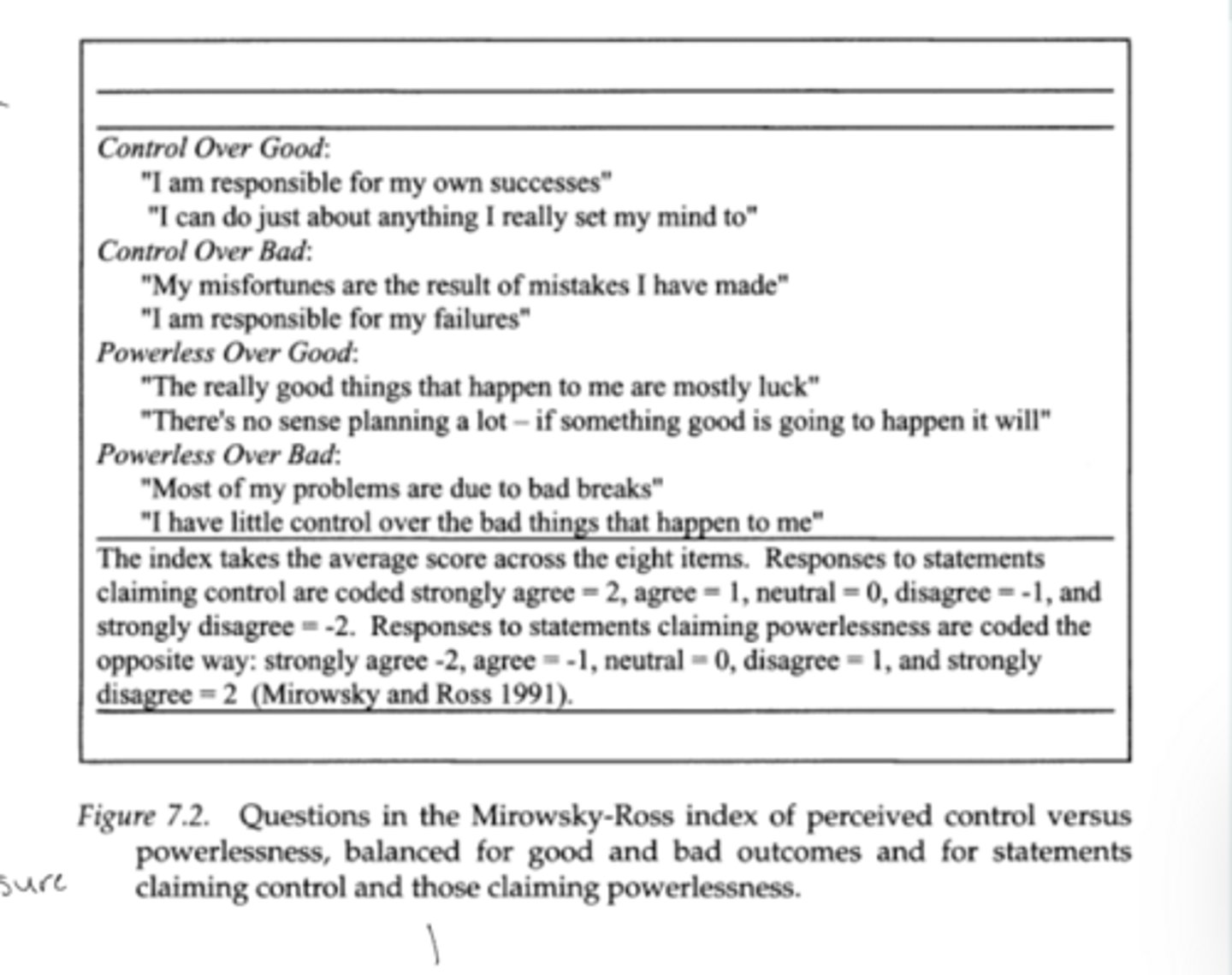
why is the perceived control measurement useful
captures a person general sense of control, not tied to one situation. Linked to mastery and self efficacy
Correlates of the sense of personal control
SES, race/ethnicity, age/cohort, gender/work and family
as ___ increases, sense of __ increases
education, control
Alienated labour (Karl Marx)
condition in which the worker does not decide what to produce, does not design the production process, and does not own the product
what does alienated labour result in
self estrangement
self estrangement
sense of being separate from that part of one's thoughts, actions and experiences given over to the control of others
alienated labour: gig economy worker example
work as a means to an end: related to low commitment and money making> intrinsically rewarding career apart of self concept
social isolation
individuals sense of detachment in the microsocial order of personal relationships
social isolation: not having anyone who is someone to you and not being __ ___ ___
someone to anyone
social support
sense of being cared for, loved, esteemed and valued as a person, and part of a network and community
Social integration
how strongly a person is connected to his or her social group
does perceived or actual support reduce depression and mediate the effects of integration on depression?
perception of support reduces depression
meaning
individuals require a sense of purpose for their lives (knowing where they want to go and believing they know how to get there), and an inherent significance and value of their existence
existential security (Thoits, 1983)
feeling your life has purpose, makes sense and you can manage what happens to you
meaning vs meaningless: roles and identities
the more identities the more existential security
roles and identities: is having more meaningful identity good or bad for mental health
research is mixed, neither good or bad
roles and identities: examples of how not all roles are equal
ie. prisoner vs disabled veteran
normality vs normlessness
degree of detachment from the rules and standards of social life (ie. a reliable set of expectations
Four main areas of investigation for normality vs normlessness
Normlessness, labelling, role stress, life cycle
Normlessness
the belief that socially unapproved behaviours are required to achieve one's goals; ie. deviance, rejection of social norms and standards
Labelling
grouping of phenomena treated as if they have an existence and essence that transcends the individual being considered; ie. psychotic, manic, alcoholic
role stress
when expectations are not met and there is role conflict, role ambiguity, role overload
life cycle
transitions that happen out of their usual sequences (life course theory)
emotional consequences of normlessness
mistrust, anxiety, low self esteem, distress
Use the hamilton example to emphasize the impact of disadvantages between neighbourhoods
there is a difference of 21 years in average age at death between people living up the mountain and those in the lower central core
neighbourhoods: where you live matters from __
birth
What constitutes neighbourhood stressors
Social and economic statuses
where does neighbourhood stressors fit into the stress process model
between SES and primary/secondary/mental health outcomes levels
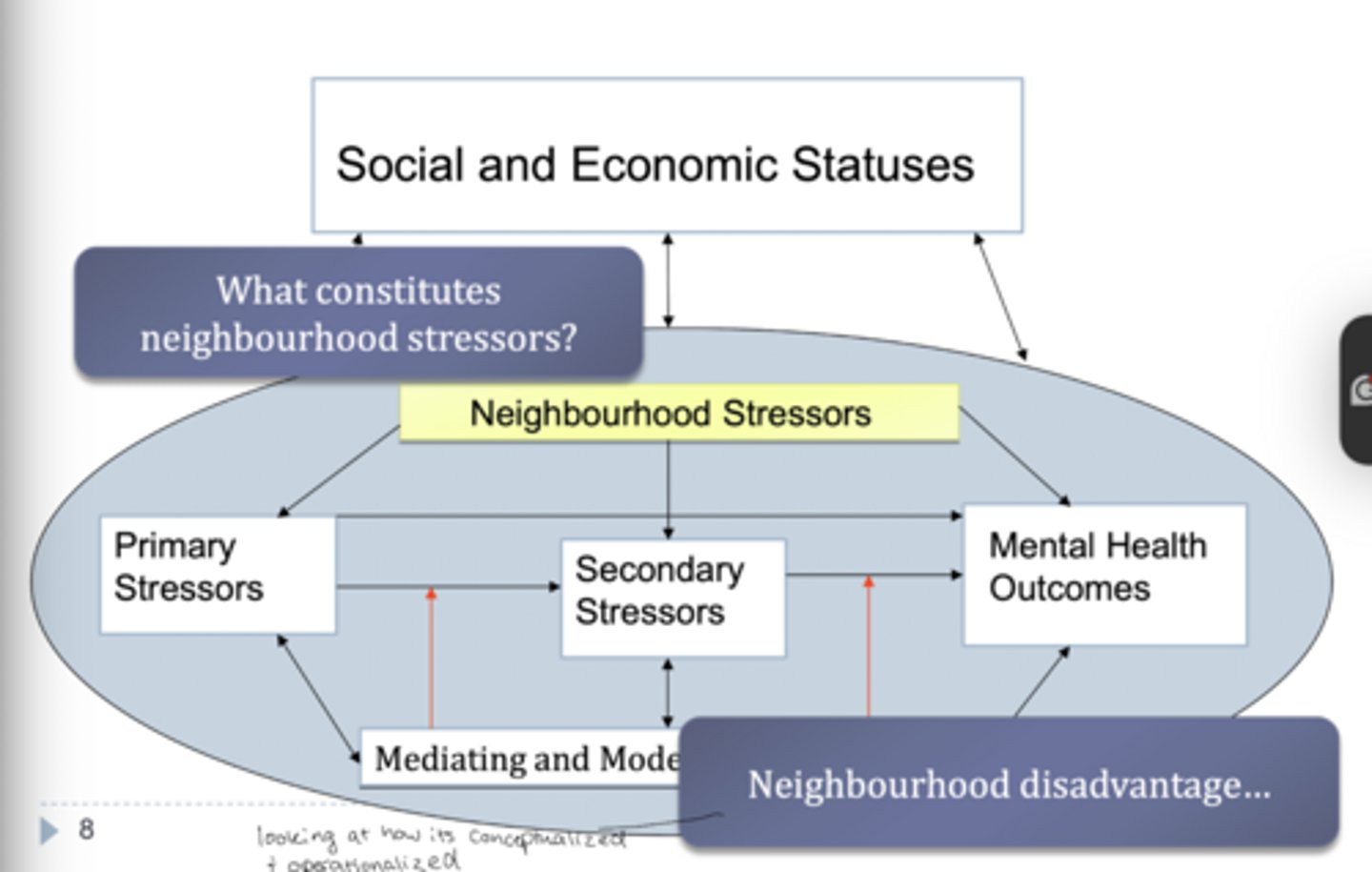
what is the sequence of studying neighbourhood disadvantage
individual disadvantage -> neighbourhood disadvantage -> mental health
How is neighbourhood disadvantage on mental health studied
aggregae stats for how neighbourhoods reflect SES trends
What are some of the main aggregate stats about the residents and households in a vicinity that indicate advantage or disadvanage?
% of households with high school degree, % of adults over 24 with a uni degree, unemployment rate, % households headed by females, % of residents that are owner occupied, mean household income, % of households headed by females raising dependent children, % of visible minority, % of households with income below the official poverty line
According to M&R structural model, what 2 factors specifically don't just matter on their own but also reflect neighbourhood disadvantage
% of households headed by females, % of households with income below the official poverty line
Examples of perceived neighbourhood disorder?
graffiti, noise, vandalism, abandoned buildings, run-down property, crime, substance use, hanging out on streets, rubbish
What are the 2 main categories of measuring perceived neighbourhood disorder
physical (ie. graffiti, noise) and social (ie. crime, drug use)
What are the steps of neighbourhood disadvantage and distress (3)
neighbourhood disadvantage (Structural) -> perceived neighbourhood disorder -> mental health (outcome)
How does context impact our perceptions of neighbourhood disorder
Affects the psychological resources we have to combat stressors
What is the most important resource protecting our mental health
sense of personal control
How can sense of personal control worsen an individuals mental health
feeling like you aren't in control of stressors signals disadvantage across the life course
What is added to the neighbourhood disadvantage and distress model and where does it go?
resources, between perceived neighbourhood stressors and mental health outcomes
Explain the role of resources in understanding the impacts of neighbourhood disadvantage on mental health
you absorb the background stressors of your neighbourhood and this effects how you can "show up" in other areas of your life
neighbourhood disadvantage and resources: structural amplification
neighbourhood disorder directly leads to worsened mental health and indirectly impacts mental health by reducing psychological sense of control (ie. unsafe neighbourhoods-> feeling less in control -> worse MH outcomes)
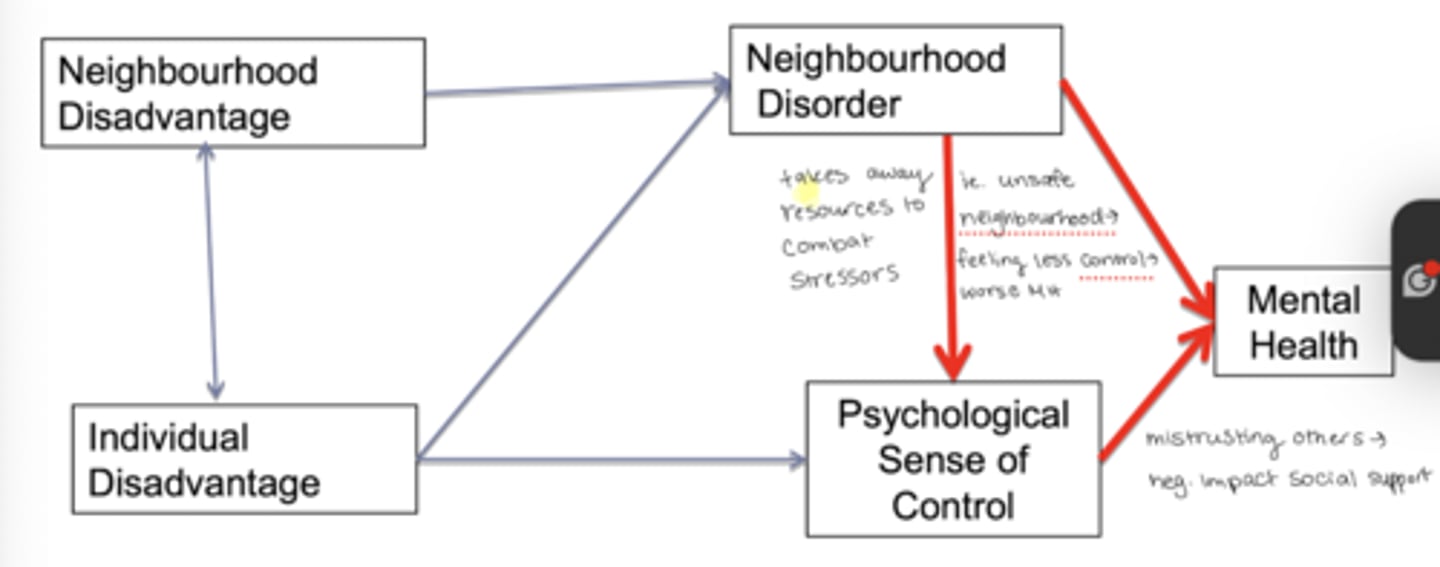
neighbourhood disadvantage and resources: structural amplification- how does psychological sense of control impact mental health
mistrusting others leads to negative impact on social support
Ecological model addresses what...
why some people in adverse social contexts are harmed whereas others attain more successful mental health outcomes
work-family conflict is experienced in moderate levels by _ out of 10 families
8
t or f: work family conflict surpasses variants like underemplyment, high job demands, low organizational justice in contributing to poor mental health
true
What are the limits of work family conflict research (2)
1. Individual level antecedents- focusing on personal situations as the cause of conflict
2. generic/theoretical definitions- research defining work-family conflict in a basic/vague way without strong theory
What are the limits of work family conflict research: example: how is I work until 5, daycare closes at 3 → conflict being viewed as an an individual level antecetent a problem
it overlooks the bigger structural factors like workplace policies, childcare systems, income inequality, gender roles
Proposed alternative to studying work family conflict
conceptualize WFC as a "chronic stressor" within the stress process model
How is viewing work family conflict as a chronic stressor within the stress process model an acknowledgement of the shortcomings of current conceptualizations
Acknowledges that WFC is dependent on context and the objective AND subjective components
"whether or not there is an objective basis for the stressor, the ___ of it operates as a stressor" (Wheaton, 1997)
perception
When researching WFC we should focus on the __ __ of neighbourhood residents relative to the individual. Why?
social composition; because similarities among residents and demographic features may be beneficial (offering support/comfort)
Neighbourhood composition
Shared understanding of available psychological resources and shared assumptions about collective identity that continually define and redefine expectations of daily life
What is the main argument behind the importance of acknowledging neighbourhood composition when trying to understand the impact of WFC
Increased similarity in ethnicity, family structure, etc between individuals will impact norms of behaviour and implicitly available social support
___ in perceived social support leads to ___ in mental health problems
increase, decrease
twofold benefits of social similarities
1. Establishes definitive norms/shared expectations
2. Increased perceived support, even if support isn't actually used, knowing its there reduces stress
What is an important limitation of twofold benefits of social similarities
these benefits only happen after meeting a certain threshold: a little similarity is not enough to change the environment, but when enough people share the traits it creates a collective identity
Structural equivalence
the specificity of similarity of social and demographic features across individuals in a given context
Structural equivalence: the more ___ statuses/role sets, the more "____" the actors are
similar, equivalent
Structural equivalence: what does the homogeneity of values benefit the individual + ex
Individuals gravitate towards those who share their values and they can buffer stressors; ie. sense of comfort in the stress experienced by all students waiting to write an exam
Structural equivalence: norm expectations and collective social support
living around similar others leads to the assumption that others face the same configuration of demands and the very notion of sharing a common stressor lowers its potential threat
Structural equivalence setting the foundation of norm expectations reflects what social psych theories (2)
Social comparison and relative deprivation
Structural equivalence: the notion of sharing a common stressor leads to a presumed ___ ___ ___ among similar others
collective social support
Gender differences in work family conflict (3)
1. Different meanings attributed to work and family roles influence experiences
2. Women interact differently with neighbourhood social context by investing more into relationships, integrating in social fabric and participating more than men
3. self vs others salience- women are more concerned about connections with, and perceptions of others

