Oncologic Disorder
 Call Kai
 Learn
Learn Practice Test
 Spaced Repetition
 Match
Match Flashcards
 Knowt Play
1/19

There's no tags or description
Looks like no tags are added yet.
Name | Mastery | Learn | Test | Matching | Spaced | Call with Kai |
|---|
No analytics yet
Send a link to your students to track their progress
20 Terms
What is cancer?
A group of disorders characterized by abnormal cell proliferation, in which cells ignore growth-regulating signals in the surrounding environment
Disease process that begins when a cell is transformed by genetic mutation of cellular DNA
Metastasis: Abnormal cells invade from original site to surrounding tissue and gain access to lymph and blood vessels carrying them to other areas of the body
Malignant cancer cells: cells or processes that are characteristic of cancer
Benign cancer cells: cells that are not cancerous
What is the malignant process?
Cell proliferation:
Genetically altered cells clone and proliferate abnormally
Evading normal intra/extracellular processes such as growth regulating and immune system defenses
Abnormalities in cell signaling processes lead to cancer development
Ultimately metastasis occurs
What are the carcinogensis and what is the process of malignant transformation?
Malignant transformation
Three-step process
Initiation: apoptosis → malignent cells evade cell death and continue to multipy
Promotion: preneoplastic/benign lesions
Progression: angiogenesis → tumor proliferates and becomes maignant and metastasis
What are the carcinogenic agents and factors?
Viruses, bacteria
Physical agents: sunlight, radiation, chronic irritation
Chemical agents: tobacco, asbestos
Genetic, familial factors
Lifestyle factors
Hormonal agents
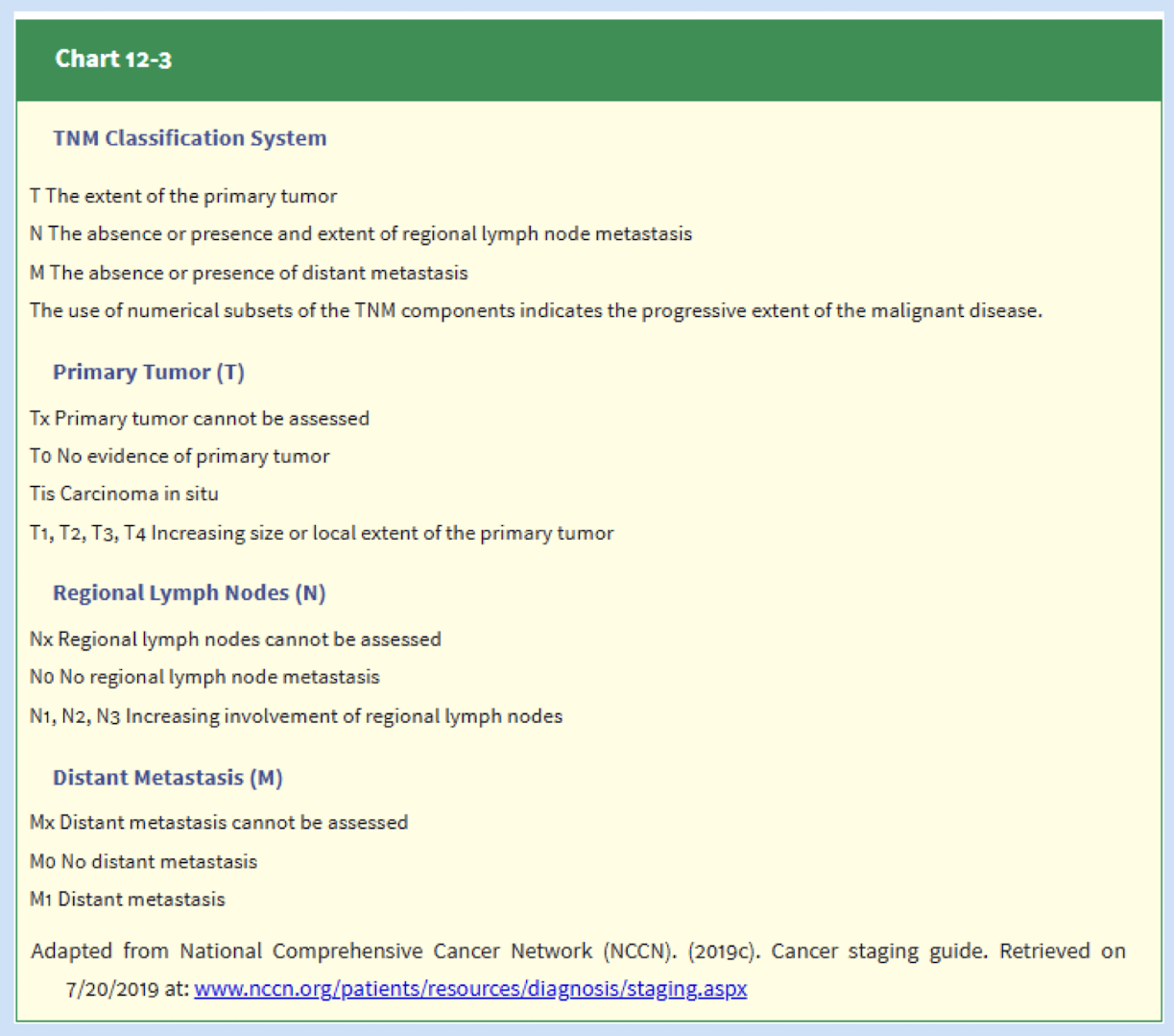
What is the staging and grading of tumors?
Staging: determines the size of the tumor, the existence of local invasion, lymph node involvement, and distant metastasis
Tumor, nodes, metastasis (TNM)
Grading: pathologic classification of tumor cells: I–IV
What are some general types of ways cancer can be managed?
Specific to type, stage, grade of cancer
Cure
Control
Palliation
Lung Cancer (Bronchogenic Carcinoma); Causes, S&S, Diagnostic
Causes: inhaled carcinogens, most often cigarette smoke (>85%); other carcinogens include radon gas and occupational and environmental agents
S&S: cough or changes to chronic cough; dyspnea, chest/shoulder pain
Diagnostic: fiberoptic bronchoscopy; transthoracic fine-need aspiration under CT; PET scan, MRI
What is the sugical treatment for cancer?
Diagnostic surgery
Biopsy: excisional, needle, incisional
Tumor removal: wide excision, local excision
Prophylactic surgery
Palliative surgery (Table 12-6)
Reconstructive surgery
Select surgical techniques (Table 12-5)
List some types of radiation therapy and nursing care for patient undergoing radiation therapy?
Curative, control, or palliative
External radiation
Internal radiation
Radiation reactions
Brachytherapy
Toxicity
Nursing Care of the Patient Undergoing Radiation Therapy
Promote healing, patient comfort, quality of life
Assessment
Skin; radiation lotion to help with burning, manage radiation dermatitis by reducing dryness, itchiness, and burns
Nutritional status
Well-being
Protecting caregivers
What is chemotherepy (Goals, dosage, extravasation, hypersensitivity reactions)
Agents used in attempt to destroy cancer cells by interfering with cellular function and replication
May be combined with surgery, radiation therapy, or both
Goals: curative, control, or palliative
Dosage: based primarily on the patients total body surface area, weight, previous exposure and response to chemotherepy, and function of major organ systems
Extravasation: the leakage of chemo agents administered intervenously damaging tissue
Hypersensitivity reactions: mild or progressively worsening S&S, such as rash, uticaria, fever, hypotension, cardiac instability, dyspnea, wheezing, throat tightness, and syncope
What does chemotherapy toxity look like in each system?
Gastrointestinal: most common N/V
Hematopoietic: myelosuppression ( decreased WBSs, RBCs, & PLTs; pancytopenia decrese in all three blood cells)
Renal: AKI, SIADH
Cardiopulmonary
Reproductive: infertility
Neurologic: severe peripheral neuropathies
Cognitive: trouble remembering dates, managing numbers and finances, face recognition
Fatigue
What is the nursing management in chemotherapy?
Assessing fluid, electrolyte status
Assessing cognitive status
Modifying risks for infection, bleeding
Administering chemotherapy
Preventing nausea and vomiting
Managing fatigue
Protecting caregivers
Hematopoietic Stem Cell Transplantation (HSCT); Types & Nursing management
Used to treat several malignant and nonmalignant diseases
Types: Allogeneic, Autologous, Syngeneic, Myeloablative, Nonmyeloablative
Nursing Management
Implementing pretransplantation care
Providing care during treatment
Providing posttransplantation care
Caring for recipients
Caring for donors
Graft v. Host disease
Major cause of morbidity and mortality in the allogeneic transplant population
Occurs when the donor lymphocytes initiate an immune response against the recipient's tissues (skin, gastrointestinal tract, liver) during the beginning of engraftment
To prevent GVHD, patients receive immunosuppressant drugs, such as cyclosporine
May be acute (within first 100 days) or chronic (occurring after 100 days)
What are some immunotherapies that can be given and what is thier purpose?
The use of medications or biochemical mediators to stimulate or suppress components of the immune system to kill cancer cells
Nonspecific immunotherapy boosts the immune system to enhance cancer cell destruction (bacilli Calmette-Guérin, cytokines)
Monoclonal antibodies
Checkpoint inhibitors
Cancer vaccines
CAR T-cell immunotherapy
Waht is target therepy + nursing management?
The use of agents to kill or prevent the spread of cancer cells by targeting a specific part of the cell, with less negative effects on healthy cells than conventional chemotherapy
Allows for personalization of cancer therapy
Nursing management
Patient education
Standards of care for anticancer treatment patients
Promote self-care
Table 12-8
What is the nursing care of patients with cancer?
Maintaining tissue integrity
Stomatitis
Radiation-associated impairment of skin integrity
Alopecia
Malignant skin lesions (see Chart 12-6)
Promoting nutrition
Nutritional impairment
Anorexia
Malabsorption
Cancer-related anorexia–cachexia syndrome
Relieving pain (Table 12-9, Figure 12-7)
Decreasing fatigue (Chart 12-8)
Improving body self-image
Sex
What is the nursing management for continuing and transitional care?
Nurse must assess the home environment and suggest modification for patient and caregivers
Arrange for ongoing nursing visits
Education
Coordination of care
Community resources
Cancer survivorship (Table 12-12)
What is the care done for the advanced cancer patient?
Care during oncologic emergencies (Table 12-13)
Superior Vena Cava Syndrome: A life-threatening condition caused by compression or obstruction of the superior vena cava, usually from a tumor (commonly lung cancer), leading to impaired venous return from the upper body. This results in facial/upper body swelling, increased intracranial pressure, and potential airway compromise, which can lead to cerebral anoxia and death.
Need to Monitor: airway, breathing, neuro status, swelling of face/neck/arms
The medical management is relieve the obstruction + support breathing:
High Fowler’s position ↑ (MOST IMPORTANT for symptoms)
Radiation / chemo → shrink tumor
Stent → open SVC
Oxygen, steroids, diuretics
Anticoagulants if clot-related
Spinal cord compression: A life-threatening condition where a tumor compresses the spinal cord, usually from metastasis to the spine, leading to decreased blood flow and nerve damage. This results in pain, neurologic deficits, and possible permanent paralysis if not treated quickly.
Need to Monitor: neuro status (motor + sensory), pain, bowel/bladder function
The medical management is relieve pressure + prevent damage:
Corticosteroids (MOST IMPORTANT early) → ↓ swelling
Radiation → shrink tumor
Surgery → decompress spine if severe
Pain control + supportive care
Hypercalcemia: A life-threatening metabolic condition where too much calcium is released from bones into the blood, often due to cancer, leading to decreased neuromuscular activity and organ dysfunction.
Think: “everything slows down”
This results in confusion, weakness, constipation, dehydration, and cardiac arrhythmias.
Need to Monitor: calcium levels, mental status, heart, hydration status
The medical management is flush it out + lower calcium:
LOTS of fluids 💧 (MOST IMPORTANT)
Loop diuretics → excrete calcium
Bisphosphonates → stop bone breakdown
Treat underlying cancer
Tumor Lysis Syndrome: A life-threatening condition that occurs when large numbers of cancer cells rapidly break down (usually after chemotherapy), releasing intracellular contents into the bloodstream. This leads to hyperkalemia, hyperphosphatemia (causing hypocalcemia), and hyperuricemia, resulting in potential cardiac arrhythmias, kidney failure, and neurologic complications (e.g., seizures).
Need to Monitor: electrolytes + heart + urine output closely.
The medical management is flush it out + fix electrolytes:
LOTS of fluids 💧 (MOST IMPORTANT)
Allopurinol / Rasburicase → ↓ uric acid.
Treat high potassium → insulin, meds.
Dialysis if severe
Pain management
Promote independence
What does hospice focus on?
Should be referred in a timely fashion
Comprehensive, multidisciplinary approach to care of patients with terminal illness, their families
Focuses on
Quality of life
Palliation of symptoms
Psychosocial, spiritual care
Grief

