Biology-Life_Processs_ NUTRITION
 Call Kai
 Learn
Learn Practice Test
 Spaced Repetition
 Match
Match Flashcards
 Knowt Play
1/22

Earn XP
Description and Tags
Revision_purposes
Name | Mastery | Learn | Test | Matching | Spaced | Call with Kai |
|---|
No analytics yet
Send a link to your students to track their progress
23 Terms
Life Processes
The basic and essential activities performed by a living organism to sustain and maintain life.
Nutrition
The process by which a living organism obtains and utilizes food is called ‘nutrition’.
Autotrophic nutrition
mode of nutrition in which organisms prepare their own food using simple inorganic substances like CO2 and H2O. Eg : green plants, algae, blue green algae
Heterotrophic nutrition
mode of nutrition where an organism depends on another for food and nutrients. Eg : humans, animals, etc.
Types of Autotrophic nutrition
Chemosynthesis - make own food but with chemicals. purple sulfur bacteria.
Photosynthesis - green plants, cyanobacteria, algae, bacteria
Types of Heterotrophic nutrition
Holozoic - animals that take in solid food which is then broken down inside the body. eg : animals, amoeba
Parasite : live inside/outside another organism (host) and derive nutrition from it. eg : cuscutta, ticks, leech
Saprophytes : organisms that feed on dead and decaying matter. eg : fungi, mushroom
Photosynthesis formula (Reactants - products)
6CO2 + 12H2O (chlorophyll, sunlight) —> C6H12O6 + 6O2 + 6H2O
Main events of photosyntesis (Very Important!!)
Absorption of light energy by chlorophyll
Conversion of light energy into chemical energy to split water molecules into hydrogen and oxygen
Reduction of CO2 to carbohydrates (/glucose/energy)
Plants store glucose in the form _______ and humans in the form of ______.
plants : starch ; humans : glycogen
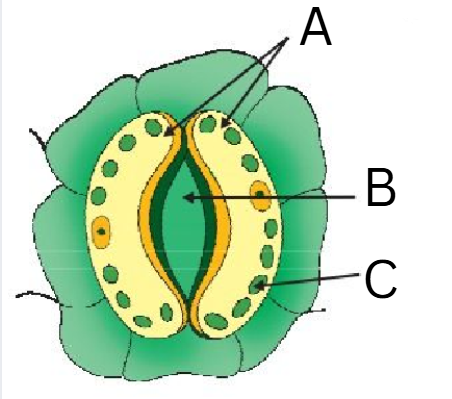
Label the following diagram of stomata
A : guard cells
B : stomatal pore
C : chloroplast
Functions of stomata (NTN)
exchange of gases
transpiration
Photosynthesis in desert plants
stomata opens at night to take in CO2 (to reduce water loss)
stomata closed during day
CO2 taken at night used for photosynthesis
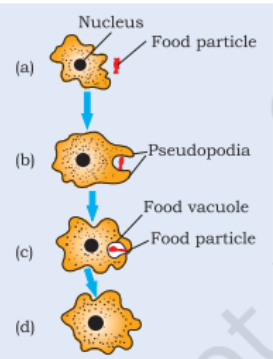
Nutrition in Amoeba (mid question)
Ingestion - surrounding food particle with pseudopodia forming food vacuole.
Digestion - enzymes secreted into food vacuole to break it into simpler soluble substances
Absorption - digested food absorbed and used as energy
Assimilation - absorbed nutrients utilized in life processes.
Egestion - undigested food expelled out.
Nutrition in paramoecium.
Follows holozoic nutrition.
ingestion : using cilia.
rest like amoeba
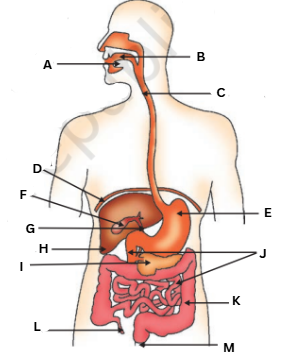
Label the following diagram (Human Alimentary Canal)
A : Tongue
B : Mouth (Buccal Cavity)
C : Oesophagus
D : Diaphragm
E : Stomach
F : Gall bladder
G : Bile duct
H : Liver
I : Pancreas
J : Small intestine
K : Large intestine
L : Appendix
M : An^s
Teeth
crushes food ; forms uniform texture
salivary glands secrete saliva
contains enzymes salivary amylase which breaks down complex sugars (Starch) into simple sugars (maltose)
Oesophagus
food pipe
connects mouth to stomach
peristalsis - rhythmic contractions in the alimentary canal to push the food down.
Stomach
Secretes gastric juice containing :
HCL - creates acidic medium (helps pepsin, kills germs)
Pepsin - digests proteins
Mucus - protects stomach inner lining from HCL
Food stays in stomach for 3-4 days
Small Intestine
Longest part - 7m
Coiled.
Site of digestion and absorption
Recieves secretions from :
Liver (Bile juice) - makes food alkaline and emulsifies fats
Pancreas (pancreatic juice) - trypsin (proteins) ; lipase (fats) ; pancreatic amylase
Intestinal glands - secretes intestinal juice
(Stomach part-2) Breaking down of compunds
Proteins —> amino acids
Carbohydrates —> glucose
Fats —> fatty acids + glycerol
(Stomach part-3) Absorption in stomach
Villi (projections) in the inner wall
increases surface area
rich blood supply transports absorbed nutrients to all body cells.
nutrients used for energy, growth and repair of tissues.
Large Intestine
absorbs water from undigested food
prepares waste
An^s
Egestion - removal of undigested waste
Controlled by anal sphincter

