2.7.1 Factor and Remainder Theorem
 Call Kai
 Learn
Learn Practice Test
 Spaced Repetition
 Match
Match Flashcards
 Knowt Play
1/5

There's no tags or description
Looks like no tags are added yet.
Name | Mastery | Learn | Test | Matching | Spaced | Call with Kai |
|---|
No analytics yet
Send a link to your students to track their progress
6 Terms
Factor Theorem
The factor theorem is used to find the linear factors of polynomial equations
This topic is closely tied to finding the zeros and roots of a polynomial function/equation
As a rule of thumb a zero refers to the polynomial function and a root refers to a polynomial equation
Factor Theorem Formula
For any polynomial function P(x)
(x - k) is a factor of P(x) if P(k) = 0
P(k) = 0 if (x - k) is a factor of P(x)
Using the Factor Theorem
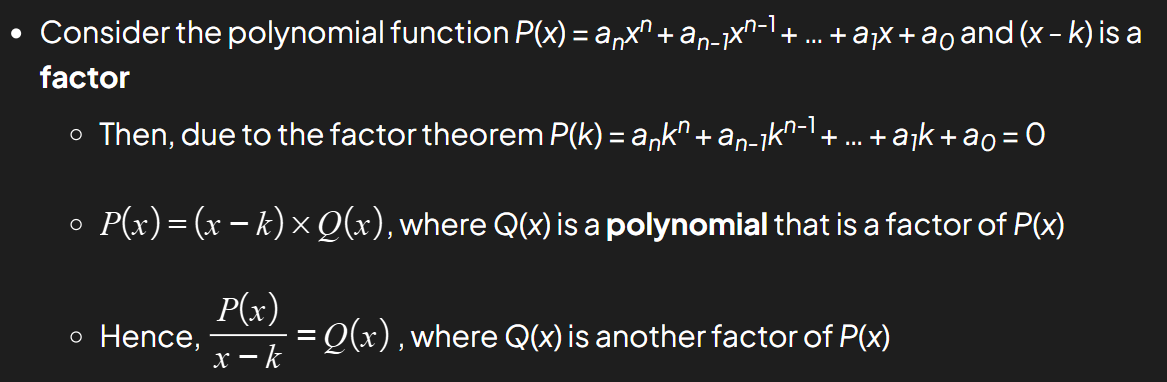
If the linear factor has a coefficient of ‘x’, then first factorize out the coefficient

*Q(x) is just the rest of the polynomial
Remainder Theorem
The remainder theorem is used to find the remainder when dividing a polynomial function by a linear function
When any polynomial P(x) is divided by any linear function (x - k) the value of the remainder R is given by P(k) = R
Note, when P(k) = 0 then (x - k) is a factor of P(x)
Factor Theorem Tip
If asked to find integer solutions to a polynomial, then only consider factors of the constant term
E.g: The integer solutions to the polynomial - x2 - 5x + 6
Consider the factors of 6: ±1,±2,±3,±6
They could be the solutions to the polynomial
Using the Remainder Theorem
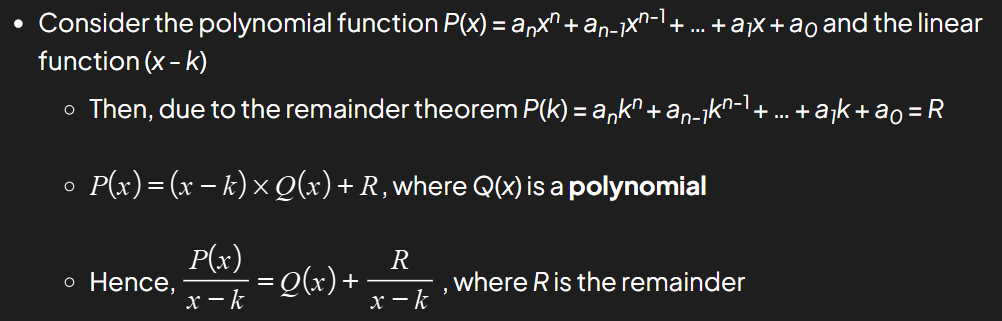
If the linear function has a coefficient of ‘x’, then first factorize out the coefficient


