all of homeostasis!! yay!
 Call Kai
 Learn
Learn Practice Test
 Spaced Repetition
 Match
Match Flashcards
 Knowt Play
1/200

Earn XP
Description and Tags
biology gcse aqa 4.5
Name | Mastery | Learn | Test | Matching | Spaced | Call with Kai |
|---|
No analytics yet
Send a link to your students to track their progress
201 Terms
what do plants use hormones for?
coordinate and control growth and their responses to light and gravity
what is phototropism?
orientation and growth of plants in response to light (positive means toward light, negative is away)
what is gravitropism?
growth of plants in response to gravity
what are 3 plant hormones?
auxin, ethene and gibberellins
what does auxin do?
regulates plant growth
how does an unequal distribution of auxin affect the plant?
unequal growth rates in plant roots and shoots
what are the agricultural uses of auxin?
weedkiller, rooting powder and promoting growth in tissue cultures
what is the function of ethene?
acts as a hormone to control cell division and ripening of fruits
what is the agricultural use of ethene?
controls ripening of fruits in storage and transport
what is the function of gibberellins?
important in initiating seed germination
what are the agricultural uses of gibberellins?
used to end seed dormancy, promote flowering and increase fruit size
what are the glands involved in the female reproductive system?
pituitary gland and ovaries
what hormones does the pituitary gland produce in relation to the female reproductive system?
follicle stimulating hormone (FSH) and luteinising hormone (LH)
what hormones do the ovaries produce?
oestrogen and progesterone
what does FSH do?
makes eggs mature in the ovaries and stimulates ovaries to produce oestrogen
what does LH do?
stimulates release of mature eggs from the ovaries (ovulation)
what does oestrogen do?
makes uterus lining thicken, prevents release of FSH and stimulates release of LH
what does progesterone do?
maintains thick uterus lining, prevents release of FSH and LH
how long the menstrual cycle last? (roughly)
28 days
when does the menstrual cycle start and end?
begins at puberty (usually between 11-14), stops at menopause (usually around 50), pauses during pregnancy or when taking contraception
what is menstruation?
shedding of the uterus lining from day 1 for a few days (varies)
what is ovulation?
release of an ovum (matured egg) from the ovary, around day 14
why does the uterus lining thicken?
to prepare the uterus for a developing embryo (if the ovum is fertilised)
explain the process of fertilisation
sperm fertilises egg cell in oviduct, zygote forms, mitosis occurs, embryo forms and implants itself in the uterus lining, eventually becomes foetus
why does the embryo implant itself in the uterus lining?
so it can get oxygen, glucose etc from the mother and release waste products until the placenta forms
in what order are the female sex hormones secreted?
FOLP - follicle stimulating hormone, oestrogen, luteinising hormone, progesterone
what happens when ova mature in the ovary?
mature inside a follicle, when egg matures the empty follice is left behind, secretes progesterone
when is the uterus lining thickest?
after ovulation, in the luteal phase
when is the blood progesterone level the highest?
after ovulation, in the luteal phase (as it maintains the lining)
when is the blood oestrogen level highest?
in the follicular phase, between menstruation and ovulation
when are the levels of pituitary hormones (FSH and LH) highest?
ovulation
what are the different types of contraception?
hormonal and non-hormonal
how does the contraceptive pill work?
it is an oral method of contraception which contains progesterone and oestrogen - inhibits production of FSH
pros and cons of contraceptive pill
99% effective at preventing pregnancy but doesn’t protect against STDs and can have side effects, also certain types cannot be taken by people with migraine disorders
what are the other types of hormonal contraception?
injection, implant or skin patch of slow release of progesterone to inhibit maturation and release of eggs for a number of months or years
what are the methods of non-hormonal contraception?
barrier methods, intrauterine devices (IUDs), spermicides, abstinence, surgical methods of sterilisation
how do barrier methods work?
prevent sperm reaching egg
how do intrauterine devices work?
prevent implantation of embryo or release hormones (like oral contraceptives)
how do spermicidal agents work?
kill or disable sperm
how are hormones used to treat infertility?
follicle stimulating hormone and luteinising hormone given to a woman in a fertility drug, this stimulates ovulation and helps parents conceive naturally or IVF
what are the cons of using hormones to treat infertility?
emotionally and physically stressful, expensive, success rates are not high, can lead to multiple pregnancies (e.g. twins) which can be dangerous for mother and children
how does IVF work?
mother given FSH and LH to stimulate maturation of several eggs, eggs are collected from mother and fertilised in a lab using father’s sperm, fertilised eggs develop into embryos, one or two are inserted into mother’s uterus
what is osmoregulation?
regulation of the blood water concentration
why is osmoregulation important?
so cells don’t gain/lose too much water by osmosis and burst/shrivel up
what 4 processes affect blood water/blood ion concentration?
drinking and eating, sweating, urinating and exhaling
what is the effect of drinking and eating?
gains water
what is the effect of sweating?
water, ion (e.g. salt) and urea loss
what is the effect of urinating?
lose water, ions and urea
what is the effect of exhaling?
lose water vapour
what is urea?
byproduct (waste) of deamination in the liver
why is urea excreted?
it is toxic (less than ammonia but still toxic)
what is deamination?
when amino acids are broken down in the liver
what is excretion?
removal of waste products of metabolism
what is the role of the kidneys?
filtering the blood
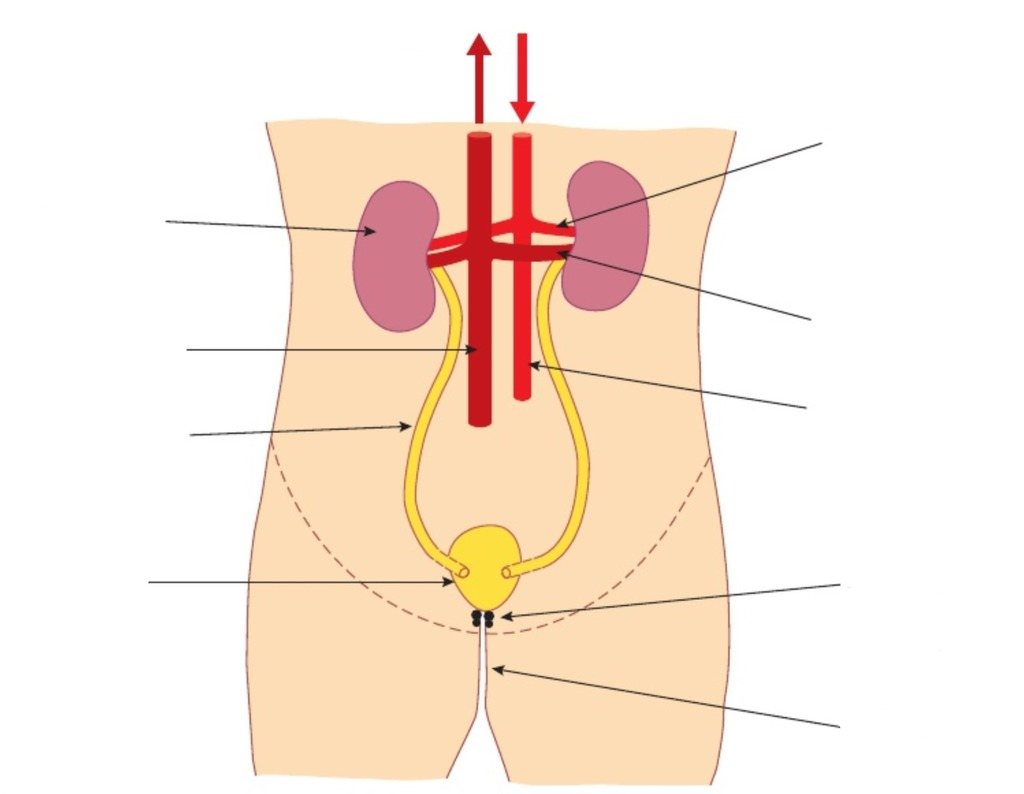
label the diagram (using letter markers a-k, top right clockwise to top left)
a) blood from heart, b) renal artery, c) renal vein, d) aorta, e) sphincter muscles, f) urethra, g) bladder, h) ureter, i) vena cava, j) right kidney, k) blood to heart
what is a kidney tubule?
a long, curvy tube found in the kidney that is the functional unit; there are millions in each kidney
how does the kidney filter the blood?
the blood is subjected to high pressure and small molecules are forced out through the walls of the capillary and into the filtrate in the kidney tubule (filtration), only cells and large molcules (e.g. protein molecules) stay in the blood, molecules needed by the body are selectively reabsorbed back into the blood, rest is excreted in the urine
what happens when the blood water concentration is too high?
pituitary gland releases less ADH, kidney tubules reabsorb less water, more urine of a lower concentration produced
what happens when the blood water concentration is too low?
pituitary gland releases more ADH, kidney tubules reabsorb more water, less urine of a higher concentration produced
how does kidney dialysis work?
blood temporarily removed from patient’s body, filtered through dialysis machine, blood passes over dialysis fluid which has no urea, urea and waste products diffuse from high concentration in blood to low concentration in dialysis fluid, blood returned to patient’s body
define homeostasis
regulating the internal conditions of a cell or organism to provide optimum conditions for cell/enzyme activity
which 5 conditions must be kept constant?
temperature, blood water concentration, blood glucose concentration, blood ion concentration, blood pH
what happens when the core body temperature is too high?
enzymes denature, chemical reactions stop
how are internal conditions kept constant?
using automatic control systems - receptor detects a stimulus (e.g. change in environment), coordinator (e.g. brain, spinal cord) receives and process information from receptor, effector (muslce or gland) carries out response to bring conditions back to optimum
what happens when the core body temperature is too low?
low enzyme activity, slow chemical reactions
what happens when the blood water concentration is too high?
water moves into cells from blood plasma via osmosis, cells swell up, burst, and die
what happens when the blood water concentration is too low?
water moves out of cells into blood plasma via osmosis, cells shrivel up and can’t function
what happens when the blood glucose concentration is too high?
not enough glucose is taken up by cells for use in respiration, causes low blood water concentration
what happens when the blood glucose concentration is too low?
not enough glucose in body for cells to use in respiration, causes high blood water concentration
what happens when the blood ion concentration is too high?
blood water concentration will be too low
what happens when the blood ion concentration is too low?
blood water concentration will be too high
what happens when there is a small change in the blood pH?
enzyme activity is too low, means chemical reactions are too slow
what happens when there is a small change in the blood pH?
enzymes denature, chemical reactions stop
how are these factors kept constant?
automatic control systems
what 3 things are automatic control systems made up of?
receptors, coordinators and effectors
what stimulus does a photoreceptor detect changes in?
light intensity and wavelength
what stimulus does a thermoreceptor detect changes in?
temperature
what stimulus does a chemoreceptor detect changes in?
concentration of chemicals
what stimulus does a mechanoreceptor detect changes in?
pressure, touch etc
give 3 examples of coordinators in humans
brain, spinal cord, pancreas
what are the two things effectors can be, and how do those two things react?
a group of muscles (contract) or a gland (secrete chemicals)
what are the two systems involved in homeostasis?
the nervous system and the endocrine system
how does the nervous system send messages to a coordinator?
nerve impulses
how does the endocrine system send messages to a coordinator?
(chemical) hormones
what is body temperature monitored and controlled by?
the thermoregulatory centre in the brain, which contains temperature receptors
what do temperature receptors detect temperarture change in?
the blood
where are there temperature receptors that isn’t the brain, and how do they alert the brain of temperature change?
in the skin, they send nerve impulses to the thermoregulatory centre of the brain
how does the body respond to a temperature increase?
vasodilation and increased sweating
how does the body respond to a temperature decrease?
vasoconstriction, shivering and decreased sweating
what is vasolidation?
when blood vessels supplying blood to the capillaries on the surface of the skin dilate (widen) so more blood flows to the surface and more energy is transferred/heat lost to surroundings, which cools the blood so cools the bod
what is vasoconstriction?
when blood vessels supplying blood to capillaries on the surface of the skin constrict (narrow) so less blood flows to the surface and less energy is transferred/heat lost to surroundings
how does sweating impact temperature?
sweat glands secrete more/less sweat, more/less evaporation from the skin, more/less energy transferred/heat lost to surroundings
how does shivering impact temperature?
skeletal muscles rapidly contract and relax, they require more energy from respiration so there is a higher rate of respiration, more heat is released (respiration is exothermic), this increases body temperature
which three effectors are involved in the response to changes in body temperature?
smooth muscle (in the walls of blood vessels supplying capillaries), sweat glands and skeletal muscles
what are hormones?
chemical messengers
from where is a hormone secreted?
ductless endocrine glands
how do hormones travel in the body?
in the blood plasma
what do hormones do?
affect specific target organs
how does a response coordinated by the endocrine system differ from that of the nervous system?
responses coordinated by the endocrine system take slower but last for longer
which gland is known as the master gland?
the pituitary gland