Org Behav Exam 1
 Call Kai
 Learn
Learn Practice Test
 Spaced Repetition
 Match
Match Flashcards
 Knowt Play
1/81

Earn XP
Description and Tags
Textbook Chapters 1, 5, 6, and 14
Name | Mastery | Learn | Test | Matching | Spaced | Call with Kai |
|---|
No analytics yet
Send a link to your students to track their progress
82 Terms
Personality-job fit theory
A theory that identifies six personality types and proposes that the fit between personality type and occupational environment determines satisfaction and turnover.
Person-organization fit
A theory that people are attracted to and selected by organizations that match their values and leave when there is no compatibility.
Personality
A theory that people are attracted to and selected by organizations that match their values and leave when there is no compatibility.
Myers-Briggs Type Indicator
A personality test that taps four characteristics and classifies people into one of sixteen personality types.
Big Five Model
A personality model that proposes five basic dimensions encompass most of the differences in human personality.
Conscientiousness
A personality dimension that describes someone who is responsible, dependable, persistent, and organized.
Emotional stability
A personality dimension that characterizes someone as calm, self-confident, and secure (positive) versus nervous, anxious, and insecure (negative).
Extroversion
A personality dimension describing someone who is sociable, gregarious, and assertive.
Openness to experience
A personality dimension that characterizes someone in terms of imagination, artistic sensitivity, and curiosity.
Agreeableness
A personality dimension that describes someone who is good natured, cooperative, and trusting.
Dark triad
A constellation of negative personality traits consisting of Machiavellianism, narcissism, and psychopathy.
Machiavellianism
The degree to which an individual is pragmatic, maintains emotional distance, and believes that ends can justify means.
Narcissism
The tendency to be arrogant, have a grandiose sense of self-importance, require excessive admiration, and possess a sense of entitlement.
Psychopathy
The tendency for a lack of concern for others and a lack of guilt or remorse when actions cause harm.
Self-monitoring
A personality trait that measures an individual’s ability to adjust their behavior to external, situational factors.
Proactive personality
People who identify opportunities, show initiative, take action, and persevere until meaningful change occurs.
Situation-strength theory
A theory indicating that the way personality translates into behavior depends on the strength of the situation.
Components of Situation Strength
Clarity, consistency, constraints, consequences
Values
Basic convictions that some actions and outcomes are more morally, socially, or personally preferable than others.
Terminal values
Desirable end-states of existence; the goals a person would like to achieve during their lifetime.
Instrumental values
Preferable modes of behavior or means of achieving one’s terminal values.
Perception
A process by which individuals organize and interpret their sensory impressions to give meaning to their environment.
Attribution theory
An attempt to explain the ways we judge people differently, depending on the meaning we attribute to a behavior, such as determining whether an individual’s behavior is internally or externally caused.
Fundamental attribution error
The tendency to underestimate the influence of external factors and overestimate the influence of internal factors when making judgments about the behavior of others.
Self-serving bias
The tendency for individuals to attribute their own successes to internal factors and put the blame for failures on external factors.
Selective perception
The tendency to choose to interpret what one sees based on one’s interests, background, experience, and attitudes.
Contrast effect
Evaluation of a person’s characteristics that is affected by comparisons with other people recently encountered who rank higher or lower on the same characteristics.
Self-fulfilling prophecy
A situation in which an individual’s behavior is determined by others’ expectations, even if untrue. In other words, if someone holds misrepresented or unfounded expectations about another person, that person may make these hypothetical, unfounded expectations into a reality.
Rational
A style of decision making characterized by making consistent, value-maximizing choices within specified constraints.
Rational decision-making model
A decision-making model that describes how individuals should behave to maximize some outcome.
Bounded rationality
A simplified process of making decisions by perceiving and interpreting the essential features of problems without capturing their complexity.
Intractable problem
A problem that may change entirely or become irrelevant before we finish the process of organizing our thoughts, gathering information, analyzing the information, and making judgments or decisions.
Intuitive decision making
An unconscious process created out of distilled experience
Anchoring bias
A tendency to fixate on initial information, from which one then fails to adjust adequately for subsequent information.
Confirmation bias
The tendency to seek out information that reaffirms past choices and to discount information that contradicts past judgments.
Availability bias
The tendency for people to base their judgments on information that is readily available to them.
Escalation of commitment
An increased commitment to a previous decision despite negative information.
Randomness error
The tendency of individuals to believe that they can predict the outcome of random events.
Riskl aversion
The tendency to prefer a sure gain of a moderate amount over a riskier outcome, even if the riskier outcome might have a higher expected payoff.
Hindsight bias
The tendency to believe falsely, after an outcome of an event is known, that one would have accurately predicted that outcome.
Outcome bias
The tendency to judge the quality of a decision based on the desirability or believability of its outcome.
Utilitarianism
An ethical perspective in which decisions are made to provide the greatest good for all.
Whistleblowers
Individuals who report unethical practices by their employer to outsiders.
Deonance
A perspective in which ethical decisions are made because you “ought to” in order to be consistent with moral norms, principles, standards, rules, or laws.
Behavioral ethics
Analyzing why people behave the way they do when confronted with ethical dilemmas.
Conflict
A process that begins when one party perceives that another party has negatively affected, or is about to negatively affect, something that the first party cares about.
Functional conflict
Conflict that supports the goals of the group and improves its performance.
Intragroup conflict
Within groups
Intergroup conflict
Different groups
Perceived conflict
Awareness by one or more parties of the existence of or conditions that create opportunities for conflict.
Felt conflict
Emotional involvement in a conflict that creates anxiety, tenseness, frustration, or hostility.
Competing
A desire to satisfy one’s interests, regardless of the impact on the other party to the conflict.
Collaborating
A situation in which the parties involved in a conflict all desire to fully satisfy the concerns of all parties.
Avoiding
The desire to withdraw from or surpress a conflict
Accomodating
The willingness of one party in a conflict to place the opponent’s interests above their own.
Compromising
A situation in which each party to a conflict is willing to give up something to resolve the conflict.
Distributive bargaining
Negotiation that seeks to divide up a fixed amount of resources; a win–lose situation.
Fixed pie
The belief that there is only a set amount of goods or services to be divvied up between the parties.
Integrative bargaining
Negotiation that seeks one or more settlements that can create a win–win solution.
BATNA
The best alternative to a negotiated agreement; the least a party in a negotiation should accept.
Mediator
A neutral third party who facilitates a negotiated solution by using reasoning, persuasion, and suggestions for alternatives.
Arbitrator
A third party to a negotiation who has the authority to dictate an agreement.
Conciliator
A trusted third party who provides an informal communication link between the negotiator and the negotiation partner.
Planning
A process that includes defining goals, establishing strategy, and developing plans to coordinate activities.O
Organizing
Determining what tasks are to be done, who is to do them, how the tasks are to be grouped, who reports to whom, and where decisions are to be made.
Leading
A function that includes motivating employees, directing others, selecting the most effective communication channels, and resolving conflicts.
Controlling
Monitoring activities to ensure that they are being accomplished as planned and correcting any significant deviations.
organizational behavior
A field of study that investigates the impact that individuals, groups, and structure have on behavior within organizations for the purpose of applying such knowledge toward improving an organization’s effectiveness.
Systemic study
Looking at relationships, attempting to attribute causes and effects, and drawing conclusions based on scientific evidence.
Evidence-based management
Basing managerial decisions on the best available scientific evidence.
Social psychology
An area of psychology that blends concepts from psychology and sociology to focus on the influence of people on one another.
Sociology
The study of people in relation to their social environment or culture.
Anthropology
The study of societies to learn about human beings and their activities.
Contingency variable
Situational factors or variables that moderate the relationship between two or more variables.
Corporate social responsibility
An organization’s self-regulated actions to benefit society or the environment beyond what is required by law.
Positive organizational scholarship
An area of OB research that studies how organizations develop human strengths, foster vitality, build resilience, and unlock potential.
Availability heuristic
Our tendency to base judgments on readily available information
Representativeness Heuristic
Our tendency to base judgments on how likely a certain event is, based on how similar it is to an existing mental prototype
Anchoring bias
A tendency to fixate on initial information and fail to adequately adjust to subsequent information
Escalation of commitment
A tendency to persist in a course of action even when there is evidence that one should try a different approach or give up.
Sunk cost
staying with a decision even if there is evidence that it is wrong
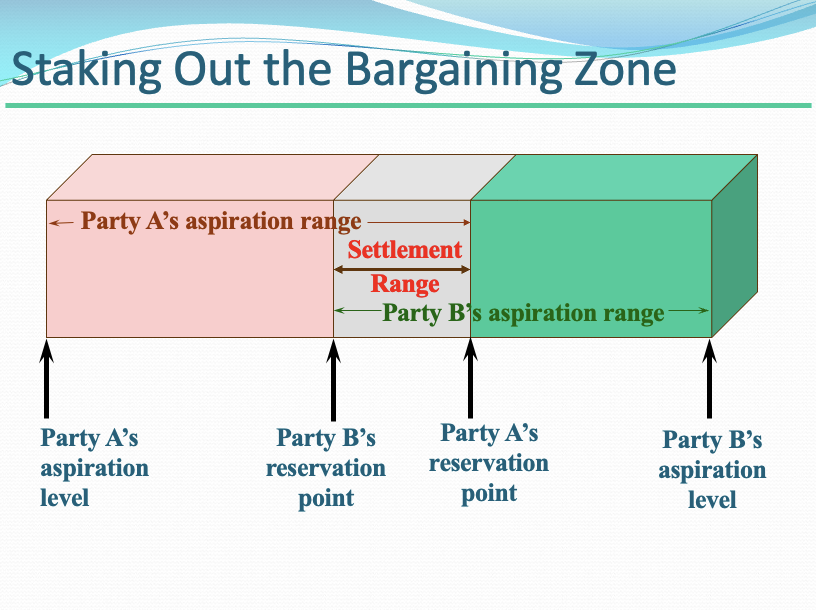
Bargaining zone