L6b The social and emotional brain 2
 Call Kai
 Learn
Learn Practice Test
 Spaced Repetition
 Match
Match Flashcards
 Knowt Play
1/72

There's no tags or description
Looks like no tags are added yet.
Name | Mastery | Learn | Test | Matching | Spaced | Call with Kai |
|---|
No analytics yet
Send a link to your students to track their progress
73 Terms
How is an emotion defined
a state associated with stimuli that are rewarding or punishing
How are these states achieved
either inherently have survival value or can be learnt through conditioning
What are the three functions of emotions
internal signposts, guide social behaviour, and signal what to avoid or seek out
What is social referencing
when individuals (esp infants) use others’ emotional expressions to guide their own behaviour in uncertain situations
The visual cliff experiment by Sorce et al involved 12 month old infants, with 3 conditions (joy, fear/anger, no depth), how did infants respond to each condition
infants crossed, infants didn’t cross, infants cross irrespectively of mother’s expression
What is Capgras syndrome (emotions and facial recognition)
a condition where a person believes their loved ones have been replaced by identical-looking imposters – consciously recognise the person but lack an emotional response to them
What physiological response in Ellis et al’s study demonstrates an emotional processing deficit in patients with Capgras syndrome
do not produce a greater skin conductance response to personally familiar faces compared to unfamiliar
Identify the brain area
important for learning and storing the emotional value of stimuli
Describe the physical nature and the location of the amygdala
small mass of grey matter, located in the top of left and right temporal lobes
What does the amygdala receive
a large amount of sensory input
What happens to fear conditioning in animals when the amygdala is lesioned before learning
the animal does not learn the conditioned fear response
What happens to fear conditioning in animals when the amygdala is lesioned after learning
the animal forgets the conditioned response
Following on from the previous FC, how else can this impact on conditioned response be rephrased as
objects lose their learned emotional value
From knowledge on the impact of amygdala lesion, what does this suggest about its dual role in memory (specifically in fear)
learning and storing conditioned fear response
What should be emphasised about the amygdala’s role in fear considering normal fear evoking stimuli still elicit fear responses
specific role in LEARNED fear responses
Using fMRI and skin conductance response when associating a visual cue with an electric shock, what did LaBar et al find about the amygdala in human fear conditioning (when it was active and what does this activity correlate with)
it was active during the learning process; its activation correlated with skin conductance response
Bechara et al found evidence (type of neuroscience evidence) of what between the amygdala and hippocampus
double dissociation
What do patients with amygdala damage show in fear conditioning tasks (one answer we have already learnt)
no conditioned skin conductance response, but they can recall the association and verbally describe it
What do patients with hippocampal damage (amnesia) show in fear conditioning tasks (consider the presence of a double dissociation as a hint for the answer)
a skin conductance response is present, but they cannot recall the association
What does the double dissociation between the amygdala and hippocampus demonstrate about their relative roles in fear conditioning
amygdala stores the conditioned fear response while the hippocampus stores the declarative memory of the association
What emotional function does bilateral amygdala damage impair
fear expression recognition
Morris et al used fMRI to measure brain activity in response to fearful faces vs happy faces – which brain areas were active for each condition
fearful associated with left amygdala activity and happy faces associated with activity in different brain areas
What are the two routes to the amygdala describe by Le Doux
fast and slow
What did Ohman and Soares find about subliminal emotional processing when they subliminally presented images of spides and snakes to participants with spider/snake phobias – what is the different in ppts behavioural and physiological responses
ppts did not report seeing the images but skin conductance responses were still measured
What does this response indicate
an emotional response without conscious awareness
What method did Tamietto et a use to measure amygdala activation, and what was the stimuli presented, in what group of patients
using fMRI, showed fearful facial expression to patients with visual cortex damage
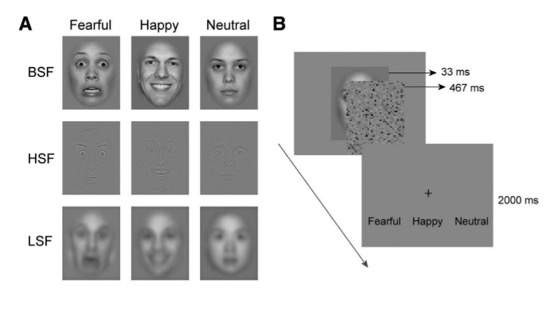
what was the aim of Wang et al’s study using intracranial EEG (iEEG)
measure ERP responses in the amygdala between different facial expressions in different spatial frequency conditions in ppts without conscious emotional awareness
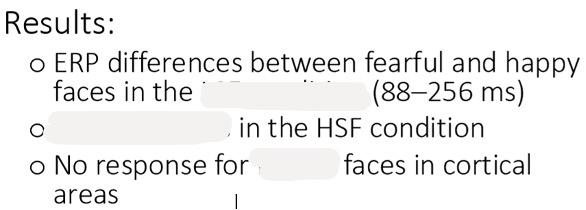
Complete the results of Wang et al’s study
LSF condition, no differences, fearful
What do these results suggest the existence of in the amygdala (no idea how this is suggested)
existence of a subcortical pathway specific for rapid fear detection
Amygdala activity leads to enhanced activity in other brain areas – name the cortex and the system it affects
visual cortex and the autonomic system (to generate fight or flight response)
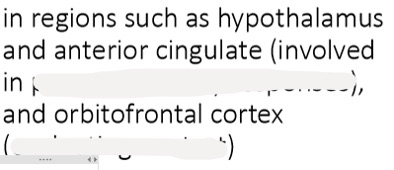
Amygdala activity also enhances activity in these regions – can you define what these regions are responsible for (think what hypothalamus regulates and think orbito like our orbit)
preparing bodily responses and evaluating context
The amygdala is often assumed to only be involved in fear, but what other facial expressions did the amygdala respond to in Labuschagne et al’s fMRI emotional face-matching study
happy and angry faces
Labuschagne et al also measured connectivity patterns in the wider network, which two brain areas had the strongest functional connectivity (FFA and IFC) and in particular recognition for which emotion
fusiform face area and inferior frontal cortex, fear recognition
What are the two key conclusions about the amygdala’s role in emotion processing considering fear assumptions that we have just assessed
there are multiple brain areas involved in the fear circuit (amygdala not lone) and amygdala has a wider role in emotion processing (other emotions)
What brain area lesion causes Kluver-Bucy syndrome in monkeys – when objects lose their learned emotional values
bilateral amygdala lesion
What are 3 symptoms of Kluver-Bucy syndrome
tameness, emotional blunting and hyperreality (examining objects with mouth)
Thinking back to Capgras syndrome (also where objects have lost their learned emotional values), what is a proposed neurological model/explanation for this
disconnect between the amygdala (face recognition) and other parts of the limbic system (emotional processing)
Where is the insula located (somewhat similar to amygdala location)
underneath the temporal lobes
What is the emotional function of the insula
creating bodily feelings associated with emotions
Which two main emotions is the insula involved with
disgust and interoception
What 3 disgust experiences will increase insula activation
moral disgust, feeling disgusted or seeing someone else disgusted
What is interoception
monitoring the internal state of the body
What interoceptive signals are sent to the insula
signals from receptors in skin, muscles, and organs
What is the nature of this monitoring of signals?
can be conscious and unconscious
How does interposition relate to emotion
bodily changes play an important role in emotions
What emotion theory supports this – explain process
james-lange theory – stimulus -> bodily response -> conscious emotion
What are the 3 main areas of the brain’s reward circuit (hint
OFC, ACC and VS)
what is the role of these 3 main areas
to evaluate and respond to rewarding or emotionally significant events
The amygdala is an additional area in the reward circuit, doing what?
regulating
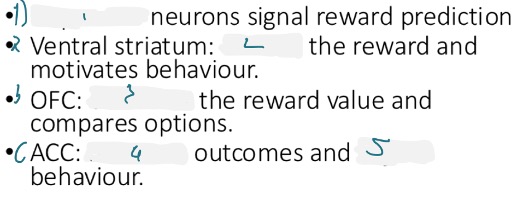
How do these areas work together
dopamine, detects, evaluates, monitors, adjusts
What altered reward processing is associated with these three main areas
emotional apathy
What is emotional apathy
deficits in using socioemotional rewards to guide behaviour
What is the specialisation and role of the ventral striatum (we’ve just looked at this)
specialised in emotions, detects the reward and motivates behaviour
What input does the ventral striatum receive
strong dopamine input
What elicited greater activity in the VS by Knutson et al, using fMRI
task with great monetary reward
What social aspect further increased VS activity within this scenario
when monetary reward was obtained via cooperation with another human compared to non-cooperation or computer
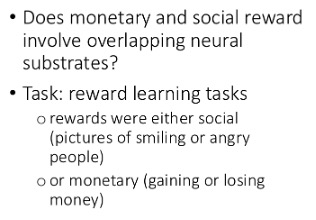
This is the task ppts were presented with, (1) what were the areas in the striatum correlated with and (2) when is activity greater
correlated with prediction errors for both types of rewards, activity is greater when the reward is better than expected
What was the nature of VS activity in autism during reward anticipation compared to typically developing (and for which types of rewards)
hypoactivation in both the left and right ventral striatum, for both social and monetary rewards
What was the nature of VS activity in autism during reward delivery (compared to typically developing)
hyper activation of the VS
How did the presence of ADHD traits affect these reward differences
reduced the gap between ASD and typically developing individuals
Did ppts with ADHD experience increased activation to cues predicting affiliative rewards or the delivery of affiliative rewards (and vice versa with decreased activation)
delivery of affiliative rewards
What does these findings mean for VS sensitivity in ADHD
hyposensitivty to reward-predicting cues in ADHD extends to affiliative (social), not just monetary ones
What is the role of the OFC (orbitofrontal cortex) in the reward circuit
computing the current value of a stimuli within the current context
What 3 scenarios is this role of the OFC important
social interactions, new learning and regulation of emotions
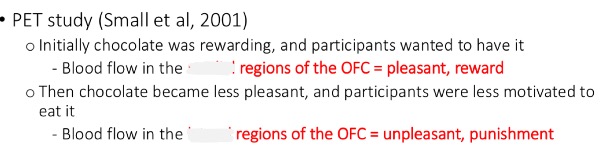
What regions of the OFC were active when chocolate was pleasant vs unpleasant
medial vs lateral regions
What social stimuli triggered lateral OFC activity
when ppts presented with an angry face instead of expected smile
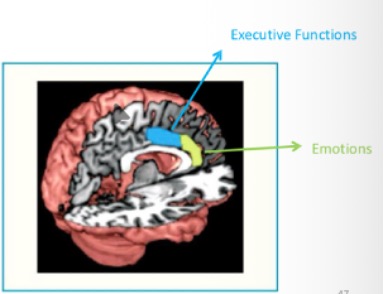
The anterior cingulate cortex (ACC) lies above the corpus callosum and each region (blue and green) is implicated in executive functions and emotional processing, what are the two regions
dorsal region and ventral region
Can you remember the role of the ACC in the reward circuit
monitors outcomes and adjusts behaviour
How does the ACC carry out response evaluation
determines the cost and benefit of actions – will an action result in reward and punishment
If the ACC is involved in monitoring outcomes, what might its role be in bodily responses in emotion
processing bodily signals and responses (output of bodily responses)
What activity did a fMRI reveal about the ACC role in regulating feelings of pain (two types of pain stimuli)
activity in ACC for physically painful stimuli or watching somebody else in pain (social pain) – the ACC responds to the perception of pain in others
What cognitive process modulates the sensitivity of ACC responses to perception of pain in others
whether the other person is perceived to deserve the pain
Another type of social pain is explored, what is it and what ACC activity is correlated
being excluded socially, ACC activity correlates with subjective distress

