AD Principles Exam 3
 Call Kai
 Learn
Learn Practice Test
 Spaced Repetition
 Match
Match Flashcards
 Knowt Play
1/134

There's no tags or description
Looks like no tags are added yet.
Name | Mastery | Learn | Test | Matching | Spaced | Call with Kai |
|---|
No analytics yet
Send a link to your students to track their progress
135 Terms
Above-the-line promotions (AKA Measured media)
Tv, radio, magazines, newspaper, outdoor, etc.
Below-the-line promotions (AKA Unmeasured media)
Direct mail, paid internet search, coupons, product placement, events, etc.
Media plan
A plan specifying the media in which advertising messages will be placed to reach the desired target audience.
Media class
is a broad category of media, such as TV, radio, or newspapers.
Media vehicle
A particular option for placement within a media class (e.g., Vogue)
Media mix
is the blend of different media that will be used to effectively reach the target audience.
Geographic scope
Scope of the geographic area to be covered by advertising media.
Geo-targeting
is the placement of ads in geographic regions where higher purchase tendencies for a brand are evident.
Geofencing
The ability to track consumers’ locations within a certain geographic area via their smartphones.
Reach
the number of people or households in a target audience that will be exposed to a media vehicle or schedule at least once during a given period of time.
Frequency
is the average number of times an individual or household within a target audience is exposed to a media vehicle in a given period of time.
Gross Impression (also called message weight):
Total number of target market exposures to a vehicle schedule or campaign.
How do we understand the reach, Impression, and frequency in detail?
We placed an ad on a weekly TV show with a 20 rating (20% of households) four weeks in a row… This show has a reach of 43% during the four–week period.
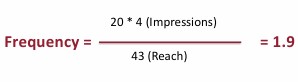
audience duplication
The total gross impression number contains ___________ ___________.
Between-vehicle duplication
People who watched the same commercial on TV program A also saw program B and read a magazine 1.
Within—vehicle duplication
Someone who saw the ad in magazine 1 on Monday and saw it again in magazine 1 on Tuesday.
Effective frequency
is the number of times a target audience needs to be exposed to a message before the objectives of the advertiser are met.
• A common industry practice is to place _________ ____________ at three exposures.
Media weight can also be expressed in terms of gross rating points
– GRP = r ×f
– Multiply the rating (reach) of each vehicle in a plan times the number of times an ad will be inserted in the media vehicle and then sum these figures across all vehicles in the plan.
Continuous scheduling
A pattern of placing ads at a steady rate over a period of time
Flighting
A media-scheduling pattern of heavy advertising for a period of time, usually two weeks, followed by no advertising for a period, followed by another period of heavy advertising
Pulsing
A media-scheduling strategy that combines elements from continuous and flighting techniques; advertisements are scheduled continuously in media over a period of time, but with periods of much heavier scheduling
Forgetting function
The _____________ _________ is the result of work done by psychologist Hermann Ebbinghaus in the late 19th century, and the repetition study by Hubert Zielske in 1958.
– This __________ guides industry media planners.
– Most appropriate when a simple outcome like brand name recall is sought.
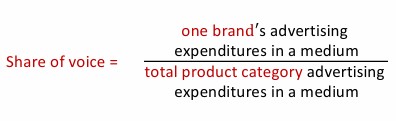
Share of voice
An advertiser must assess its competitors’ IBP investing and the relative _______________ its brand is getting.
– A detailed report will show how much a brand was advertised in a particular media category versus the combined media category total for all other brands in the same product category
Cost per thousand (CPM)
Each medium under consideration in a media plan must be evaluated for the efficiency with which it performs.
• A common measure of media efficiency is
• can be used to compare the relative efficiency of two media choices within a media class or between media classes

Pull media
With a few exceptions, Internet or digital media are _____ ________.
– Consumer has more control
Push media
Most traditional media is usually
Media buying
Once an overall media plan and a schedule are in place, the focus turns to _____ ______.
programmatic media buying
Much of media buying occurs through ____________ _______ _______.
– Typically relies on technologies that track a consumer’s online behavior, such as where the person clicks or the key terms in that person’s social media messages
– Has the potential for further improving effective target marketing and customized advertising in ways driven by artificial intelligence
Not all media planning and buying is ___________ ______ _______.
Agency of record
Advertising agency chosen by the advertiser to purchase time and space. (E.g., Media Specialist)
– Coordinates media discounts.
– Negotiates all contracts for time and space
Upfronts
A period of media buying in which advertisers purchase time on network TV a few months before (May) the new season of shows begin (September); they are thus bought “up-front.”
Media-buying service
An independent organization that specializes in buying large blocks of media time and space and reselling it to advertisers.
Earned media
The incremental exposure that a brand earns through viral engagement and consumer interactions with the brand
– ________ in a natural way instead of having to pay for it
Owned media
Brand assets created within social networks by an organization, such as a Facebook page or an application
– May cost some money to generate but it does not necessarily entail payments to place messages in the media or social media
Paid media
Advertisements that can be purchased on digital platforms
Drives awareness!
Paid media strength
Reach/Frequency, Audience Targeting, Media mix, Content Association, and Accountability
Reach/Frequency
Scheduling advertising in paid media offers the brand the opportunity to reach a significant audience
Audience Targeting
Paid media offers the opportunity to place your message in front of a specific audience.
Media Mix
Through paid media, brand has opportunity to have your message on different media types and properties.
Content Association
By associating the brand’s message within desirable content provides a positive halo effect.
Accountability
Paid media provides a high level of accountability where there is an audit of costs and delivery that is reconciled on a periodic basis.
Paid media Weakness
Cost, Clutter, and Control
Cost
There can be a significant____ to funding paid media.
Clutter
Your brand is typically not alone when purchasing paid media.
Control
There is an increasing lack of ______ over when a consumer may be exposed to your message and the content that your message is within.
Social Networking websites and mobile applications
– Social orientation: Facebook, Twitter, and Pinterest
– Video- and photo-sharing orientations: YouTube, TikTok, and Instagram
– Ephemeral video social media platform
Location-based technologies
use geographical coordinates to determine where the person is and can synergize with digital advertising for nearby businesses.
Owned media
refers to content channels that the brand controls directly
provides information!
Examples: Company website, brand blog, email newsletters, brand social media pages, etc.
Control
Owned media allows you to _______ the message freely.
Timely
Owned media can be very ______.
Lasting
Owned media allows you to have a _______ message.
Personal
Owned media can be very ________ and flexible.
Cost efficient
Owned media can be highly ____ _______.
Owned media strengths
Control, Timely, Lasting, Personal, and Cost Efficient
Owned media weakness
Not trusted, Time consuming, and Lack of consistency
Not Trusted
Owned media provides a company or brand message. Consumer may be skeptical of the message.
Time consuming
Owned media can take a lot of personnel hours to effectively manage a strong owned media portfolio.
Lack of consistency
Owned media can have many owners
Owned Media Other Types
• Physical assets (such as paint on the window)
• Digital assets: tablet applications (such as Nike offers a series of training applications on mobile app)
• Created Assets: events and sponsorships
Earned Media
publicity or attention gained organically through audience engagement or third-party coverage.
amplifies trust and conversation
Example: social media shares, User generated content, product reviews, press coverage, influencer mentions, WOM recommendations, etc.
Earned Media strength
Trusted, Unique, Cost efficient
Trusted
People trusted earned media more than paid media. They also trusted their friends and connections more than a TV ad.
Unique
Earned media expands brand reach organically and signals brand relevance.
Cost efficient
It’s free in the sense that clients are not billed for the earned media placement
Earned Media Weakness
Control, Time consuming, Difficult to predict
Control
Earned media is hard to control. No guarantees that all content is positive.
Time consuming
Earned media can take a lot of personnel hours to effectively manage a strong owned media portfolio.
Difficult to predict
Earned media can have many drawbacks in terms of its random content.
Video and Photo Sharing via Social Media:
– Focus on consumers’ ability to watch, upload, and share videos and photos.
– Some have attributed social media with contributing to fake news.
Fake news
refers to false information that is broadcast or published as news for fraudulent motivated purposes
Blogs
– Sites written and maintained by individuals
– Hosted and technically owned by an organization that provides access to Web space and a content-management system
– Key characteristics are its journal format and its informal style
– Blogs can be helpful environments for advertising messages
Microblogs
Social networking services (such as Twitter) that enable users to post and read short messages
Newspaper and Digital Newspaper Pros
• Geographic selectivity
• Timeliness (lead time)
• Creative opportunities
• Credibility
• Audience Interest and Demographics
• Low-cost (absolute cost)
Newspaper and Digital Newspaper Cons
• Limited segmentation
• Creative constraints
• Cluttered environment
• Short life
Display advertising
uses standard components of a print ad to set it off from the news content of the paper
Inserts
Folded into the newspaper before distribution.
• Preprinted insert: An advertisement delivered to the newspaper fully printed and ready for insertion into the newspaper.
• Free-standing insert (FSI): A newspaper insert ad that contains cents-off coupons for a variety of products and is typically delivered with Sunday newspapers
Classified advertising
Appears as all-copy messages under categories, such as sporting goods, employment, and automobiles.
The future of newspapers
• Depends on its ability to evolve.
• Hyper-localism
• Pay-for-inquiry advertising model
Hyper-localism
Opportunity of newspapers to be the only source for local news.
Pay-for-inquiry advertising model
Payment is based solely on the inquiries an advertiser receives in response to an ad.
Magazines Pros
• Audience selectivity
• Audience interest
• Creative opportunities
• Long life (pass-along readership)
Magazines cons
• Limited reach and frequency
• Clutter
• Long lead times
• Cost
The futures of magazines
• Magazines are adapting to digital, social, and mobile media opportunities.
• Publishers are exploring other ways to take advantage of the interactive environment beyond just digital version publications.
Television Categories
Network TV, Cable TV, Video on demand (VOD)
Network TV
Broadcasts programming over airwaves to affiliate stations across the country under a contract agreement
– Reaches more than 90 percent of U.S. households
Cable TV
Transmits a wide range of programming to subscribers through wires
– Still has the dominant share of the TV market
Video on demand (VOD)
Subscribers can watch their selection at any time
– Fastest-growing category
– Subscription-based and/or advertising-supported
Television syndication
Original programming or programming that first appeared on network TV
Examples Off-network syndication, First-run syndication, Barter syndication
Off-network syndication
Programs that were previously run in network prime time
• Examples: Young Sheldon and Seinfeld
First-run syndication
Programs developed specifically for sale to individual stations
• Example: Star Trek: The Next Generation
Barter syndication
Allows national advertisers to participate in the national syndication market conveniently
• Examples: Jeopardy! and Judge Judy
Local TV
Programming other than the network broadcast that independent stations and network affiliates offer local audiences
– News, movies, syndicated programs, community interest programs
– Commands significant advertising dollars
Satellite
Programming transmitted to audiences via satellite transmission
– Closed circuit: Direct transmission (Example: CNN Airport Network)
Streaming Services and Digital Downloads
– The next evolution of TV transmission
– Extent of programming varies by service
– More consumers are likely to “cut the cord.”
Television Pros
• Creative opportunities
• Coverage, reach, and repetition
• Cost per contact
• Audience selectivity
– Narrowcasting: Development and delivery of specialized programming to well-defined audiences.
Television Cons
• Fleeting message
• High absolute cost
• Poor geographic selectivity
• Poor audience attitude and attentiveness
– Channel grazing
– Digital video recorders (DVRs)
• Clutter
TV Households
Estimate of the number of households that are in a market (such as Northwest Arkansas or Dallas-Fort Worth, etc.) and own a TV.
– E.g., 1000 households in A town own TVs.
Households Using TV (HUT)
Measure of the number of households tuned to a TV program during a particular time period.
– E.g., 800 of those 1000 households in A town watched a TV program last night between 8 – 9 pm.
Rating or Program Rating
Percentage of TV households that are in a market and are tuned to a specific program during a specific time period.
– E.g., 500 of those 1000 households in A town watched the program XYZ between 8 – 9 pm last night.
• Program rating: 500/1000 = 50%\
– 1 Ratings point: Indicates that 1 percent of all the TV households in an area were tuned to the program measured.
• E.g., XYZ rating = 50 rating
Share of Audience
Percentage of households that are using TV during a specific time period and are tuned to a particular program. – E.g., 800 of those 1000 households in A town watched a TV program between 8 – 9 pm last night.
• 500 of them watched XYZ program
• 300 of them watched NYT program
• XYZ share of audience = 500/800 = 62.5% or 62.5 shares
The future of television
• Streaming is likely a big part of the future of TV.
• A lighter ad load is seen as unsustainable in order for online TV to achieve profitability, but will heavier loads reduce online viewership?
• The partnership between TV and social media has many possibilities.

