Ch. 3 - Consumer Behavior
 Studied by 0 people
 Call Kai
 Learn
Learn Practice Test
 Spaced Repetition
 Match
Match Flashcards
 Knowt Play
1/40

There's no tags or description
Looks like no tags are added yet.
Name | Mastery | Learn | Test | Matching | Spaced | Call with Kai |
|---|
No analytics yet
Send a link to your students to track their progress
41 Terms
Purchase decision process
Stages that a buyer passes through when making choices about which products or services to buy.
It includes five stages.
A customer’s involvement in the purchase decision process varies based on the complexity of the decision.
The time spent in each stage will depend on various factors, including what is being purchased.
Five Stages of the Purchase Decision Process
Problem recognition: Perceiving a need.
Information search: Seeking value.
Evaluation of alternatives: Assessing value.
Purchase decisions: Buying value.
Post-purchase behavior: Value in consumption or use.
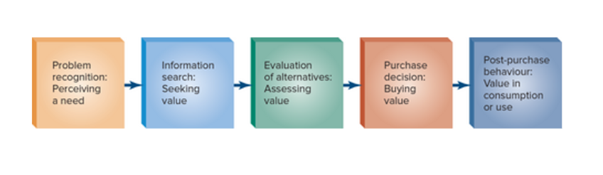
Step 1: Problem Recognition
Part of the Purchase Decision Process
Person acknowledges a need that can be met through purchasing a good or service.
In marketing businesses do this by highlighting the shortcomings of existing products and services.
Information Search (& Sources)
Part of the Purchase Decision Process
Customers begin to look for information about what product or service may satisfy their newly discovered need. This includes internal and external searches.
External searches includes:
Public sources, personal sources, marketer-dominating sources, showrooming.
Internal Search (Information Search)
Part of the Purchase Decision Process
Scanning their memory for previous products that have worked, or that have been used in the past.
This can draw on items and brands through the individual’s brand loyalty.
External Search (Information Search)
Public sources
Personal sources
Marketer-dominated sources
Showrooming
Part of the Purchase Decision Process
When a customer lacks experience with or knowledge about a product, the risk of making a bad decision is high, and the cost of gathering information is low.
Public sources: Various reviews and product rating organizations.
Personal sources: Friends, family, coworkers that are trusted.
Marketer dominated sources: Information from sellers, which includes advertising, websites, salespeople, and point-of-purchase displays.
Showrooming: The practice of visiting a shop or shops in order to examine a product before buying it online at a lower price.
Step 2: Evaluation of Alternatives - Assessing Value
Objective
Subjective
Evoked Set
Part of the Purchase Decision Process
Clarifies the problem for the customer by suggesting criteria, or points to consider for the purchase. This can include looking at certain brands that can meet the desired criteria, and developing customer value perceptions.
Objective criteria: The actual product features and offerings.
Subjective criteria: Status, material perception and emotion attached to a product. Reflection of the customers own self image, values and status.
Evoked set: The group of brands that a customer would consider acceptable among all the brands in the product class to choose from.
Step 4: Purchase Decision - Buying Value
Part of the Purchase Decision Process
After examining alternatives in the evoked set, customers narrow down to final choices. This can be defined as: The chosen brand, from whom to buy, and when to buy.
Various factors can affect the buying decision (e.g. salesperson, brand deals, shopping experience, time pressure, financial constraints, etc.).
Mobile technology can play a role in this stage by facilitating the stages in a quicker and more effective manner.
Step 5: Post-purchase Behavior
Cognitive Dissonance
Part of the Purchase Decision Process
After the purchasing, a customer then compares it with their expectations and is either satisfied or dissatisfied. The internet has amplified this stage, as consumers will go online to talk about their purchase.
Cognitive dissonance: Post-purchase psychological tension or anxiety about purchasing the wrong product.
Involvement
Involvement and Problem Solving Variations
Depending on the purchase size, customers may instead engage in all five steps. They may instead minimize the level of involvement required.
Involvement: Personal, social, and economic significance of a purchase to the consumer.
Low Level Involvement
Involvement and Problem Solving Variations
This can be for everyday products such as drinks, food. Products that not much thought and consideration go into buying. These can even be brand that customers have developed brand loyalty to, and that they just buy without thought (habitual).
Example: Buying a coffee from Starbucks every morning.
High Level Involvement & 3 Characteristics
Involvement and Problem Solving Variations
This includes high stake purchase such as new cars, houses, computers, etc. Typically has at least one characteristic which includes:
Expensive: The item to be purchases is expensive
Rare Occurrence: bought infrequently (less than everyday items).
Social Image: Could reflect on one’s social image (e.g. new Mercedes Benz, new phone).
Routine Problem Solving
Variation in Customer Purchase Process
Everyday purchases for lower-stakes items (e.g. table salt and milk).
Habits are already established, and products already bought for low-stakes items.
Marketers strive to attract and maintain habitual buyers by creating a stronger brand with the customer.
Limited Problem Solving
Variation in Customer Purchase Process
Low customer involvement but significant perceived differences among brands.
Customers rely on past experience more than external information.
May pay attention to new varieties shown in advertising and point-of-purchase displays.
This can occur when buying jeans, getting lunch, and other scenarios where little energy and time is spent on deciding.
Extended Problem Solving
Variation in Customer Purchase Process
Uses each of the five stages, along with extensive time and effort dedicated.
This specifically relates to the information search and identifying and evaluating alternatives.
Goes beyond the five stages in depth, lots of thought, consideration and planning.
Customer Touchpoints
Customer touchpoints shape the customer experience and influence perceptions, satisfaction, and loyalty. Any interaction where a customer comes into contact with a business, brand, or product, before, during, or after they buy.
If these touchpoints are plotted along side the five parts of the customer purchase decision process, marketers can create a customer journey map to visually represent the buyer journey.
Five Situational Influences
Purchase Task: Who is the product for?
Social Surroundings: Who is there during the sale of the product or service?
Physical Surroundings: What decor, music, lighting, scents, and environment are they around when purchasing?
Temporal Effects: What time of day is it?
Antecedent States: What mood is the buyer in, what is their financial state.
Motivation
Psychological Influence
The energizing force that stimulates behaviour to satisfy a need.
Because customer needs are the focus of the marketing concept, marketers try to arouse these needs.
Abraham Maslow Hierarchy on Need
5 Levels
Psychological Influence
Psychological needs: Basic survival needs, to be satisfied first.
Safety needs: Self-preservation and physical well-being. Smoke detector and burglar alarm manufacturers focus on these needs.
Social needs: Love and friendship (Tinder, Eharmony, fragrance).
Esteem needs: Need for achievement, status, prestige, and self-respect (specific brands).
Self-actualization needs: Involves personal fulfillment (e.g. travelling).
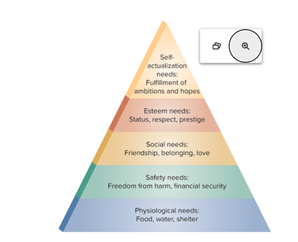
Personality
Actual self concept
Ideal self concept
Psychological Influence
Refers to a person’s character traits that influence behavioural responses. Personality traits that may influence what someone buys (e.g. aggressive people purchase razors over electric shavers).
Actual Self-concept: The way people see themselves and the way they believe others see them.
Ideal Self-Concept: How people would like to see themselves.
Marketers try to appeal to the two self-images.
Perception
Psychological Influence
The process by which an individual selects, organizes, and interprets information to create a meaningful picture of the world.
This includes selective perception, selective exposure, selective comprehension, selective retention and the perceived risk.
Learning
Psychological Influence
Refers to those behaviours that result from repeated experience and reasoning.
Behavioral Learning & Four Variables
DCRR
Psychological Influence
The process of developing automatic responses to a type of situation built up through repeated exposure to it.
Four variables are central to how people learn from repeated experience: drive, cue, response, and reinforcement.
Drive: A need, such as hunger, that moves an individual to action.
Cue: Stimulus or symbol that one perceives.
Response: The action taken to satisfy the drive, and a reinforcement is the reward.
Reinforcement: The reward.
Stimulus generalization
Behavioral Learning
Psychological Influence
When you learn to respond to one thing, you respond the same way to similar things.
Occurs when a response brought about by one stimulus (cue) is generalized to another stimulus.
One concept used from behavioral learning theory.
Using the same known name of a brand to generate other products (e.g. Tylenol Flu).
Stimulus discrimination
Behavioral Learning
Psychological Influence
The ability to perceive differences among similar products.
Customers may do this easily with some groups of products, such as automobiles.
Cognitive Learning
Behavioral Learning
Psychological Influence
Involves making connections between two or more ideas or simply observing the outcomes of others’ behaviours and adjusting your own accordingly.
Repetition of linking products to a solution (e.g. Dyson for flyaway hairs).
Brand Loyalty
Behavioral Learning
Psychological Influence
Favourable attitude toward and consistent purchase of a single brand over time; the degree of target market commitment toward a brand over time that results in varying levels of purchase commitment.
Correlates to habits, and even routine problem solving.
Attitudes
Values, Beliefs and Attitudes
A learned predisposition to respond to an object or class of objects in a consistently favourable or unfavourable way.
Shaped by our beliefs, which we develop from our environmental surroundings.
Personal Values
Values, Beliefs and Attitudes
Traits that we have which leads us to interpret the world around us. This can include things such as discipline, ambition, frugality, sustainability.
Marketers are concerned with this mostly. Personal values affect attitudes by influencing the importance assigned to specific product attributes, or features.
Beliefs
Values, Beliefs and Attitudes
Perceptions about how different attributes of a product or brand perform. Based on personal experience, advertising, and discussions with other people.
Attitude Changes (3 Approaches)
Values, Beliefs and Attitudes
Marketers use three approaches to try to change customer attitudes toward products and brands. This includes:
Ability Alteration: Changing beliefs about the extent to which a brand has certain abilities (promoting a product to ensure it eases possible concerns).
Importance Attributes: Changing the perceived importance of attributes (through new studies and information and the importance of it).
New Attributes: Adding new attributes to the product (e.g. adding new materials or ingredients).
Lifestyle
A way of living that reflects how people spend their time and resources (activities), what they consider important in their environment (interests), and how they think of themselves and the world around them (opinions).
Includes customer behavior and self-orientation.
Customer Behavior
Lifestyle
Actions a person takes when purchasing and using products and services.
Self-orientation
Lifestyle
Describes the patterns of attitudes and activities that help a person reinforce their social self-image. Three patterns have been uncovered, which are oriented toward principles, status, and action.
Opinion Leadership
Socio-cultural Influence
Individuals who have social influence over others are called opinion leaders. This includes celebrities, politicians and people of recognizable status.
A customer’s purchases are often influenced by the views, opinions, or behaviours of others. Two aspects of personal influence are important to marketing: opinion leadership and word-of-mouth activity.
Word of Mouth
Buzz marketing
Viral marketing
Socio-cultural Influence
People influencing each other during conversations. Word of mouth is perhaps the most powerful information source for customers, because it typically involves friends or family who are viewed as trustworthy.
Buzz marketing: A brand becoming popular as a result of people talking about it to friends and neighbours.
Viral marketing: Use of online platforms to spread information about a product.
A customer’s purchases are often influenced by the views, opinions, or behaviours of others. Two aspects of personal influence are important to marketing: opinion leadership and word-of-mouth activity.
Reference Groups (3 Types)
A group of people who influence a person’s attitudes, values, and behaviours.
Reference groups affect customer purchases because they influence the information, attitudes, and aspiration levels that help set a customer’s standards.
Membership group: A group to which a person actually belongs, including fraternities and sororities, social clubs, and family. Such groups are easily identifiable and are targeted by firms selling insurance, insignia products, and vacation packages.
Aspiration group: One that a person wishes to be a member of or wishes to be identified with. An example is a person whose dream is to play in the NHL. Brands such as Gatorade and Nike frequently rely on spokespeople or settings associated with their target market’s aspiration group in their advertising.
Dissociative group: One that a person wishes to maintain a distance from because of differences in values or behaviours.
Family Influence
Consumer socialization
Family life cycle
Family decisions making
Spouse
Joint
Includes customer socialization, passage through the family life cycle, and decision making within the family or household.
Consumer socialization: The process by which people acquire the skills, knowledge, and attitudes necessary to function as customer. Adults passing on the purchasing knowledge and influence to children.
Family life cycle: A family’s progression from formation to retirement, with each phase bringing distinct needs and purchasing behaviours.
Family decisions making: Related to relationship dynamics in a household. Spouse dominant and joint decision making. Joint = both parents. Spouse = one spouse.
Culture and Subcultures
The set of values, ideas, and attitudes that are learned and shared among the members of a group.
Subcultures: Subgroups within the larger, or national, culture with unique values, ideas, and attitudes.
Cultural Symbols
Objects, ideas, or processes that represent a particular group of people or society.
Symbols and symbolism play an important role in cross-cultural analysis because different cultures attach different meanings to things.
By cleverly using cultural symbols, global marketers can tie positive symbolism to their products and services to enhance their attractiveness to customers.
However, this can also have a negative impact.
Back Translation
Retranslating a word or phrase back into the original language by a different interpreter to catch errors.
 Note
Note  Flashcards (27)