Article 5: Selectively Distracted & Review
 Call Kai
 Learn
Learn Practice Test
 Spaced Repetition
 Match
Match Flashcards
 Knowt Play
1/78

There's no tags or description
Looks like no tags are added yet.
Name | Mastery | Learn | Test | Matching | Spaced | Call with Kai |
|---|
No analytics yet
Send a link to your students to track their progress
79 Terms
When conducting a "Go No-Go" task in adults with ADHD, what is one network that shows hyperactivation?
Inferior frontal gyrus
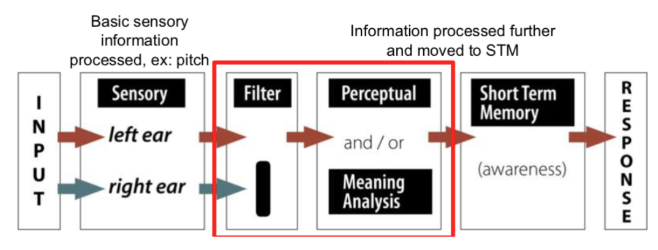
Which model suggests that the filter comes after perception, and is this method efficient?
Late selection model, no
What type of visual search is this, and is it top-down or bottom-up processing? You are looking for a friend on the great lawn during graduation who brought the wrong color cap and gown. She is wearing a bright yellow gown when everyone else is wearing black.
Feature-based, top-down
Explain this study
This study was looking at how dividing attention affects memory. There were two experiments done in this study, both looking at studying the effects of divided attention during encoding. The first experiment had 192 undergraduate participants study items that would need to be remembered while also doing a digit-detection task or listening to background music. The stimuli for this experiment were six lists that each had 20 words, with the word length varying from four to seven letters. There was also a music distractor, which was done to affect memory and selective study. The participants were assigned groups of different studying conditions being a full-attention condition, a divided attention condition, a familiar music condition, or an unfamiliar music condition (Middlebooks et al, 2017). It was found that in experiment one, there was no significant difference between the conditions or a significant interaction between the list and condition. In experiment two, 96 undergraduate participants were completing a similar test to experiment one, but instead of the digit-detection task, they were doing a tone-detection task. The tone detection task was done to try to reduce conflict between numbers in the divided attention task (Middlebooks et al, 2017). Participants were split into four study conditions: full-attention, ton-monitoring, paired-tones, and 1-back conditions. It was found that participants in the full-attention condition remembered more items than participants in the other conditions, but total recall did not change significantly between full-attention condition lists. It was also found that the tone-detection task diminished participants' ability to remember the presenteditems compared to the full-attention study.
Which of the following best describes the relationship between attention and arousal?
It follows a U-shaped function, suggesting optimal “middle” level of arousal for focus.
In the context of visual attention, what is the definition of “covert attention”?
Ability to focus without moving your eyes
According to William James, the “possession by the mind” of one obejct implies:
Withdrawal from something to deal effectively with others.
Which of the following would be an example of “top down processing”
Looking for a friend wearing a specific red and white striped shirt in a crowd.
Which of the following structures is not visible in a lateral view of the brain?
Hippocampus
Define “bottom up processing” and provide one specific example of how it is triggered.
Bottom up processing is when attention is attracted automatically or reflexively by a stimulus in the environment based on its physical salience. Examples include a sudden loud noise, a bright flash of light, or any sensory input that captures attention automatically.
Which best describes exogenous attention?
Attention driven by external stimuli
Which model: all information is processed for meaning before being filtered?
Late selection model
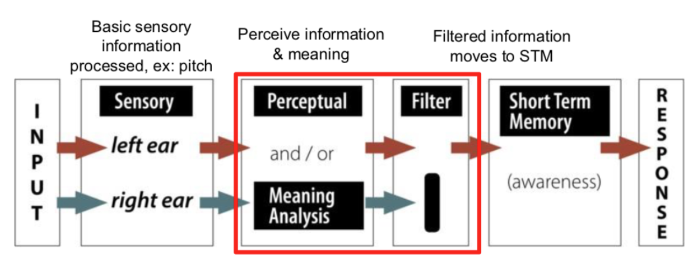
A major limitation of the early selection model is:
It cannot explain the cocktail party effect.
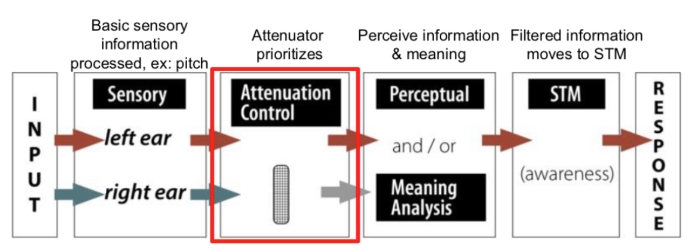
The attenuation model proposes that unattended infromation is:
Weakened but still processed
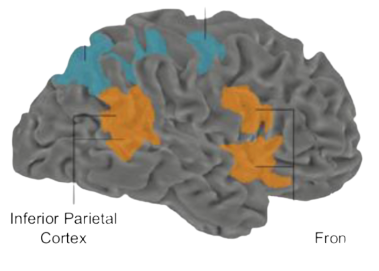
The brain network most associated with bottom-up attention:
Ventral frontoparietal network. VFPN. Orange stimulus driven
What is spatial attention (“Visual pop”)
The ability to focus on a specific area in your visual field, specifcally when
an object instantly stands out because it differs from its surroundings (ex: a red dot among blue ones).
What is the average attention span for an adult?
20 minutes
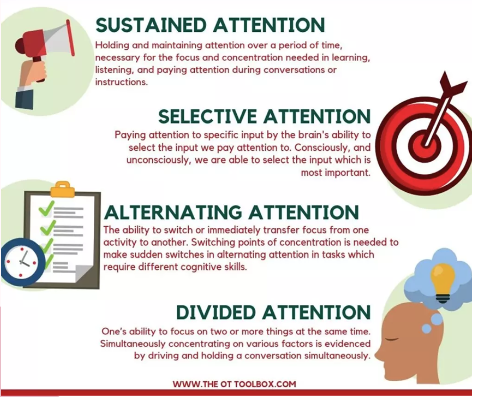
Which type of attention is defined as “holding and maintaining attention over a period of time, necessary for the focus and concentration needed in learning, listening, and paying attention during conversations or instructions.”
Sustained attention
What is the primary purpose of the continuous performance task (CPT)?
Measure sustained and selective attention
Which part of the frontal-parietal network is responsible for top-down processing?
Dorsal FPN
Which of the following is not a primary characteristic of ADHD?
Memory loss
What is hemi-spatial neglect? Identify the brain area most commonly associated with it and provide an example of how it might affect a person’s behavior in daily life.
Hemi-spatial neglect is a condition in which a person ignores one side of space on the opposite side of the injury. It is most commonly caused by damage to the posterior parietal cortex. Even though vision is intact, the person does not attend to that side. For example, they may only eat food from one side of their plate or ignore objects on one side.
Which mechanism best explains why high-valued items were still remembered under divided attention.
Strategic allocation of limited attentional resources toward high-value items.
How do the findings refine our understanding of attention and memory?
Attention can be selectively deployed based on goals, even when limited.
Which of the following best describes the trade-off observed in the study?
Preservation of high-value information at the expense of low-value information under divided attention.
Compared to full attention conditions, divided attention most strongly affected which type of information?
Low-value items disproportionately more than high-value items.
The persistence of value-directed remembering under divided attention suggests that strategic control processes can operate even when cognitive resources are limited.
True. The study shows that participants can still strategically allocate attention to important items, indicating that goal-directed processes remain functional under cognitive load.
The study supports the idea that memory encoding is purely stimulus-driven and unaffected by top-down goals.
False. The results strongly support top-down control, where participants use goals (point values) to guide what they remember.
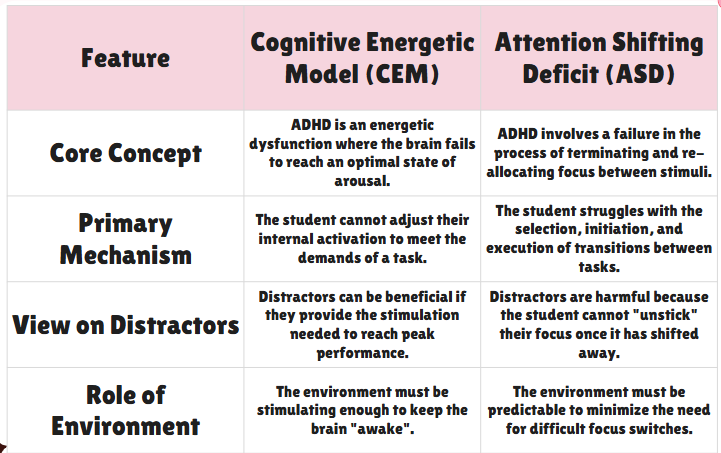
A teacher notices that a student with ADHD becomes completely disengaged when a classmate drops a water bottle, but seems to “snap back” to the lesson when the teacher uses a loud, colorful prop. Why does this occur?
The water bottle is an “irrelevant area” distractor that the student cannot easily shift away from due to an attention-shifting deficit.
An adult patient exhibits a theta/beta ratio (TBR) of 3.0. Based on developmental maturation principles, how should this be interpreted compared to a 10-year-old with the same ratio?
It signifies significant under-arousal, as adult cutoffs are much lower (approx. 1.92)
If a researcher only uses PFDAOI (Fixation duration) to measure ADHD severity, which symptom profile are they most likely to miss entirely?
A predominantly hyperactive-impulsive presentation
A student completes 75 sessions of neurofeedback, successfully increasing their resting beta waves. Despite this, they continue to fail timed math tests. This outcome supports which research finding?
Cortical activation improvements at rest do not necessarily transfer to active task execution.
Why does an “irrelevant” distractor (E.G., a student dropping a pencil) cause a significant drop in PFDAOI for ADHD students but not for controls?
Deficits in attention shifting make it difficult to return to the teacher after the distraction.
Compare and contrast how the "Cognitive Energetic Model" and the "Attention Shifting Deficit" explain the impact of environmental stimuli on a student with ADHD.
The Cognitive Energetic Model suggests that ADHD students suffer from chronic under-arousal; therefore, "relevant" stimuli (distractors within the area of focus) can actually improve performance by helping the brain reach an optimal activation state. In contrast, the Attention Shifting Deficit explains why "irrelevant" stimuli (distractors outside the focus area) are harmful. Because the student struggles to terminate a cognitive activity and re-allocate focus, they become "stuck" on the distraction, leading to decreased performance in the relevant task.
What is attention?
Selectively concentrating while excluding other stimuli
Which is the ability to focus on something without moving your eyes?
Covert
Conversely, which is the act of directing your eyes to a stimulus?
Overt
What is one’s ability to focus on two or more things at the same time, simultaneouly
Divided
Which of the following is paying attention to a specific input, consciously or unconsciously?
Selective
Which is holding and maintaining attention over a period of time?
Sustained
Which is the ability to switch or immediately transfer focus from one activity to another?
Alternating
Attention is an executive function that directs and focuses other mental process
True
Which of the following is NOT considered to be stimulus-driven?
Feature-Based
What is correct about Exogenous and Endogenous attention?
Exogenous is reflexive; endogenous is voluntary
What model represents processes involved in cognitive mechanisms?
Process
Which model is a representation of the physical structure of attention?
Structural
Which model is a representation of how attention elements work together?
Computational
Which of the following is TRUE about the Early Selection Model?
Filtering happens after basic sensory information is processed
Which of the following is an example of spatial attention?
Kelly looking for her friend in a blue striped blazer in a crowd of red
Which kind of attention processing includes a longer search time?
Feature-based
Which model proposes that the stage of selection can change depending on the task?
Multi-modal
An FMRI is a common way of measuring brain activity when focusing on attention
True
Which of the following is NOT a brain region of interest for studying attention?
Broca’s Area
Electrophysiology is an invasive method that measures electrical activity of dead brain cells of non-human primates.
False
What is the duration of time we can hold our attention called?
Attention Span
Which of the following can we use to determine capacity for attention?
Multiple Object Tracking
The Dorsal Frontal Parietal Network is responsible for
Feature Driven (Top-Down)
Name it: You're trying to focus on this kahoot and we bring a 13,000 lb elephant into the room. You completely miss it.
Inattentional Blindness
Who has problems with attention?
All of these have problems with attention. (Autism, ADHD, Hemi-spatial Neglect)
A(n) _____ stroke is caused by a blood clot, and a(n) _____ stroke is caused by a rupture or leak.
Ischemic, Hemorrhagic
People with Hemi-Spatial Neglect can see the side they neglect.
True
Hemi-Spatial Neglect is caused by…
A disruption between the Dorsal and Ventral FPN
Which of the following is NOT a characteristic of ADHD?
Hysteric
Which of the following brain regions did NOT display hyperactivity during the G0-No Go Task?
Somatosensory Cortex
What was the main finding when looking at selectivity under divided attention?
Selectivity was maintained across all distraction conditions
Which distraction condition significantly reduced overall recall compared to full attention?
Digit-detection tasks
In experiment 2 which distraction task was supposed to be the most mentally demanding?
The 1-back task
What did the Bayesian analysis ultimately show about differences in selectivity across conditions?
Strong evidence that there were no differences
Why did the researchers assign each word a point value from 1-10?
To push people to focus on high-value words
What type of tool did they use to study for fixations where distractions arose?
Eye Tracking
What does PFDAOI stand for?
Proportion of Total Fixation Duration on Areas of Interest
How did children with Adhd perform in the relevant areas compared to controls?
Lower PFDAOI
How did children with Adhd perform in the irrelevant areas compared to controls?
Higher PFDAOI
There was a positive correlation between relevant PFDAOI and correctly remembered items.
True
What tool was used to assess brainwaves in study using neurofeedback?
MiniQ Instrument
Which brain waves are linked to ADHD?
Theta/Beta
The goal of the treatment is to decrease beta and increase theta.
False
Why was the treatment needed for the fourth grade girl?
Poor Academic Performance
Did the subject improve during real-life tasks such as reading and arithmetic?
No
Explore top notes

Explore top flashcards
