developmental 16

0.0(0)
studied byStudied by 0 people
0.0(0)
full-widthCall Kai
learnLearn
examPractice Test
spaced repetitionSpaced Repetition
heart puzzleMatch
flashcardsFlashcards
GameKnowt Play
Card Sorting

1/29

encourage image

There's no tags or description

Looks like no tags are added yet.

Study Analytics
Name
Mastery
Learn
Test
Matching
Spaced

No study sessions yet.

30 Terms

1
New cards

exposure to language

infants exposed to language even birth and are interested in what they hear

2
New cards

DeCaspar and Spence (1986) exposure to language

• Mothers’ read 3 stories to their babies in womb twice daily for 6 weeks 
• Two days after birth, showed preference for previously exposed stories (increased sucking frequency) 

3
New cards

Speech sounds: 

Infants prefer vocalisations to artificial sounds (Vouloumanos & Werker, 2007) 

• Newborn infants (about 2 days old) 
• Played synthetic voice sounds, human nonsense speech sounds 
• Pacifier sucking study – more sucks to preferred sounds 
• Preferred speech sounds 

4
New cards

Vouloumanos et al. (2010): 

• Played human nonsense speech sounds and Rhesus monkey vocalisations 
• Newborns, no preference between human and Rhesus monkey vocalisations 
• Also looked at three-month old infants (preferential looking). Preferred human vocalisations 

5
New cards

Infants are primed to communicate 

Discrimination of Speech Sounds (Eimas et al., 1971): 

• Investigated infant phoneme recognition using /pa/ and /ba/ sounds 
• Measured sucking frequency. Habituated to one sound (/pa/) then changed to another (/ba/). 
• Infants (1 and 4 months old) discriminated in the same way as adults 

-> children in an English speaking household  

6
New cards

Specialisation with age 

Differentiating phonemes from different languages 

1–2-month-old infants can respond to phonemes from all languages (Kuhl et al., 1992) 
As they get older, they start to specialise to their native language. 

7
New cards

Werker & Tees (1984) 
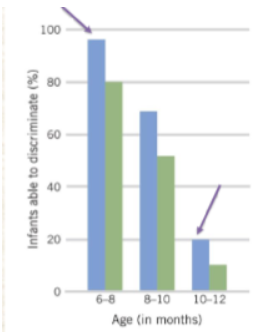
• Phoneme distinction for English native speaking infants, for different Hindi (blue) and Nthlakapmx (Canadian first nation language) (green) phonemes 

• At 6-8 months, still good discrimination 
• By 12-months, significantly less able to discriminate 
• Ability to specialise is related to later language development: 
• Kuhl et al. (2005) found a negative correlation between early specialisation and larger vocabularies 
<p><span style="background-color: inherit; line-height: 20.7px; color: windowtext;"><span>• At 6-8 months, still good discrimination</span></span><span style="line-height: 20.7px; color: windowtext;"><span>&nbsp;<br></span></span><span style="background-color: inherit; line-height: 20.7px; color: windowtext;"><span>• By 12-months, significantly less able to discriminate</span></span><span style="line-height: 20.7px; color: windowtext;"><span>&nbsp;<br></span></span><span style="background-color: inherit; line-height: 20.7px; color: windowtext;"><span>• Ability to specialise is related to later language development:</span></span><span style="line-height: 20.7px; color: windowtext;"><span>&nbsp;<br></span></span><span style="background-color: inherit; line-height: 20.7px; color: windowtext;"><span>• Kuhl et al. (2005) found a negative correlation between early specialisation and larger vocabularies</span></span><span style="line-height: 20.7px; color: windowtext;"><span>&nbsp;</span></span></p>
8
New cards

Word segmentation 

Identifying words in a pattern of speech is also difficult 

By 7-months olds, infants show a preference for words previously heard in a sentence string, to a novel word (Jusczyck & Aslin, 1995) 
 

Discrimination between previously heard syllable sequences and novel sequences @ 8 months also suggests a recognition of the types of syllables used in a specific language (e.g. Aslin et al., 1998) 
 

Discrimination of frequently used words – babies can recognise their own name by 4½ months 

9
New cards

stages of early vocalisations

knowt flashcard image
10
New cards

universality of babbling

Infants from different cultures babble some of the same consonant- vowel combinations (Thevenin et al., 1985) 
 

However, can be identified as from a specific language by 8-10 months of age (de Boysson-Bardies et al., 1984) 
 

Some evidence that deaf infants can babble verbally (Lenneberg et al., 1965) although later and less complex than hearing infants 
 

Evidence that babies from deaf families “babble” with nonsense sign language (Pettito & Marentette, 1991) 

11
New cards

babbling and later language development

Roe (1975) – timing of peak of neutral vocalisations (cooing) was correlated with cognitive development Oller et al. (1998) -> the earlier babbling occurred, the greater the cognitive development that occurred  
• Followed 1536 infants at high risk for language delay (being assessed because of risk of deafness, premature) 
• Late canonical babbling (not present by 10 months) significantly predicted later developmental delay Walker & Bass-Ringdahl (2007) 
• 19 infants with cochlear implants 
• Complexity of babbling (following implants) predicted language skills (including vocabulary) @ 4 years of age

12
New cards

first words Tardif et al (2008)

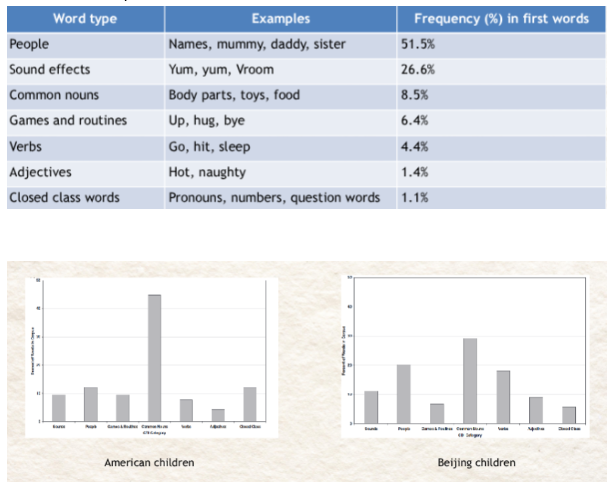
Children aged 8-16mths speaking 1-10 words from 
• USA – English (n=264) 
• Hong Kong – Cantonese (n=367) 
• Beijing – Putonghua (n=336) 
 

Parents completed questionnaires listing common words and  asked to identify which their child used. 

Some similarities 
Not universal – suggests importance of language exposure 
Value of different elements of language – emphasis on correct address in Cantonese (paternal grandma, maternal grandma) 
<p><span style="background-color: inherit; line-height: 20.7px; color: windowtext;"><span>Children aged 8-16mths speaking 1-10 words from</span></span><span style="line-height: 20.7px; color: windowtext;"><span>&nbsp;<br></span></span><span style="background-color: inherit; line-height: 20.7px; color: windowtext;"><span>• USA – English (n=264)</span></span><span style="line-height: 20.7px; color: windowtext;"><span>&nbsp;<br></span></span><span style="background-color: inherit; line-height: 20.7px; color: windowtext;"><span>• Hong Kong – Cantonese (n=367)</span></span><span style="line-height: 20.7px; color: windowtext;"><span>&nbsp;<br></span></span><span style="background-color: inherit; line-height: 20.7px; color: windowtext;"><span>• Beijing – Putonghua (n=336)</span></span><span style="line-height: 20.7px; color: windowtext;"><span>&nbsp;<br>&nbsp;</span></span></p><p class="Paragraph SCXO224398550 BCX0" style="text-align: left;"><span style="background-color: inherit; line-height: 20.7px; color: windowtext;"><span>Parents completed questionnaires listing common words and</span></span><span style="line-height: 20.7px; color: windowtext;"><span>&nbsp; </span></span><span style="background-color: inherit; line-height: 20.7px; color: windowtext;"><span>asked to identify which their child used.</span></span><span style="line-height: 20.7px; color: windowtext;"><span>&nbsp;</span></span></p><p class="Paragraph SCXO224398550 BCX0" style="text-align: left;"><span style="background-color: inherit; line-height: 20.7px; color: windowtext;"><span>Some similarities</span></span><span style="line-height: 20.7px; color: windowtext;"><span>&nbsp;<br></span></span><span style="background-color: inherit; line-height: 20.7px; color: windowtext;"><span>Not universal – suggests importance of language exposure</span></span><span style="line-height: 20.7px; color: windowtext;"><span>&nbsp;<br></span></span><span style="background-color: inherit; line-height: 20.7px; color: windowtext;"><span>Value of different elements of language – emphasis on correct address in Cantonese (paternal grandma, maternal grandma)</span></span><span style="line-height: 20.7px; color: windowtext;"><span>&nbsp;</span></span></p>
13
New cards

understanding and interpreting first word

• Adults’ interpretation of words used -> might not actually be first word 
• Babbling identified as words 
• Recognition of what’s spoken about – social referencing e.g. toy not known to observer  
• Simplification of word, pronunciation (“nana”) 
• Caregivers vs. other adults (“oooh” as shoe) 

14
New cards

timing of speech development

knowt flashcard image
15
New cards

the gavagai problem

a child acquiring language is facing the problem of the indeterminacy of translation when trying to understand the meaning of a novel word

16
New cards

joint attention

• important to help understand the world

Relevant to language development and making sense of what is being communicated 
– Intersubjectivity
– Social referencing
– Following attention  
– Directing attention
• Aids label identification and words learning 

17
New cards

intersubjectivity

– shared understanding of knowing that both looking at same thing 

18
New cards

social referencing

baby looking at caregiver for a cue

19
New cards

following attention

baby is following where adult is looking

20
New cards

directing attention

child brings adult’s attention to what they’re referring to or vice versa

21
New cards

Fast mapping/word exclusivity 

Children assume each object only has one label 
If there is a known and new object, new object must relate to new word 
Show me the “blicket” 
(Markman & Wachtel, 1988) 

-> knows what a dog is so uses process of elimination  

22
New cards

pragmatic cues

• Social contexts to identify word use: adult attention or emotional response 
Where’s the “gazzer” -> looks sad looking for the object, look in last bucket and look happy and relieved, children understand that the object is in the last bucket, even though they have never seen it before or know what it is  
Akhtar et al. (1996) 

23
New cards

linguistic context

• By using known grammatical cues, influences what a child understands by a certain word 
“sibbing”, “a sibber” 
Brown (1957) 

24
New cards

common early errors

Overextension – using same word for many things 
• Under extension – using a word in a restricted and individualistic way e.g. car for only the family’s car; dog for only their dog. 
• Comprehension outstrips production – children understand more words than they can say 

25
New cards

learning grammatical rules

• Plural: -s; Past tense: -ed 
• Children learn these rules (Wug test) 
• Irregular plurals (men, went) 
– Initially the correct form is used (exemplar learning) 
– Then the rule is acquired and overregularization occurs: e.g. mans, goed, foots, feets, breaked, broked 
– Exceptions to the general rule are ‘re-learned’ 

<p><span style="background-color: inherit; line-height: 20.7px; color: windowtext;"><span>• Plural: -s; Past tense: -ed</span></span><span style="line-height: 20.7px; color: windowtext;"><span>&nbsp;<br></span></span><span style="background-color: inherit; line-height: 20.7px; color: windowtext;"><span>• Children learn these rules (Wug test)</span></span><span style="line-height: 20.7px; color: windowtext;"><span>&nbsp;<br></span></span><span style="background-color: inherit; line-height: 20.7px; color: windowtext;"><span>• Irregular plurals (men, went)</span></span><span style="line-height: 20.7px; color: windowtext;"><span>&nbsp;<br></span></span><span style="background-color: inherit; line-height: 20.7px; color: windowtext;"><span>– Initially the correct form is used (exemplar learning)</span></span><span style="line-height: 20.7px; color: windowtext;"><span>&nbsp;<br></span></span><span style="background-color: inherit; line-height: 20.7px; color: windowtext;"><span>– Then the rule is acquired and overregularization occurs: e.g. mans, goed, foots, feets, breaked, broked</span></span><span style="line-height: 20.7px; color: windowtext;"><span>&nbsp;<br></span></span><span style="background-color: inherit; line-height: 20.7px; color: windowtext;"><span>– Exceptions to the general rule are ‘re-learned’</span></span><span style="line-height: 20.7px; color: windowtext;"><span>&nbsp;</span></span></p>
26
New cards

exposure to speech to help make sense of the world

• We speak to infants from their first day of life 
• Comments on infant behaviour 
• Verbalisations of caregiving activities 
• Grammatically well-formed 
• Instructions on how to behave! (Reingold & Adams, 1980) 
 

However, not all cultures speak directly to infants. 
• Mayans in Mexico (Brown et al., 2002) 

27
New cards

Parental/Adult Influences 

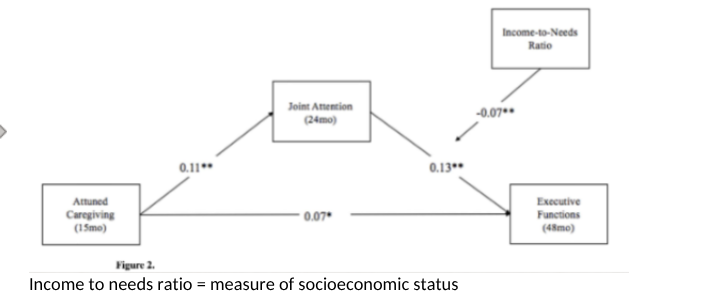
• Intersubjectivity and learning turn-taking 
• Labelling objects that have the child’s attention 
• Use of infant directed speech to emphasise support word learning 
• Parental scaffolding: repeating and building on child’s words. E.g. “dog” “yes, there is a spotty dog” 
• Evidence that such scaffolding aids language development (Hoff, 2005) 
• Playing word games (“where’s your nose? yes your nose is on your face”) 
<p><span style="background-color: inherit; line-height: 20.7px; color: windowtext;"><span>• Intersubjectivity and learning turn-taking</span></span><span style="line-height: 20.7px; color: windowtext;"><span>&nbsp;<br></span></span><span style="background-color: inherit; line-height: 20.7px; color: windowtext;"><span>• Labelling objects that have the child’s attention</span></span><span style="line-height: 20.7px; color: windowtext;"><span>&nbsp;<br></span></span><span style="background-color: inherit; line-height: 20.7px; color: windowtext;"><span>• Use of infant directed speech to emphasise support word learning</span></span><span style="line-height: 20.7px; color: windowtext;"><span>&nbsp;<br></span></span><span style="background-color: inherit; line-height: 20.7px; color: windowtext;"><span>• Parental scaffolding: repeating and building on child’s words. E.g. “dog” “yes, there is a spotty dog”</span></span><span style="line-height: 20.7px; color: windowtext;"><span>&nbsp;<br></span></span><span style="background-color: inherit; line-height: 20.7px; color: windowtext;"><span>• Evidence that such scaffolding aids language development (Hoff, 2005)</span></span><span style="line-height: 20.7px; color: windowtext;"><span>&nbsp;<br></span></span><span style="background-color: inherit; line-height: 20.7px; color: windowtext;"><span>• Playing word games (“where’s your nose? yes your nose is on your face”)</span></span><span style="line-height: 20.7px; color: windowtext;"><span>&nbsp;</span></span></p>
28
New cards

Adult responsibility  

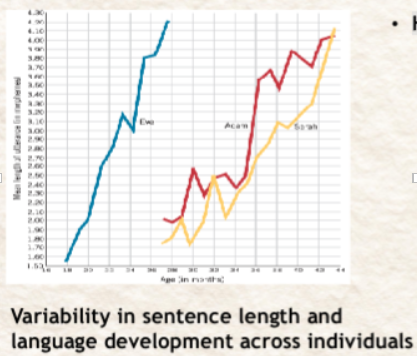
• Indication that there are individual differences in adults’ responsiveness to infant language 

• Bornstein et al. (1991) 
• Observed 30 children and their mothers @ 13 months & again at 20 months 
• Looked at child and mother vocabulary and maternal responsiveness (timely and appropriate responses to child speech) 
• Maternal responsiveness at 13 months, predicted child vocabulary @ 20 months 
• Child vocabulary increases also predicted maternal responsiveness @ 20 months 
29
New cards
<p><span style="background-color: inherit; line-height: 20.7px; color: windowtext;"><span>Individual differences&nbsp;</span></span><span style="line-height: 20.7px; color: windowtext;"><span>&nbsp;</span></span></p><p class="Paragraph SCXO174519817 BCX0" style="text-align: left;"><span style="background-color: inherit; line-height: 20.7px; color: windowtext;"><span>Hart &amp; Risley (1995)</span></span><span style="line-height: 20.7px; color: windowtext;"><span>&nbsp;</span></span></p>

Individual differences  

Hart & Risley (1995) 

– Recorded the speech of 42 parents with their children from infancy to age 3 years 
– Children of parents on welfare heard 616 words per hour 
– Children of parents with low Social class 1251 words per hour 
– Children of middle-class parents 2153 words per hour 
– Evidence to link social class and word hearing to child vocabulary 

Lower socioeconmic class = hear 30 million words less at home than those from higher socioeconoic class 

-> only looked at caregivers  
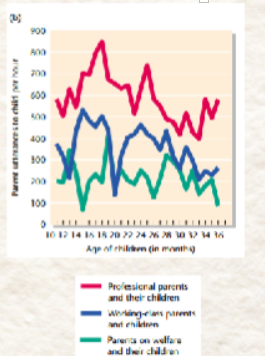
<p><span style="background-color: inherit; line-height: 20.7px; color: windowtext;"><span>– Recorded the speech of 42 parents with their children from infancy to age 3 years</span></span><span style="line-height: 20.7px; color: windowtext;"><span>&nbsp;<br></span></span><span style="background-color: inherit; line-height: 20.7px; color: windowtext;"><span>– Children of parents on welfare heard 616 words per hour</span></span><span style="line-height: 20.7px; color: windowtext;"><span>&nbsp;<br></span></span><span style="background-color: inherit; line-height: 20.7px; color: windowtext;"><span>– Children of parents with low Social class 1251 words per hour</span></span><span style="line-height: 20.7px; color: windowtext;"><span>&nbsp;<br></span></span><span style="background-color: inherit; line-height: 20.7px; color: windowtext;"><span>– Children of middle-class parents 2153 words per hour</span></span><span style="line-height: 20.7px; color: windowtext;"><span>&nbsp;<br></span></span><span style="background-color: inherit; line-height: 20.7px; color: windowtext;"><span>– Evidence to link social class and word hearing to child vocabulary</span></span><span style="line-height: 20.7px; color: windowtext;"><span>&nbsp;</span></span></p><p><span style="background-color: inherit; line-height: 20.7px; color: windowtext;"><span>Lower socioeconmic class = hear 30 million words less at home than those from higher socioeconoic class</span></span><span style="line-height: 20.7px; color: windowtext;"><span>&nbsp;</span></span></p><p class="Paragraph SCXO48634320 BCX0" style="text-align: left;"><span style="background-color: inherit; line-height: 20.7px; color: windowtext;"><span>-&gt; only looked at caregivers&nbsp;</span></span><span style="line-height: 20.7px; color: windowtext;"><span>&nbsp;</span></span></p>
30
New cards


What type of speech are relevant? PS2011 
• Sperry, Sperry and Miller (2019) 

– Critique of Hart & Risley – looking just at direct mother-child speech 
– Exposure to different types of language/speech e.g. other adults and overheard speech 
– Considering other cultures where direct speech is less common/valued

– Replicated Hart & Risley’s study (n=42), also included other definitions of speech 
• Direct caregiver-child speech 
• All caregivers to child 
• All speech in child’s hearing 

Variability within and across groups is important 
Different types of language exposure can be beneficial – especially if that’s what you’re used to 

Every type of speech is relevant, not just caregivers  
over 3,000 words an hour are heard from all speech  
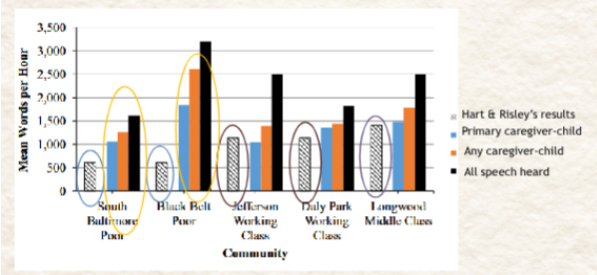
<p><span style="background-color: inherit; line-height: 20.7px; color: windowtext;"><span>– Critique of Hart &amp; Risley – looking just at direct mother-child speech</span></span><span style="line-height: 20.7px; color: windowtext;"><span>&nbsp;<br></span></span><span style="background-color: inherit; line-height: 20.7px; color: windowtext;"><span>– Exposure to different types of language/speech e.g. other adults and overheard speech</span></span><span style="line-height: 20.7px; color: windowtext;"><span>&nbsp;<br></span></span><span style="background-color: inherit; line-height: 20.7px; color: windowtext;"><span>– Considering other cultures where direct speech is less common/valued</span></span></p><p class="Paragraph SCXO4308215 BCX0" style="text-align: left;"><span style="background-color: inherit; line-height: 20.7px; color: windowtext;"><span>– Replicated Hart &amp; Risley’s study (n=42), also included other definitions of speech</span></span><span style="line-height: 20.7px; color: windowtext;"><span>&nbsp;<br></span></span><span style="background-color: inherit; line-height: 20.7px; color: windowtext;"><span>• Direct caregiver-child speech</span></span><span style="line-height: 20.7px; color: windowtext;"><span>&nbsp;<br></span></span><span style="background-color: inherit; line-height: 20.7px; color: windowtext;"><span>• All caregivers to child</span></span><span style="line-height: 20.7px; color: windowtext;"><span>&nbsp;<br></span></span><span style="background-color: inherit; line-height: 20.7px; color: windowtext;"><span>• All speech in child’s hearing</span></span><span style="line-height: 20.7px; color: windowtext;"><span>&nbsp;</span></span></p><p class="Paragraph SCXO4308215 BCX0" style="text-align: left;"><span style="background-color: inherit; line-height: 20.7px; color: windowtext;"><span>Variability within and across groups is important</span></span><span style="line-height: 20.7px; color: windowtext;"><span>&nbsp;<br></span></span><span style="background-color: inherit; line-height: 20.7px; color: windowtext;"><span>Different types of language exposure can be beneficial – especially if that’s what you’re used to</span></span><span style="line-height: 20.7px; color: windowtext;"><span>&nbsp;</span></span></p><p class="Paragraph SCXO4308215 BCX0" style="text-align: left;"><span style="background-color: inherit; line-height: 20.7px; color: windowtext;"><span>Every type of speech is relevant, not just caregivers </span></span><span style="line-height: 20.7px; color: windowtext;"><span>&nbsp;<br></span></span><span style="background-color: inherit; line-height: 20.7px; color: windowtext;"><span>over 3,000 words an hour are heard from all speech&nbsp;</span></span><span style="line-height: 20.7px; color: windowtext;"><span>&nbsp;</span></span></p>