Chapter 8: Microbial Genetics - Part I: Gene Regulation & Mutations
 Call Kai
 Learn
Learn Practice Test
 Spaced Repetition
 Match
Match Flashcards
 Knowt Play
1/68

There's no tags or description
Looks like no tags are added yet.
Name | Mastery | Learn | Test | Matching | Spaced | Call with Kai |
|---|
No analytics yet
Send a link to your students to track their progress
69 Terms
Where do bacterial regulate gene expression
during transcription
In Prokaryotes Operons are:
one promoter and terminator regulates gene expression for a cluster of gene known as operons
Constitutive Genes in Bacteria:
60-80% of genes are constitutive : products are continuously produced
genes are “ON” all the time
codes for proteins/enzymes that are needed in large amount for essential processes like in cellular respiration and binary fission
Repression
regulatory mechanism that inhibits gene expression, and decreases the synthesis of a protein
repressor proteins
turning OFF
Induction
regulatory processes that turns on (induces) the transcription of a gene(s), increasing protein synthesis
inducers are substances that initiate transcription
turning ON
Promoter
initiation of transcription → RNA polymerase binding
Operator
regulatory element that controls the activation or repression of the operon
transcription factors can bind this region or to adj. binding sites to activate or repress transcription
Operon
promoter and group (cluster) of genes that code for enzymes and proteins in bacteria - regulated as a unit
Inducible Operon
not usually transcribed, must be induced and activated
default is OFF, you have to induce operon → turn ON
Repressible Operon
continuously transcribed until repressed
default is ON, needs to be repressed (turned OFF)
Transcription factors
regulatory proteins that bind DNA and affect transcription
Repressors
Activators
Repressors & How they work
proteins known as transcription factors that can bind to DNA during transcription
block the ability of RNA Pol to bind
OFF
do not need inducer to repress
Activators & How they work
proteins known as transcription factors that can bind to DNA during transcription
promote transcription of genes by facilitating binding of RNA Pol
think if it as a signal that recruits RNA Pol
ON
DO NOT WORK if inducers are not present
Genetic Inducers
Induce transcription by:
removing/blocking repressors
allowing the binding of activators
work by binding to transcription factors NOT operon
induce transcription ALWAYS
Repressor + Inducer =
ON Operon:
WHY:
removal of repressor so there is no blockage
Activator + Inducer =
ON Operon
WHY:
recruitment of RNA Pol to promoter
Lac Operon
contains genes needed for the transport and catabolism of lactose
3 genes coordinately regulated as a unit
genes code to allow bacteria to use lactose
Lac Operon is an Inducible Operon meaning it is expressed when:
Glucose is absent or in low concentrations
Lactose is present
usually OFF , meaning it is NOT essential
as long as there is glucose Lac operon is off that is why it is inducible
Lac Operon Transcription Factors
Activator - CAP
Repressor - Lac repressor = blockage
Lac Operon Inducers
Bind to transcription factors
CAMP → binds to activator
Allolactose/lactose → binds repressor
Lactose is absent , is Lac Operon ON or OFF ?
OFF
repressor is active, so operon is off
the repressor protein binds with operator, preventing transcription from the operon
Lactose is present , is Lac Operon ON or OFF ?
ON
repressor is inactive, operon is on
the inducer allolactose binds to the repressor protein, inactivating the repressor and it can no longer block transcription
What controls cAMP ?
Glucose controls the intracellular levels of cAMP (alarm signal)
cAMP signals glucose is low
Glucose is present No Lactose Is the Operon OFF or ON ?
OFF
Operon is off because glucose is present , so low cAMP (inducer) levels meaning CAP (activator) can not bind
repressor is bound to operator blocking polymerase
Glucose Present Lactose Present Is the Operon OFF or ON ?
OFF
THINK: Glucose is present so we don’t need Lac Operon
Because glucose is present, cAMP is low and CAP cannot bind
The Lactose/Allolactose function as inducer and are present so repressor is NOT repressing but there is glucose & no inducer cAMP for activator CAP so it is OFF
No Glucose Lactose Present Is the Operon OFF or ON ?
ON
Glucose is not present which means cAMP is high, cAMP is the inducer for the activator CAP meaning cAMP binds to CAP & allows it to bind to the activator-binding site
Allolactose & lactose is present as well which is the inducer for the Lac operon repressor, meaning it binds to the repressor which prevents it from binding to the operator and blocking polymerase
No Glucose & No Lactose Is the Operon OFF or ON ?
OFF
Think: Lac Operon functions to make genes needed for the transport and catabolism of lactose , if there is no lactose why would it be on ?
There is no glucose so cAMP meaning it can bind to CAP & then to the operon to recruit RNA Polymerase however there is no lactose/allolactose to induce the repressor thus the repressor is bound to the operon blocking polymerase
Down-Regulation: Lac Operon OFF
Glucose present, Lactose absent
Glucose present, Lactose present
Glucose absent, Lactose absent
Up-Regulation: Lac Operon ON
Glucose absent, Lactose present
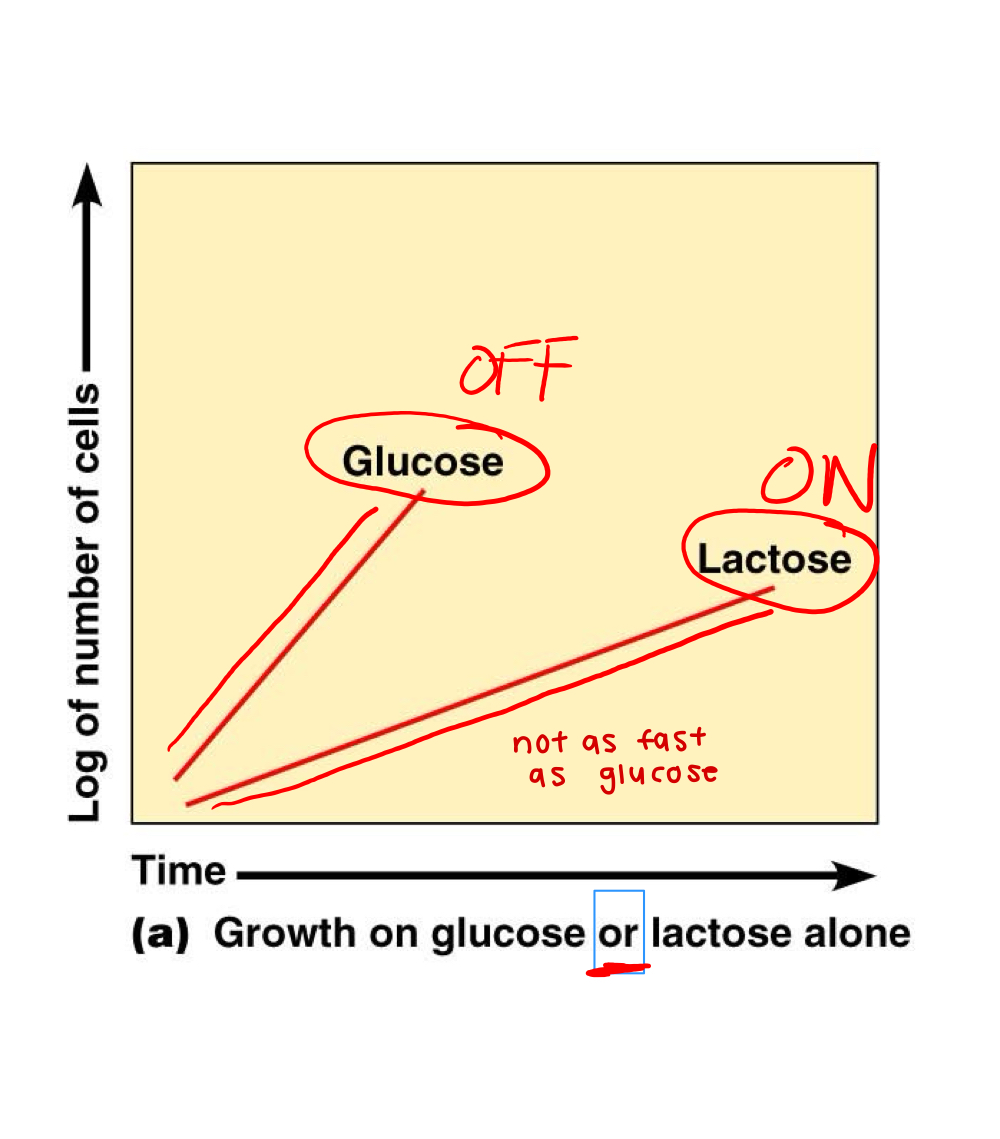
What does this graph represent ?
This represents growth of cells on glucose OR lactose alone
notice they grow on glucose much faster than on lactose
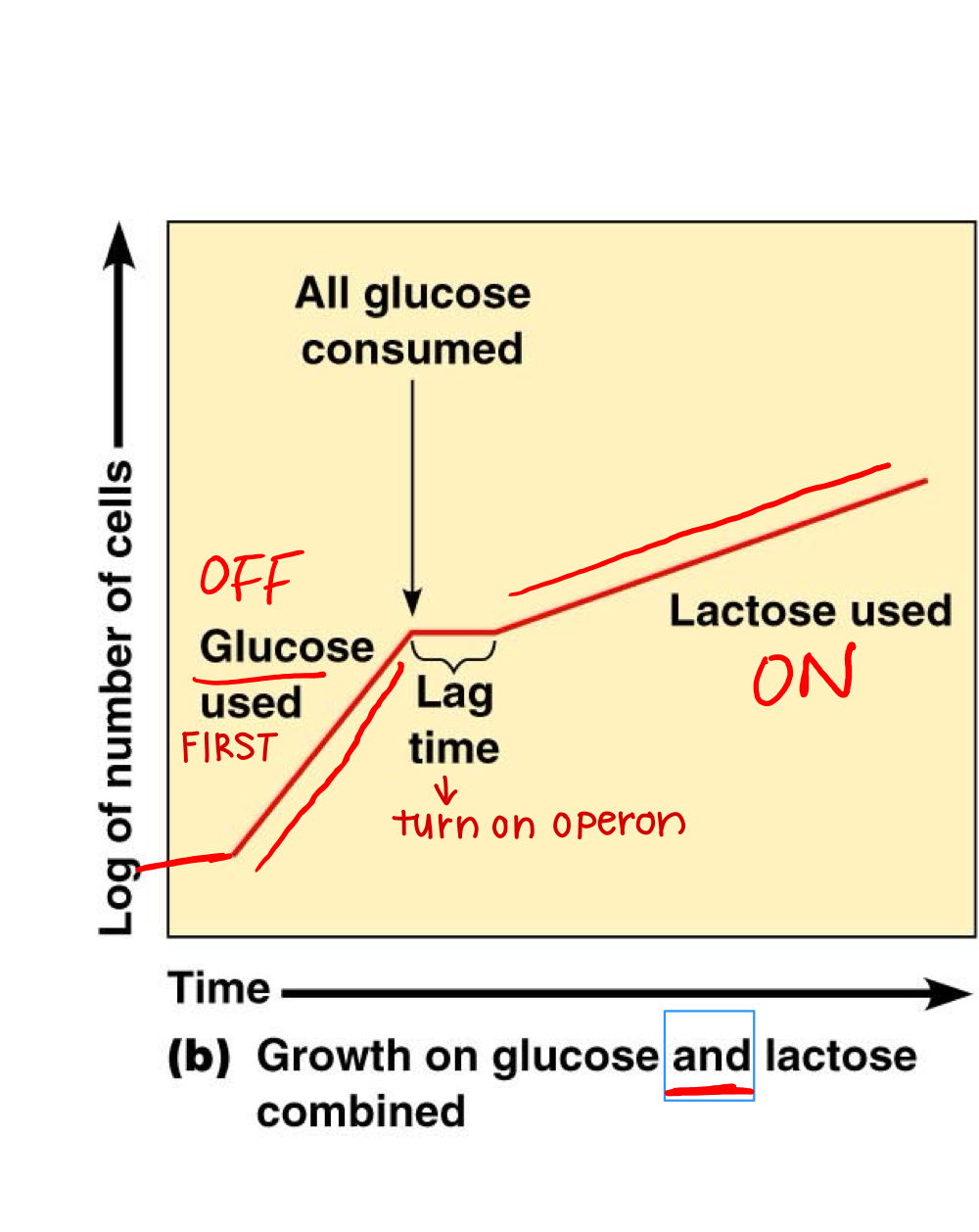
What does this graph represent ?
Growth on glucose & lactose combined
Glucose is used first, then when it is all consumed there is a lag which represents the operon turning on, then lactose is used
What is a mutation
any change in the base sequence of genes
What is a point mutation ?
a single nucleotide base change
base substitution: single nucleotide base is replaced
What are mutagens
agents that can cause mutations
What does wild type refer to ?
without mutation; the normal state of an organism (also used for genes)
What is a missense mutation ?
change that codes for a different amino acid
What is a nonsense mutation ?
changes amino acid codon into STOP codon causing truncation (cut short)
What is a silent mutation ?
Does not change amino acid
there is a change in DNA → codon but redundancy allows it to code for same amino acid
What is a frameshift mutation ?
Changes reading frame of codons, shifting it and creating new codons
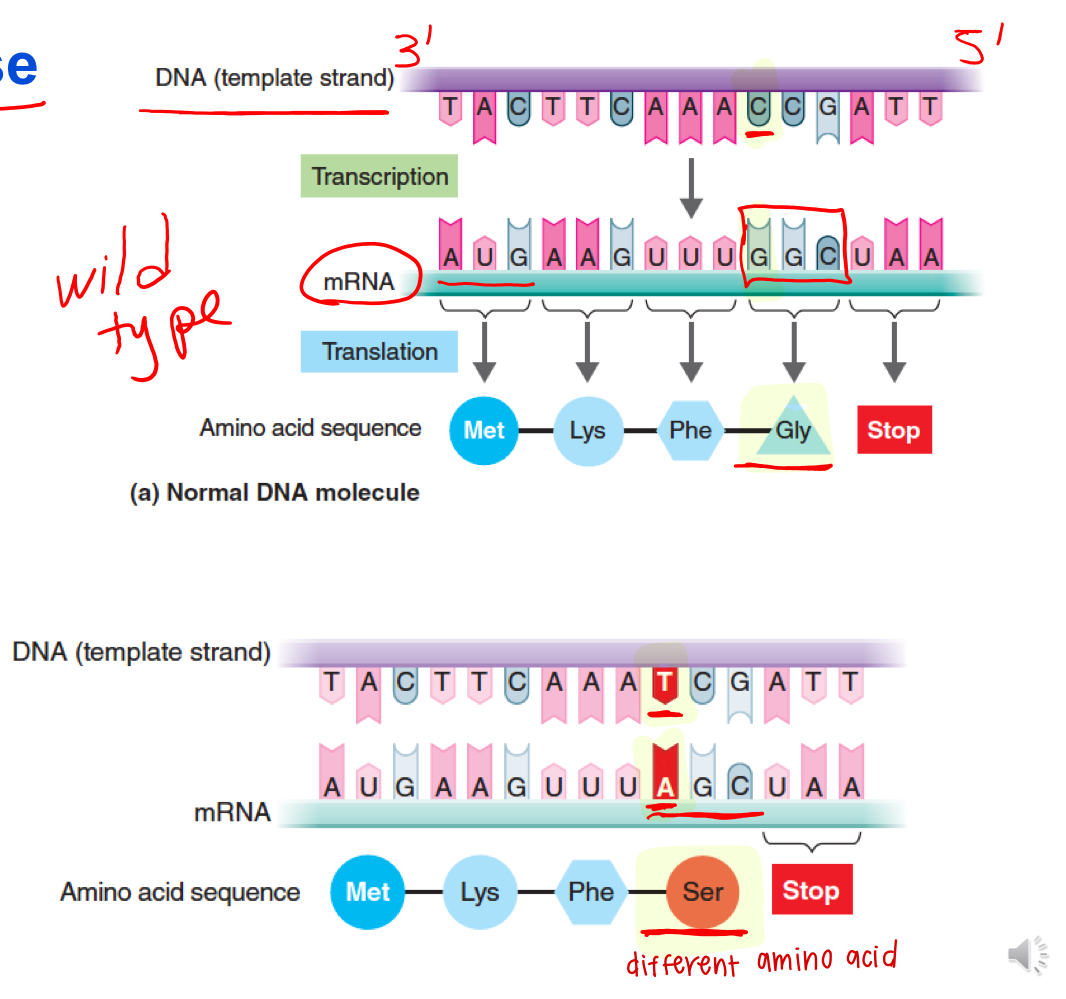
What type of mutation is depicted ?
Missense
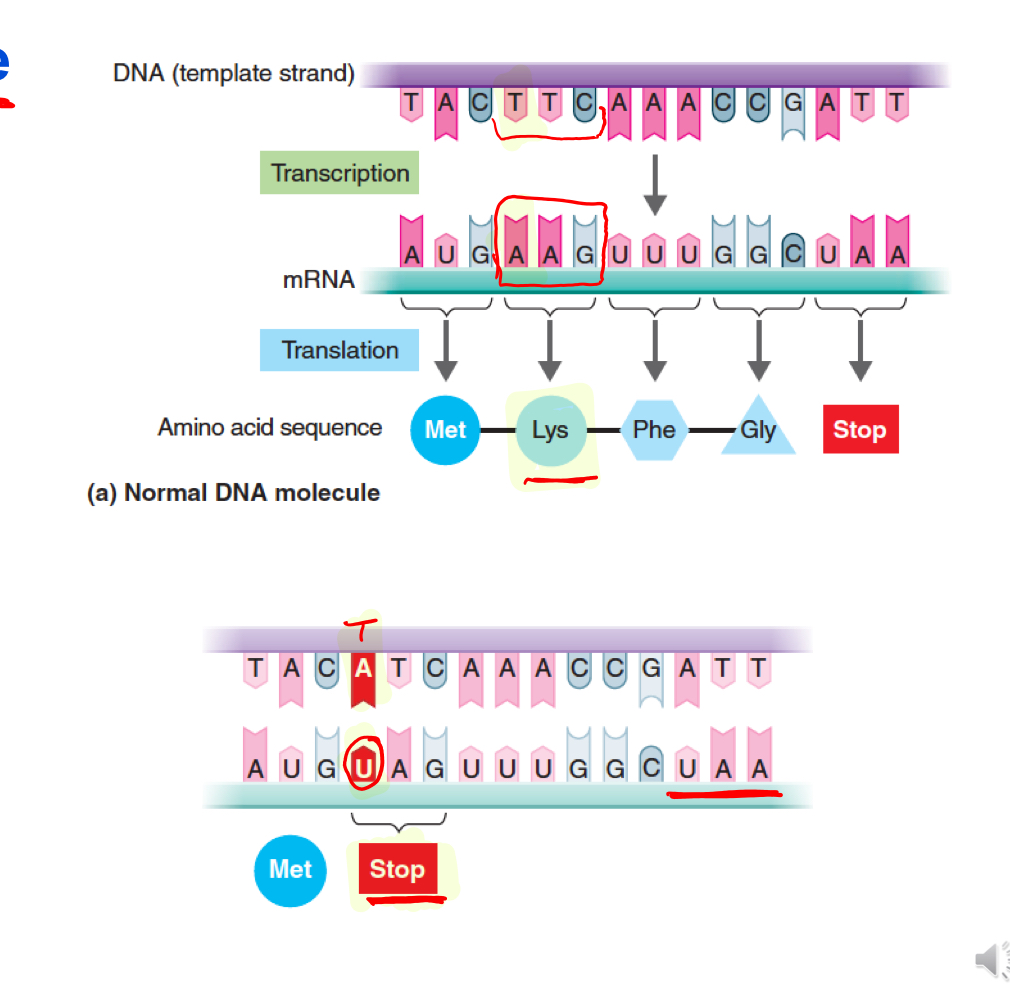
What type of mutation is depicted ?
Nonsense
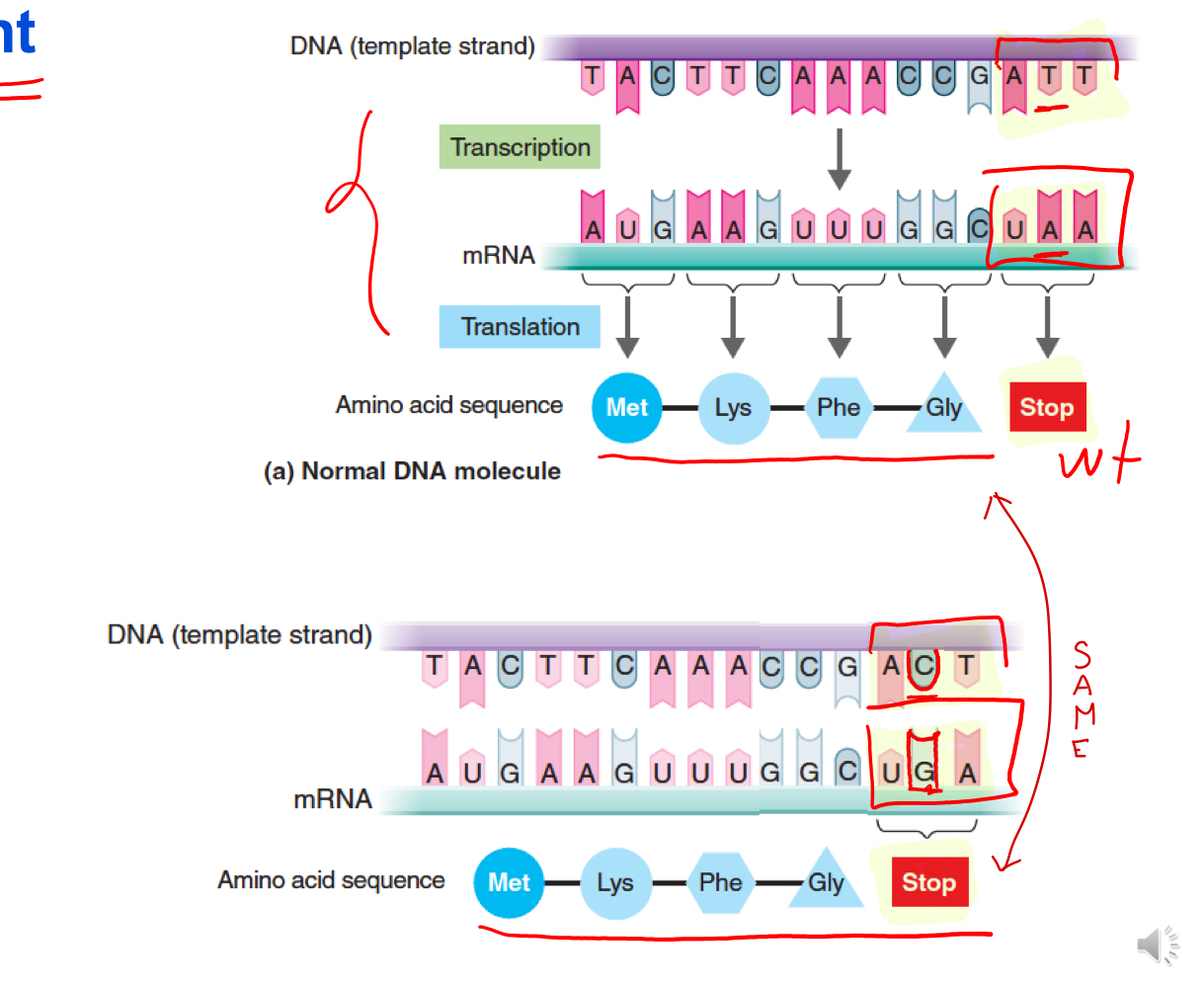
What type of mutation is depicted ?
Silent
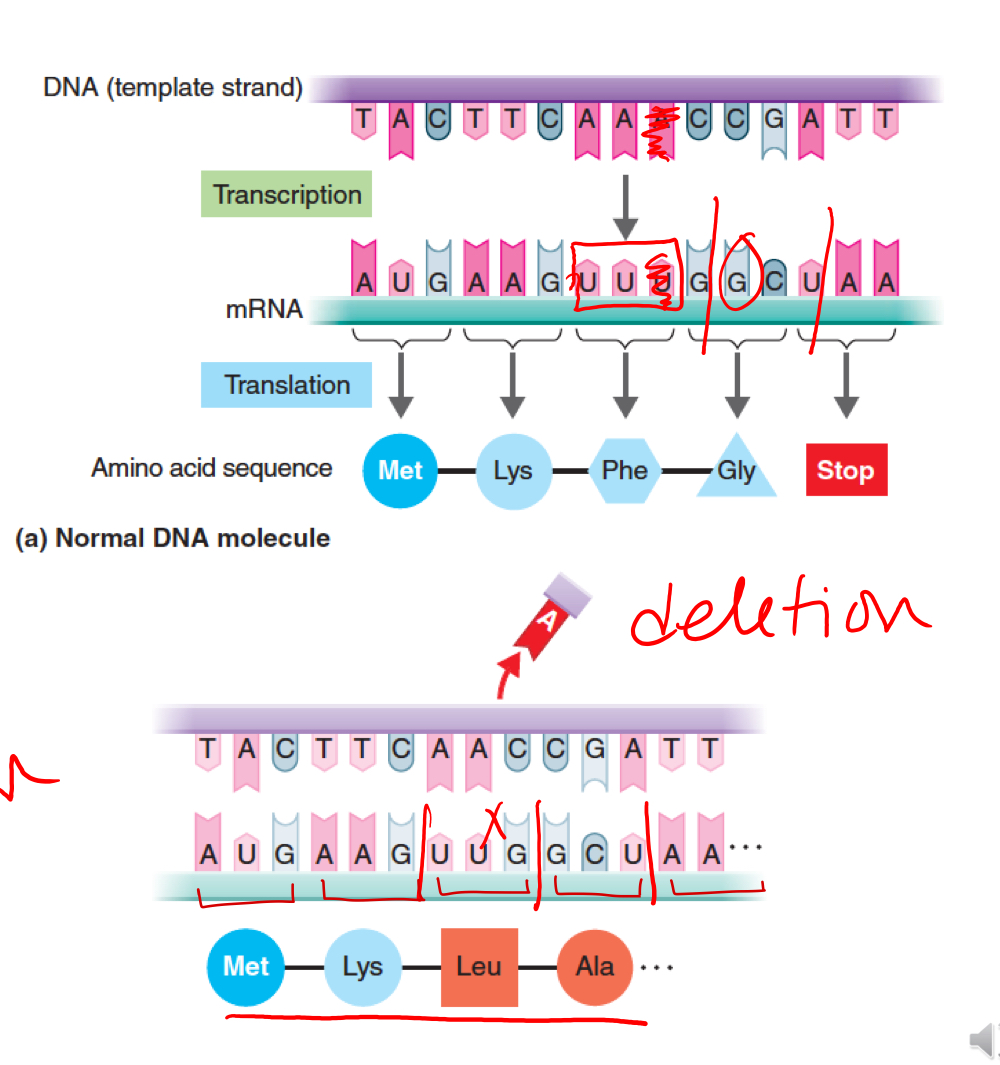
What type of mutation is depicted ?
Frameshift
Causes of Mutations ?
Spontaneous mutations
Induced mutations
What are spontaneous mutations ?
introduced by errors in replication and/or repair, and by recombination events
proof-reading mechanisms for prevention
rare events that could be beneficial allows organisms to survive and adapt to env.
Recombination: long stretches of DNA move in chromosomes, introducing frameshifts
What are induced mutations ?
Result from exposing DNA to physical or chemical agents (mutagens)
NOT natural
Nucleotide altering chemicals
alter structure of nucleotides, altering base pairing
Nucleotide analogs
compounds structurally similar to normal nucleotides; act like nucleotides in DNA synthesis
Intercalating agents
insert between base pairs resulting in frameshift mutation
Physical Mutagens
Ionizing radiation
Non-ionizing radiation
Ionizing Radiation & Effects
x-rays and gamma rays
can cause breaks in the backbone of DNA, separates strands by breaking H bonds, damages base structure
irreversible damage
Non-ionizing Radiation & Effects
UV radiation
causes thymine (pyrimidine) dimers
What are Thymine Dimers ?
Adj. thymines become cross-linked, forming a thymine dimer and disrupt their normal base pairing
double covalent bond
What are the two ways pyrimidine dimer’s can be repaired ?
Photoreactivation → photolysases
ONLY BACTERIA
Nucleotide excision repair (dark repair) → enzyme complex
Photoreactivation / Light Repair
An enzyme requiring visible light for activity breaks covalent bond joining adj. thymine molecules allowing them to resume original shape
Excision Repair
Endonucleases and exonucleases cut out the damaged DNA
resynthesis of original DNA by DNA Polymerase I
Ligation to repair sugar phosphate backbone by DNA ligase
Horizontal Gene Transfer
lateral transfer to cells of the same generation
Transformation (recombination)
Transduction (recombination)
Conjugation (with or w/o recombination)
Genetic Recombination
Exchange of genes between 2 DNA molecules to form new combinations of genes
Griffith’s Classic Experiment
Demonstrated bacterial transformation, where heat-killed lethal bacteria transformed living non-lethal bacteria into lethal ones. This proved that genetic information could be transferred between organisms, leading to the discovery of the "transforming principle"
Transformation
*EXOGENOUS DNA
Recipient cell takes up donor DNA
Donor DNA aligns with complementary bases
Recombination occurs between donor DNA and recipient DNA
Competence
alterations in the cell wall that make it permeable to DNA
a cell is competent when it is able to acquire exogenous DNA
Transduction
Transfer of DNA between different bacteria by a virus
a phage infects the donor bacteria cell
Phage DNA and proteins are made, and the bacterial chromosome is broken into pieces
Occasionally during phage assembly pieces of bacterial DNA are paackaged in phage capsid → phage then lyses cell
Phage carrying bacteria DNA infects new host cell , the recipient cell
Recombination can occur producing a recombinant cell with a genotype diff. from both donor and recipient cell
Conjugation
transfer of DNA between two bacteria
can transfer plasmid OR portion of the chromosome
Transformation VS. Transduction VS. Conjugation Simply Put
Transformation
exogenous DNA
Transduction
Virus
Conjugation
sharing plasmid or portion of chromosome
Plasmids
self-replication, circular DNA molecules
extra chromosomal DNA
can aid bacterial survival
R factors: plasmids that code for antibiotic resistance genes
F factor
a plasmid
F + cell
donor cell
F - Cell
recipient cell , converted to F+cell
Genetic recombination
An Hfr cell (High-frequency recombination cell) is a bacterium with a fertility factor ( factor) plasmid integrated into its main chromosome. Unlike normal cells, Hfr cells attempt to transfer their entire chromosome to recipient cells during conjugation, often transferring bacterial genes instead of just the plasmid, creating high genetic diversity.
Explore top notes

Explore top flashcards
