W1- Trial Balances & Double entry system
 Call Kai
 Learn
Learn Practice Test
 Spaced Repetition
 Match
Match Flashcards
 Knowt Play
1/35

There's no tags or description
Looks like no tags are added yet.
Name | Mastery | Learn | Test | Matching | Spaced | Call with Kai |
|---|
No analytics yet
Send a link to your students to track their progress
36 Terms
What does prudence mean?
being cautious when making a judgement
What is meant by the accruals concept?
fundamental principle of accounting- matching income to expenses
What is meant by dual aspect
refers for the double entry of accounting where total debits = total credits
What is the difference between a sole trader and a company?
sole trade- single owner responsible for all liabilities & includes all personal assets
Companies- single/multiple owners (PLC and LTD) and shareholders’ liability limited by the amount paid for shares, they are a separate legal entity
What are the 4 types of financial statements/accounts?
SOFP/ balance sheet- statement of financial position
SOCI / income statement- statement of comprehensive income
CFS- statement of cash flowers
SOCE- only for Limited Companies or PLCs
What does a SOFP/balance sheet show?
a company’s financial position at a point in time (net assets)
SOFP as at [date]
shows what business owns minus what they owe
What does income statement show?
a company’s financial performance (change in profit)
'“income statement for the period ended [date]”
shows all income minus all expenses over period of time
What does CFC show?
change in cash
“CFC for the period ended [date]”
What is the SOCE and what is it only used for?
statement of changes in equity
only for Limited companies or PLCs
it links SOCI to SOFP by showing changes in profits, reserves and equity over a period of time
What elements make up the SOFP?
assets, liabilities, equity (at a point in time)
What elements make up the income statement?
income and expenses (for the accounting year to same point in time as SOFP)
What is meant by the term assets?
owned & used to generate future economic benefits
What are non-current assets? Give examples
includes tangible and intangible assets used/held for a long period of time
eg. property, plant & equipment
What are current assets? Give examples
assets that are held for a short period of time
eg. inventories, trade receivables, bank (positive balance) & cash (petty cash)
What is meant by inventories?
goods & materials used for resale & production eg. raw materials and finished goods
What is meant by trade receivables?
amounts owed by customers to the business on credit
What is meant by bank balance? What happens if it is a positive or negative balance
positive bank balance = asset
negative bank balance = liability (overdraft)
What is meant by liabilities?
this is what the business owed
What are non-current liabilities? Give examples
include long term loans and borrowings which are due > 1 year
eg. long term bank loans or mortgage accounts
What are current liabilities? Give examples
include short term loans and borrowings which are due to be repaid < 1 year
eg. Trade payables, bank overdraft account
What is meant by trade payables?
amounts owed by the business to trade suppliers (credit purchases)- they have to pay them back quickly otherwise they might not supply to firm anymore
What is meant by income? Give examples
increase in economic benefits during accounting period in form of inflows/ enhancements of assets/ decreases of liabilities
eg. income raised from trading activities of the business, including all sales (cash & credit)
What is meant by expenses? Give examples
decreases in economic benefits during accounting period in form of outflows/ depletion of assets/ increase of liabiities
all costs from accounting year regardless of cash was paid for it or still owed
eg. expenses from manufacturing, administration, sales, tax
What is meant by equity? Give examples
what the business owes the owner (capital & profits)
residual interest in assets after deducting liabilities
eg. capital and all profits (retained earnings & reserves) built up over time
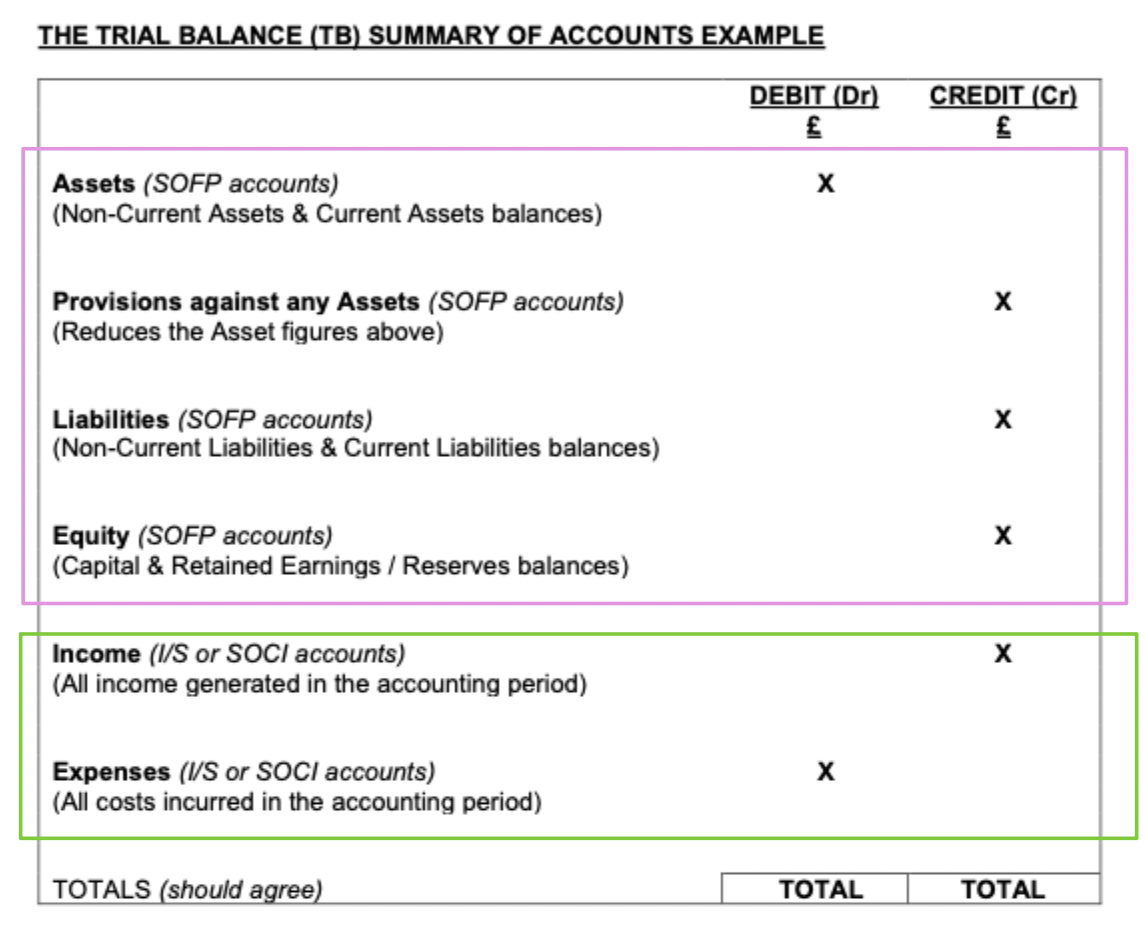
What is a trial balance?
a list of accounts at the year-end (these accounts are then reflected in the SOFP and I/S)
each account has a debit or credit balance
debit = credit
What is the opening/ brought forward figure?
it is taken from the closing/carried forward figure from previous accounting year
Are there opening or closing figures for the income statement?
no balances are brought forward as they’re closed off at the end of accounting period
Sort assets, provisions against assets, liabilities, equity, income & expenses into debit and credit (explain what this means)
debit- if the business owns something
credit- if the business owes something
LHS - assets & expenses
What does it mean to credit or debit something in the SOFP and I/S?
SOFP- debit ↑ credit ↓
SOCI- debit ↓ credit ↑
What do u need to add to the end of a trial balance to make the trial balance balance?
owner’s equity/investment
What is the double entry system?
there are 2 sides to every transaction a debit and a credit
If an account has a debit or credit balance what happens when u debit or credit it?
If account has debit balance eg. asset, expense
debiting = increasing
crediting = decreasing
If account has credit balance eg. liability, income, equity
debiting = decreasing
crediting = increasing
What happens if an asset is bought on cash? What is the double entry?
debiting the asset’s account
crediting the bank account (money leaves bank account)
What happens if an asset is bought on credit? What is the double entry?
debiting the asset’s account
crediting the liability
What is the double entry if cash is received from a sale?
debit the bank account
credit the sales account (income generated is always credited)
What is the double entry if the sale was made on a credit?
debit trade receivables account (more owed to business)
credit sales account (income increases)

