unit 3 learning aim A - Health Psychology
 Studied by 0 people
 Call with Kai
 Learn
Learn Practice Test
 Spaced Repetition
 Match
Match Flashcards
 Knowt Play
1/91

Earn XP
Description and Tags
Name | Mastery | Learn | Test | Matching | Spaced | Call with Kai |
|---|
No analytics yet
Send a link to your students to track their progress
92 Terms
what is biomedical?
views illness as physical or biological factors. It sees illness as a physical disease, the illness is treated with physical methods which address these causes. absence of illness, someone free from disease, pain and disability. And to return to pre illness condition.
what is biopsychosocial ?
illness is a result of several interacting factors; biological (genes), psychological (stress) and social environment (family, culture). Aims to enhance health and prevention.
what is health as a continuum?
health varies between extremely healthy/unhealthy, you can move up and down this continuum through your life. This is true of mental health as well as psychical health.
what is addiction?
addiction is the compulsion to perform a behaviour or use a substance, even though one understands that the consequences are harmful. If someone has an addiction, then they are unable to stop using the substance or stop performing the behaviour
what is non-substance related addiction ?
a form of addiction that involves a compulsion to engage in a rewarding, non-substance related behaviour
what is psychological addiction?
a physical addiction to a substance
what are Griffiths 6 components of addiction?
Physical and psychological dependence
Tolerance
Withdrawal
Relapse
Conflict
Mood alteration
what is Physical and psychological dependence
It is impossible for the person to do every day life activities without taking substance or behaviour, this means that positive activities are neglected, if its not present the substance or behaviour is carved.
what is tolerance?
When the individual requires an increase in the dose in order to achieve the same feeling originally felt before.
what is a gateway drug?
a drug which supposedly leads the user on to more addictive or dangerous drugs. E.g. nicotine, alcohol.
what is a Withdrawal?
An individual suddenly reduces or ceases the addictive activity.
Withdrawal can include psychological and physical symptoms
what are the psychological symptoms of withdrawal?
anxiety
depression
social isolation
emotional instability
frustration
anger
irritability
what are the physical symptoms of withdrawal?
restlessness
muscle tension
tightness of chess
insomnia
tremors
seizures
nausea
hot flashes
fatigue etc.
what is relapse?
person repeatedly goes back to (reverts) earlier patterns of dependent behaviour, after having given them up. happen after a very long period of abstinence, or a short period.
what can trigger a relapse ?
One of the triggers could be seeing people you were friends with while under substance, seeing them and influencing you to get back on the substance.
what are the two types of conflict ?
Interpersonal conflict
Intrapersonal conflict
what is Interpersonal conflict?
between an addicted person and other people. The pursuit of short term pleasure can cause conflict with others, because other areas of life are ignored or neglected, or because the addict is not being successful in quitting their addiction despite the negative effect it has on those around them.
what is Intrapersonal conflict?
within the addicted person. They experience a loss of control because they want to stop behaving in ways that are damaging, but can't do so.
what is mood alteration?
The addict gets a rush or buzz when engaged in the behaviour. The addict is also able to use their behaviour to bring about a mood change.
what are stressors ?
things that make us stressed, there are physical stressors (temp, crowing, noise) or psychological stressors (annoyance, feeling hassled)
bodily responses are called stress response, what are the two responses?
Physiological stress responses(how body responds to a stressor (increased heart rate , sweating feeling sick)
Psychological stress(emotions you experience when a stressor occurs )
what is Perceived ability to cope?
Psychological stress occurs when the perceived demands of your environment are greater than your perceived ability to cope with them.
what are Perception of available resources?
Internal coping resources- resilience self confidence
External coping resources- friends family support , teachers.
how does social approach, role models, affect healthy and unhealthy behaviour
role models - role models are someone we look up to, simply because we believe they are more knowledgeable.
Unhealthy behaviours may include: discrimination, bad habits (drinking/smoking). Healthy behaviours respectful to other people, to have good conversation, interact with people.
how does social approach, peer models, affect healthy and unhealthy behaviour
are individuals who are comparable to ourselves. That can be our friends, classmates, work colleges, anyone you identify with.
unhealthy cna include drinking because it gives you popularity, to fit in. On the other hand, healthy behaviours can include: a friend exercising to be more healthy/lose weight which encourages us to do it as well.
what are the strengths of social approach?
- Positive real life application:
It can help governments to improve people's lives - for example through more effective public health campaigns.
- Emphasis the importance of cognitive factors in learning:
Recognises that it is an automatic process for us to copy others.
what are the weaknesses of the social approach?
- Not Generalisable:
t it doesn't explain why some people don't copy their parents - not everyone who grows up in a smoking household becomes a smoker, It is likely there are other factors involved (e.g. biological).
- Deterministic:
Suggests we don't have any free will in choosing to behave healthily or unhealthily. It suggests that behaviour is caused by past learning experiences and ignores the effect of any cognitive/thought processes in behaviour. This suggests that we don't have any ability to change behaviour which impacts people's motivation to quit
how does behaviourists approach, cues, affect healthy and unhealthy behaviour
A cue is something that props a behaviour in some way. It can be either internal (a physical state; drunk) or external (something in the environment; watching tv while you smoke). This happens as a result of classical conditioning having taken place, where we associate two things.
Unhealthy habits:
GAMBLING: If you are addicted, walking past an arcade and seeing the flashing lights (cue) can prompt you to gamble (behaviour)
HEALTH/OBESITY: you always eat something while playing video games. The theme song for a certain game could make you crave food.
how does behaviourists approach, positive reinforcement , affect healthy and unhealthy behaviour
Positive reinforcement occurs when a behaviour is followed by a pleasant consequence. The consequence reinforces the behaviour and makes it much more likely to happen.
This could influence our health, wellbeing and illness. By receiving something positive it can lead us to keep doing it, sometimes even without a consequence, for your own wellbeing. However if done incorrectly it can increase the unhealthy behaviours/your well being/health/illness.
how does behaviourists approach, negative reinforcement , affect healthy and unhealthy behaviour
Negative reinforcement occurs when a behaviour is followed by the removal of an unpleasant stimulus.
This could influence our health, incorrectly used: people usually resort to drugs to stop pain, drinking to cure boredom. However positive, like talking about feeling can relieve the build up, doing activities can cure boredom.
what is incentivising?
means giving rewards to cause positive behaviour to continue.
what is a token economy?
is a form of behaviour modification which would give you tokens for desirable behaviour. The aim is to decrease undesirable behaviour and make it more desirable. The tokens are later for exchange for something meaningful or an object/privilege.
what are the strengths of the behaviourists approach
- Implications for Healthcare
Effective treatments have been developed out of it - e.g. aversion therapy for addiction, where the positive feelings associated with the addiction are replaced with negative ones.
- Increased Validity
A wealth of research supports this approach. Skinner used operant conditioning to reward rats with food and to teach pigeons to play ping pong. There have also been human research studies conducted in schools and prisons which suggest that rewards have an impact on behaviour.
what are the weaknesses of the behaviourists approach
- Deterministic
It suggests we don't have any free will in choosing to behave in a certain way and ignores the effect of any cognitive/thought processes in behaviour.
- Not Generalisable
It can't explain why only some people become addicted to gambling/alcohol when most people experience reward from drinking it.
what is Genetic predisposition?
The likelihood of developing a particular disease based on your genetics, it develops the disease but not directly by causing it, some people get it, some don't.
how does biological approach, genes, affect healthy and unhealthy behaviour
negative impact can create a person struggling physically. positively they can enhance our performance, health/immune system.
what type of mental disorders can we inherit?
autism
depression
adhd
bipolar disorder
schizophrenia.
what are neurotransmitter imbalances?
Neurotransmitter is a chemical messenger that castries, boosts, and balances signals between neurons. They usually target cells that may be in glands,muscles or other neurons. We need different neurotransmitters at the correct levels for lots of different functions in our body. However sometimes as a result of genetics, environment, drugs, or diet, we can end up with too much or too little of certain neurotransmitters. This can cause problems within the nervous system, leading to physical or psychological issues.
how can neurotransmitters affect our health?
it can alter our mood, bodily functions, affect our mental health and chronic pain.
what are Steratoning functions?
functions our mood, sleep, digestions, wound healing, bone health.
what are the strengths of genetic disposition?
- Implications for healthcare:
People can be screened for that gene and get more effective treatments and intervention, once their disease is fully understood.
- Objective approach:
It doesn't involve making subjective value judgments about someone's behaviour. Supported by scientists with methodology, valid.
what are the weaknesses of genetic disposition?
- Influence of environment:
Solely focuses on genes rather than environmental factors. Many psychologists focus on how genes and environment contribute to a disorder, this is know as interactionism
- Deterministic:
Fixed by biology rather than the environment, we don't have free will to change our behaviour.
what are the strengths of neurotransmitter imbalances?
- Implications for healthcare:
If it is understood people can be treated for any imbalances and their symptoms vastly improve
- Objective approach:
Does Not involve making subjective value judgments about someone's behaviour. It's valid.
what are the weaknesses of neurotransmitter imbalances?
- Influence of environment:
Solely focuses on neurotransmitters, ignores the environmental factors.
- Deterministic:
Fixed on our biology. We don't have free will.
Cognitive theory states that our thought processes are the main influence on our behaviour. what are the healthy and unhealthy ways we manage our health
We often decide to behave in ways that are risky to our health to manage other health problems. Such as chronic pain with drinking.
however we enagage in healthy behaviour such as Being physically active - walking, running, sports
Eating a diet with lots of fruit and veg.
Taking prescribed medication
what is cognitive dissonance ?
when we have two thoughts that are inconstant with each other. A disagreement with yourself when it comes to decisions
examples of cognitive dissonance
wanting to smoke, but you also want to give up smoking.
what are the strengths of cognitive approach?
- Positive real life applications
Understanding the cognitive processes involved in decision making (of unhealthy behaviours) means that these can be tackled within therapy to prevent the unhealthy behaviours.
- Understanding the unconscious bias has had positive impact on health service
Without understanding the effect or impact of unconscious bias it's impossible to tackle it and improve how marginalised groups experience the system. Many centres now run training on how to identify and mitigate unconscious bias affecting diagnosis and treatment.
what are the weaknesses of cognitive approach?
- Too reliant on inference
Thought processes cannot be observed so scientists need to make assumptions about what has happened rather than being able to see it, therefore the evidence is less scientific than other approaches.
- Incomplete explanation
There may be other factors which affect people's decision to engage in unhealthy behaviours (biology/social learning) e.g. some people may have a genetic predisposition to smoking which may explain this behaviour more than to provide relief from anxiety
what is professional bias?
Two common examples are racial bias and gender bias. These disadvantage people from ethnic minorities and women. These biases are cognitive because they are based on stereotypes - they occur when professionals perceive clients not as individuals but as members of a group
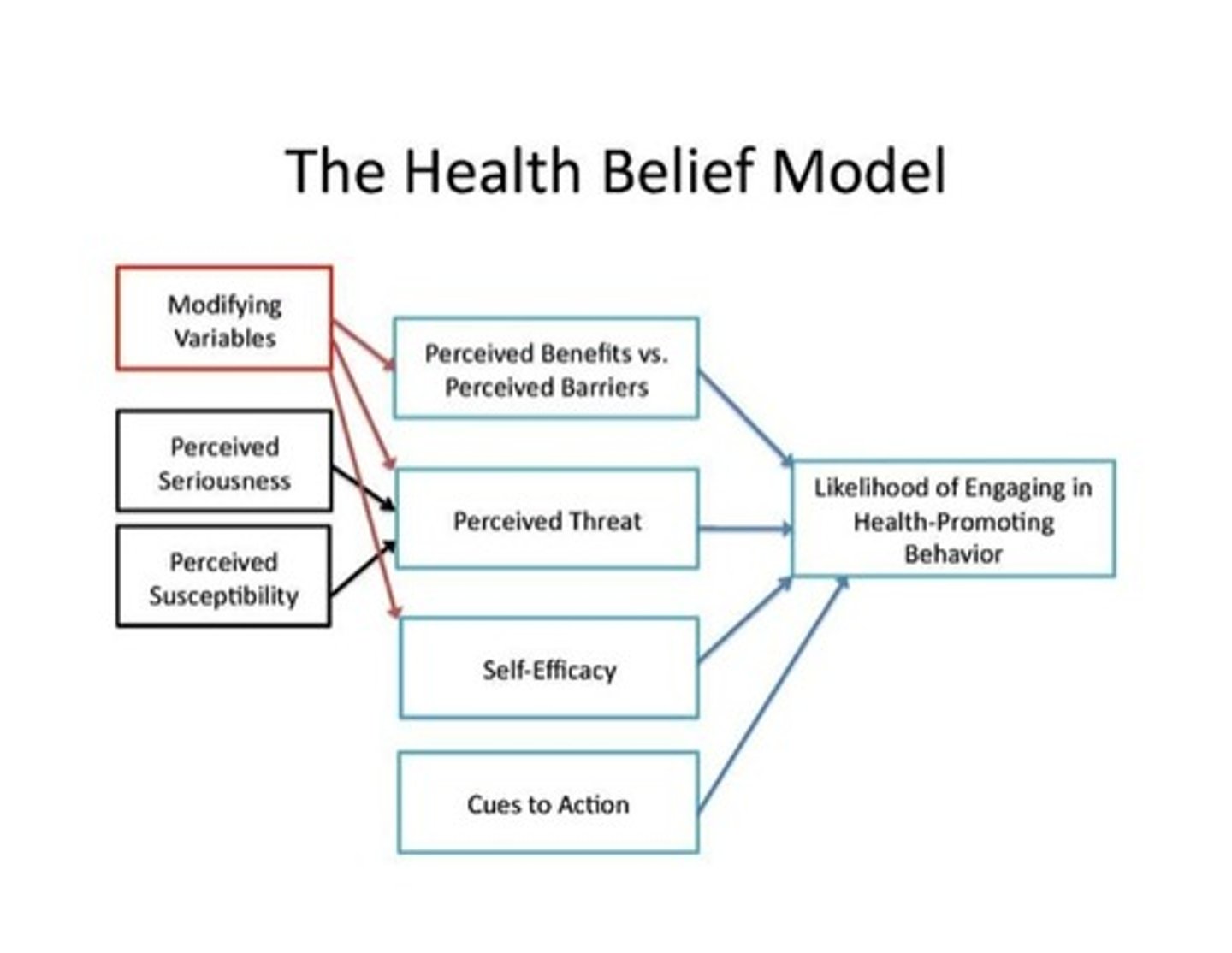
what is the The health belief model (Rowe stock, 1966)
This is a psychological theory that tries to explain why people do or do not engage in healthy behaviour.
perceived seriousness
perceived susceptibility
cost-benefit analysis
demographic variables
Cues to action from the external environment
persons self efficacy
what is percieved seriousness
how the person sees how severe the consequences would be and would either change their behaviour or not. It's not just about health, it includes other outcomes as well finding partners, effects of family, work social relationships.
what is perceived susceptibility?
A person has to believe that they are personally and realistically vulnerable to the illness or disease. If the person consider themselves exclusively not getting that illness and only certain people can, they do not consider themselves as susceptible
what is cost-benefit analysis
Perceived benefits of a health related action are balanced against obstacles that stop the person taking that action. Whether or not someone completes a health related action will depend on their analysis of whether the benefits outweigh the costs or vice versa.
Perceived benefits:
They have to believe that the action will bring benefits
Perceived barriers:
There also will be barriers to each individual that will make completing the action more difficult.
what are the examples Demographic variables
- gender
- age
- religion / culture
- race / ethnicity
- class / economic status / income / area
Cues to action from the external environment
Information that is presented to people may predispose them to be more or less to change their behaviour this then Affects their perceived seriousness/susceptibility.
People receive cues differently:
child from a parent
Teenager from social media
Parents from the news
Posters/leaflets/pamphlets/advertisement
Schools
Doctors
Friends
what is Person's self efficacy
persons belief of how capable they are to change their behaviour.
what are the strengths of the health belief model?
- Effectiveness and practical applications, use in developing practical interventions to change health-related behaviour. the HBM to devise a programme to increase the number of people seeking screening for bowel and colon cancers.
- Strong credibility, developed by health researchers and practitioners. The health researchers worked directly with people who wanted to change their health-related behaviours. Therefore the model is based on real-life experiences of health problems. This makes the HBM a credible explanation that is accepted by people who want to change their behaviour and the professionals who want to help them.
what are the weaknesses of the health belief model?
- multiple models, not been welcomed by everyone. Zimmerman and Vernberg (1994) argued that adding demographic and self-efficacy factors to the model means that the HBM becomes a different model altogether. This suggests that the HBM might not be one single model and could be attempting to be 'all things to all people'.
- how rational are we?, based on the assumption that people make rational decisions about their health behaviours. We supposedly weigh up the costs and benefits of a behaviour before deciding how to act.
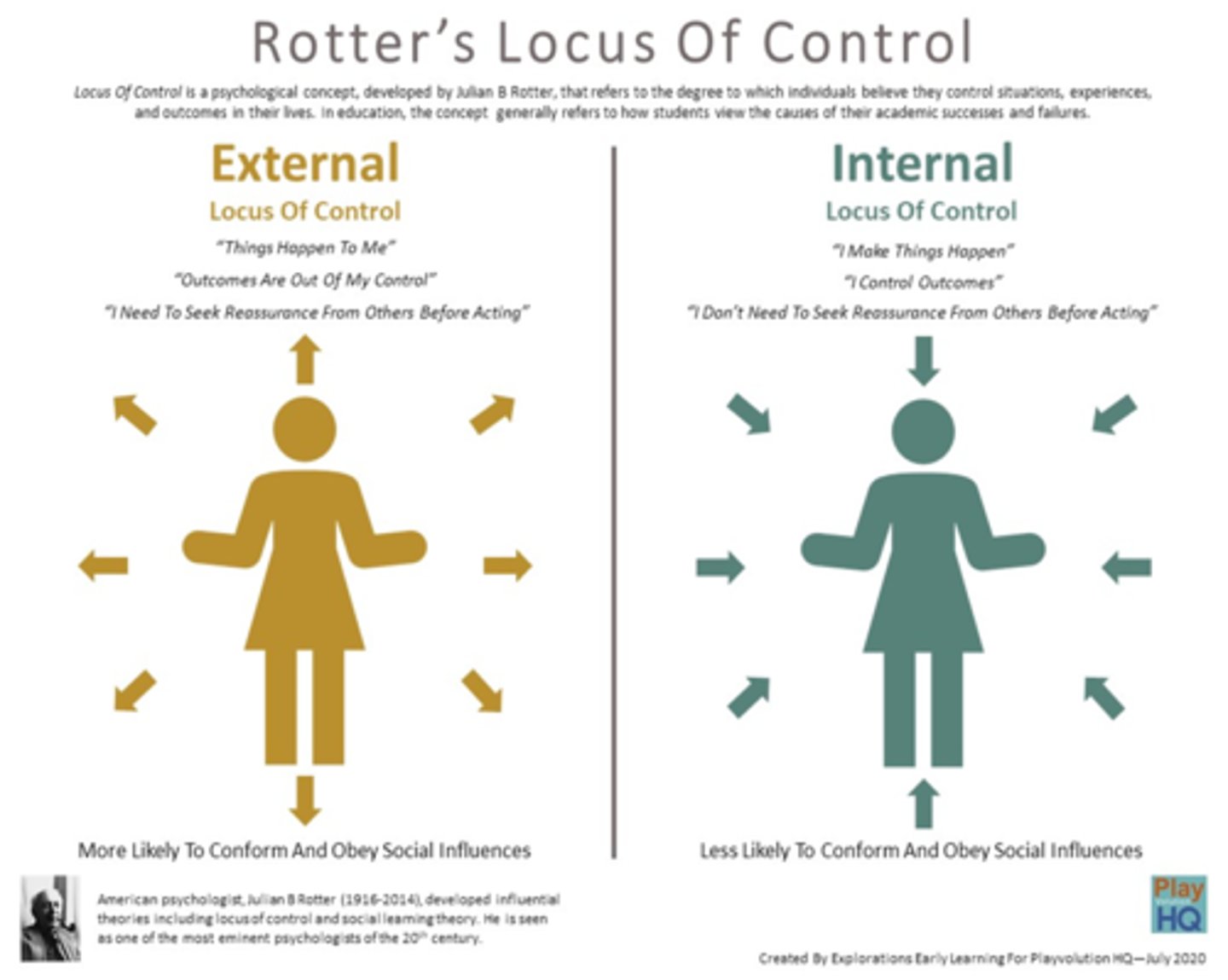
what is Locus of Control ?
Refers to a person's perception of personal control over their own behaviour.
what is internal locus of control?
High level of personal control over their lives and behaviour. Take personal responsibility for it. 'I made it happen!'
what is external locus of control?
The belief that life is determined by external/environmental factors, such as luck. 'Wrong place, wrong time!'
what are attributions ?
It is a process of explaining others and your own behaviours.
what is a strength of LOC?
- the link between an internal LOC and health is useful, interventions aimed at developing an internal LOC could be one way of helping people to gain health benefits later.
what is a weakness of LOC?
- the link between LOC and stress is not simple. it is too simplistic to suggest that LOC can account for individual difference in health-related behaviours. The traditional view is that extreme internals cope better with stress than extreme externals.
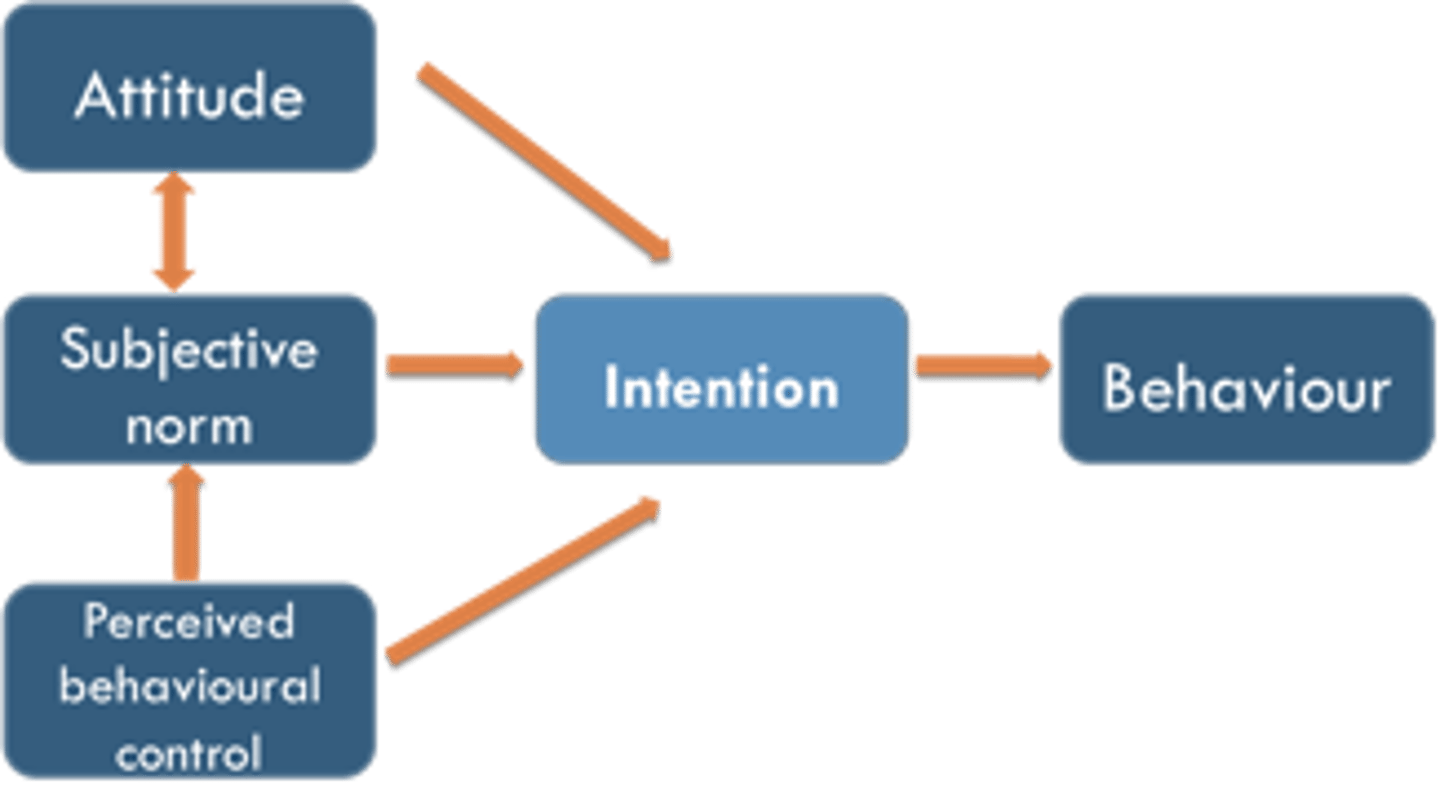
what is the theory of planned behaviour?
explain how people exercise control over their own behaviour. Assumption is that intention determines our behaviour. If we plan something we are likely to do it. It looks at our intentions to change our behaviour with actual changes in our behaviour.
attitudes towards the behaviour, subjective norms, perceived behavioural control.
what is the Attitudes towards the behaviour?
This can be a positive or negative evaluation of the behaviour and a belief about the outcome
example of Attitudes towards the behaviour
losing weight takes a long (negative evaluation) but it will improve my health significantly (positive evaluation).
what is subjective norms?
perception of other people’s attitude to the behaviour, i.e. family and friends.
example of subjective norms
will my friends approve the way i dress, i want their approval.. It is the person's belief whether their friend would approve/disapprove their style.
what is Perceived behavioural control?
How easy/hard to display a certain behaviour, there are two types of control.
what are the two types of control
Internal control - whether or not you believe you can perform the behaviour
External control - weather outside factors may influence your ability to do a behaviour
example of perceived behavioural control
if someone knows they can stop smoking by using nicotine packs and keep using less of them they are more likely to do it.
what are the strengths of theory of planned behaviour?
- Predicts intention rather than behaviour change:
Miller & Howell (2005)
Studied underage teenagers and their gambling
The found model was successful in predicting intention to change rather than actual behavioural change.
They couldn't predict using the model whether the teenagers would actually give up or not
what are the weaknesses of theory of planned behaviour ?
-too rational and focused on cognitions (thoughts):
Found that the model found it difficult to anticipate the strong desires and emotions in ppts. TPB cannot judge whether or not people will have strong desires/emotions about the thing they are planning/not planning to do.
-The TPB relies on the use of self report measures
-The TPB is a poor predictor of long-term changes.
what is self-efficacy?
the belief of an individual that they can perform and complete certain tasks
what are the 4 influences that affect self-efficacy ?
Enactive (mastery) influence
vicarious reinforcement
social persuasion
emotional state
what is Enactive (mastery) influence?
experience of performing a task successfully. When performing a task successfully it demonstrates that we are capable and we feel more competent increasing likelihood we do it again.
If we fail the tasks, our self-efficacy decreases and we are more likely to fail. This is bad if it happens before our self-efficacy is developed.
what is vicarious reinforcement?
Our self efficacy can be affected by watching others performing the tasks. If you observe the person being successful, your self-efficacy increases. If they fail your self-efficacy decreases. If the other person is similar to you, this can have a greater impact on your self-efficacy.
what is social persuasion?
Encouragement and discouragement from others can impact our self efficacy. If used correctly social and verbal persuasions adds to the person's self belief that they can succeed. The effects of social persuasion depend on the perceived credibility of the persuader.
what is emotional state?
how our mental/emotional state effect our self efficacy. If you feel stressed, anxious or fearful then your self-efficacy is reduced.
what are the strengths of self-efficacy theory?
- - Support from research
Victor Strecher reviewed many studies of self-efficacy. They found strong relationships between beliefs and behavioural change in the areas of weight control etc. it showed that self efficacy can be increased. It shows that it is consistent and reliable .
Effective practical applications
Offers several strategies that interventions can use to produce behavioural change
what are the weaknesses of self-efficacy theory
- Definition and measurement issues
Huge variation in how concepts of the theory are defined and measured.questions were unclear, open to interpretation and in many cases not measuring self-efficacy at all. May not be valid
- Backfire effects
Assumes that high self-efficacy is universally a positive thing. But can backfire. Can lead to overconfidence and make less effort in the tasks.
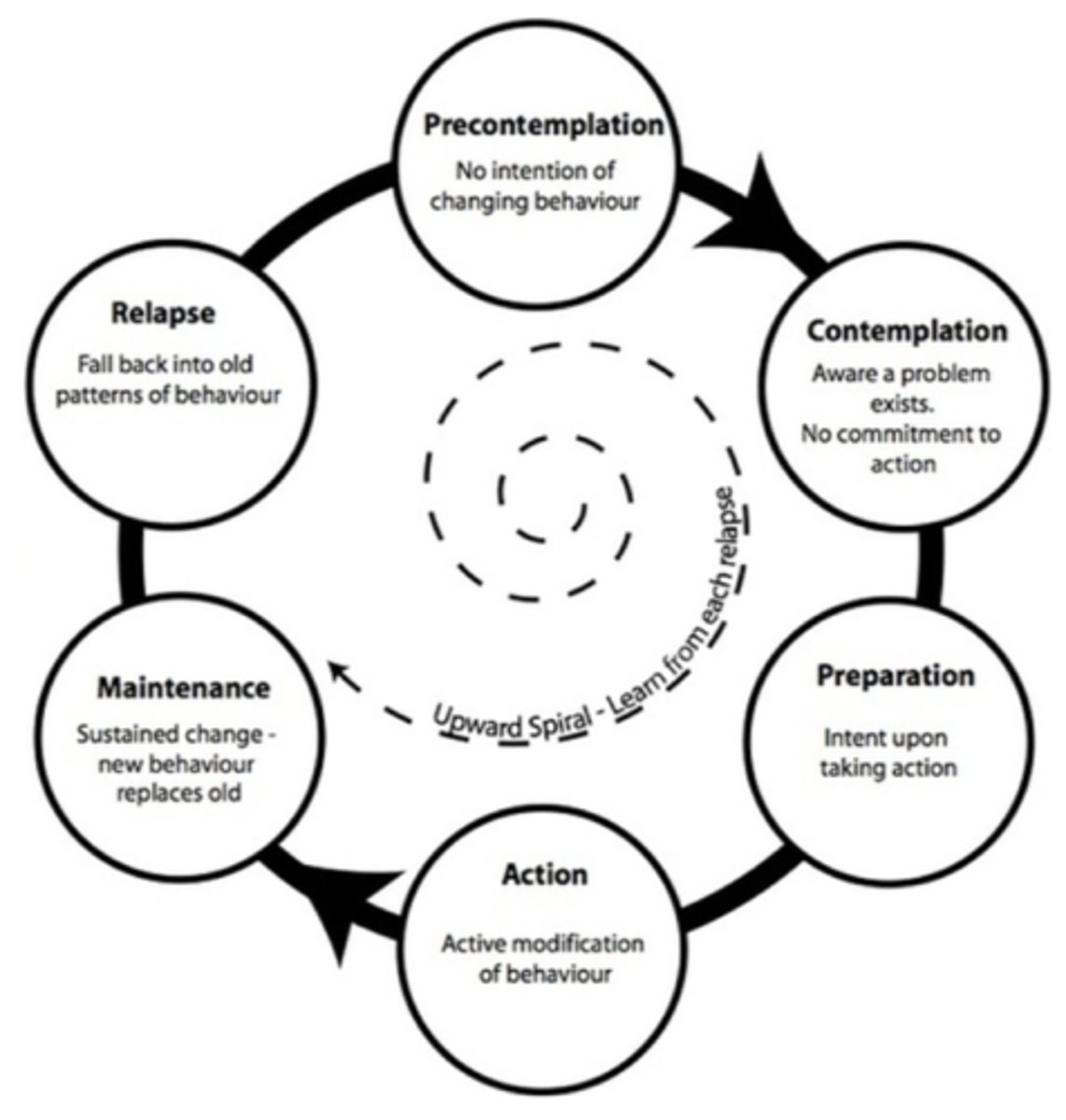
what is the Transtheoretical Model of Behaviour Change?
(TTM) is an integrative, biopsychosocial model used to conceptualize the process of intentional behaviour change — that is, an individual's readiness to act on new, healthier behaviour.
what are the stages of change?
pre-contemplation
contemplation
preparation
action
maintenance
what is pre-contemplation?
Do not intend to quit and start healthy behaviour in the near future and may be unaware of the need for change.
Underestimate the pros of changing, overestimate the cons.
individuals need to be more mindful and balance the pros and cons of their decision making.
what is contemplation?
Minted to quit and start more healthy in the next 6 months
Their pros and cons are balanced
This ambivalence about changing can cause them to keep putting off taking action.
Individuals in this stage learn about the benefits of change and the kind of person they could be if they quit and changed their behaviour to more healthy ways.
what is preparation?
Start taking action within the next 30 days. They take small steps that they believe can help them quit.
Helpful for individuals to seek support from friends they trust, tell people about their plan to change and think how they would feel if they behaved in a healthier way.
The better prepared they are, the more likely they are to keep progressing.
what is action?
Have changed their behaviour within the last 6 months and need to work hard to keep progressing in recovery.
Learn how to strengthen their commitments to change and fight urges.
They progress by learning to substitute activities related to unhealthy behaviour with positive ones. And avoiding people, places, things and situations that would keep them behaving unhealthy.
what is maintenance ?
They changed their behaviour more than 6 months to a lifetime.
It is important to be aware of situations that may tempt them to slip back to relapse. - particularly in stressful situations
Individuals at this stage are best served when they seek support and talk with people whom they trust, and who behave in a healthy way, remembering to engage in healthy activities to be able to cope with stress in a healthy way.
what are the strengths of the TTM?
- different interventions strategies are most effective at moving the person to the next stage of change. This is useful in developing treatments
- used to explain and treat people who are trying to quit smoking.
- views behaviour change as a dynamic process. It emphasises the importance of time. It's useful because it matches the experience of many people who try to change their behaviour
- useful in real life practice because it has a positive view of relapse. Is more acceptable to clients because they can see it is realistic about relapse.
what are the weaknesses of the TTM?
- The model assumes that individuals make coherent and logical plans in their decision making process when this is not always true. People often make decisions that don't make sense this isn't accounted for in this model.
- no clear sense for how much time is needed for each stage, or how long a person can remain in a stage, lowering the usefulness of the model.
- ignores the social context in which change occurs such as social class and income.
- Behaviour change is continuous so the model makes inappropriate assumptions that there are separate stages.
- Little research support for the stages of the model. Hard to distinguish one stage from another. Little usefulness for understanding changes over time and for treatment recommendations.
 Note
Note  Flashcards (20)