org. evolution - CH14 - group selection
 Call Kai
 Learn
Learn Practice Test
 Spaced Repetition
 Match
Match Flashcards
 Knowt Play
1/30

There's no tags or description
Looks like no tags are added yet.
Name | Mastery | Learn | Test | Matching | Spaced | Call with Kai |
|---|
No analytics yet
Send a link to your students to track their progress
31 Terms
What is group selection?
Selection where traits are favored because they increase group success, even if they decrease individual fitness.
Why does individual selection usually override group selection?
Because selfish individuals have higher fitness within groups and outcompete altruists, reducing altruism over time.
What is the key conceptual conflict between individual and group selection?
Selfishness is favored within groups, but altruistic groups outperform selfish groups.
What must be true for group selection to overcome individual selection?
Differences between groups must be strong enough that more cooperative groups produce more offspring than less cooperative groups.
What happens to altruists within a mixed group over time?
They decrease in frequency because they pay a cost while non-altruists receive benefits without paying the cost.
What determines whether altruism increases overall in a population?
The balance between within-group selection (against altruists) and between-group selection (favoring groups with more altruists).
How does kin selection explain altruism?
Altruism increases inclusive fitness if it helps relatives who share the same alleles reproduce
How does reciprocity explain altruism?
Individuals help others if the benefit will be returned in future interactions, increasing their own fitness later
How does group selection explain altruism?
Individuals sacrifice fitness, but groups with more altruists have higher overall success, indirectly benefiting individuals.
Why is altruism selected against within groups?
Altruists pay a cost (C) while others gain benefits (B), giving non-altruists higher fitness.
Why can altruistic groups still outperform selfish groups?
Because the cumulative benefits of cooperation increase total group fitness and reproductive output.
What is multilevel selection?
Selection acts simultaneously at multiple levels (individual and group), with opposing effects on traits like altruism.
What does “frequency of altruists is a group-level trait” mean?
The proportion of altruists affects group success and can be selected for at the group level.
What does Fisher’s principle predict about sex ratios?
Natural selection favors a 1:1 sex ratio because each sex contributes equally to future generations.
How can group or kin selection lead to biased sex ratios?
If producing one sex increases inclusive or group fitness more than the other, biased ratios can be favored.
Given the population parameters below, what should be the average fitness of an altruist in this population? (Assume interactions among individuals is random)
Effective pop size, Ne=100
Frequency of altruists, p=0.5
Baseline fitness, ω=10
Benefit to recipient, B=5
Cost to altruist, C=1
A. 6
B. 9
C. 10
D. 11.5
E. 14
D
Is altruism a stable strategy in this population?
Fitness of altruists = 11.47
Fitness of meanies = 12.53
A. Yes
B. No
C. I’m not sure
B
What do you predict would happen to a mutant lion lineage that evolved to limit its feeding rate in order to keep its prey species from going extinct?
A. It would go extinct because it is eating less and therefore would leave behind less offspring.
B. It would become more frequent because it is ensuring that its food supply is sustainable.
C. I’m not sure.
A
The average speed of a herd of deer is 29.5 mph. The slowest individual deer is caught by a panther, so the average speed of the herd increases to 30 mph. Was this an example of group selection?
A. Yes
B. No
C. I’m not sure
B
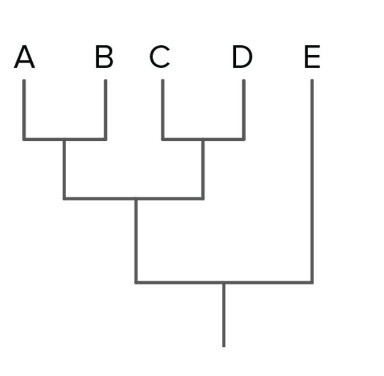
In this phylogenetic tree, which species is most closely related to E?
A. A
B. B
C. C
D. D
E. All of them are equally related to E
E
What is an example of a group-level trait?
A. Intelligence
B. Color
C. Diversity
D. Aggression
E. Clutch size
C
A pregnant female parrot flies to a new island. Each clutch of eggs laid by parrots comprises 10 eggs. Given a 1:1 sex ratio, how many grandchildren (F2) will this parrot produce on this island?
A. 10
B. 20
C. 50
D. 100
E. 500
C
A pregnant female parrot flies to a new island. Each clutch of eggs laid by parrots comprises 10 eggs. Given a 9:1 female-biased sex ratio, how many grandchildren (F2) will this parrot produce on this island?
A. 9
B. 18
C. 81
D. 90
E. 162
D
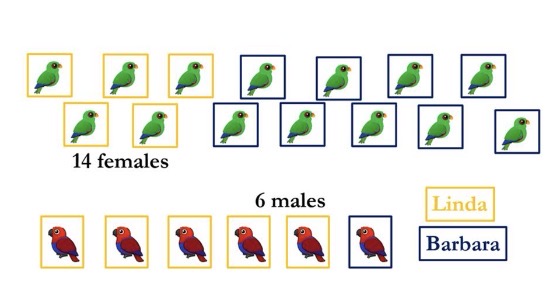
Two pregnant female parrots fly to a new island. Linda produces a 1:1 sex ratio of offspring, and Barbara produces a 9:1 female biased ratio of offspring. Each clutch of eggs laid by both parrots comprises 10 eggs. Assuming that mating is random, how many grandchildren will Linda produce on this island?
A. 50
B. 100
C. 113
D. 150
E. 167
E
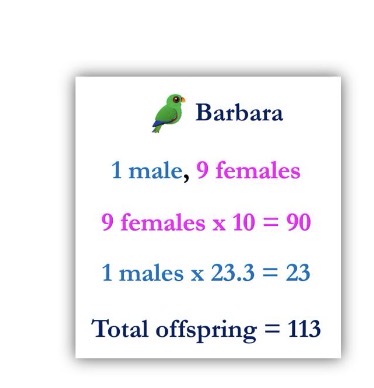
Are biased sex ratios evolutionarily stable?
A. Yes
B. No
C. Not sure
B
In humans, a single gene is responsible for whether earwax is wet or dry, where the dominant allele (E) is associated with wet earwax. A population of humans shows this proportion of genotypes:
0.5 EE, 0.2 Ee, and 0.3 ee. Is the population evolving?
A. Yes, it is evolving
B. No, it is not
A
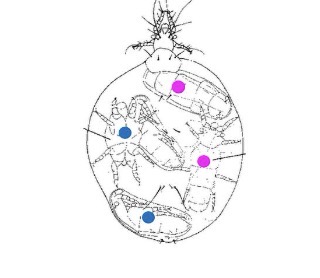
Consider a mite species where females always produce four offspring that mate before they emerge from the mother. How many grandchildren (F2) would it produce if it produced offspring in a 1:1 sex ratio?
A. 4
B. 8
C. 12
D. 24
B
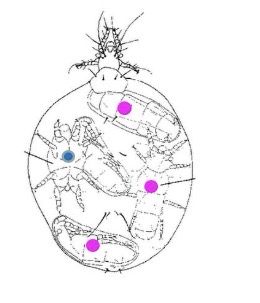
Consider a mite species where females always produce four offspring that mate before they emerge from the mother. How many grandchildren (F2) would it produce if it produced offspring in a 3:1 female to male sex ratio?
A. 4
B. 8
C. 12
D. 24
c
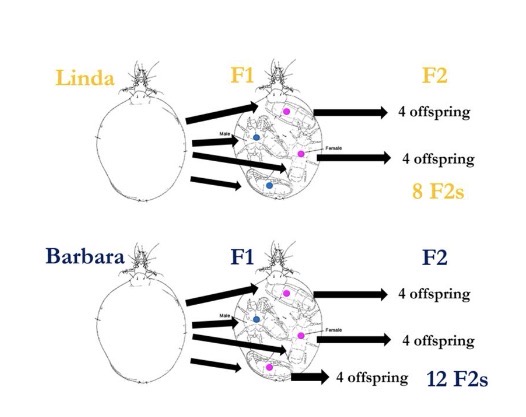
Is this biased sex ratio evidence of group selection?
A. Yes
B. No
C. Maybe
B
In 4 o’clock flowers, a single gene is responsible for flower color, where RR = red flowers, RW = pink flowers, and WW = white flowers. If the pink flowers are visited by pollinators more often, what should become of our two color alleles?
A. The R allele should go extinct
B. The W allele should go extinct
C. Both R and W should be maintained in the population
C
An allele, Q, is advantageous, leading to a 50% increase in number of offspring in its possessor. The Q allele is also a victim of meiotic drive from its rival allele and only shows up in 45% of germ cells. If all else is equal, how should the frequency of the Q allele change in the population?
A. It should increase
B. It should decrease
C. It should stay the same
A

