Alternating Current [INCOMPLETE]
 Call Kai
 Learn
Learn Practice Test
 Spaced Repetition
 Match
Match Flashcards
 Knowt Play
1/20

Earn XP
21 Terms
What are the two conditions required for a current to be an alternating current?
Amplitude is constant
Alternate half cycle is positive and negative
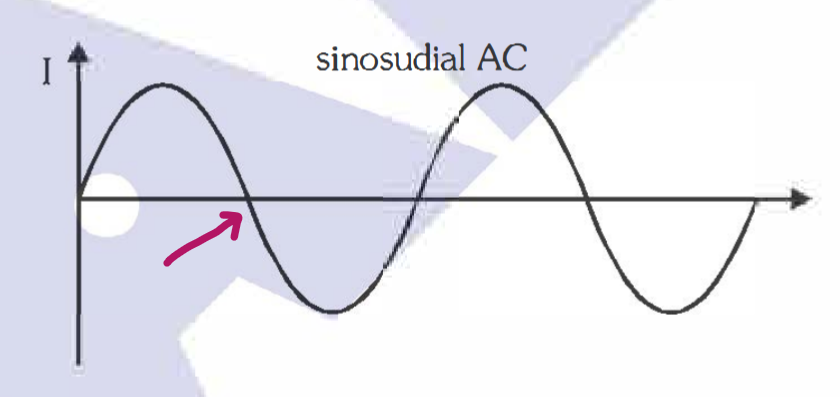
If I=I0sin(ωt) then what is the value of the x axis at this point?
ωπ
What is average emf for 1 time period?
0
What is the formula for average emf in half a time period? (there are 3)
εavg=Δtarea under ε-t curve=∫dt∫ε dt=π2ε0
where ε0 is the peak voltage.
What is the formula for average current in half a time period? (there are 3)
Iavg=Δtarea under I-t curve=∫dt∫I dt=π2I0
where I0 is the peak current.
What is the formula for rms value of current?
Irms=<I2>=∫dt∫I2 dt=2I0 (the last one is for sinusodial current)
for two currents:
Irms=<(I1+I2)2>=2sum of squares of peaks
What is the formula for peak value of current when there are multiple currents for which you know the peaks?
Ipeak=sum of squares of peaks
What is the formula for rms value of voltage?
Vrms=<V2>=∫dt∫V2 dt=2V0 last one is for sinusodial emf)
AC-measuring instruments always measure ____ (peak, rms) value of current/voltage. Why?
AC-measuring instruments always measure rms value of current/voltage, because they measure the heating effects of it.
In a purely resistive circuit, what is the phase difference between current and voltage? Which one leads the other?
0, neither leads.
In a purely inductive circuit, what is the phase difference between current and voltage? Which one leads the other?
phase difference is 2π and voltage leads current.
In a purely capacitive circuit, what is the phase difference between current and voltage? Which one leads the other?
phase difference is 2π and current leads voltage.
What is the formula for capacitive reactance?
XC=ωC1
What is the formula for inductive reactance?
XL=ωL
What does the graph look like for ε,I by t in a purely resistive circuit?
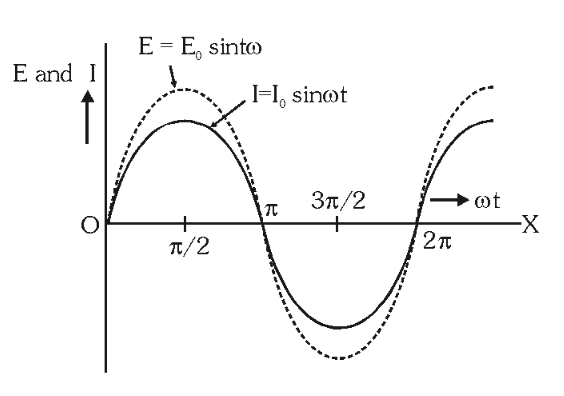
What does the graph look like for ε,I by t in a purely inductive circuit?
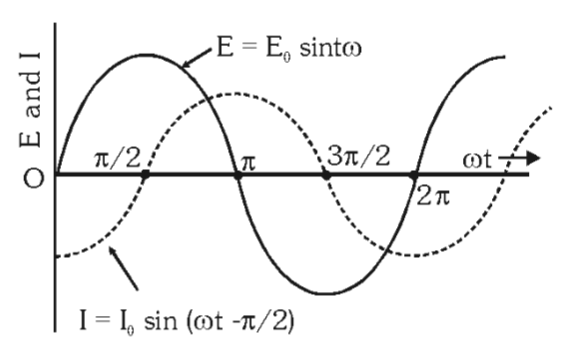
What does the graph look like for ε,I by t in a purely capacitive circuit?
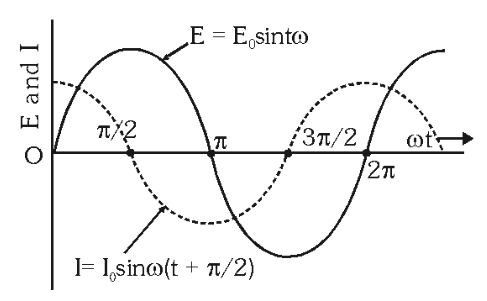
When AC flows through a circuit, what is the emf induced in an inductor? Explain why it is positive or negative sign.
ε=−LdtdI
it is negative because the emf induced is in opposite polarity to the emf applied.
What is the unit of reactive inductance and reactive capacitance?
Ohm
Which of the following is true:
XL∝f
XL∝f1
XL∝f