Child Development Final
 Studied by 0 people
 Call Kai
 Learn
Learn Practice Test
 Spaced Repetition
 Match
Match Flashcards
 Knowt Play
1/81

There's no tags or description
Looks like no tags are added yet.
Name | Mastery | Learn | Test | Matching | Spaced | Call with Kai |
|---|
No analytics yet
Send a link to your students to track their progress
82 Terms
Erikson’s Stage 3
Initiative vs. Guilt
6-12 years old
Adult expectations and children’s drive toward mastery lead children to this psychological conflict
Children have the desire to make and do things!
Conflict resolved positively when children develop a sense of competence at useful tasks (industry)
Erikson’s stage 3 continued
motivation to be productive in addition to play
Context: school learning, interactions with peers
In school, children gain adult skills (reading and writing)
Danger of inadequacy or inferiority = having little confidence in one’s ability to do things well
Morality
An appreciation of standards of conduct based on empathy and social understanding
Emotional Component
Cognitive Component
Behavioral Component
3 components of Morality
Emotional Component
Feel empathy, guilt
Cognitive Component
social understanding and judgements about right vs. wrong
Behavioral Component
Actually doing what’s right
Internalization
Moral development is viewed as a process of internalization
adopting societal standards for right action as one’s own
Results from a combination of influences within the child and the rearing environment
Parents discipline
Child’s age, temperament
Parents characteristics
Perspectives on Moral Development
Biological
Evolutionary, genetic
Psychoanalytic
Empathy based guilt, Freud
Social Learning
Modeling moral Behavior
Behaviorist
Rewards and punishment
Cognitive Developmental
Children as active thinkers about social rules
Inductive Discipline
Helps child notice others’ feelings
point out effects of misbehavior on others
note others distress
make clear the child caused the distress (empathy based guilt)
Characteristics of good moral behavior
Warmth and responsiveness
Competence and power
Consistency between words and behavior
Positive Discipline
Build Mutually respectful bond
Let child know how to act
praise mature behavior
Children as active thinkers
By age 4…
Children consider intention in making moral judgements
Children can recognize lying vs. truthfulness
Children distinguish among
Moral imperatives
social conventions
matters of personal choice
Piaget’s theory of moral development
Heteronomous Morality vs Autonomous Morality
Heteronomous Morality
5-10 years old
View rules as handed down by authorities, permanent, unchangeable, strict obedience
Judge wrongness by outcomes not intentions
Autonomous Morality
10 years +
Rules are seen as socially agreed on, changeable
Standard of ideal reciprocity (Golden rule)
Judge others on outcomes and intentions
Development of Distributive Justice
Equality: 5-6 years
same amount
Merit: 6-7 years
Effort or winning is rewarded
Benevolence: around 8 years
take into account children’s special circumstances
Moral Autonomy
Ability to think for oneself when deciding between right and wrong, coupled with a desire to act morally that is independent of rewards and punishments
Development of Aggression
Aggressive acts by age 2
Proactive or instrumental aggression
to get what they want
Reactive or hostile aggression
Angry or defensive, intent to cause harm
3 forms of aggression
Physical aggression
punch kick
Verbal Aggression
threats, hostile, teasing
Relational Aggression
social exclusion, gossip
Gender schema theory
Environmental pressures and children’s cognitions work together to shape a gender-role development
Actively thinks about gender and if their gender should do something
Gender social learning theory
Promotes gender typed behaviors
Piaget’s theory of development in middle childhood
Concrete operational Stage (7-11 years)
Concrete operational Stage
Cognitive Achievements
Conservation
Decentration
two attributes in mind at the same time
Reversibility
Classification
group objects based on certain characteristics
Seriation
Transitive inference
some 6 year old’s, most 8 year old’s
Limitations of concrete operational thought
Operations work best with objects that are concrete
Problems with abstract ideas
Horizontal Decalage
Development withing a Piagetian stage, gradual mastery of logical concepts
number, length, liquid, mass conservation in that order
Self-Concept in Middle Childhood
Refinement of self concept
Describe selves in terms of personality traits
Emphasize competencies
Frequent social comparisons
Judgements of their appearances, abilities, and behavior in relation to others
Self descriptions now include reference to social groups
Self Esteem in middle childhood
Preschoolers: very high self esteem
Middle Childhood: Adjusts to more realistic level
Why?
Receive feedback from peers and teachers
Social Comparisons
Hierarchical Structure of self esteem in middle childhood
Academic Competence
Math reading other subjects
Social Competence
Relationships with peers
Physical/Athletic competence
Team sports running dance
Physical appearance
Height weight, facial features
Self Esteem and motivation
Children with high self esteem and academic motivation make mastery oriented attributions
hold an incremental view of ability
believe that abilities can be improved by putting in effort and practice
Other children display learned helplessness
Have gotten used to failure and believe it is inevitable
Attribute failure to ones own lack of ability
attribute success to luck
Parent and Teacher Influences on Achievement related attributions
Person Praise: emphasizes child’s traits (you’re so strong)
Process Praise: Emphasizes behavior and effort ( you really spent a lot of time on that!)
Teachers who emphasize learning over grades tend to have mastery oriented students
Development of Peer Sociability
Middle Childhood and Adolescence
More advanced Theory of Mind and perspective taking
More peer communication
More prosocial behavior
Rough and tumble play
Dominance hierarchy
ordering of group members that predicts who will win when conflict arises
Parental Influences on Peer relations
Direct
Arrange informal peer activities
Guidance on how to act towards others
monitoring activities
Indirect
Secure attachment
Authoritative parenting
Parent-Child Play
Parent’s own social network
Thinking about Friendship
Handy playmate (4-7 years)
Mutual trust and assistance (8-10 years)
Intimacy, mutual understanding and loyalty (11-15 years)
Selectivity and Stability of friendships
More selective with age
From 4-6 best friends to 1-2 in adolescence
Remarkably stable at all ages
younger children are more dependent on environment
middle childhood, 50-70% endure over a school and many for several years
Friendships that cut across multiple contexts tend to be the most stable
Interactions between friends
Compared to non-friends, friends have more
positive interactions
emotional expression
prosocial behavior
self disclosure
Also more disagreement and competition
aggressive friends can lead to hostile relationship
Benefits of friendship
Opportunities to explore self
Form deep understanding of another
Foundations for future intimate relationships
help deal with life stress
Can improve attitude and school involvement
Peer Acceptance
Likability
Extent to which a child is viewed by a group of agemates as a worthy social partner
SOCIOMETRICS: research techniques that measures children’s social preferences (Peer nomination)
Peer acceptance categories
Popular: popular prosocial, popular antisocial
Rejected: Rejected aggressive, rejected withdrawn
Controversial
Neglected
Popular – get many positive votes and are well liked
Rejected – get many negative votes (dislked)
Controversal – receive many votes, postive and negative and are liked and disliked
Neglected – seldom mentioned either positively or negatively
Average – receive average number of positive and negative votes
Neglected children tend to be well adjusted
Determinants of peer acceptance
Popular prosocial
Academically and socially competent, solve social problems constructively, friendly
Popular antisocial
Tough kids who defy authority, relationally aggressive, may be athletically skilled “cool”
Rejected Aggressive
Negative social behaviors, high aggression and conflict, impulsive, hyperactive
may become bullies
Rejected withdrawn
Passive, socially awkward, socially anxious
may become victims
Both types of rejected children are at risk for peer harassment
Bullies
Most are boys
physically, relationally aggressive
high status, powerful, popular
eventually become disliked
Victims
Passive when should be active
Give in to demands
lack defenders
inhibited temperament
physically frail
overprotected, controlled by parents
Cliques
Small Groups of 5-7
good friends
identified by interests, social status
popular vs unpopular
Crowd
Larger, several cliques
membership based on reputation, stereotype
Adolescence
Transitioning between childhood and adulthood
Puberty occurs in beginning of adolescence
Length varies among cultures
Tribal societies have shorter phase
industrialized societies have longer phases
early adolescense (11-14)
Middle adolescence (14-16)
Late adolescence (16-18)
Puberty
Biological events that lead to an adult body and sexual maturity
Adolescent Brain development: Prefrontal cortex
Prefrontal cortex development
the governor of thought and action
prefrontal cortex becomes a more effective executive (managing and integrating brain areas)
Executive function is still developing
tasks requiring inhibition, planning, future orientation
Greater linkage between cerebral hemispheres and better communication between other brain areas
Adolescent risk taking development
Neurons are more responsive to excitatory neurotransmitters as a result of puberty
drive for novel experiences
react strongly to stressful events
experience pleasurable stimuli more intensely
sensitive to social stimuli (peer pressure)
Changes in the brains social/emotional network outpace development of the cognitive-control network which leads to increased risk taking
drugs, reckless driving, unprotected sex,
Adolescent Sleep Development
Changes in the brain regulation of sleep timing
Increased neural sensitivity to evening light, circadian delay, stay up later
stay up later but can’t sleep in because of HS start times
Sleep deprivation
Sluggish cognitive performance
anxiety, irritability, depressed mood
Lower academic performance
How much sleep do teens need?
9 hours
sleep rebound on weekends leads to difficulty falling asleep on sunday which makes the cycle worse
Piaget’s Formal Operational Stage
Abstract thought
11+ years old
Hypothetico Deductive Reasoning
Deductive hypotheses from a general theory
Pendulum problem
Propositional thought
Evaluating the logic of verbal propositions
if… then…
Consequences of abstract and egocentric though for teens
Self conscious and self focusing
Imaginary audience (everyone ins watching me)
Personal Fable
nobody knows what this is like
Adolescent cognitive development: Information Processing
Cognitive gains
More selective attention
inhibition improves
strategies more effective for encoding and retrieval
knowledge increases
metacognition and problem solving improves
cognitive self regulation improves (Redirecting, thinking, monitoring, evaluation)
Working memory increases
processing speed increases
From cliques to dating
Boys and girls cliques come together
mixed sex cliques hang out
groups of several couples forms and spend time together
individual couples
Changes in dating during adolescence
Goals change throughout adolescence
Early: recreation, group activities, shallow intimacy
Gradually look for more intimacy
Relations with parents, friends contribute to internal working models for dating
The Identity puzzle Erikson stage
Identity vs. role confusion
adolescence is the time when individuals must initiate the process of identity formation, attempting to resolve their identity in both the personal and social spheres in order to form an adult identity
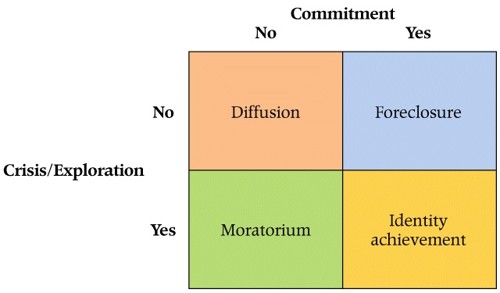
Four stages of adolescent identity formation proposed by Marcia
Emerging adulthood stage of development
New transitional developmental period from the late teens to the mis 20s (18-25)
Jeffrey Arnett (2011) defines this stage by 5 features
Feeling in between
identity exploration
Self Focused
Instability
Possibilities
How has the cultural change and variation contributed to emerging adulthood?
Higher education delays financial independence and career commitment
Gains in life expectancy in prosperous nations → less pressure on young people’s labor → more time for moratorium
Strong association with SES and higher education
Brain Development in Emerging Adulthood
Further brain development in the prefrontal cortex
Fine tuning of neural networks
planning, reasoning, decision making
Further connections between prefrontal cortex and other brain regions
Further experience-dependent brain growth as a result of specialized work/ education experiences
Piaget’s Postformal Thought
Cognitive development beyond formal operations
College students encounter new ideas, freedoms, opportunities that combine with personal effort to promote thinking that is increasingly…
Rational flexible
practical
accepting of uncertainties
variable across situations
Adolescent thinking is more idealistic
Cognitive changes “Epistemic Cognition
William Perry (1981) work on students reflections on knowing
students thinking about how they arrived at certain knowledge (facts, belief)
Gradual transition
Dualistic thinking
Relativistic thinking
Commitment within relativistic thinking
Erikson’s Intimacy vs. Isolation
Young adults (19-40) have need to form intimate, loving relationships with other people
Those who have not developed a sense of identity may retreat or have trouble forming lasting intimate or romantic relationships
Romantic Relationships (General Trends)
Longer lasting than adolescence
Involved greater trust, support, commitment, emotional closeness
May take time to forge a committed relationship
By age 25 nearly all people are sexually active
Emerging adults have more sexual partners than adults in their 30s
Partner similarity, good communication, and a secure internal working model of attachment predict happy, lasting relationships
Romantic relationships in College
Uncommitted sexual encounters, hookups, friends with benefits
two thirds report at least one hook up
¼ report 10+
Associated with other risk taking behaviors (drugs alcohol, unprotected sex)
Romantic relationships: Dating, cohabitation, Marriage
More that 1/3 of single adults use dating websites
2nd most common way of meeting a partner, behind being introduced through friends
Prolonged computer mediated communication can lead to “idealizing” and disappointment face-to-face
Cohabitation in the preferred “mode of entry” into a committed relationship for 70% of romantic partners under age 30
Committed partners report more satisfying sexual encounters than single people
Married couples are on average, more financially stable, and more physically and mentally healthy than unmarried individuals
Work Life
Emerging adults’ work experiences increasingly focus on preparation for adult work roles
Construct a “dream”
Men: a career (independent achiever)
Women: Career and marriage and concerns about combining work and family responsibilities
What helps emerging adults meet their goals?
relationships with mentors
quality of higher education
many colleges are not rigorous enough to support success in the work world
Religious and spiritual development
In emerging adulthood, attendance at religious services drops to its lowest level of the lifespan
less pressure form parents
question own beliefs
identity development
Many begin to construct their own individualized faith
As with adolescents, emerging adults who are religious or spiritual, tend to be better adjusted
Less depression/anxiety
higher self esteem
more community service
less risky behavior
50% of U.S. young people remain stable in their religious commitment (or lack thereof) from adolescence into emerging adulthood
Of the small number of individuals who increase in religosity during emerging adulthood, most are women, hispanic, and african american
Risk and resilience in emerging adulthood
Risks
Lack of direction
High anxiety
loneliness
risky behaviors
social disengagement
academic problems
Resilience
Cognitive attributes
planning, decision making
academic achievement
Emotional and social attributes
self esteem
conflict resolution skills
emotional self regulation
Social Supports
Parents, friends, teachers, mentors
Erikson’s Theory
Trust vs. Mistrust
Age: Birth–1 year
Conflict: Can I rely on others to meet my needs?
Key idea: Consistent, responsive caregiving leads to trust; inconsistent care leads to mistrust.
Outcome: Hope
Autonomy vs. shame and doubt
Age: 1–3 years
Conflict: Can I do things on my own?
Key idea: Toddlers seek independence (walking, toilet training). Support leads to autonomy; overcontrol leads to shame/doubt.
Outcome: Will
Initiative vs. Guilt
Age: 3–6 years (early childhood)
Conflict: Can I take initiative and plan activities?
Key idea: Encouragement of play and leadership fosters initiative; criticism leads to guilt.
Outcome: Purpose
Industry vs inferiority
Age: 6–11 years (middle childhood)
Conflict: Am I competent?
Key idea: Success in school and tasks leads to industry; repeated failure leads to inferiority.
Outcome: Competence
Identity vs confusion
Age: Adolescence (≈12–18)
Conflict: Who am I?
Key idea: Teens explore values, beliefs, and goals. Successful exploration leads to identity; lack of exploration leads to role confusion.
Outcome: Fidelity
Intimacy vs isolation
Age: Young adulthood (≈18–25/30)
Conflict: Can I form close relationships?
Key idea: Ability to form deep, committed relationships results in intimacy; failure leads to isolation.
Outcome: Love
Piaget’s Stages
Sensorimotor stage
0-2
explore through senses and motor actions
Preoperational
2-7
Symbolic thought: Use of words, images, pretend play
Egocentrism: Difficulty seeing others’ perspectives
Centration: Focus on one aspect of a situation
Animistic thinking: Belief that inanimate objects have lifelike qualities
Irreversibility: Cannot mentally reverse actions
Concrete Operational
7-11
Conservation: Understanding quantity remains the same despite changes in appearance
Decentration: Focus on multiple aspects of a problem
Reversibility: Can mentally undo actions
Classification: Ability to group objects into categories
Seriation: Ordering objects by size or number
Passing inclusion tasks
Formal Operational
11+
Abstract thought: Thinking beyond concrete objects
Hypothetico-deductive reasoning: Formulating and testing hypotheses
Propositional thought: Evaluating logic of statements without real-world reference
Scientific reasoning
Pendulum problem: Systematic testing of variables
Post operational
Which of the following is a cognitive limitation for children in Piaget’s stage of Concrete Operations?
inability to think abstractly
Maria sees the boys playing dodgeball at recess and thinks to herself, "I'm not going to play dodgeball because I'm not a boy and only the boys play dodgeball at recess." Maria is demonstrating _____________ when she decides not to play.
gender schema theory
One explanation for why concrete operational children pass conservation tasks is that they display
decentered thinking
In Erikson's fourth stage, children have a desire to be productive and to use their new skills of reading and writing that they are learning in school. They are driven to "make things and do things" well. This middle childhood stage of Erikson's theory is called __________ vs. Inferiority.
Industry
A child who believes that students who read the most independent reading books should get more prizes from the treasure box than students who read fewer books is in the MERIT stage of distributive justice.
True
James feels guilty after stealing a dollar from his mother's purse. The guilt that James feels is considered which component of morality?
emotional
Many children are taught to have good manners at the dinner table, to hold doors for others, and to respect their elders. These standards are examples of
Social Conventions
Aidan shoved Billy on the playground at daycare because Billy said he wasn't good at kickball. Which form of aggression did Aidan display?
hostile
Self-concept in middle childhood often includes the social groups to which children belong (sports teams, clubs, scouting groups etc.).
True
Which of the following is NOT a true statement about peer relationships during middle childhood?
Kids in middle childhood are in the "handy playmate" stage of friendship.
Abstract thought
Ability to think about ideas and concepts that are not physically present
Goes beyond concrete objects and experiences
Examples:
Thinking about justice, freedom, love
Solving algebraic equations (e.g., x + 3 = 7)
Contrast: Children in earlier stages need concrete, visible objects
Hypothetico Deductive reasoning
Ability to generate hypotheses and systematically test them
Thinking logically about “what could be” rather than just “what is”
Involves:
Forming a hypothesis
Testing one variable at a time
Drawing logical conclusions
This is a hallmark of formal operational thinking
Pendulum Problem
Classic task used by Piaget to test hypothetico-deductive reasoning
Task: Determine what makes a pendulum swing faster or slower
Possible variables:
Length of the string
Weight of the object
Height of release
Correct approach: Change one variable at a time
Finding: Adolescents (formal operational stage) systematically test variables; younger children try random combinations
Propositional thought
Ability to evaluate the logic of a statement without needing real-world confirmation
Focuses on whether a statement is logically valid, not whether it is true in reality
Example:
“If dogs are purple and purple things fly, then dogs can fly.”
Even though it’s unrealistic, the logic is correct
Emerges in the formal operational stage
4 Revolutions
Technology revolution
manufacturing economy → knowledge economy
Sexual Revolution
birth control has broken the link between sexuality and marriage and parenthood
Women’s Movement
Women are in college just as much as men
changed how women thought about their lives
delay marriage, progress in career
Youth Movement
Adulthood is less a status of responsibility
Adulthood is diminished, young people prolonged their youth
 Note
Note  Flashcards (84)