AP Language and Composition: The Language of Composition General Terms
 Call Kai
 Learn
Learn Practice Test
 Spaced Repetition
 Match
Match Flashcards
 Knowt Play
1/94

There's no tags or description
Looks like no tags are added yet.
Name | Mastery | Learn | Test | Matching | Spaced | Call with Kai |
|---|
No analytics yet
Send a link to your students to track their progress
95 Terms
rhetorical appeals
Rhetorical techniques used to persuade an audience by emphasizing what they find most important or compelling. The three major appeals are the ethos (character), logos (reason), and pathos (emotion).
ethos
Greek for "character." Speakers appeal to ethos to demonstrate that they are credible and trustworthy to speak on a given topic. Ethos is established by both who you are and what you say.
counterargument
An opposing argument to the one a writer is putting forward. Rather than ignoring a counterargument, a strong writer will usually address it through the process of concession and refutation.
concession (concede)
An acknowledgement that an opposing argument may be true or reasonable. In a strong argument, a concession is usually accompanied by a refutation challenging the validity of the opposing argument.
refutation (refute)
A denial of the validity of an opposing argument. In order to sound reasonable, refutations often follow a concession that acknowledges that an opposing argument may be true or reasonable.
logos
Greek for "embodied thought." Speakers appeal to logos or reason, by offering clear, rational ideas and using specific details, examples, facts, statistics, or expert testimony to back them up.
connotation
Meanings or associations that readers have with a word beyond its dictionary definition, or denotation. Connotations are usually positive or negative, and they can greatly affect the author's tone.
pathos
Greek for "suffering" or "experience." Speakers appeal to pathos to emotionally motivate their audience. More specific appeals to pathos might play on the audience's values, desires, and hopes, on the one hand, or fears and prejudices, on the other.
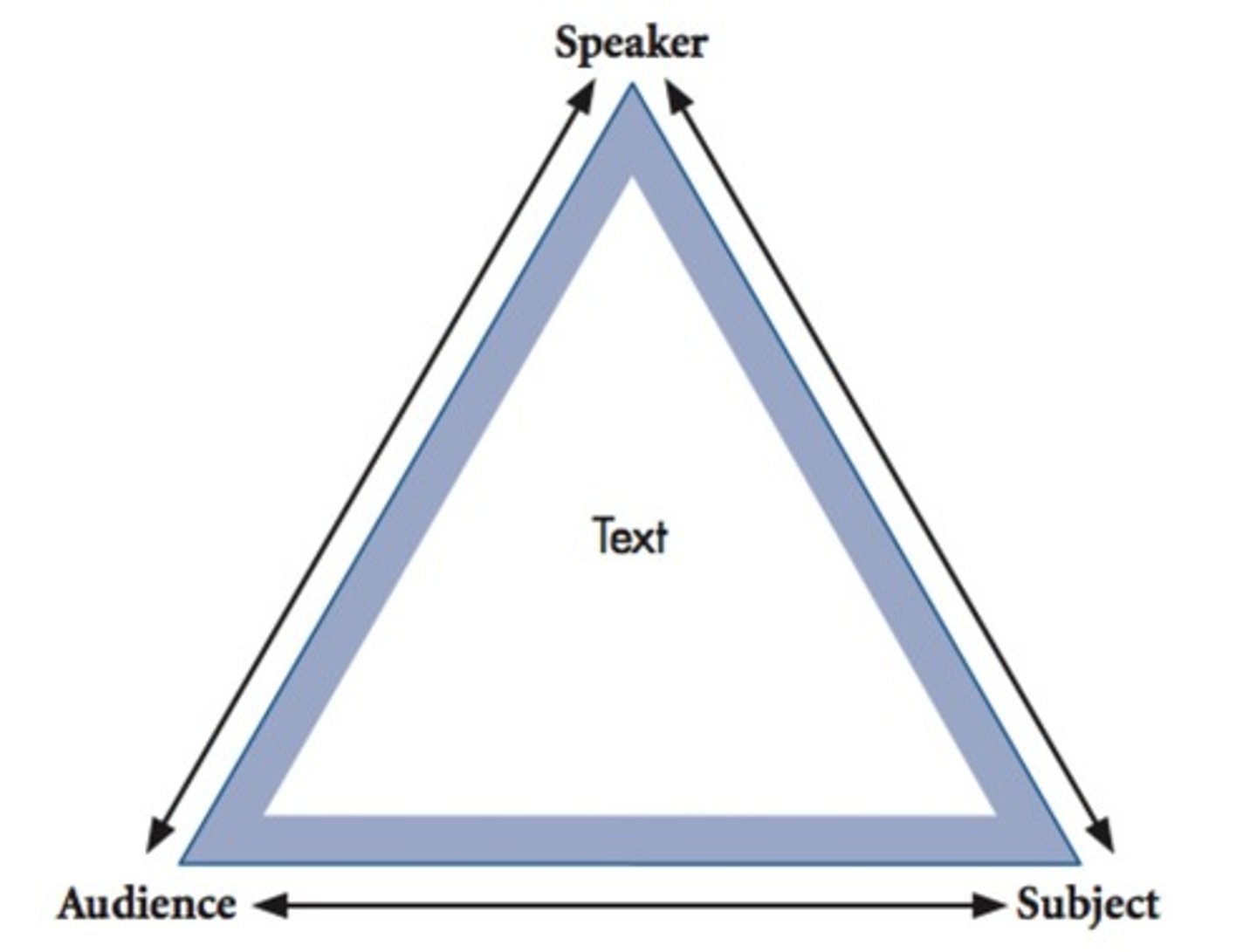
Rhetorical Triangle
A diagram that illustrates the interrelationship among the speaker, audience, and the subject in determining a text.
audience
The listener, viewer, or reader of a text. Most texts are likely to have multiple audiences
context
The circumstances, atmosphere, attitudes, and events surrounding a text.
occasion
The time and place a speech is given or a piece is written.
persona
Greek for "mask." The face or character that a speaker shows to his or her audience.
polemic
Greek for "hostile." An aggressive argument that tries to establish the superiority of one opinion over all others. Polemics generally do not concede that opposing opinions have any merit.
propaganda
The spread of ideas and information to further a cause. In its negative sense, propaganda is the use of rumors, lies, disinformation, and scare tactics in order to damage or promote a cause.
purpose
The goal the speaker wants to achieve.
rhetoric
As Aristotle defined the term, "The faculty of observing in any given case the available means of persuasion." In other words, it is the art of finding ways to persuade an audience.
SOAPSTone
A mnemonic device that stands for Subject, Occasion, Audience, Purpose, Speaker, and Tone. It is a handy way to remember the various elements that make up the rhetorical situation.
speaker
The person or group who creates a text. This might be a politician who delivers a speech, a commentator who writes an article, an artist who draws a political cartoon, or even a company that commissions an advertisement.
subject
The topic of a text; what the text is about.
text
While this terms generally means the written word, in the humanities it has come to mean any cultural product that can be "read"-meaning not just consumed and comprehended, but investigated. This includes fiction, nonfiction, poetry, political cartoons, fine art, photography, performances, fashion, cultural trends, and much more.
diction
The speaker's choice of words
syntax
How the words are arranged
tone
The speaker's attitude toward's the subject as revealed by his or her choice of language
mood
How the work makes the reader feel.
metaphor
Figure of speech that compares two things without using like or as; says one thing IS another.
similes
Figure of speech that compares two things using like or as.
personification
Attribution of a human quality to an inanimate object or idea.
hyperbole
Exaggerated statements or claims not meant to be taken seriously
parallelism
Similarity of structure in a pair or series of related words, phrases, or clauses.
juxtaposition
Placement of two things closely together to emphasize similarities or differences.
antithesis
Opposition, or contrast, of ideas or words in a parallel construction.
compound sentence
A sentence with more than one subject or predicate
complex sentence
A sentence containing a subordinate clause or clauses
periodic sentence
Sentence whose main clause is withheld until the end.
cumulative sentence
Sentence that completes the main idea at the beginning of the sentence and then builds and adds on.
imperative sentence
Sentence used to command or enjoin.
pacing
How fast a story unfolds. Does the author reveal details quickly or slowly? How does he or she build suspense?
figures of speech
A word or phrase used in a nonliteral sense to add rhetorical force to a spoken or written passage
zeugma
Use of two different words in a grammatically similar way that produces different, often incongruous meanings.
satire
The use of irony or sarcasm to criticize
anaphora
Repetition of a word or phrase at the beginning of successive phrases, clauses, or lines.
hortative sentence
Sentence that exhorts, urges, entreats, implores, or calls to action.
alliteration
Repetition of the same sound beginning several words or syllables in sequence.
allusion
Brief reference to a person, event, or place (real or fictitious) or to a work of art.
antimetabole
Repetition of words in reverse order.
archaic diction
Old-fashioned or outdated choice of words.
Asyndeton
Omission of conjunctions between coordinate phrases, clauses, or words.
inversion
Inverted order of words in a sentence (variation of the subject-verb-object order).
oxymoron
Paradoxical juxtaposition of words that seem to contradict one another.
rhetorical question
Figure of speech in form of a question posed for the rhetorical effect rather than for the purpose of getting an answer.
synedoche
Figure of speech that uses a part to represent a whole.
imagery
When a writer describes something using language that appeals to our five senses (sight, smell, taste, touch, hearing)
argument
A process of reasoned inquiry; a persuasive discourse resulting in a coherent and considered movement from claim to conclusion.
Rogerian Arguments
Developed by psychiatrist Carl Rogers, Rogerian arguments are based on the assumption that having a understanding of an opposing position is essential to responding to it persuasively and refuting it in a way that is accommodating rather than alienating.
claim
Also called an assertion or a proposition, a claim states the argument's main idea or position. A claim differs from a topic or subject in that a claim has to be arguable.
claim of fact
A claim of fact asserts that something is true or not true.
claim of value
A claim of value argues that something is good or bad, right or wrong.
claim of policy
A claim of policy proposes a change.
closed thesis
A closed thesis is a statement of the main idea of the argument that also previews the major points the writer intends to make.
open thesis
An open thesis statement is one that does not list all the points the writer intends to cover in an essay.
counterargument thesis
a summary of the counterargument, usually qualified by although or but, precedes the writer's opinion
logical fallacy (fallacy)
Logical fallacies are potential vulnerabilities or weaknesses in an argument. They often arise from a failure to make a logical connection between the claim and the evidence used to support it.
red herring
When a speaker skips to a new and irrelevant topic in order to avoid the topic of discussion
ad hominem
Latin for "to the man," this fallacy refers to the specific diversionary tactic of switching the argument from the issue at hand to the character of the other speaker. If you argue that a park in your community should not be renovated because the person supporting it was arrested during a domestic dispute, then you are guilty of ad hominem.
faulty analogy
A fallacy that occurs when an analogy compares two things that are not comparable. For instance, to argue that because we put animals who are in irreversible pain out of their misery, we should do the same for people, asks the reader to ignore significant and profound differences between animals and people.
straw man
A fallacy that occurs when a speaker chooses a deliberately poor or oversimplified example in order to ridicule and refute an idea.
either/or (false dilemma)
A fallacy in which the speaker presents two extreme options as the only possible choices.
hasty generalization
A fallacy in which conclusion is reached because of inadequate evidence.
circular reasoning
A fallacy in which the writer repeats the claim as a way to provide evidence.
first-hand evidence
Evidence based on something that the writer knows, whether it's from personal experience, observations, or general knowledge of events.
second-hand evidence
Evidence that is accessed through research, reading, and investigation. It includes factual and historical information, expert opinion, and quantitative data.
post hoc ergo propter hoc
This fallacy is Latin for "after which therefore because of which," meaning that it is incorrect to always claim that something is a clause just because it happened earlier. One may loosely summarize this fallacy by saying that correlation does not simply imply causation.
appeal to false authority
This fallacy occurs when someone who has no expertise to speak on a issue is cited as an authority. A TV star, for instance, is not a medical expert, even though pharmaceutical advertisements often use celebrity endorsements.
quantitative evidence
Quantitative evidence includes things that can be measured, cited, counted, or otherwise represented in numbers-for instance, statistics, surveys, polls, census information.
ad populum (bandwagon appeal)
This fallacy occurs when evidence boils down to "everybody's doing it, so it must be a good thing to do."
introduction (exordium)
Introduces the reader to the subject under discussion.
narration (narratio)
Provides factual information and background material on the subject at hand or establishes why the subject is a problem that needs addressing.
confirmation (confirmatio)
Usually the major part of the text, the confirmation includes the proof needed to make the writer's case.
refutation (refutatio)
Addresses the counterargument. It is a bridge between the writer's proof and conclusion.
conclusion (peroratio)
Brings the essay to a satisfying close.
induction
From the Latin inducere, "to lead into"; a logical process whereby the writer reasons from particulars to universals, using specific cases in order to draw a conclusion, which is also called generalization.
deduction
Deduction is a logical process whereby one reaches a conclusion by starting with a general principal or universal truth (a major premise). The process of deduction usually demonstrated in the form of a syllogism.
syllogism
A logical structure that uses the major premise and minor premise to reach a necessary conclusion.
Toulmin model
An approach to analyzing and constructing arguments created by British philosopher Stephen Toulmin in his book The Uses of Argument (1985). The Toulmin model can be stated as a template:
Because (evidence as support), therefore (claim), since (warrant or assumption), on account of (backing), unless (reservation).
warrant
In the Toulmin model, the warrant expresses the assumption necessarily shared by the speaker and the audience.
assumption
In the Toulmin model, the warrant expresses the assumption necessarily shared by the speaker and the audience.
backing
In the Toulmin model, backing consists of further assurances or data without which the assumption lacks authority.
qualifier
In the Toulmin model, the qualifier uses words like usually, probably, maybe, in most cases, and most likely to temper the claim, making it less absolute.
reservation
In the Toulmin model, a reservation explains the terms and conditions necessitated by the qualifier.
rebuttal
In the Toulmin model, a rebuttal gives voice to possible objections.
begging the question
A fallacy in which a claim is based on evidence or support that is in doubt. It "begs" a question whether the support itself is sound.
the classical oration
Five-part argument structure used by classical rhetoricians. The five parts are:
-introduction (exordium)
-narration (narratio)
-confirmation (confirmatio)
-refutation (refutatio)
-conclusion (peroratio)
SPACECAT stands for ?
S - Speaker: Who is delivering the message?
P - Purpose: What is the speaker hoping to accomplish?
A - Audience: Who is the intended audience?
C - Context: What is the time/place and "climate" of the text?
E - Exigence: What is the "spark" or catalyst that prompted the writing?
C - Choices: What specific moves/devices does the author use?
A - Appeals: What rhetorical appeals (ethos, pathos, logos) are used?
T - Tone: What is the speaker’s attitude towards the subject?
When and how to use SPACE CAT?
Use this on the Rhetorical Analysis Essay, the first essay prompt on the AP Lang exam, to analyze how a writer’s choices help them achieve their purpose. It is a
pre-writing tool that helps you to identify the core components of the text before drafting your essay. It is often used to create a solid thesis statement. It also helps in identifying the context and exigence (the 'why now') that drives the speech.

