Bones of the Proximal Forelimb and Shoulder (Week 1, Mod 7)
 Studied by 0 people
 Call Kai
 Learn
Learn Practice Test
 Spaced Repetition
 Match
Match Flashcards
 Knowt Play
1/23

There's no tags or description
Looks like no tags are added yet.
Name | Mastery | Learn | Test | Matching | Spaced | Call with Kai |
|---|
No analytics yet
Send a link to your students to track their progress
24 Terms
What is a “cursorial vertebrate”?
Animals that run on all fours, and are structurally modified for speed and endurance
What are 3 cursorial adaptations?
1) Reduced pectoral skeleton
More cranial / caudal movements
Clavicle ABSENT (or vestigial)
Deep, narrow chest
2) Elongation at proximal end of limb
Scapula lies lateral and vertical, instead of horizontal like humans
3) Elongation at distal end of the limb
Long metacarpals
Walk on toes or hooves (increased leg length)
Describe the orientation and overall positioning of the scapula… how is this adventitious? What is absent in the dog scapula that is present in the human scapula?
Vertical orientation of scapula
Allows for scapular glide and rotation at the pivotal point
Increases stride length
Restricted lateral movement (abduction / adduction)
Dogs DON’T HAVE CLAVICLES
Only have muscular attachment to trunk
What are the identifying characteristics of the LATERAL surface of the scapula? Think of borders, and what’s in the middle
Dorsal border - palpable
Cranial border - palpable
Caudal border - can’t palpate, beneath muscle
Scapular spine - palpable
Divides scapula into a Supraspinous fossa (“above spine”) and Infraspinous fossa (“below spine”)
Acromion process - PALPABLE
Found towards the distal end of the scapula
Is used as a marker to find the shoulder joint
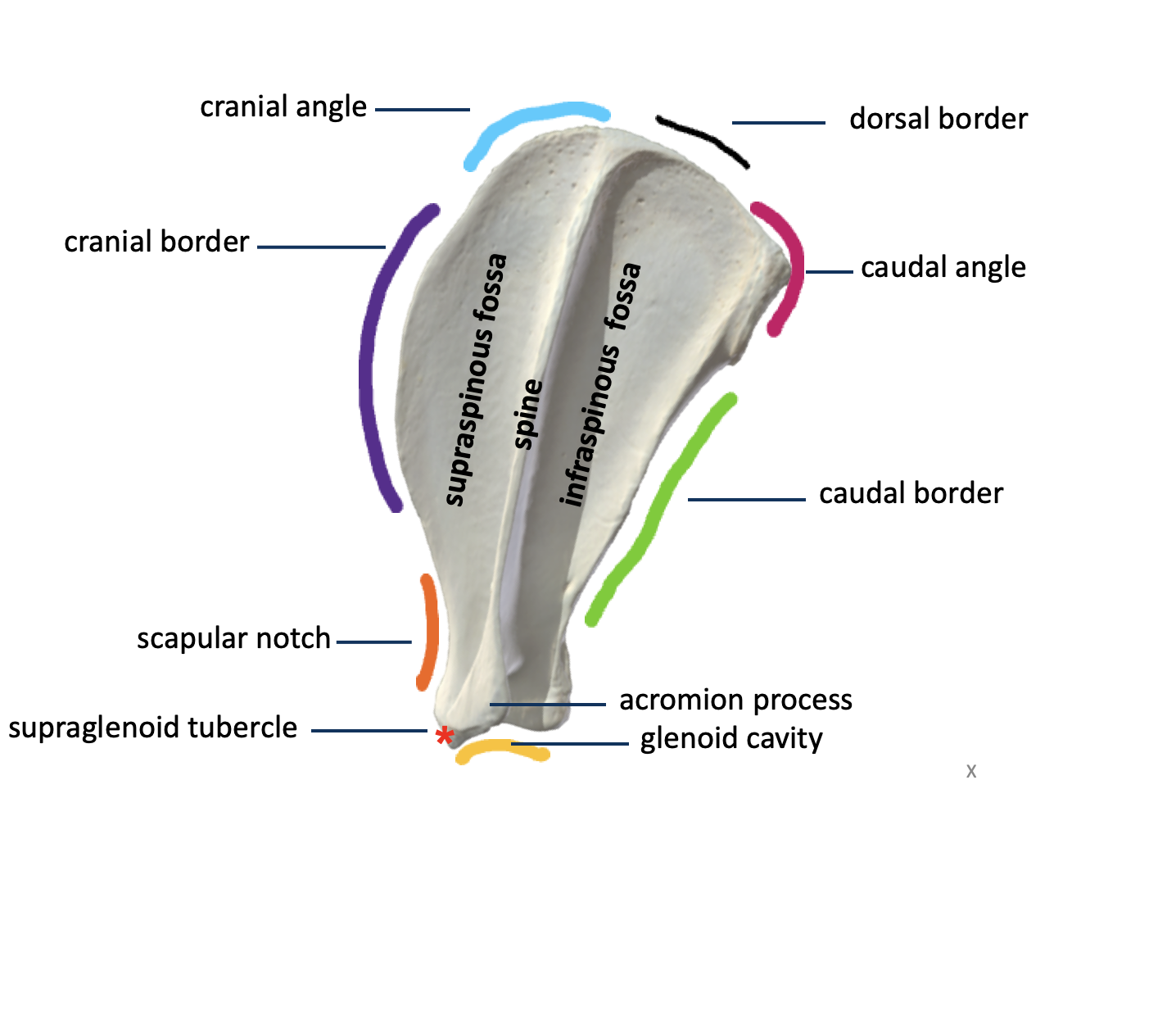
What characteristic of the lateral surface of the scapula is the most CLINICALLY significant and why?
Supraglenoid tubercle
Is incredibly palpable, is a little hook-like process found cranially to the acromion process
Is an obvious landmark for finding the shoulder joint
What are the notable characteristics of the ventral aspect of the scapula?
Glenoid cavity
Is the concave portion of the scapula where the proximal head of the humerus fits in
Has a smooth, articular surface
Supraglenoid tubercle
Can be seen from the ventral aspect
Is used as an attachment point for the biceps brachii muscle
What are some notable characteristics of the medial / costal surface of the scapula? (costal = associated with ribs)
Is a flat, rough surface
Flat → scapular glide
Rough → good for muscle attachment
Muscles that attach are:
Serratus ventralis muscle (dorsal)
Subscapularis muscle (ventral)
How is the cat scapula different from the dog scapula? What tubercle / process do they have that a dog does not have?
Has a more rounded CRANIAL angle than a dog scapula
Has a suprahamate process instead, found proximal to the acromion process
How is the horse scapula different from the dog scapula? List 3 things
1) Has a tuber on the spine
2) Cartilage extension at the dorsal border
3) DOES NOT have an acromion process
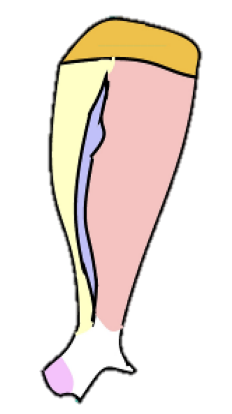
What are the 2 centers of ossification of the scapula? What could happen due to these weak points?
The centers of ossification can be found in the body and the supraglenoid tubercle
Could possibly see an avulsion fracture at the supraglenoid tubercle, as it acts as the origin for the tendon of the biceps brachii muscle
What are some defining characteristics of the proximal HEAD of the humerus? List and describe 4
1) Head
Articulates with the glenoid cavity of the scapula
2) Greater tubercle
Can be felt on the LATERAL aspect of the proximal limb; also a landmark to find the shoulder joint
3) Lesser tubercle
Not palpable, but know that its there
4) Intertubercular groove
The groove between the greater and lesser tubercles
Allows for the passage of the biceps tendon
Smooth surface
What is the DISTAL end of the humerus called?
Condyle
What are some of the defining characteristics of the condyle of the humerus? List and describe 6
1) Medial epicondyle - palpable
2) Lateral epicondyle - Palpabe
3) Trochlea - a central depression between the two epicondyles
This is where the radius and ulna fit in to make the elbow joint
Runs from the cranial aspect to the caudal aspect of the condyle (see image)
4) Ulnar fossa - just above trochlea on the CAUDAL aspect of the humerus… fits the ulna when leg fully extended
5) Radial fossa - above trochlea on the CRANIAL aspect of the humerus… fits the radius when leg flexed
6) Supratrochlear foramen
A hole JUST above the trochlea, connecting the radial and ulnar fossas… nothing passes through here
Provides a place for the hooked portion of the elbow to go when the elbow is fully extended
**** CATS DON’T HAVE THIS
Instead, have a supracondyle foramen just above the condyle, on the medial aspect (looks like the eye of a needle)
Brachial artery and median nerve pass through here
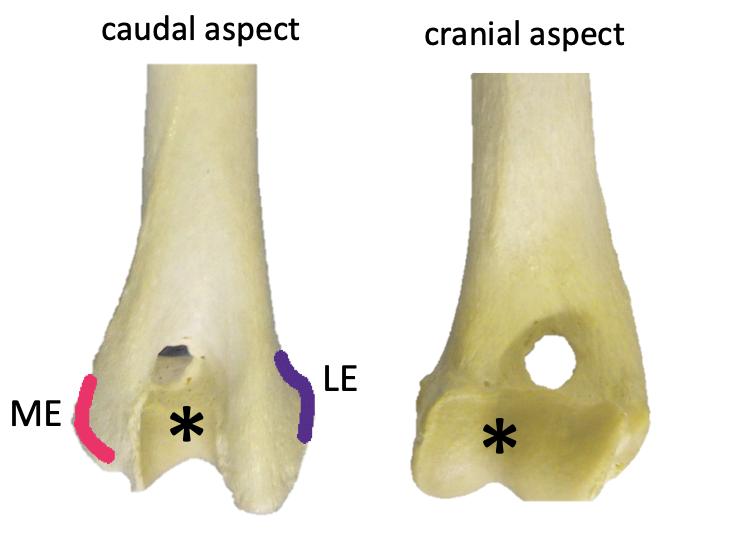
How many centers of ossification does the humerus have? Where are they found?
5 centers
Proximal epiphyses (head)
Body
Condyle: at the medial epicondyle, the medial half of the condyle, and the lateral half
In the shoulder joint, what is the bicipital bursa?
An outpouching of the joint capsule that extends into the intertubercular groove and forms a protective layer around the biceps brachii tendon, protecting it from wear and tear
Is held in place by the transverse ligament
What muscles provide lateral support at the shoulder? Know their origins, insertions, and nerve supply
The supraspinatous muscle (o = supraspinous fossa) and the infraspinatous muscle (o = infraspinous fossa)
Insertion → proximal, lateral humerus
Nerve supply → suprascapular nerve
What muscle provides MEDIAL support to the shoulder? Know its origin, insertion, and nerve supply
The subscapularis muscle
O → subscapular fossa
I → proximal, MEDIAL humerus
Nerve supply: subscapular nerve
How do muscles attach themselves to bone? There are 3 different ways listed, describe each
1) Directly to bone
Rough surface area of bone
Bony bumps / tubercles
2) Via aponeurosis
Sheets of fibrous tissue that extend from muscle body
Allows for muscles to reach areas of restricted access (muscle fiber ends, fibrous tissue continues
3) Via tendons
EXTRINSIC FORELIMB MUSCLES
Describe the brachiocephalic muscle… origin, insertion, location on the body, and effect on the limb upon contraction.
** name hint: brachio = arm, cephalic = head
Origin - Cervical vertebrae and skull
Insertion - humerus
Location - cranial to the limb; crosses over the shoulder joint
Is a forearm PROTRACTOR, AND a shoulder EXTENSOR
Moves leg CRANIALLY in relation to trunk when contracted, while INCREASING the angle of the shoulder joint (extending the limb)
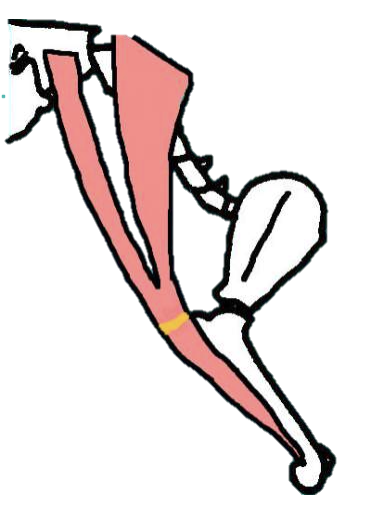
Side note: what is present in the human and cat shoulder area, but is absent in dogs?
A clavicle (collar bone)
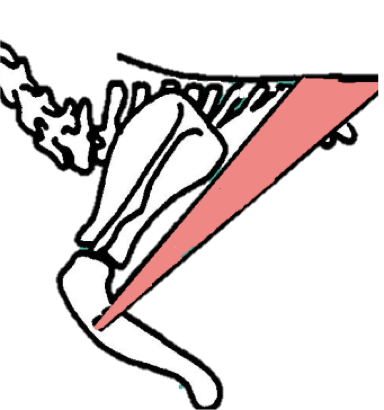
Describe the latissimus dorsi muscle… origin, insertion, location on the body, and effect on the limb upon contraction.
Name hint: lat = broad, dorsi = back
Origin - thoracic vertebrae
Insertion - Humerus
Location - CAUDAL to the limb (travels ventro-cranially from thoracic vertebrae to attach to the caudal aspect of the humerus)
Is a forelimb RETRACTOR, and a shoulder FLEXOR
Pulls limb CAUDALLY when contracted, which REDUCES the angle of the shoulder joint
Functions in forward propulsion
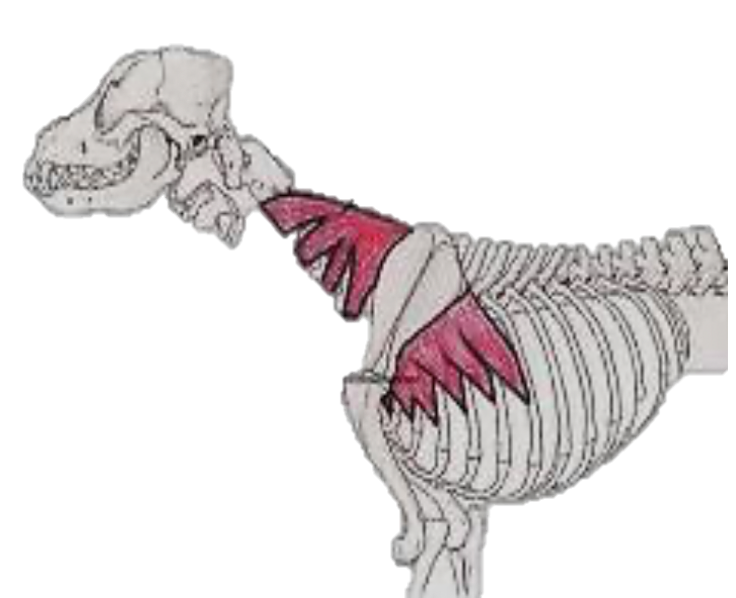
Describe the Serratus ventralis muscle… origin, insertion, location on the body, and effect on the limb upon contraction.
Has TWO origins
Thoracic wall
Cervical vertebrae
Insertion - proximal scapula on the MEDIAL aspect… also proximal to the pivotal point (point of rotation in the scapula)
Location - MEDIAL in relationship to the limb; essentially attaches scapula to the trunk
These muscles attach to the proximal aspect of the scapula, and because there are technically two parts to the muscle, the two different parts effect the limb differently when they contract.
The cranial portion of the muscle causes RETRACTION of the limb when contracted; pulls the dorsal portion of the scapula cranially, causing the remainder of the limb to swing back
The caudal portion of the muscle causes PROTRACTION of the limb; pulls the dorsal aspect of the scapula caudally, causing the remainder of the limb to swing FORWARD
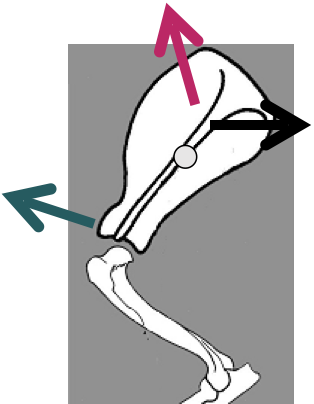
Describe the trapezius muscle… origin, insertion, location on the body, and effect on the limb upon contraction.
Origin - Cervical and thoracic vertebrae
Insertion - Proximal scapular spine
Is ALSO divided into 2 parts… cranial and caudal
Location - Proximal to the limb, and proximal to the scapular pivotal point
Causes ABDUCTION of the limb (also PROTRACTION)
Pulls the point of insertion (scapular spine) closer to the trunk of the body… essentially, opens the scapula
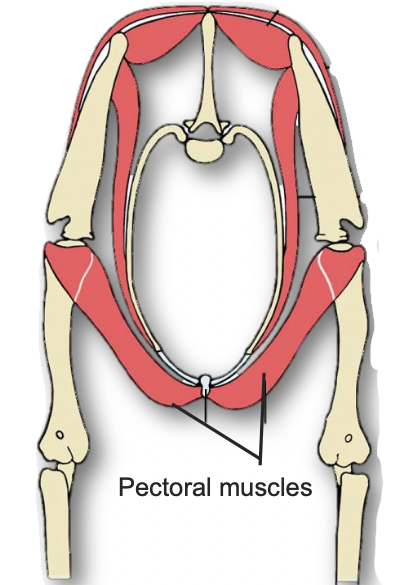
Describe the pectoral muscles… origin, insertion, location on the body, and effect on the limb upon contraction.
Origin - Sternum
Insertion - Humerus
Has TWO HEADS!! One deep, one superficial
Location - medial to the limb, and DISTAL to the pivotal point
Causes ADDUCTION of the limb, pulling it closer to the medial line. Does the opposite of the trapezius muscle
 Note
Note  Flashcards (129)