Introduction to Research Methods in Psychology: Key Concepts and Study Designs
 Studied by 0 people
 Call Kai
 Learn
Learn Practice Test
 Spaced Repetition
 Match
Match Flashcards
 Knowt Play
1/303

There's no tags or description
Looks like no tags are added yet.
Name | Mastery | Learn | Test | Matching | Spaced |
|---|
No study sessions yet.
304 Terms
What is the main focus of PSYC 2100 B?
Introduction to Research Methods in Psychology.
What are the two main goals of the course?
To become effective producers of knowledge and informed consumers of knowledge.
What methods are used to study self-knowledge?
Surveys, interviews, tasks/morality games, IQ tests, personality assessments, and conversations.
How is participation graded in the course?
Participation is graded out of 8 points through Wooclap check-ins.
What is the textbook for the course?
Research Methods in Psychology, 5th edition by Beth Morling.
What is the purpose of Wooclap in class?
To practice retrieval of knowledge during lectures.
What is empirical science?
Science based on systematic, direct, unbiased observations used to draw conclusions.
What is a theory in scientific research?
A set of statements that describe general principles about how variables relate to each other.
What is the significance of comparison groups in research?
They enable systematic observation of alternative situations.
What are the types of comparison groups mentioned?
Treatment group, therapy group, treatment + therapy group, and control group.
What does it mean for a theory to be testable?
It can be observed with real-world data.
What does falsifiable mean in the context of a theory?
It is possible to observe results that contradict the theory.
What is confirmation bias?
The tendency to look for evidence that confirms existing beliefs while ignoring contradicting evidence.
What is the availability heuristic?
A cognitive bias where people overestimate the frequency of events based on how easily they come to mind.
What is the present/present bias?
Failing to consider what isn't there, focusing only on present situations.
What is the bias blind spot?
The belief that others are biased while being unaware of one's own biases.
What is anecdotal evidence?
Knowledge based on personal experience or stories rather than systematic observation.
What is the role of authority in knowledge acquisition?
People often trust information from authority figures, but it should be evaluated for its basis in research.
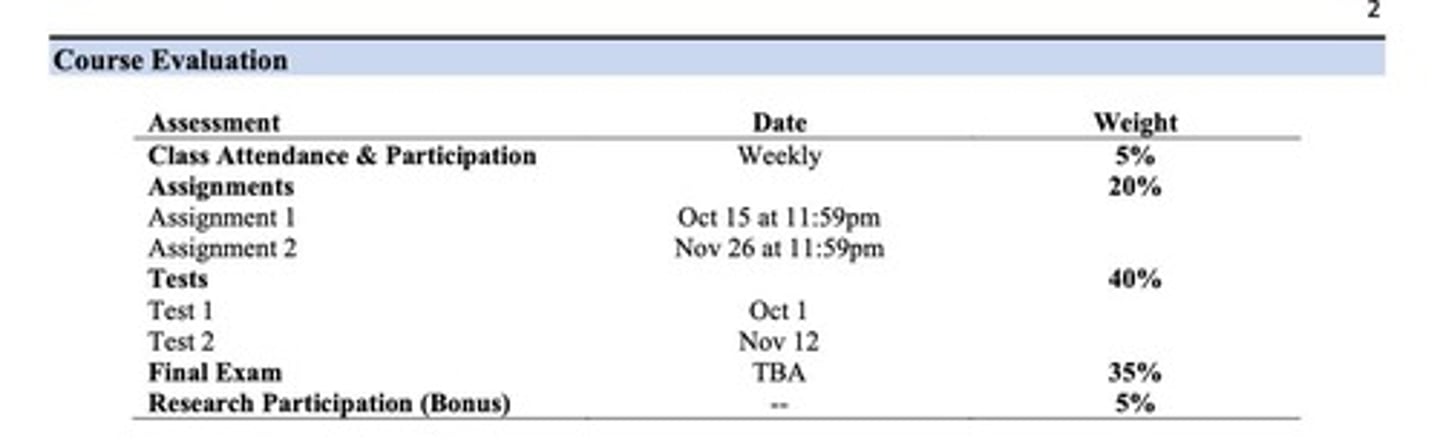
What are the deadlines for assignments in the course?
Assignment 1 is due on Oct. 15th and Assignment 2 on Nov. 26th.
What is the grading breakdown for the course evaluations?
5% participation, 20% assignments, 35% tests, and 40% final exam.
What is the importance of self-awareness in relationships?
Self-awareness is tied to relationship quality and overall well-being.
What is the purpose of the workshop days?
To teach students how to use resources for their assignments.
What is the significance of the course's communication guidelines?
To ensure clear and effective communication with instructors and TAs.
What is a confederate in research?
A researcher-hired individual who interacts with participants in a specific way.
What is the role of intuition in knowledge acquisition?
Intuition can be biased and lead to incorrect conclusions based on personal beliefs.
What is pseudoscience?
A theory that cannot be refuted by any conceivable event, making it non-scientific.
What is irrefutability in the context of scientific theories?
Irrefutability is considered a vice of a theory; a good scientific theory should be falsifiable.
What is an example of an unfalsifiable theory?
Freud's iceberg theory of the unconscious and repressed memories.
What does the principle of parsimony state?
The simplest explanation that makes the fewest assumptions should be preferred.
What is Occam's Razor?
A principle that suggests choosing the simplest theory that explains the data.
What are the characteristics of a good research question?
It should be relevant to theory, novel, testable, and not too broad.
What is a hypothesis?
A specific prediction about what needs to happen for a theory to be true, which is testable and unique to the theory.
What is the null hypothesis (Hₒ)?
It states that there is no effect or difference; for example, Hₒ: μ₁ = μ₂.
What is the alternative hypothesis (H₁)?
It states that there is an effect; for example, H₁: μ₁ > μ₂.
When do we reject the null hypothesis?
When the p-value is less than 0.05, indicating statistical significance.

What does a p-value indicate?
The probability of observing the results if the null hypothesis is true.
What is effect size?
It measures the strength or magnitude of an effect, indicating how meaningful the results are.
What is the difference between basic research and applied research?
Basic research seeks to understand foundational concepts, while applied research tests interventions in real-world settings.
What is translational research?
Research that tests an intervention in a lab before applying it in a real-world context.
What is the significance of replication in science?
Replication allows for public verification and helps to self-correct scientific findings.
What are the norms of scientific research?
Universalism, communality, disinterestedness, and organized skepticism.
What does it mean for science to be probabilistic?
Conclusions are based on probability theory and statistics rather than absolute proof.
What is the role of claims in scientific research?
Claims reflect the researcher's assertions about effects or relationships based on evidence.
What is the relationship between personal experience and scientific knowledge?
Scientific knowledge is based on empirical evidence rather than personal experience or intuition.
What is the purpose of hypothesis testing?
To evaluate the evidence for or against a theory by testing specific predictions.
What is a significant p-value threshold in hypothesis testing?
A p-value of less than 0.05 indicates statistical significance.
What does it mean to retain the null hypothesis?
To fail to reject the null hypothesis when p > 0.05, indicating no statistically significant effect.
What is the importance of testable hypotheses?
They allow researchers to design studies that can provide evidence for or against a theory.
What is an example of a basic research question?
What parts of the brain are active when experienced meditators are meditating?
What is an example of applied research?
Testing whether a new meditation program helps students focus longer on math lessons.
What does the term 'self-correcting' refer to in science?
The ability of science to discover and correct mistakes through ongoing research and verification.
What is the significance of the t-test in hypothesis testing?
It is a statistical test used to determine if there is a significant difference between two groups.
What does the term 'claims' refer to in scientific research?
Statements made by researchers about the existence or absence of effects based on evidence.
What is a Type 1 error in research?
A Type 1 error (false positive) occurs when a statistically significant result is found (p < .05) when there is actually no effect.
What does a p-value greater than .05 indicate?
It indicates a statistically insignificant result, leading to the retention of the null hypothesis.
What was the purpose of the Tuskegee Syphilis Study?
To understand the effects of untreated syphilis on men, but participants were misled and not treated.
What are the Belmont Principles in research ethics?
1. Respect for persons, 2. Beneficence, 3. Justice.
What does 'Respect for persons' entail?
It includes the right to informed consent, no coercion, and protection of vulnerable individuals.
What is meant by 'Beneficence' in research ethics?
Minimizing risks and maximizing benefits for participants.
What does 'Justice' refer to in the context of research ethics?
Fairness in the distribution of research burdens and benefits.
Who sets the ethical guidelines for research in psychology?
The American Psychological Association (APA) through its ethics code.
What is the TCPS?
The Tri-Council Policy Statement, which provides ethical guidelines for Canadian researchers.
What are the core principles of the TCPS?
1. Respect for persons, 2. Concern for welfare, 3. Justice.
What does 'informed consent' require?
Participants must be provided with necessary information about risks, benefits, and their right to withdraw.
What is passive deception in research?
Omission of certain information from participants, often used to avoid bias.
What is active deception in research?
Deliberately providing false information to participants.
What is debriefing in research?
Providing participants with full disclosure of the study's purpose after their participation.
What is the purpose of the Institutional Review Board (IRB)?
To review research involving human participants to ensure ethical standards are met.
What are the Three Rs of Animal Research?
1. Replacement, 2. Reduction, 3. Refinement.
What does 'Replacement' mean in the context of animal research?
Using alternatives to animal testing when possible, such as computer simulations.
What does 'Reduction' refer to in animal research?
Minimizing the number of animals used in research while still achieving valid results.
What is 'Refinement' in animal research?
Modifying procedures to minimize pain, stress, or discomfort to animals.
What constitutes research misconduct?
Data fabrication, data falsification, and plagiarism.
What is an example of research misconduct related to vaccines?
The false claim that vaccines cause autism, based on fabricated studies.
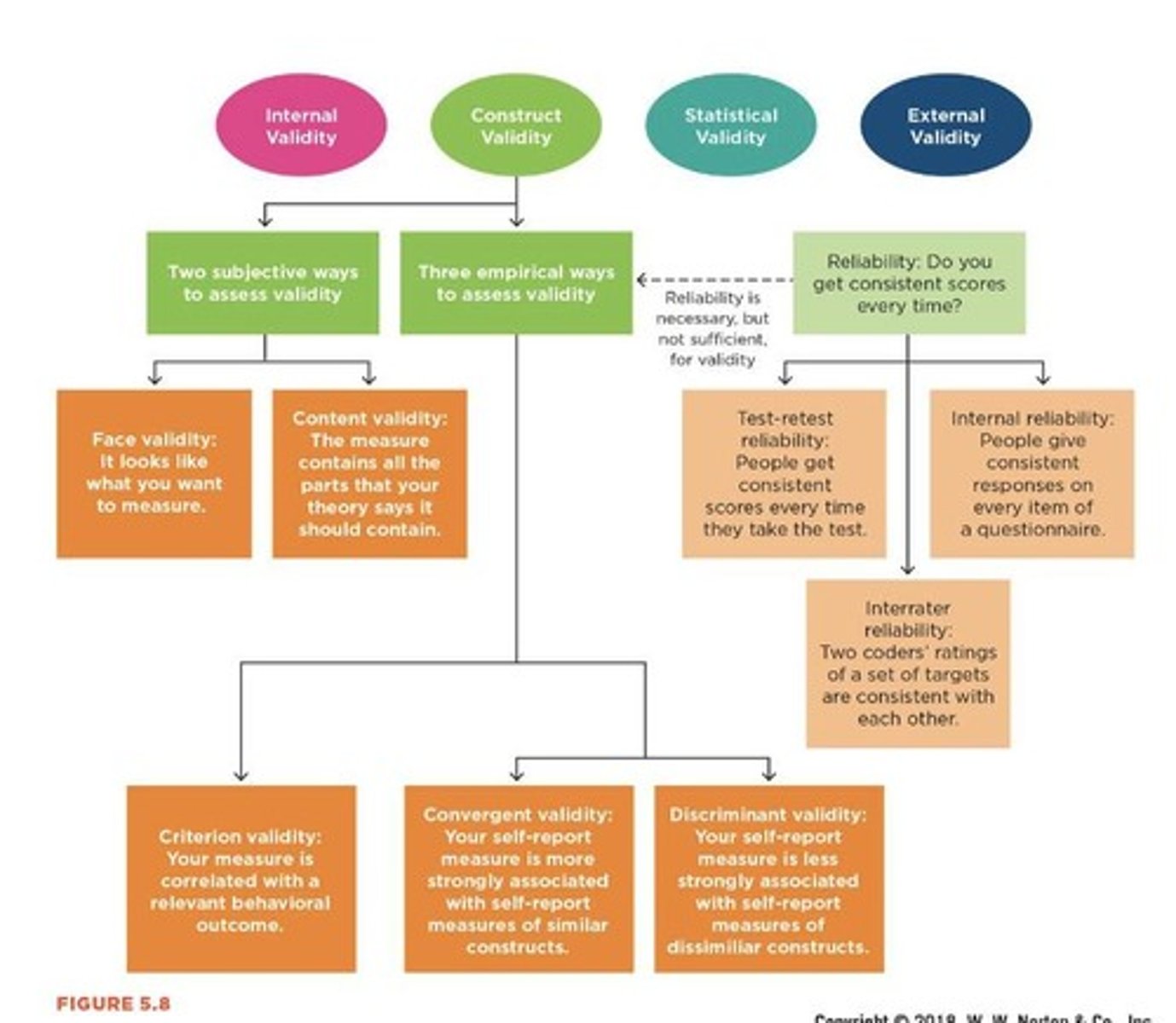
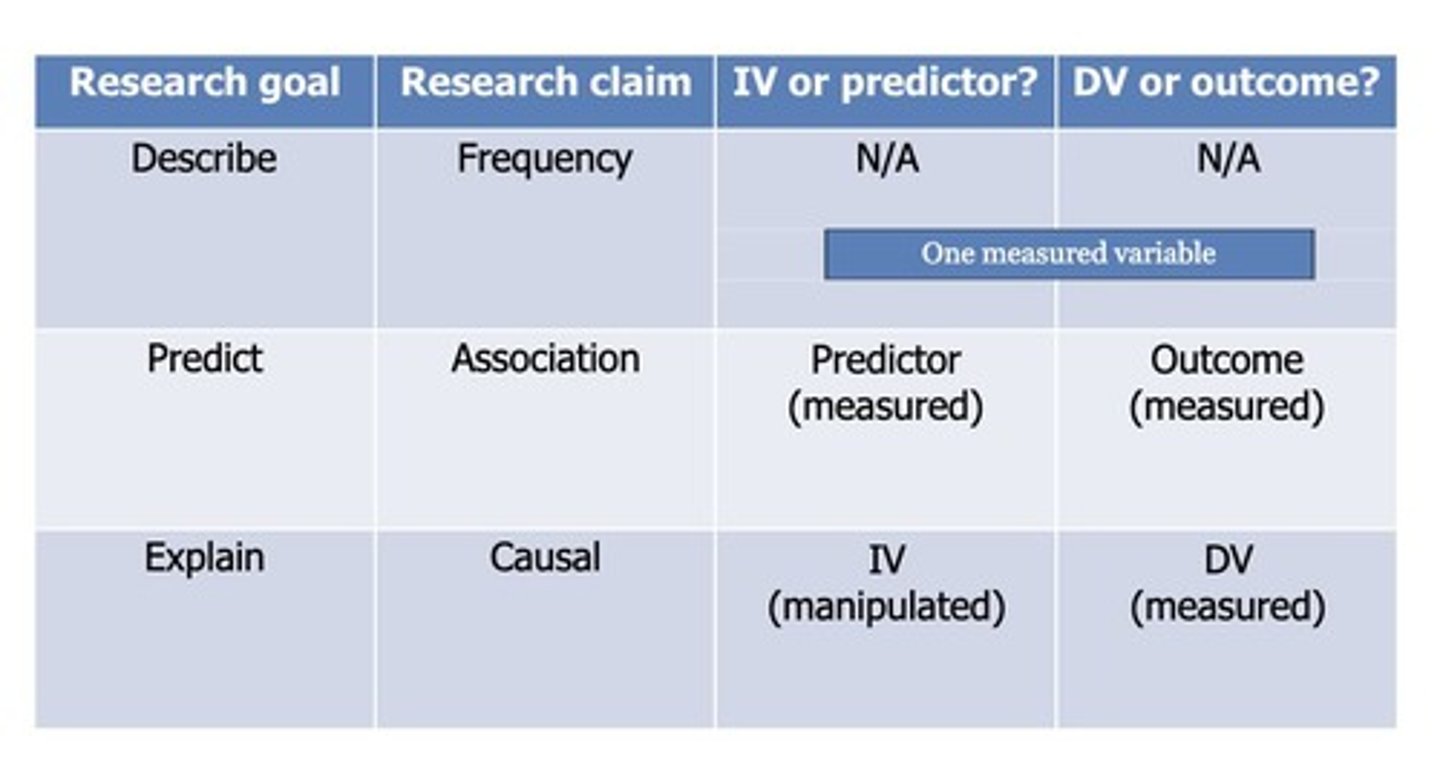
What are the types of research claims?
Frequency claims, association claims, and causal claims.
What is construct validity?
The degree to which a test measures what it claims to measure.
What is external validity?
The extent to which research findings can be generalized to other settings or populations.
What is statistical validity?
The accuracy of the statistical conclusions drawn from the data.
What is internal validity?
The degree to which a study accurately establishes a cause-and-effect relationship.
What is the definition of a variable in research?
A thing that varies or changes; a constant is a fixed variable that does not change.
What is a manipulated variable?
A variable that the researcher changes or controls in an experiment.
What is a measured variable?
A variable that is not manipulated but is observed and measured as it is.
What is an operational definition?
It specifies exactly how a conceptual variable is measured or manipulated.
Give an example of an operational definition for relationship satisfaction.
Self-report measures of relationship satisfaction.
What is a frequency claim?
A claim that describes the rate or frequency of a variable.
What type of claim predicts the relationship between two variables?
Association claim.
What is a causal claim?
A claim that explains the relationship between variables, indicating that one variable causes changes in another.
What is covariance in the context of causal claims?
It means that as one variable changes, the other variable also changes.
What is temporal precedence?
It refers to the cause occurring before the effect in time.
What is the difference between independent and dependent variables?
The independent variable is manipulated by the researcher, while the dependent variable is the outcome that is measured.
What is random assignment?
A method where every participant has an equal chance of being assigned to any condition in an experiment.
What is a Type I error?
A false positive, concluding there is an association when there is none.
What is a Type II error?
A false negative, concluding there is no association when there actually is one.
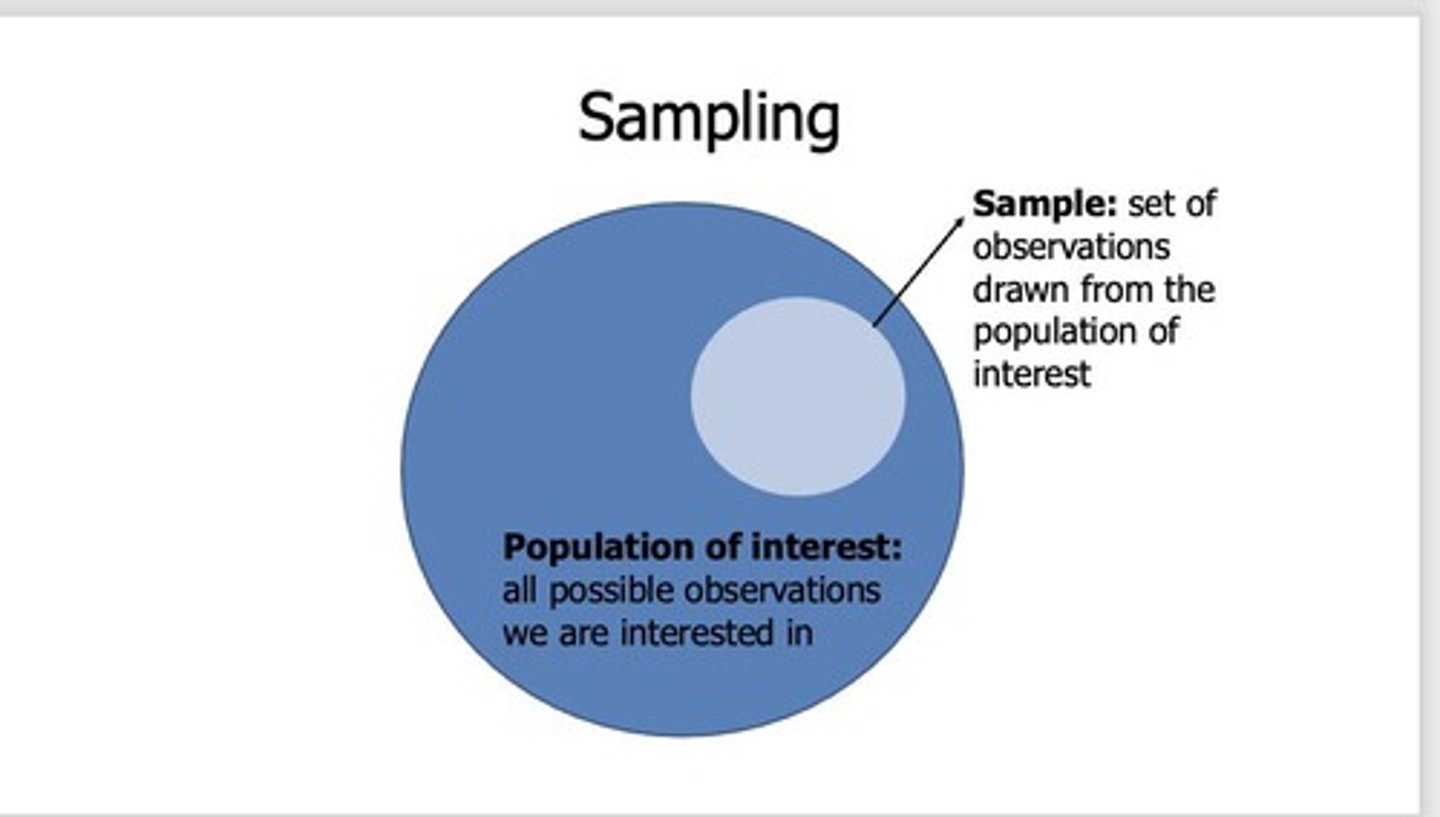
What is the importance of a large sample size in research?
It reduces the margin of error and increases the power to detect an effect.
What does effect size indicate?
It measures the strength of the relationship between two variables.
What is the significance of a confidence interval?
It provides a range of values within which the true population parameter is expected to lie.
What is the trade-off between external and internal validity?
Focusing on internal validity in experiments may reduce the generalizability of findings.
What is an example of a frequency claim?
10% of people in a committed relationship met their partner through online dating.
What does it mean if a correlation coefficient (r) is 0.6?
It indicates a strong positive association between two variables.
What does it mean if a correlation coefficient (r) is -0.6?
It indicates a strong negative association between two variables.
 Note
Note  Flashcards (79)