Governing under Mary I
 Studied by 0 people
 Call Kai
 Learn
Learn Practice Test
 Spaced Repetition
 Match
Match Flashcards
 Knowt Play
1/33

There's no tags or description
Looks like no tags are added yet.
Name | Mastery | Learn | Test | Matching | Spaced | Call with Kai |
|---|
No analytics yet
Send a link to your students to track their progress
34 Terms
What was Marys reign shaped by?
Mary's reign (1553-1558) saw her attempting to solidify her royal authority while navigating deep political and religious divisions inherited from previous reigns
What was Marys character like?
Mary I was known to be a conscientious and hard-working queen who was determined to be closely involved in government business and policy-making
Despite lacking the majesty of her father and her sister, she was resolute and brave in the face of opposition
How was Mary majorly limited?
However, she had little experience of government or politics and not much "inherent sense of manoeuvre"
The Privy Council Under Mary I
What was the issue with parliment?
Mary's Council structure presented a unique challenge, marked by both a large number of official appointments and deep-seated tensions among her key figures
Composition and Challenges
What issue did Mary inherit?
Mary inherited a significant problem - she would have to rely on individuals who had served her Protestant half-brother, Edward VI, and were thus implicated in the religious reforms she despised
How did Mary try to overcome this issue and what were the limitations?
Her most trusted and loyal supporters, such as Robert Rochester, Edward Waldegrave, Sir Henry Jerningham, and Sir Henry Bedingfield, were devout Catholics but lacked serious experience in government
To compensate, she had to rely on others
Who did Mary rely on?
Bishop Stephen Gardiner
Lord Paget
Other Churchmen
Cardinal Pole
What was Bishop Stephen Gardiners background?
Bishop Stephen Gardiner: Who had been Henry VIII’s secretary, upheld religious conservatism under Edward VI (and suffered imprisonment for it), and returned to favour under Mary, becoming Lord Chancellor
What was Marys attitude towards Bishop Stephen Gardiner?
Mary regarded him as indispensable, despite never fully trusting him because he had failed to support her mother, Catherine of Aragon, during the break with Rome.
What was Lord Pagets background?
Lord Paget: One of the more conservative councillors who had served Edward
What was Marys relationship with Lord Paget?
Mary eventually lost confidence in Paget due to his opposition to her religious program
What were the Other Churchmens background?
Other Churchmen: Who had been excluded from influence under Edward’s reign
What was Cardinal Pole backround?
Cardinal Pole: A key trusted adviser, though he was never a member of the Privy Council
Structure and Effectiveness
What was the structure of the council?
Mary's approach to forming and managing the Council led to debates about its effectiveness
How may councillors were appointed during her reign?
Mary appointed approximately 50 councillors during her brief reign
What issues did the large number of councillors lead to?
This large number has led some to claim that her government was inefficient and faction-ridden
What contradicts the fact that there were fractions in the council?
This assertion is misleading, as Mary appears to have treated the title of councillor as mostly honorary
The working council board was much smaller and dominated by experienced men like Gardiner, the Marquis of Winchester, and Paget
What was Marys relationship wiht her councillors?
Decision-Making and Trust:
Despite the official Council, Mary was never quite at ease with her key councillors
Whose death impacted the council
Gardiner's death in 1555 left a significant gap that was never satisfactorily filled, especially as Cardinal Pole distanced himself from secular issues
After Gardiners death who did Mary rely on?
Consequently, Mary heavily relied on the advice of two foreigners she implicitly trusted:
• Her husband, Philip II of Spain,
• Simon Renard, the Imperial ambassador of Charles V.
Overall waht was the nature of Marys government?
Her government was not weak in any general sense of being unable to enforce its will;
Her Council was thorough in the discharge of its administrative duties and succeeded in enforcing her will on key matters like her marriage and the return to Rome
Key Functions and Cooperation
What was the main function if parliment?
Parliament's primary role was to pass laws and to grant taxation
How did Mary use Parliment?
Mary successfully used Parliament to reverse the religious reforms of the previous reigns:
Reversal of Edwardian Legislation: Her first Parliament (October 1553) repealed the religious laws passed under Edward VI and restored the order of service that existed at the time of Henry VIII's death
Restoration of Papal Authority: The crucial reconciliation with Rome and the revocation of the royal supremacy were achieved through her third Parliament (November 1554 to January 1555), in the Great Act of Repeal
Opposition and Limitations
What limited Marys use of parliment?
Parliament was not simply compliant and exercised significant caution, particularly regarding property rights
What was parliments major concern and why?
Parliament’s major concern was the disposition of former monastic land
Concern for property rights ensured that ex-monastic property would not be restored to the Church, and Mary, despite her deep desire, wisely did not press the point
How did mary react to the opposition?
Mary was ultimately forced to acknowledge the jurisdiction of statute law in matters involving religion
What was one way the opposition was counteracted and whatw as the result?
When Pole granted absolution to the realm in 1554, he had to concede that Church lands redistributed after the dissolution of the monasteries and chantries would remain in lay hands
Parliament rejected a bill in 1555 that sought to allow the seizure of property belonging to Protestant exiles
A substantial minority of approximately 80 MPs opposed the reversal of the Edwardian religious legislation
What bill was rejected that concered Marys marriage?
In 1554, Parliament rejected a bill that would have specifically included Philip along with Mary in a proposed new law on treason, and in 1555, it successfully prevented Philip’s coronation as King
Mary also quarrelled with Parliament over the issue of the succession
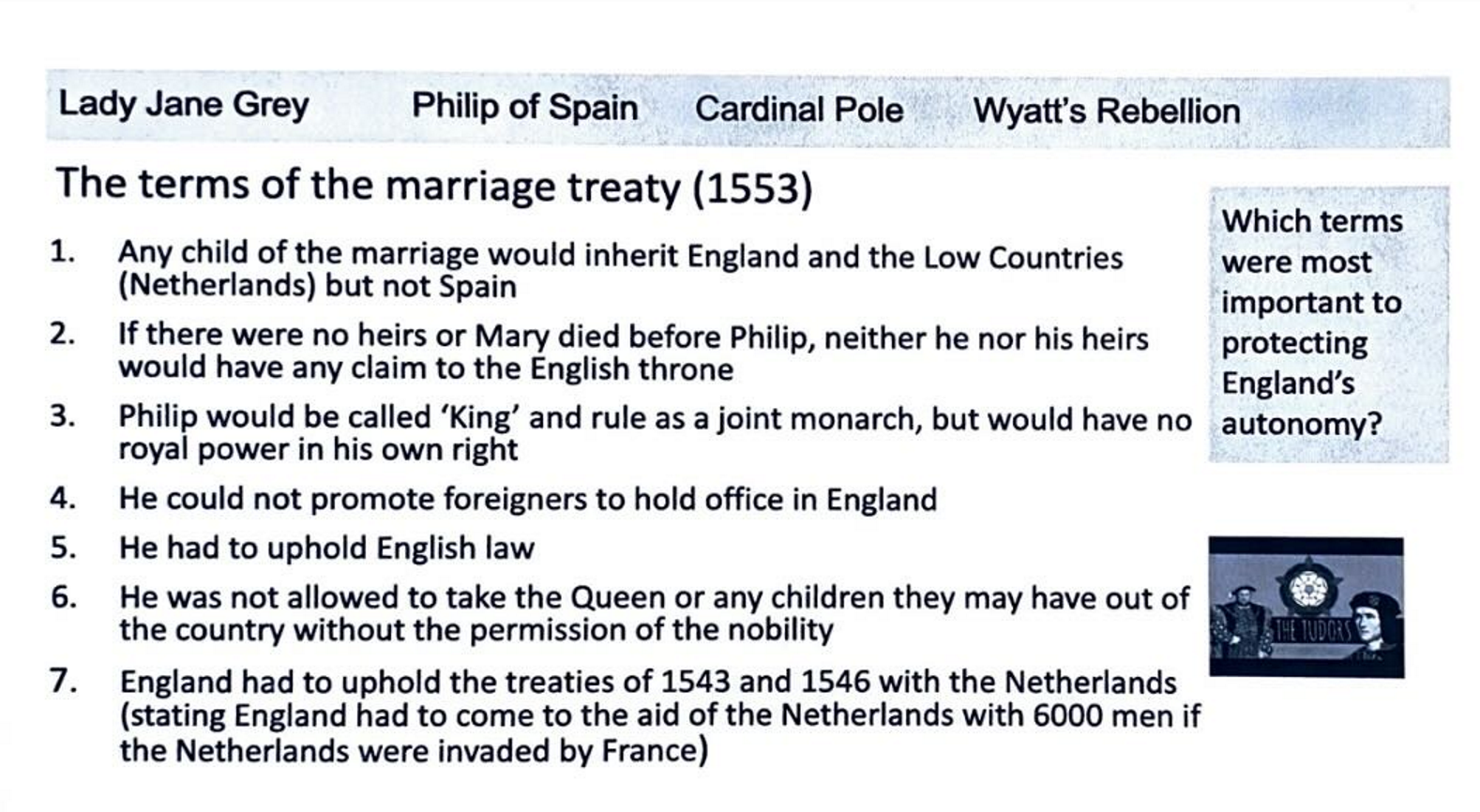
Whatw ere the terms of the marriage treaty?
 Note
Note  Flashcards (73)