Biothermodynamics Heat Transfer Exam 1
 Call Kai
 Learn
Learn Practice Test
 Spaced Repetition
 Match
Match Flashcards
 Knowt Play
1/64

Earn XP
Description and Tags
Lectures 9, 10, 11, 12, and 13
Name | Mastery | Learn | Test | Matching | Spaced | Call with Kai |
|---|
No analytics yet
Send a link to your students to track their progress
65 Terms
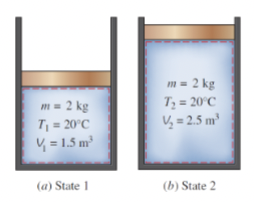
thermodynamics
“Macro” systems, boundary, surroundings
Based on conversions between energy types: Kinetic, potential, internal, work, heat, etc.
Equilibrium states - Properties are spatially uniform - system is in equilibrium with itself
heat transfer
Infinitesimal control volume, boundary, surroundings
Based on mechanisms of heat transfer: Conduction, convection, radiation
Properties are continuously distributed in space and vary with time
NO LONGER using quasi-equilibrium system
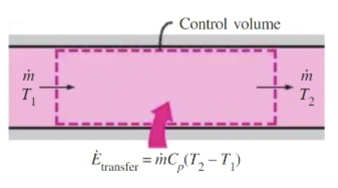
cross sectional area
unlike thermodynamic processes, which occur within devices like a piston cylinder, heat transfer occurs across a __________, with a temperature difference driving this exchange
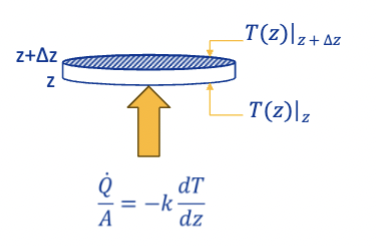
conduction
One mechanism of heat transfer: Occurs by the transfer of the energy of motion between adjacent molecules. Occurs in solids, liquids, and gases. Present in all solid, liquids, and gases in which a temperature gradient exists. Driving gradient - temperature difference driving exchange of heat in the system of interest
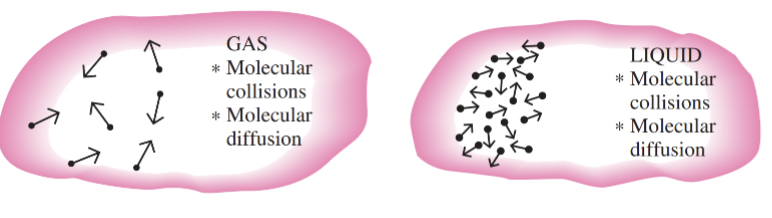
conduction in gases and liquids
occurs due to molecular collisions and molecular diffusion
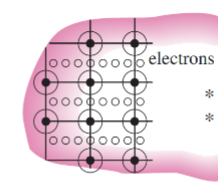
conduction in solids
due to lattice vibrations (energy exchange between bonds) and the flow of free electrons
convection
One mechanism of heat transfer: Occurs by bulk transport and mixing of macroscopic elements. Occurs in liquids and gases
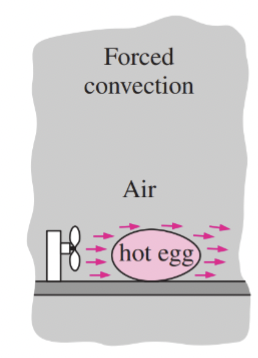
forced convection
fluid/gas is forced to flow past a solid surface by mechanical means
Ex: exercising outside, cool breeze (wind and sweat interact)
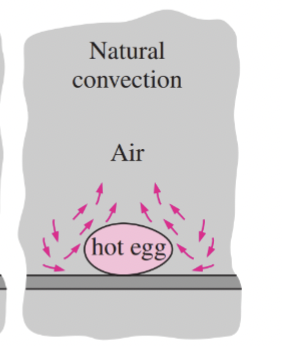
natural convection
natural circulation of fluid due to a density difference resulting from a temperature gradient.
Ex: concrete on a hot day
radiation
One mechanism of heat transfer: Transfer of energy through space via electromagnetic waves. All solids, liquids, and gases emit, absorb, or transmit _______ to some degree
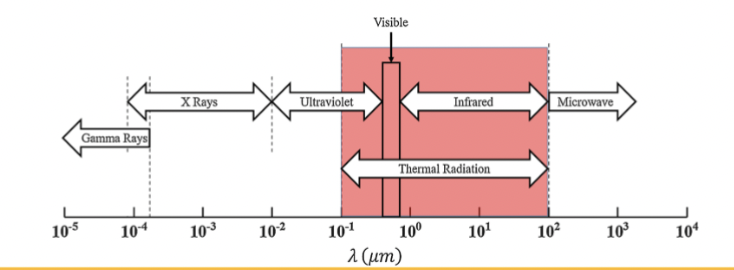
thermal radiation
radiation emitted by bodies because of their temperature; Unrelated to x-rays, gamma rays, microwaves, radio waves, television waves
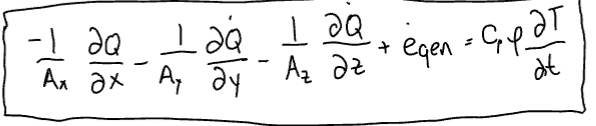
conservation of heat equation
for a rectilinear object
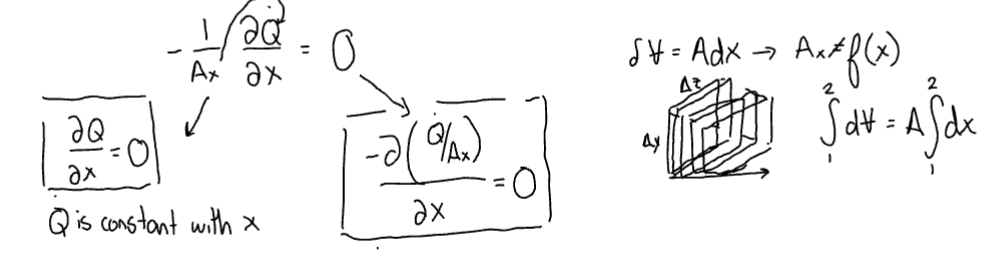
constant flux
First application of conservation of heat: no energy generation (egen = 0), 1D heat transfer (dQ/dy=dQ/dz=0), and Steady state (dT/dt=0).
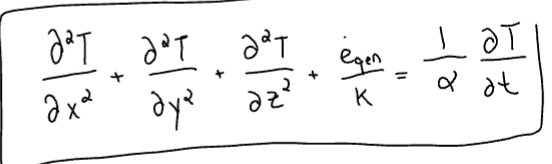
Fourier’s law of heat conduction
second application of conservation of heat: empirical law - gathered data and found an equation to fit.
isotropic material
properties of the material are constant with direction. Ex: constant thermal conductivity
anisotropic
materials change with respect to direction. k=f(x)
diffusivity
how fast heat diffuses (movement without bulk motion) through a material.
α = k/ρc
heat conducted/heat stored per unit volume.
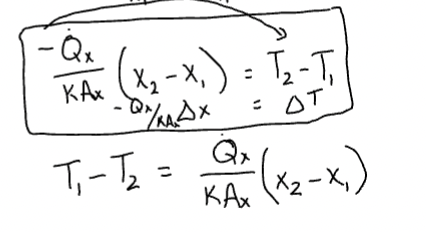
heat flow through a flat plate
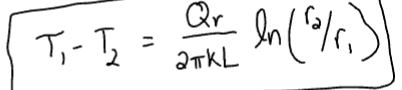
conductive heat transfer in hollow cylinder
heat flows in radial direction, inside out. Flow (Q) is indpendent of direction BUT flux (Q/A) is dependent on direction.
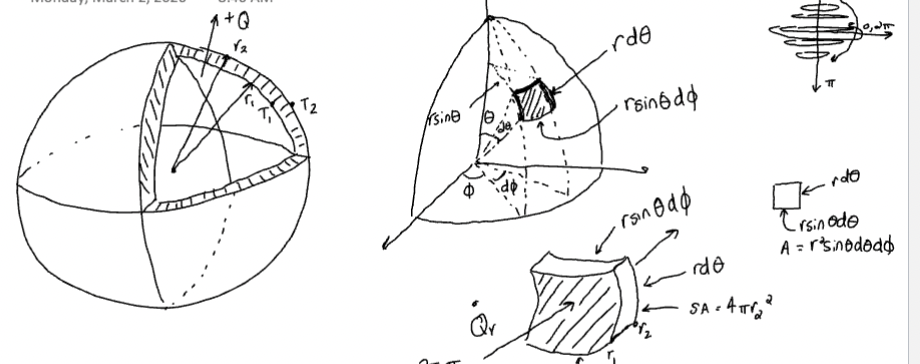
conductive heat transfer in hollow sphere
Q(r2-r1) /( 4πr1r2k) = T1-T2
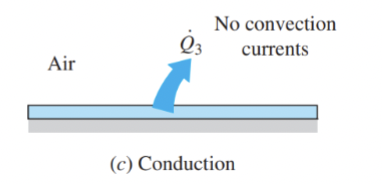
conduction definition
requires a material medium. Solids; Fluids (liquid or gas) in the absence of bulk motion; Quiescent fluid
convection definition
Requires a material medium. Fluids (liquids or gas) in the presence of bulk motion
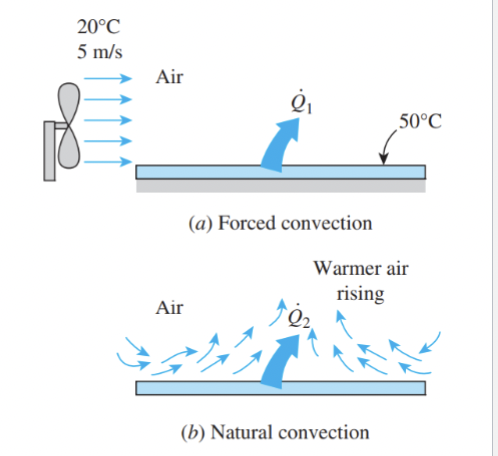
bulk motion and convection
must now consider both heat transfer and fluid motion. Heat AND momentum transfer
fluid motion
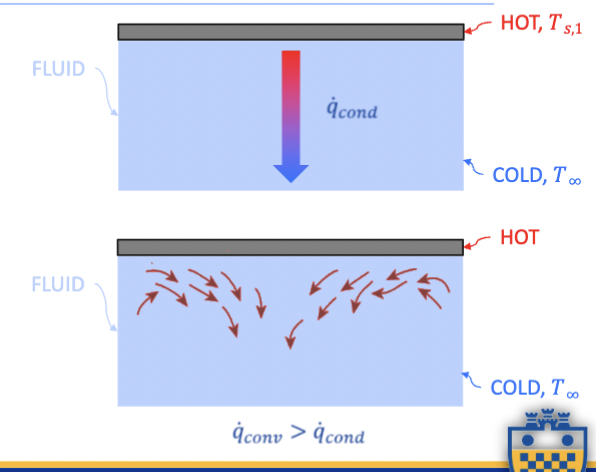
enhances heat transfer. Brings warmer and cooler “chunks” of fluid into contact. Increases conduction. Increased mixing (fluid velocity) leads to increased rate of heat transfer.
heat transfer coefficient (h)
Rate of heat transfer between a solid surface and a fluid per unit surface area per unit temperature difference
Function of:
type of fluid flow (laminar or turbulent), Re
dynamic viscosity, μ
thermal conductivity, k
density, ρ
specific heat capacity, cp
fluid velocity, v
geometry of surface, Lc
roughness of solid surface, Cf
type of fluid flow
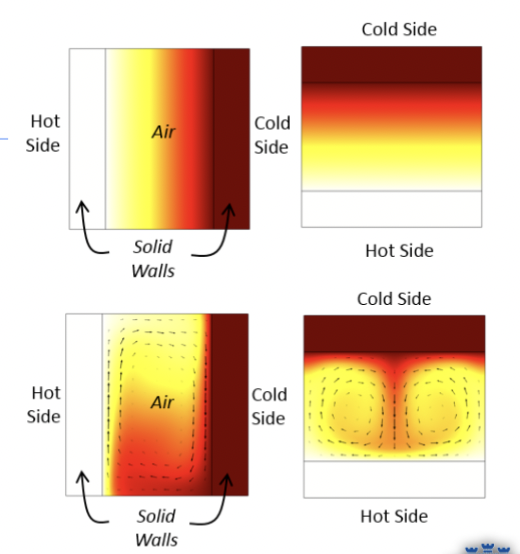
Laminar: crystalline, smooth stream
Turbulent: chaotic, splashy
quantified by Reynolds number
dynamic viscocity
a measure of the resistance to flow in a fluid; metric of how sticky a fluid is - how well individual layers stick to each other - internal friction in the fluid
thermal conductivity
how well heat is conducted through the fluid. The amount of heat conducted/transferred within a unit temperature gradient through a unit thickness perpendicular to a unit surface area
specific heat capacity
how much energy the fluid can store per unit mass per temperature
fluid velocity
increases with mixing; the time rate of change of a fluid particle's position in space
geometry of surface
more complex = more complex flow conditions. Quantified by characteristic length
roughness of solid surface
smooth: not as much friction conducted to form boundary layer
rough: more friction through layers of fluid. more energy - more movements/bumps
empirical coorelation
The heat transfer coefficient cannot be predicted theoretically; phenomenological relationship supported by experimentation and not necessarily theory
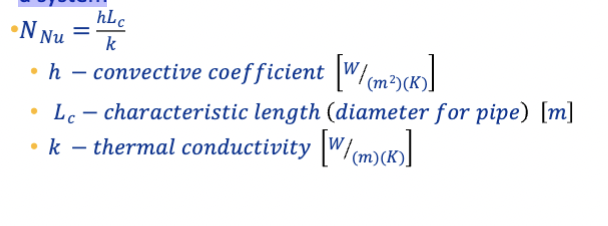
Nusselt number
used to relate data for the heat transfer coefficient to thermal conductivity of a system
laminar
highly ordered motion and smooth streamlines
turbulent
velocity fluctuations and highly disordered motion. circular pipe: Re < 1200
transition
flow fluctuates between laminar and turbulent before it becomes fully turbulent. circular pipe: Re > 6000
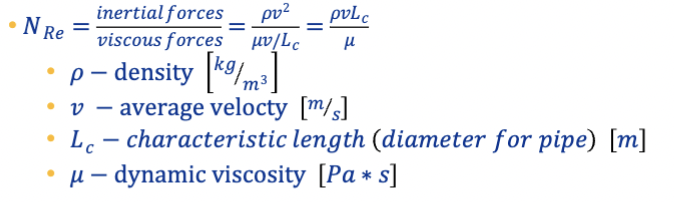
Reynolds number
represents the ratio of inertial to viscous forces within a fluid and is used to indicate the laminar or turbulent nature of a flow
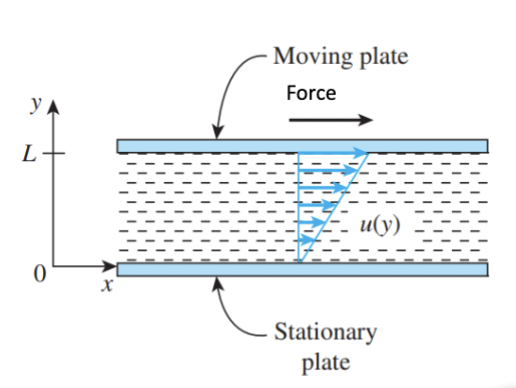
fluid flow
Fluid consists of adjacent layers of molecules. Friction between the moving plate and the adjacent fluid layer initiates fluid movement
movement of fluid layers
First fluid layer attempts to drag adjacent fluid layer along with it due to friction force. Perpetuates throughout fluid
Bottom layer is “stuck” to the stationary plate due to friction → No Slip Condition
no slip condition
velocity of the adjacent plate is stationary. Velocity of plate is same as this type of fluid (?)
assumes that the speed of the fluid layer in direct contact with the boundary is identical to the velocity of this boundary. There is no relative movement between the boundary and this fluid layer, therefore there is no slip.
shear stress
friction force per unit area
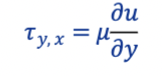
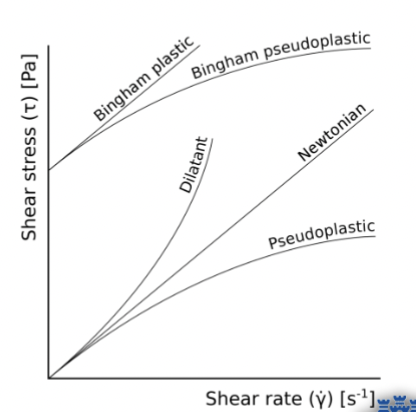
Dynamic viscosity (μ)
Measure of a fluid’s resistance to deformation, depends strongly on temperature
Newtonian Fluids: μ ≠ f(u or y) → Water, oil, saline
Non-Newtonian μ = f(u or y) → Blood, mayonnaise, oobleck (cornstarch and water)
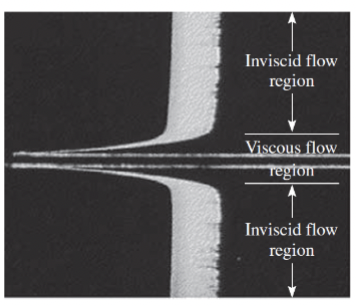
viscous flow region
Region of flow where frictional effects are significant
inviscid flow region
Region of flow where viscous forces are negligibly small compared to inertial or pressure forces
boundary layers of viscous flow region
Fluid with uniform (no change with location) velocity approaches a stationary (V=0) flat plate
Bottom layer of fluid sticks to the plate: No slip condition
Motionless layer of fluid slows down particles of adjacent layer
Continues until the diffusion of momentum between the layers becomes insignificant
X component of velocity varies from u=0 at y=0 to u = Vb at y > δ
V =0.99*Vb where V is the velocity of the free stream or inviscid flow region
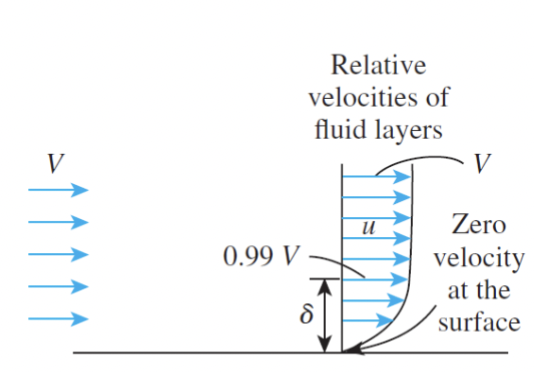
region of viscous flow
0 ≤ y ≤ δ
boundary layer
region of inviscid flow
y > δ
viscous forces << inertial or pressure forces
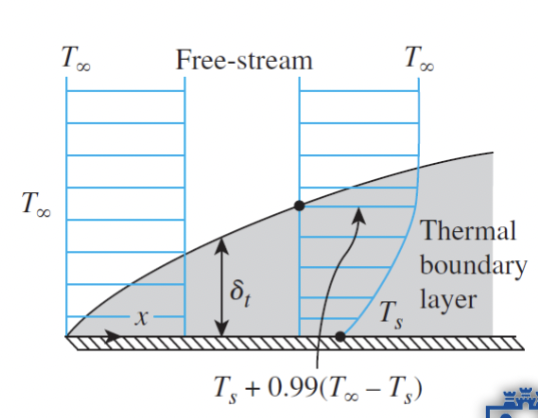
thermal boundary layer
Fluid with a uniform velocity and temperature (Tꚙ) approaches a stationary plate with a temperature (Ts)
Bottom layer of fluid reaches thermal equilibrium with plate (no slip condition)
Bottom layer of fluid exchanges energy with adjacent layers
Continues until the diffusion of energy between layers becomes insignificant
Temperature varies from T=Ts at y=0 to T = Tꚙ at y > δt
T=Ts+0.99(Tꚙ-Ts) at y=δ
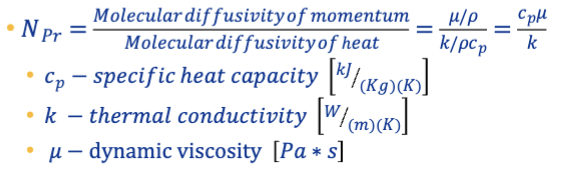
Prandtl number
relative thickness of the velocity and thermal boundary layers; a dimensionless quantity that correlates the viscosity of a fluid with its thermal conductivity, assessing the relationship between momentum transport and thermal transport capacity.
0.5 ≤ Pr ≤ 1 for gases
2 ≤ Pr ≤ 104 for liquids
dimensionless numbers
Nusselt, Reynolds, and Prandtl numbers
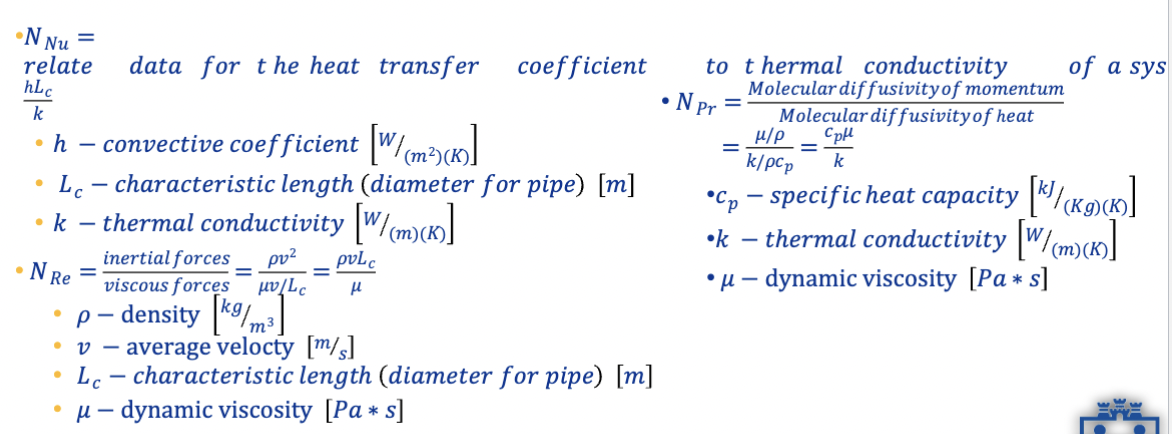
relating dimensionless numbers
Nu=cRenPrm
where c, n, and m are constants.
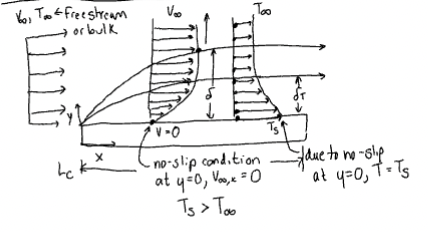
convective heat transfer assumptions
Boundary layer approximations apply
Gravity and other body forces are negligible
dP/dy=0
dP/dx inside and outside of boundary layer is negligable
Fully developed flow
Upstream velocity is uniform and steady
Incompressible flow
simple compressible system
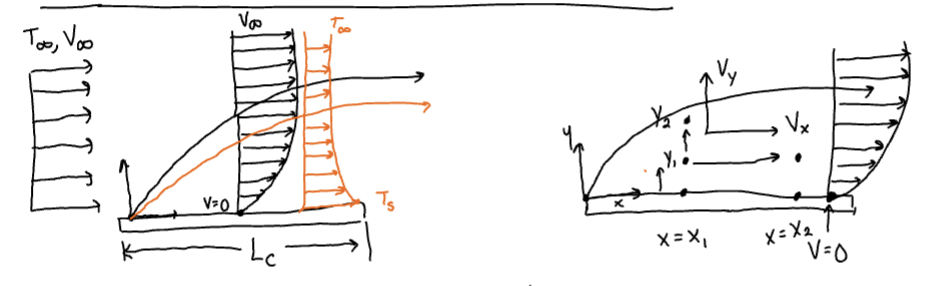
boundary layer approximations
Vx >> Vy
dVy/dy and dVy/dx are negligible and dVx/dy >> dvx/dx
dT/dy >> dT/dx
gravity and other body forces
negligible for convective heat transfer ie only surface forces (shear forces between layers of fluid) are being considered.
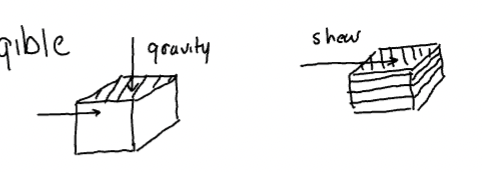
pressure
variation of _______ in the y-direction is negligible for convective heat flow. the variation of _______ in the x direction inside and outside the boundary layer is also negligible
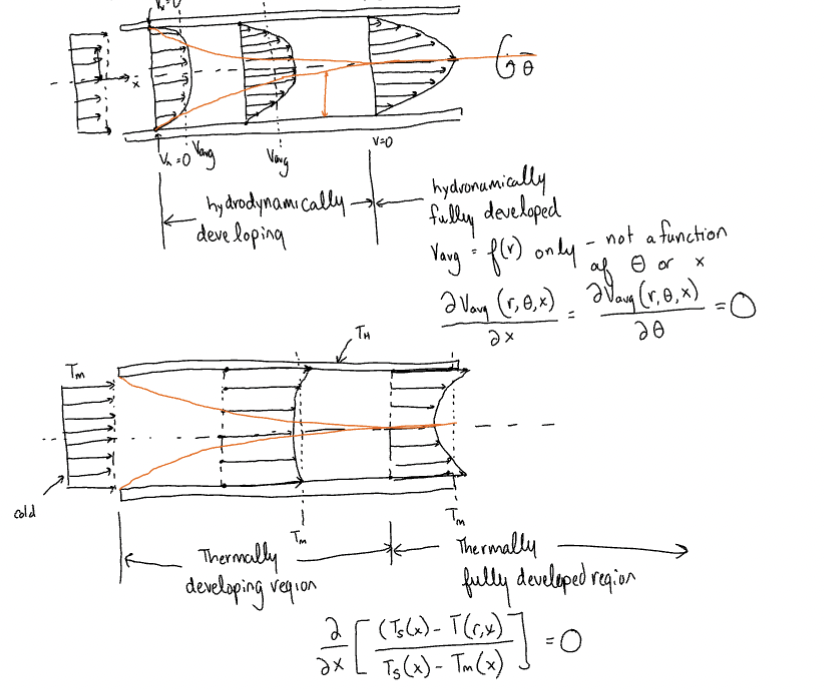
fully developed flow
Hydrodynamically: Vavg is a function of r only
Thermally: T(r,x) → Tm(x) and they approach constant values in the x direction
incompressible flow
density does not change with position. dρ/dx = dρ/dy = dρ/dz = 0 so can calculate Re
simple compressible system assumption
the derivation for the Nusselt number comes from an energy balance on open systems with steady flow.
film temperature
Tf = (Ts+T∞)/2
Fluid properties are assumed constant at this temperature. if we are evaluating heat transfer for the entire surface, we are using an average heat transfer convective coefficient (otherwise use integral)
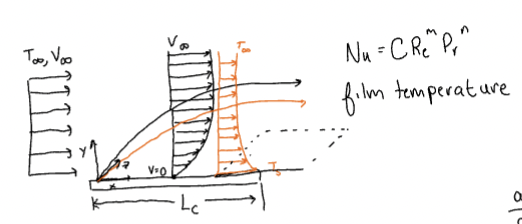
parallel flow over an isothermal flat plate
critical Reynold’s number: Recr = 5×10⁵
Laminar: Re < 5×10⁵ Nu=hL/k = 0.664Re1/2Pr1/3
Turbulent Re > 5×10⁵ Nu=hL/k = 0.037Re0.8Pr1/3
0.6 ≤ Pr ≤ 60
Zukaukas and Jacob
equations for flow across single cylinder that is smooth, using Tf and Nucyl = hD/k = cRemPr1/3
Table 12-3
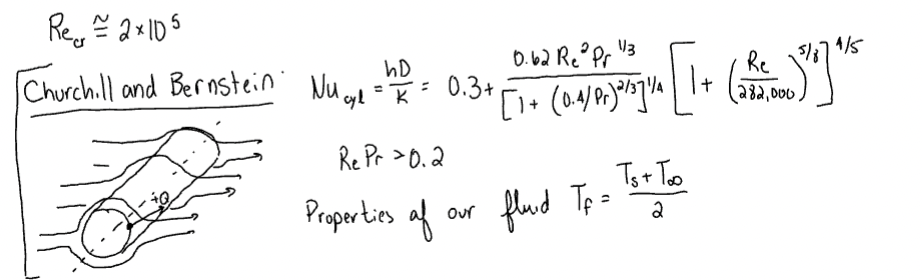
Recr = 2×10⁵
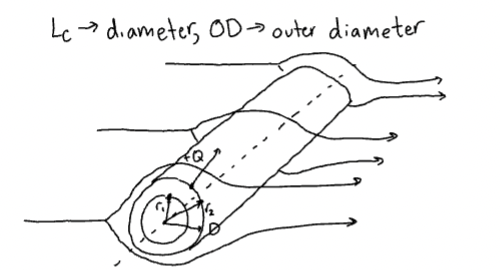
Churchill and Berstein
properities of fluid evaluated at Tf - more exact
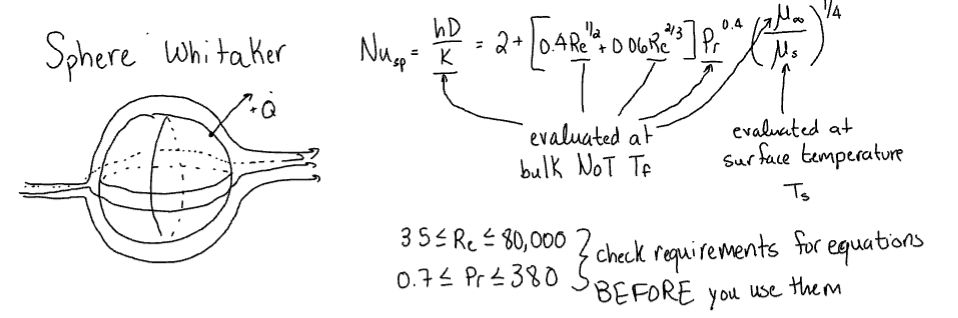
Whitaker
for calculating flow across spheres
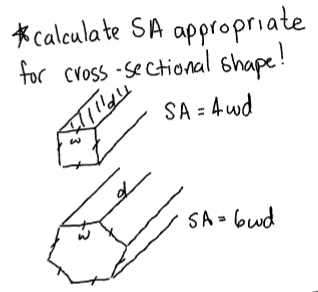
surface area
Q=hA(Ts-T∞)
cylinder → 2πrL = πDL (circular cross section)
sphere → 4πr² = πd²