instapolls, quizzes, hw, LOs - UNIT 1
 Studied by 1 person
 Call with Kai
 Learn
Learn Practice Test
 Spaced Repetition
 Match
Match Flashcards
 Knowt Play
1/86

Earn XP
Description and Tags
HW in google doc, added AE1, AE2, Instapolls
Name | Mastery | Learn | Test | Matching | Spaced | Call with Kai |
|---|
No study sessions yet.
87 Terms
1-1 Compare and contrast mitosis and meiosis in terms of their
function and the chromosome number in daughter cells as compared to the original cell
Mitosis is for growth, repair, and asexual reproduction, producing 2 identical diploid (2n) daughter cells.
Meiosis is for sexual reproduction, producing 4 genetically diverse haploid (n) gametes.
1-2. Know what these terms mean and be able to relate them:
DNA molecule, chromosome, gene, allele
Gene: A DNA segment that encodes a functional product (usually a protein).
Allele: Alternative forms of a gene.
DNA molecule: the molecule that contains genes
Chromosome: a highly condensed DNA-protein complex containing many genes
1-3. If the diploid number (2n) for a species is 50, how many
homologous pairs are in that species’ genome, and how many
chromosomes are in a sperm cell of that species?
If 2n = 50, there are 25 homologous pairs and 25 chromosomes in a sperm cell.
1-4. Distinguish sexual and asexual reproduction; relate to mitosis
and meiosis and to reproductive life cycles
Sexual reproduction involves meiosis, gamete fusion (fertilization), and results in a diploid zygote.
Asexual reproduction involves mitosis and produces genetically identical offspring.
1-5. For the following pairs of terms, define and distinguish between
them: gene & allele; genotype & phenotype; homozygous &
heterozygous; dominant & recessive alleles.
Gene vs. Allele: A gene is a segment of DNA, while an allele is a variant of that gene.
Genotype vs. Phenotype: Genotype is the set of alleles, and phenotype is the observable trait.
Homozygous vs. Heterozygous: Homozygous is having identical alleles (e.g., AA), while heterozygous is having different alleles (e.g., Aa).
Dominant vs. Recessive: A dominant allele expresses its phenotype in both homozygous and heterozygous conditions, while a recessive allele only expresses its phenotype when homozygous.
1-6. Tell how the Punnett square is related to meiosis and fertilization
Punnett squares are related to meiosis because they visualize the possible combinations of gametes (produced through meiosis) during fertilization.
This replicated chromosome
contains two identical double-stranded DNA
molecules. (one chromosome, two identical
replicates still attached to each other early in
mitosis or meiosis)
1. The image shown here
contains which?
A. DNA from one of your parents
on the left and DNA from the other
parent on the right.
B. DNA from only one of your parents
PICTURE - 2 chromatids connected with a centromere
B. DNA from only one of your parents.
"This replicated chromosome contains two identical double-stranded DNA molecules. (one chromosome, two identical replicates still attached to each other early in mitosis or meiosis)". The replicated chromosome comprises two identical sister chromatids joined at a centromere
2. Which of the following best describes the two members of a homologous pair of chromosomes? A. they have totally identical DNA B. they have genes controlling the same kinds of characters C. they were inherited from the same parent
B. they have genes controlling the same kinds of characters.
Homologous chromosomes have genes for the same traits at the same locations, but they may have different alleles for those genes. They are similar but not identical.
3. If a cell with a genome of 20 homologous pairs of chromosomes undergoes normal meiosis, how many cells result, and how many chromosomes are in each of the resulting cells?
A. Two cells, each with 20 chromosomes B. Two cells, each with 40 chromosomes C. Four cells, each with 10 chromosomes D. Four cells, each with 20 chromosomes E. Four cells, each with 40 chromosomes
D. Four cells, each with 20 chromosomes.
Meiosis: As stated in the notes, meiosis involves two successive divisions, ultimately resulting in four daughter cells.
4. (from L.O. 1-3). If the diploid number (2n)
for a species is 50,
how many homologous pairs are in that
species’ genome,
and how many chromosomes are in a sperm
cell of that species ?
A. 50, 50
B. 50, 25
C. 25, 25
D. 25, 50
C. 25, 25
Homologous Pairs: The notes state "a diploid cell contains both members of all homologous pairs; it contains 2n chromosomes". If 2n = 50, then there are 50/2 = 25 homologous pairs.
Chromosomes in Sperm Cell: According to the notes, "a haploid cell is a cell containing only 1 member of each homologous pair; it contains n chromosomes". Therefore, a sperm cell (which is haploid) would contain n = 25 chromosomes.
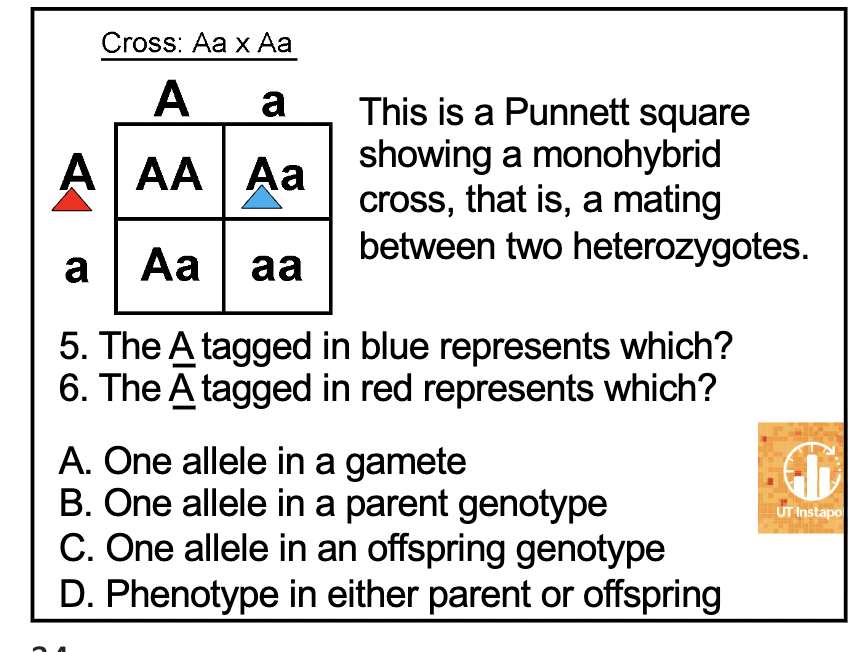
The A tagged in blue represents: C. One allele in an offspring genotype
The A tagged in red represents: A. One allele in a gamete
Genetic information is transmitted from one generation to another through mitosis, meiosis and fertilization. a. Compare and contrast mitosis and meiosis in terms of chromosome arrangement and chromosome number in daughter cells as compared to the original cell.
a. Mitosis vs. Meiosis: Chromosome Arrangement and Number
Feature | Mitosis | Meiosis |
|---|---|---|
Chromosome Arrangement | Individual chromosomes line up during metaphase. | Homologous pairs line up during Metaphase I, followed by individual chromosomes lining up in Metaphase II. |
Chromosome Number in Daughter Cells | Maintains diploid (2n) number; daughter cells have the same number of chromosomes as the parent cell. | Reduces chromosome number by half; daughter cells are haploid (n). |
Genetic Composition | Genetically identical to the parent cell (clonal). | Genetically diverse due to recombination and independent assortment. |
Purpose | Growth, repair, asexual reproduction | Production of gametes for sexual reproduction |
Division Type | One division →→ 2 daughter cells. | Two successive divisions →→ 4 daughter cells. |
Key Stages | Prophase →→ Metaphase →→ Anaphase →→ Telophase (single cycle). | Meiosis I (homolog separation) →→ Meiosis II (sister chromatid separation). |
Outcome for a cell with 1 chromosome pair | 2 cells, each with 2 chromosomes |
b. Describe how genetic variation among individuals is generated by meiotic independent assortment and recombination. Be able to label and follow alleles on chromosomes
Independent Assortment:
During Metaphase I, homologous pairs align randomly at the metaphase plate.
The orientation of each pair is independent of other pairs.
This leads to different combinations of chromosomes in the resulting gametes.
Recombination (Crossing Over):
Occurs during Prophase I.
Homologous chromosomes exchange genetic material.
Creates new combinations of alleles on the same chromosome.
The notes states: "Genetically diverse (due to recombination & independent assortment)".
c. Distinguish asexual reproduction from sexual reproduction, and state the evolutionary advantages and potential limitations of each in different environments.
Feature | Asexual Reproduction | Sexual Reproduction |
|---|---|---|
Process | May involve mitosis only. | Involves meiosis →→ haploid gametes →→ fertilization →→ diploid zygote. |
Offspring | Genetically identical to the parent. | Genetically diverse. |
Advantages | Rapid population growth; well-suited to stable environments. | Increased genetic variation; better adaptation to changing environments; removal of harmful mutations. |
Limitations | Lack of genetic diversity; susceptible to environmental changes. | Slower reproduction rate; requires more energy; potential for harmful genetic combinations. |
Evolutionary Advantages & Limitations:
Asexual Reproduction:
Advantage: Rapid reproduction is advantageous in stable environments where the parent is well-adapted.
Limitation: Lack of diversity makes the population vulnerable to new diseases or environmental changes.
Sexual Reproduction:
Advantage: Genetic diversity allows for adaptation to changing environments and can eliminate harmful mutations.
Limitation: Slower reproduction and greater energy investment can be disadvantages in stable environments.
1.7. Generate Punnett Squares and calculate the probability of offspring genotypes and phenotypes when given information about parental phenotypes and the dominance pattern.
Punnett squares predict offspring genotypes by combining parental gametes (derived from meiosis). They are based on Mendel's Law of Segregation, where each parent contributes one allele per locus. For example, a Punnett square can visually represent an Aa×AaAa×Aa cross.
The probability of each genotype and phenotype can then be calculated from the Punnett square results. For example, in the Aa×AaAa×Aa cross, the expected genotypic ratio is 1:2:1 (AA:Aa:aaAA:Aa:aa).
1.8. Distinguish these forms of allele dominance: Simple (=complete), incomplete dominance, co-dominance
Simple (complete) dominance: The dominant allele masks the recessive allele in heterozygotes. The phenotype is the same as the homozygous dominant. For example, with cystic fibrosis (where 'f' is the recessive allele), only ff individuals express the trait.
Incomplete dominance: The heterozygote shows a blended phenotype, intermediate between the two homozygotes. An example is pink snapdragons, where CRCWCRCW heterozygotes are pink, CRCRCRCR are red, and CWCWCWCW are white.
Co-dominance: Both alleles are fully expressed in the heterozygote phenotype. An example is MN blood type, where individuals can express either the M antigen, the N antigen, or both (MN).
1.9. Practice. What offspring phenotypes, and in what ratios, are expected from a mating between two heterozygotes:
(a) simple dominance example: Cystic fibrosis recessive trait (F & f);
(b) incomplete dominance: pink snapdragons (alleles CR ,CW ).
(c) co-dominance example: MN blood types (alleles M,N; possible blood type phenotypes M, N, MN)
(a) simple dominance example: Cystic fibrosis recessive trait (F & f)
With a Ff x Ff cross, the expected phenotypic ratio is 3 normal : 1 affected.
(b) incomplete dominance: pink snapdragons (alleles CR,CWCR,CW)
With a CRCW×CRCWCRCW×CRCW cross, the expected phenotypic ratio is 1 red : 2 pink : 1 white.
(c) co-dominance example: MN blood types (alleles M, N; possible blood type phenotypes M, N, MN)
With a MN×MNMN×MN cross, the expected phenotypic ratio is 1 M : 2 MN : 1 N.
1.10. Human ABO blood group phenotypes are determined by multiple alleles possible at same gene locus, specifically three alleles IA, IB, (both dominant) and i (recessive). Given information about parental genotypes, use a Punnett square to determine possible offspring phenotypes.
The alleles IAIA and IBIB are co-dominant, while i is recessive.
For example, with a IAi×IBiIAi×IBi cross, the possible offspring phenotypes are A, B, AB, and O, each with a 1/4 probability.
1.11. Use the multiplication rule to determine the probability of a certain combination of two independent events. (e.g., 2 sons)
The multiplication rule states that for independent events, the probability of both occurring is the product of their individual probabilities.
For example, the probability of having two sons is 12×12=1421×21=41
Question: Which statements (A–E) are true?
Answer: G. Three of these are true.
A (circle is a gamete) → True
B (aa is a gamete) → False
C (a is an allele) → True
D (Aa is a phenotype) → False
E (Aa is a genotype) → True
Question: In simple dominance, which statement is correct?
Answer: B. Individuals showing the recessive allele phenotype are all homozygous recessive.
Question: What fraction of offspring are albino from Aa × Aa?
Answer: D. 1/4
Question: If one sister is albino, what is the probability the normal sister is a carrier?
Answer: E. 0.67
Question: Cross Tt × Tt — probability of recessive phenotype?
Question: Cross Tt × TT — probability of tt offspring?
Answer: B. 0.25
Answer: A. 0
Question: Cross Tt × TT — proportion heterozygous?
Answer: C. 0.5
Question: Cross cream (C₂C₂) × palomino (C₁C₂).
Question: MN blood group — genotype of type N individual?
Question: Probability first two children are sons?
Question: Probability next child is a son after two sons?
Question: Probability both children are albino from Aa × Aa?
Answer: C. Half cream, half palomino.
Answer: B. LᴺLᴺ
Answer: D. ¼ Answer: C. ½ Answer: B. 1/16
Inheritance patterns of phenotypes can be predicted based on Mendelian inheritance and chromosome linkage.
a. Generate Punnett Squares and calculate the probability of offspring genotypes and phenotypes when given information about parental phenotypes and the dominance pattern.
b. Show how a Punnett Square is related to meiosis and fertilization.
a. A Punnett Square shows all possible allele combinations from parental gametes and predicts offspring genotype and phenotype ratios based on dominance.
b. It models meiosis by showing how alleles separate into gametes and fertilization by combining one gamete from each parent to form zygotes.
Homologous pairs
homologous chromosomes are each from a parent, and are replicated into sister chromatids
homologous pairs are BOTH of the sisters (from each parent) think two X’s XX
Question 4
The diploid number (2n) for a species is 60.
(a) How many homologous pairs are in a diploid cell of that species?
(b) How many chromosomes are in a diploid cell of that species?
(c) How many chromosomes are in a sperm cell of that species?
Answers
(a) 30 homologous pairs
(b) 60 chromosomes
(c) 30 chromosomes
Explanation:
Diploid (2n) = 60 means there are 60 total chromosomes in body cells.
Homologous pairs = 60 ÷ 2 = 30.
Sperm cells are haploid (n), so they contain half the diploid number → 30 chromosomes.
Question 5
A man has six fingers on each hand and six toes on each foot. His wife and their daughter have the normal number of digits. Having extra digits is a dominant trait. What fraction of this couple’s children would be expected to have extra digits?
Also explain why it is helpful to know that this couple has a child with a normal number of digits.
Answer
Let E = extra digits (dominant) and e = normal digits (recessive).
The man shows the dominant trait but has a normal daughter, so his genotype must be Ee.
The wife is normal → ee.
Punnett square:
e | e | |
|---|---|---|
E | Ee | Ee |
e | ee | ee |
Results:
½ (Ee) → extra digits
½ (ee) → normal digits
Fraction with extra digits: ½ or 50%.
Question 7(c)
A woman with blood type B marries a man with blood type A. Both have a parent with type O. What blood types are possible in their children?
Answer:
Woman: Iᴮi
Man: Iᴬi
Punnett square → IᴬIᴮ (AB), Iᴬi (A), Iᴮi (B), ii (O)
Possible blood types: A, B, AB, or O
Correct answer: D
AE Question 1
If a cell with a genome of 20 pairs of chromosomes undergoes normal meiosis, how many cells result, and how many chromosomes are in each?
Correct. The answer is D. Four cells, each with 20 chromosomes.
Reason: The starting cell has 20 pairs (2n = 40). Meiosis produces 4 haploid cells (n = 20). Each resulting cell has 20 chromosomes, not 10, because each pair contributes one chromosome to the haploid set.
Question:
In cats, the allele for short hair (H) is dominant over the allele for long hair (h). A short-haired female has produced some long-haired kittens before. If she’s mated with a long-haired male, what fraction of the offspring is expected to have long hair?
A. 0 (none)
B. 1/4
C. 1/2
D. 3/4
E. 1 (all)
C. 1/2
Question 3
In cats, the agouti allele for the “tabby” coat pattern (A) is dominant over the allele for solid color (a). If two solid black cats (aa) mate, what proportion of their offspring would be solid black?
A. 0 (none)
B. 1/4
C. 1/2
D. 3/4
E. 1 (all)
Answer:
E. 1 (all)
Explanation:
Both parents are aa, so all offspring receive a from each parent → all aa (solid black).
Sickle-cell anemia is a recessive trait. John and Maria are both heterozygous carriers (Ss).
What proportion of their offspring are expected to have sickle-cell anemia? What proportion are expected to be carriers?
A. 0; 1/4 B. 1/4; 1/4 C. 1/4; 1/2 D. 1/2; 1/2 E. 1/2; 3/4
Answer:
C. 1/4; 1/2
Explanation: Ss × Ss → ¼ ss (disease), ½ Ss (carriers).
If only one parent is a carrier, what proportion of their offspring would have sickle-cell anemia?
A. 0 B. 1/4 C. 1/2 D. 3/4 E. all
Answer:
A. 0 (none)
Explanation: Ss × SS → no ss offspring.
Question 15
If an infant born to a mother with blood type O is also type O, possible types for the father are:
A. AB B. O or A C. A or B D. O only E. O, A, or B
Answer:
E. O, A, or B
Explanation: Mother ii, baby ii → father must contribute i → only type O (ii).
Question 16
Which set of parents is probably not correctly matched to their child by blood type?
A. A and B → AB B. A and O → AB C. A and O → O D. A and B → O E. AB and B → AB
Answer:
B. Parents A and O, child AB
Explanation: A parent with O (ii) cannot pass Iᴮ, so AB child impossible.
Question 17
In snapdragons, red (RR) × white (rr) → pink (Rr). When two pinks cross, what proportion of offspring are pink?
A. 0 B. 0.25 C. 0.50 D. 0.75 E. 1.0
Answer:
C. 0.50
Explanation: Rr × Rr → ¼ RR (red), ½ Rr (pink), ¼ rr (white). ½ = 0.50 pink.
1-11. Use the multiplication rule to determine the probability of a certain combination of two independent events (e.g., 2 sons).
Answer: The multiplication rule states that for independent events A and B, the probability of both occurring is P(A and B)=P(A)⋅P(B)P(A and B)=P(A)⋅P(B). For example, the probability of having two sons is ½ x ½ = ¼
1-11. How do single-locus genes with pleiotropy affect the phenotype of an individual?
Answer: Pleiotropy is when a single gene influences multiple, seemingly unrelated phenotypic traits. For example, the FBN1 gene is associated with Marfan syndrome, which affects the skeletal, ocular, and cardiovascular systems.
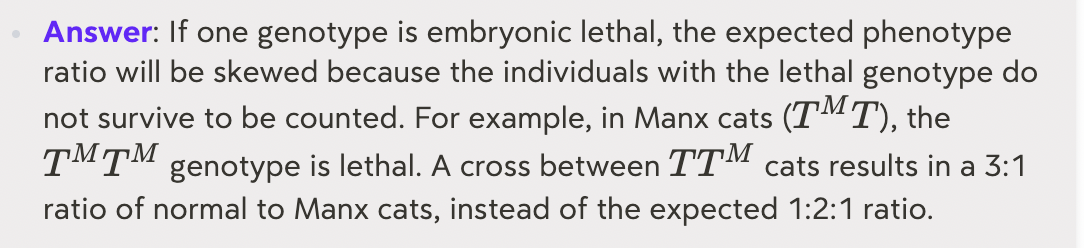
1-12. How could the offspring phenotype ratio from a heterozygote mating be different if one offspring genotype is embryonic-lethal?
1-13. Name an example where some aspect of the environment affects gene expression so that the phenotype might differ.
Answer: Hydrangea flower color varies with soil pH and aluminum availability. Acidic, aluminum-rich soils produce blue flowers, while alkaline conditions result in pink flowers.
1-14. Review chromosome changes during meiosis, and briefly define or describe two processes in normal meiosis that lead to greater genetic variation among gametes
Answer:
Independent Assortment: The random orientation of homologous chromosome pairs during metaphase I, resulting in 2n2n possible gamete genotypes (where n is the number of chromosomes).
Crossing Over (Recombination): The exchange of genetic material between homologous chromatids during prophase I, generating new allele combinations within chromosomes.
Question 1
If the probability of one coin toss being heads is ½, what’s the probability of tossing two coins and getting both heads?
Answer:
D. 1/4
Explanation:
½ × ½ = ¼
A couple is expecting twins. What’s the probability both will be boys?
If identical twins (same fertilized egg): ½ (since both share the same sex).
If not identical twins (two eggs): ¼ (½ × ½).
Answer:
Each child has a ¼ chance of being albino (aa).
For both children to be albino:
¼×¼=1/16
Correct answer: B. 1/16
Pleiotropy
Answer:
C. One gene can affect multiple systems of the person’s body.
Explanation:
Pleiotropy occurs when a single gene influences multiple traits or body systems. For example, the sickle-cell allele affects red blood cell shape, oxygen transport, and resistance to malaria.
Reason: Pleiotropy involves one gene that affects multiple traits, not genes at more than one locus. Option B describes polygenic inheritance, where multiple genes influence a single trait.
Explanation:
Manx cats are heterozygous (Mm) for the tail gene.
MM = lethal (embryo dies)
Mm = Manx (tailless)
mm = normal tail
ratio ? Answer: D. 1 Manx : 2 normal
Cross: Mm × Mm → ¼ MM (dead), ½ Mm (Manx), ¼ mm (normal).
After removing the lethal genotype, the surviving kittens show a 1 Manx : 2 normal ratio.
Explanation:
All cells in a Siamese cat have the same genes, but the pigment gene is temperature-sensitive. It’s active only in cooler body areas (ears, tail, paws), producing dark fur there, and inactive in warmer areas, producing light fur.
Answer:
B. Only some of the cells are expressing the genes for dark pigment.
Explanation:
The cell shown is FfQq. During meiosis, independent assortment allows all combinations of alleles from the two genes.
Possible sperm genotypes:
Answer: C. FQ, Fq, fQ, fq
Possible sperm genotypes:
FQ
Fq
fQ
fq
That gives 4 possible gametes → C is correct.
Question 8
When n is the number of homologous pairs, the number of possible combinations of parental chromosomes in gametes is which?
A. 2n
B. n²
C. 2ⁿ
Explanation:
During meiosis I, homologous chromosomes assort independently. Each pair can orient in two ways, so the total number of possible chromosome combinations in gametes is 2ⁿ, where n = number of homologous pairs.
Question 9
Which of the following are normal phenomena that contribute to genetic variability among gametes produced by one parent?
A. Independent assortment
B. Crossing over
C. Random fertilization
D. Mutation
E. Two of the above
F. Three of the above
G. All four of the above
Answer:
F. Three of the above
Explanation:
Independent assortment, crossing over, and random fertilization are normal sources of genetic variation.
Mutation is rare and not a regular part of meiosis.
d. Applying your knowledge of the chromosomal basis of sex in mammals, explain how X-linked genes show unique patterns of inheritance.
X-linked genes show unique inheritance because males have only one X chromosome, so a single recessive allele is expressed in them. Females have two X chromosomes, so they can be carriers without showing the trait. This causes X-linked traits to appear more often in males and to pass from carrier mothers to sons.
1-15. Review chromosome changes during meiosis, and briefly define or describe two processes in normal meiosis that lead to greater genetic variation among gametes
Chromosome Changes: Meiosis reduces a diploid cell to haploid gametes through two rounds of division.
Genetic Variation:
Independent Assortment: Random alignment of homologous pairs creates many chromosome combinations.
Crossing-Over: Exchange of segments between homologous chromosomes creates recombinant chromosomes.
1-16. What are linked genes, and how are they an exception to the law of independent assortment?
Linked Genes: Genes on the same chromosome that tend to be inherited together.
Exception: Linked genes don't segregate independently, deviating from Mendelian ratios.
1-17. How does a translocation differ from other large-scale chromosomal abnormalities? (see Fig 12.14)
Translocation: A segment moves to a non-homologous chromosome.
Difference: Unlike deletions, duplications, and inversions, translocation involves a different chromosome.
1-18. How can non-disjunction (error during meiosis) lead to an abnormal chromosome number (aneuploidy) in the gametes?
Non-Disjunction: Failure of chromosomes to separate during meiosis.
Aneuploidy: Non-disjunction leads to gametes with abnormal chromosome numbers (e.g., monosomy, trisomy).
1-19. What is the genetic (chromosomal) basis of sex determination (male or female) in placental mammals?
Genetic Basis: The SRY gene on the Y chromosome triggers testis development.
Chromosome Complement: 22 autosomal pairs + XX (female) or XY (male).
1-20. Given information about parental phenotypes for an X-linked recessive trait, draw a Punnett Square (including X and Y chromosomes) and predict the percentage or fraction of (a) their offspring and (b) their sons that would express the recessive trait in their phenotype. [if time]
Example: Mother (XHXhXHXh), Father (XHYXHY)
XHXH | YY | |
|---|---|---|
XHXH | XHXHXHXH | XHYXHY |
XhXh | XHXhXHXh | XhYXhY |
(a) Proportion of offspring that would express the recessive trait in their phenotype: 25% (1/4).
(b) Proportion of sons that would express the recessive trait in their phenotype: 50% (1/2).
1-21. How can XX females, heterozygous for X-linked traits, express different phenotypes, even though genetically identical?
X-Inactivation: Random silencing of one X chromosome in each cell.
Phenotype Variation: Creates a mosaic pattern where some cells express one allele, and others express the other, leading to different phenotypes despite identical genotypes, "the body of an XX female develops as a genetic mosaic in which some tissues express the maternal X chromosome and other tissues express the paternal X."
REVIEW 1. Siamese Cat Pigmentation
Question: Which of the following is the best explanation of why a Siamese cat has some parts of the body that are dark and some light?
A. Only some of the cells contain genes for dark pigment
B. Only some of the cells are expressing the genes for dark pigment
C. Fur in parts of the body were dyed black by its owner.
D. Both A and B are true.
Answer: B. Only some of the cells are expressing the genes for dark pigment.
Explanation: As mentioned in the notes with the Siamese cat illustration, "The genes for melanin pigment are only expressed in cells that are slightly cooler than core body temperatures. The environment of warmer cells turns off gene expression." All cells contain the genes for dark pigment, but the expression of these genes is temperature-dependent.
REVIEW 2. Sperm Cell Genotypes
Question: As pictured, "F" and "f" represent two different versions of one gene. "Q" and "q" represent two different versions of another gene. Which is the correct list of possible sperm cell genotypes (specific allele combinations) produced from this cell by meiosis?
A. FfQq only
B. Ff, Qq
C. FQ, fq, Fq, fQ
D. Ff, Qq, FQ, fq, Fq, fQ
Answer: C. FQ, fq, Fq, fQ
Explanation: During meiosis, the alleles for different genes assort independently (assuming they are on different chromosomes). Thus, a cell with FfQq can produce gametes with the combinations FQ, fq, Fq, and fQ.
L.O. 1-15. Review chromosome changes during meiosis, and briefly define or describe two processes in normal meiosis that lead to genetic variation among gametes. One is the independent assortment of different homologous pairs in meiosis adds to genetic variability among gametes. This variability is NOT due to mutations. 3. When n is the number of homologous pairs, the number of possible combinations of parental chromosomes in gametes is which? (choose a formula) A. 2n B. n 2 C. 2 n
Chromosome Changes During Meiosis:
Meiosis is a specialized cell division that reduces a diploid (2n) cell to four haploid (n) gametes. In Meiosis I, homologous chromosomes separate. In Meiosis II, sister chromatids separate.
Two Processes Leading to Genetic Variation:
Independent Assortment: Homologous pairs align randomly on the metaphase plate. At the end of meiosis I, each homologous pair moves into daughter cells randomly and independently from assortment of other homologous pairs. This process isn't due to mutations, but rather the random combinations of parental chromosomes.
Crossing-Over (Recombination): Homologous chromosomes exchange segments during prophase I, creating recombinant chromosomes. Maternal and paternal homologs exchange segments and this variability is NOT due to mutation.
Part 2: Formula for Chromosome Combinations
When 'n' is the number of homologous pairs, the number of possible combinations of parental chromosomes in gametes is:
C. 2n2n
Explanation: The formula 2n2n accurately reflects the number of possible chromosome combinations due to independent assortment. For example, the notes mention humans have n=23, so 223223 results in a huge number of possible combinations! I hope this helps! If you would like me to respond in another language, just let me know!
Which of the following are normal phenomena that contribute to genetic variability among gametes produced by one parent?
A. Independent assortment B. Crossing over C. Random fertilization D. Mutation E. Two of the above F. Three of the above G. All four of the above
Answer: F. Three of the above
Explanation:
A. Independent assortment: As stated in the notes, "each homologous pair aligns randomly on the metaphase plate; the number of possible chromosome combinations in a gamete is 2n2n (for humans, 223223)". This is a normal process that generates vast gamete diversity.
B. Crossing over: As the RAGCONTEXT mentions, "Maternal and paternal homologs exchange segments. This is called “recombination", and it contributes to genetic variability.
C. Random fertilization: While random fertilization does increase genetic variability in a zygote, it is between two parents. The question asked about the genetic variability in the gametes of one parent.
D. Mutation: Mutations can introduce new genetic variation, but mutations are not considered a normal process, as the prompt indicates, and are errors.
Correct answer: B. It involves breaking off a segment and attaching it to another chromosome.
Explanation:
A translocation occurs when a chromosome segment breaks off and becomes attached to a nonhomologous chromosome, unlike deletions, duplications, or inversions, which stay within the same chromosome.
Answer: B. Father
Explanation: In humans, the father determines the sex of the child because he produces two types of sperm — one carrying an X chromosome and one carrying a Y chromosome. The mother’s egg always provides an X. If the sperm contributes an X → female (XX). If it contributes a Y → male (XY).
Explanation:
The woman is heterozygous (XᴴXʰ) for the recessive X-linked hemophilia allele, and the man is normal (XᴴY).
Punnett square:
Daughters: XᴴXᴴ (normal) or XᴴXʰ (carrier) → ½ carriers
Sons: XᴴY (normal) or XʰY (hemophilia) → ½ affected
So, ½ of the daughters are carriers, and ½ of the sons have hemophilia.
AE2 Which of these differences in the phenotype is due to a difference in the alleles present and NOT due to different expression of genes?
A. Palomino Horses color
B. Calico Cat female fur color
C. hydrangea flower color
D. Siamese Cat fur color
A. Palomino Horses color
During a rare error in meiosis, a gamete with one extra chromosome can be formed.
Which of the following is NOT such an error?
A. non-disjunction in meiosis I
B. non-disjunction in meiosis II
C. polyploidy during meiosis I or II
C. polyploidy during meiosis I or II
3 A woman is heterozygous for the recessive X-linked gene for hemophilia. Her husband is not affected by hemophilia. Determine the the parent genotypes (with X and Y chromosomes), and draw the Punnett Square for this mating.
What proportion of their sons will have hemophilia?
A. 0 (none)
B. 1/4
C. 1/2
D. 3/4
E. 1 (all)
C. 1/2
Question 4
1 / 1 pts
If a baby girl was born color-blind, which of the following can be assumed to be true about her parents’ phenotype?
A. Both of her parents must be color-blind
B.Her father must be color-blind
C. Her mother must be color-blind
D. None of these above about her parents’ phenotype can be assumed
B.Her father must be color-blind
Very few protein-coding genes are on the Y chromosomes, and there is virtually no crossing-over between X and Y.
Y-linked genes include the sry gene that expresses the testis-differentiation protein and determines male development. A male with this gene will
A. usually pass it to his sons, but about 10% of the time also pass it to a daughter
B. only pass the gene to his sons
C. only pass the gene to his daughters
D. only pass the gene to his grandsons, not sons
E. pass the gene to all of his children if the mother is a carrier
B. only pass the gene to his sons
6. Why do X-linked recessive traits appear in the phenotype of males more than in females?
A. Males always carry more recessive traits
B. Males inherit more recessive traits from their mothers than females do.
C. Males inherit more recessive traits from their fathers than females do
D. Females have two X chromosomes so if one has a recessive gene a normal allele on the other X chromosome can be expressed.
D. Females have two X chromosomes so if one has a recessive gene a normal allele on the other X chromosome can be expressed.
3a.
3. Microevolution produces changes in allele frequency from one generation to the next and can occur by several different means. Adaptations in organisms are the product of evolution by natural selection. a. Describe a gene pool quantitatively in terms of allele frequencies and genotype frequencies . Use two Hardy-Weinberg equations to calculate and predict these frequencies in subsequent generations under conditions of equilibrium
A gene pool is the total collection of alleles in a population. Allele frequencies are p and q, and genotype frequencies are p2, 2pq, and q2. The Hardy-Weinberg equations are p+q=1 and p2+2pq+q2=1.
b. List the five assumptions of Hardy-Weinberg equilibrium.
3b. Five assumptions: no mutation, no migration (gene flow), no natural selection, random mating, and large population size (no genetic drift).
c. Identify mechanisms that lead to changes in allele frequency in population over time (genetic drift, mutation, selection, nonrandom mating, gene flow), and for each give an example and explain how microevolution occurs.
3c. Mechanisms of change:
Genetic drift: random allele changes in small populations (e.g., bottleneck).
Mutation: introduces new alleles (e.g., point mutation).
Selection: favors beneficial traits (e.g., antibiotic resistance).
Nonrandom mating: certain traits preferred (e.g., sexual selection).
Gene flow: movement of alleles between populations (e.g., migration).
d. Use the output of a simulation (Red Lynx Model) in the context of population genetics. Be able to predict changes in allele frequencies in a population with the input of micro-evolutionary forces.
3d. In the Red Lynx simulation, altering forces like selection, mutation, or drift changes allele frequencies over generations. The model shows how microevolution occurs when equilibrium assumptions are violated.
1-19. How can a female mammal that is heterozygous for an X-linked trait become a genetic mosaic (patchy expression) because of X-chromosome inactivation?
In female mammals, X-chromosome inactivation (XCI) leads to genetic mosaicism when they are heterozygous for an X-linked trait. Here's how:
Random Silencing: During early embryogenesis, one of the two X chromosomes in each cell is randomly inactivated. This means that in some cells, the maternal X chromosome is inactivated, while in others, the paternal X chromosome is inactivated.
Barr Body Formation: The inactivated X chromosome becomes highly condensed, forming a Barr body, and is heavily DNA-methylated.
Co-Dominant Alleles: If a female is heterozygous for a co-dominant X-linked trait (e.g., Black (B) and Orange (O) alleles in cats), different cells will express different alleles depending on which X chromosome is active.
Patchy Expression: Because all daughter cells inherit the same inactive X, tissues become a "patchwork" of cells expressing different alleles. For example, in tortoiseshell and calico cats, this results in random patches of different colors (black and orange, or black, orange, and white). As the notes state: "Because different patches of skin derive from cells with opposite X‑inactivation, the coat shows random patches of each colour."
1-20. Define & distinguish these terms; what do they mean? genotype vs phenotype allele frequency vs genotype frequency
Genotype vs. Phenotype
Genotype: The genetic makeup of an individual, specifically the alleles they carry for a particular gene.
Phenotype: The observable characteristics or traits of an individual, which are influenced by both their genotype and environmental factors.
Allele Frequency vs. Genotype Frequency
Allele Frequency: The proportion of a specific allele among all copies of a gene in a population. It's usually denoted as pp or qq.
Genotype Frequency: The proportion of individuals with a particular genotype (e.g., AAAA, AaAa, aaaa) in a population.
1-21. Describe a gene pool quantitatively in terms of allele frequencies and genotype frequencies (practicing during lecture with a “population” of cookie chip individuals.)
A gene pool can be quantitatively described using allele frequencies and genotype frequencies:
Allele Frequencies: Describe the proportion of each allele in the population. If there are two alleles, AA and aa, their frequencies are represented as pp (frequency of AA) and qq (frequency of aa). The sum of all allele frequencies for a gene must equal 1 (i.e., p+q=1p+q=1).
Genotype Frequencies: Describe the proportion of each genotype in the population. For a gene with two alleles, the genotypes are AAAA, AaAa, and aaaa. Their frequencies are represented as p2p2 (frequency of AAAA), 2pq2pq (frequency of AaAa), and q2q2 (frequency of aaaa).
1-22. Calculate allele frequency (p, q) and genotype frequencies (p 2, 2pq, q 2) using the two Hardy-Weinberg equilibrium equations.
The Hardy-Weinberg equilibrium equations are used to calculate allele and genotype frequencies under specific conditions.
Allele Frequencies:
p+q=1p+q=1, where pp is the frequency of allele AA and qq is the frequency of allele aa.
Genotype Frequencies:
p2+2pq+q2=1p2+2pq+q2=1, where:
p2p2 is the frequency of genotype AAAA
2pq2pq is the frequency of genotype AaAa
q2q2 is the frequency of genotype aaaa
Example:
If you know the frequency of the aaaa genotype (q2q2), you can find qq by taking the square root of q2q2. Then, you can find pp using the equation p+q=1p+q=1. Finally, you can calculate the frequencies of the AAAA and AaAa genotypes using p2p2 and 2pq2pq, respectively. For example, from "Problem Set 2 – Butterfly Colour", given that 25% of butterflies are white (aaaa, so q2=0.25q2=0.25):
Find qq: q=0.25=0.5q=0.25=0.5
Find pp: p=1−q=1−0.5=0.5p=1−q=1−0.5=0.5
Calculate genotype frequencies:
AA=p2=(0.5)2=0.25AA=p2=(0.5)2=0.25 (25%)
Aa=2pq=2×0.5×0.5=0.5Aa=2pq=2×0.5×0.5=0.5 (50%)
aa=q2=(0.5)2=0.25aa=q2=(0.5)2=0.25 (25%)
1-23. (coming up Monday) Name the main assumptions of Hardy-Weinberg equilibrium. Tell how violating any one of those assumptions would cause the population (gene pool) to evolve and not stay in equilibrium
The main assumptions of Hardy-Weinberg equilibrium are:
(a) No mutations: The allele frequencies do not change due to new mutations.
(b) Random mating: Individuals mate randomly, without any preference for certain genotypes.
(c) No natural selection: All genotypes have equal survival and reproductive rates.
(d) Large (effectively infinite) population size: The population is large enough to avoid random fluctuations in allele frequencies due to chance (genetic drift).
(e) No gene flow (migration): There is no migration of individuals into or out of the population, which could alter allele frequencies.
Violation of any assumption leads to microevolution (change in allele frequencies over time):
Mutations: Introduce new alleles into the population, changing allele frequencies.
Non-random mating: Alters genotype frequencies; for example, inbreeding increases the frequency of homozygous genotypes.
Natural selection: Favors certain genotypes, leading to changes in allele frequencies as advantageous alleles become more common.
Small population size: Genetic drift causes random changes in allele frequencies, potentially leading to the loss of some alleles and the fixation of others.
Gene flow: Introduces or removes alleles from the population, altering allele frequencies.
 Note
Note  Flashcards (50)