(27.15) Regulation of Female Reproductive System

0.0(0)
studied byStudied by 0 people
0.0(0)
full-widthCall Kai
learnLearn
examPractice Test
spaced repetitionSpaced Repetition
heart puzzleMatch
flashcardsFlashcards
GameKnowt Play
Card Sorting

1/11

encourage image

There's no tags or description

Looks like no tags are added yet.

Study Analytics
Name
Mastery
Learn
Test
Matching
Spaced

No study sessions yet.

12 Terms

1
New cards

Describe Establishing the Ovarian Cycle

  • Before puberty, ovaries secrete small amounts of estrogen

  • As puberty nears GnRH is released stimulating FSH and LH release by pituitary that then acts on ovaries

  • Events continue until an adult cyclic pattern is achieved and menarche occurs

2
New cards

Describe the regulation of the ovarian and uterine cycles.

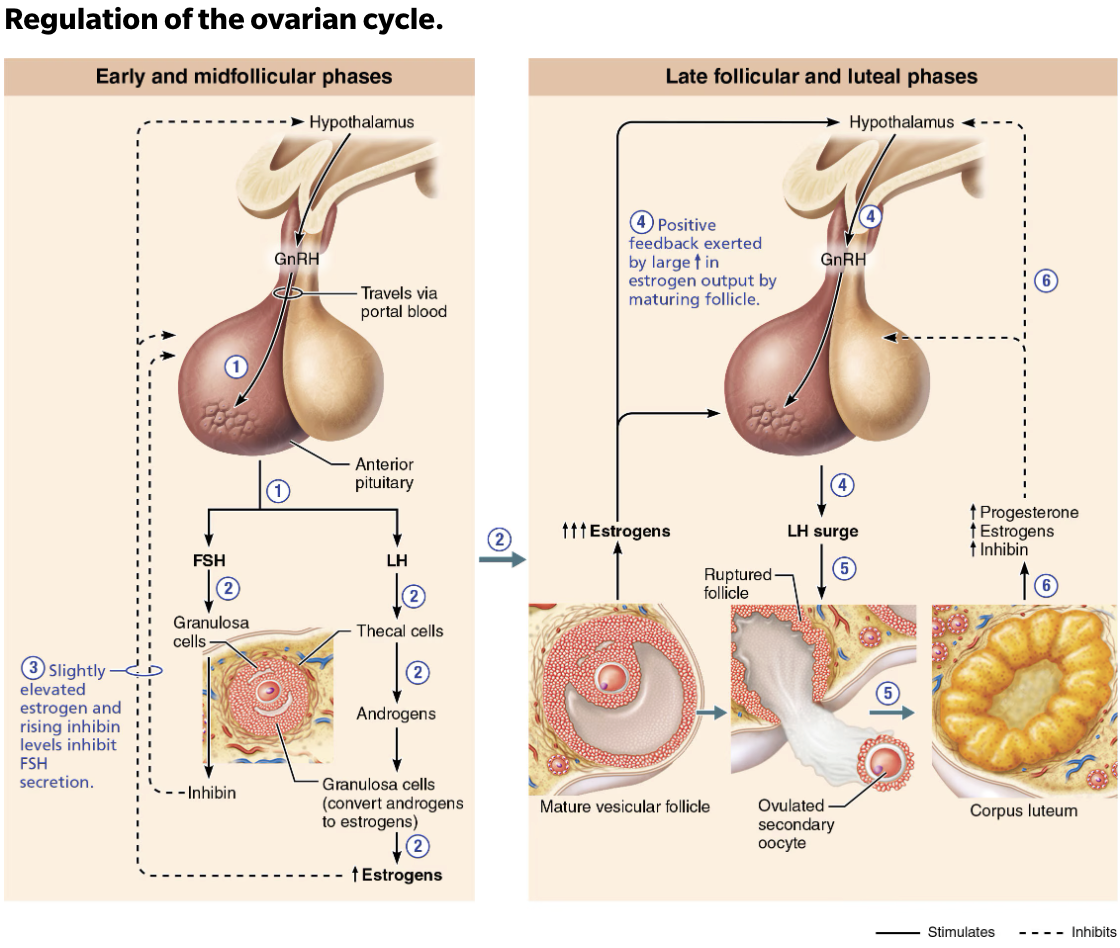
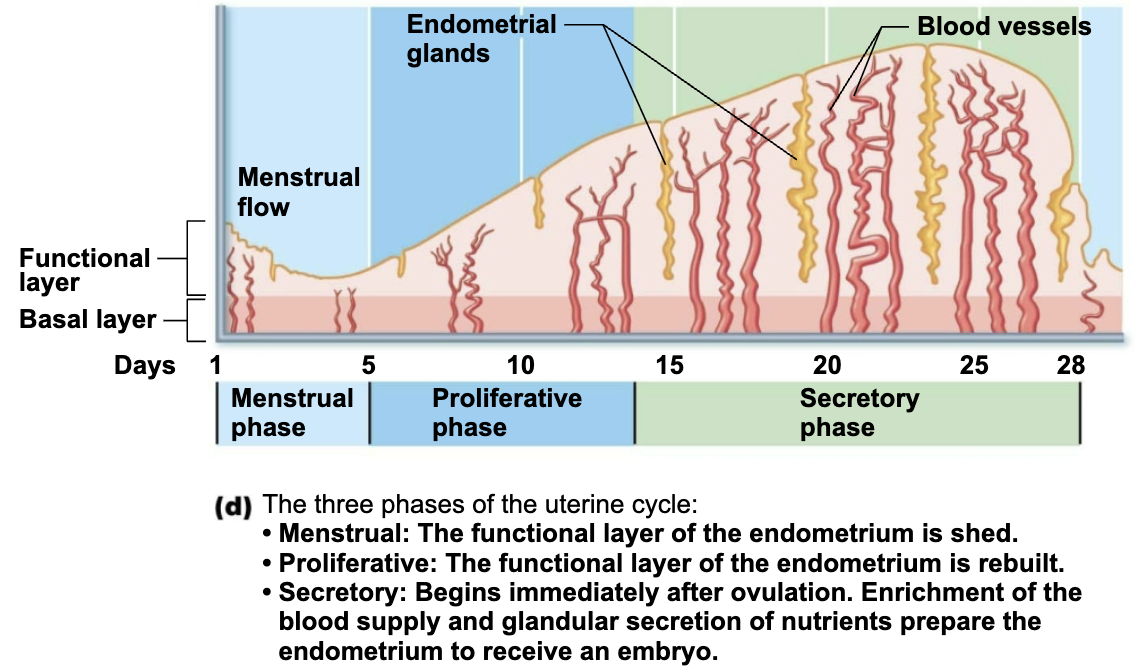
  1. GnRH stimulates FSH and LH secretion

  2. FSH and LH stimulate follicles to grow, mature, and secrete sex hormones

    • FSH stimulates granulosa cells to release estrogen and LH prods thecal cells to produce androgens, which granulosa converts to estrogens

  3. LH surge triggers ovulation and formation of the corpus luteum

    • Surge triggers ovulation:

      • LH surge triggers primary oocyte to complete meiosis I to become secondary oocyte

      • Secondary oocyte then enters meiosis II, continuing on to metaphase II

    • Shortly after ovulation:

      • Estrogen levels decline

      • LH transforms ruptured follicle into corpus luteum

      • LH stimulates corpus luteum to secrete progesterone and some estrogen almost immediately

  4. Negative feedback inhibits LH and FSH release

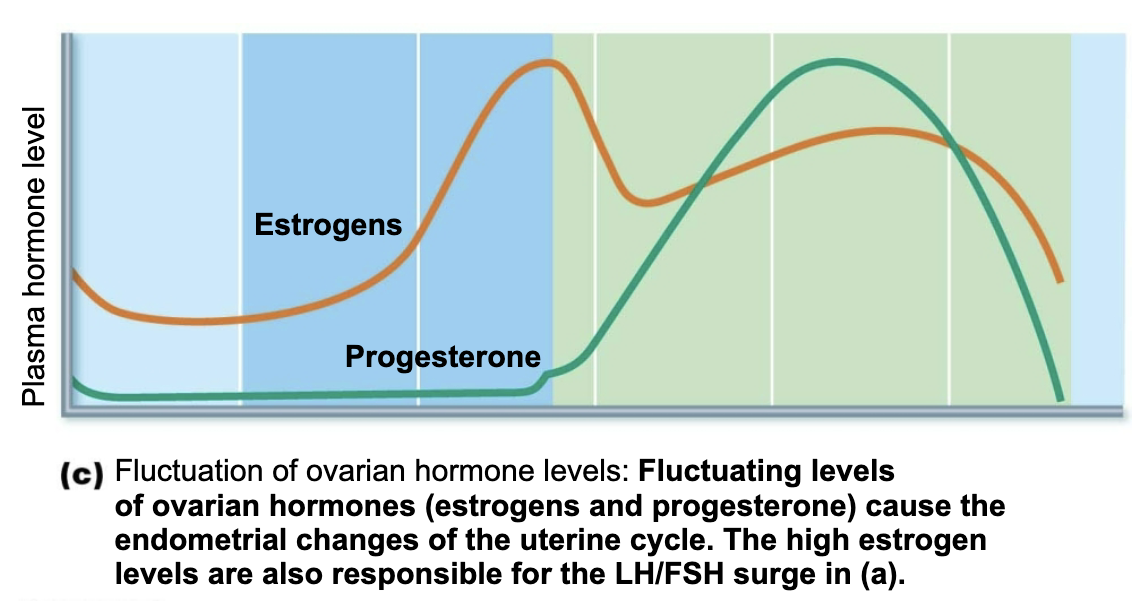
    • Negative feedback from rising plasma progesterone and estrogen levels inhibits LH and FSH release

      • Inhibin, from corpus luteum and granulosa cells, enhances inhibitory effect

      • Declining LH ends luteal activity and inhibits follicle development
<ol><li><p><span style="color: red;"><strong><span>GnRH</span></strong></span><strong> stimulates FSH and LH secretion</strong></p></li><li><p><span style="color: red;"><strong><span>FSH</span></strong></span><strong> and </strong><span style="color: red;"><strong><span>LH</span></strong></span><strong> stimulate follicles to grow, mature, and secrete sex hormones</strong></p><ul><li><p><strong>FSH</strong> stimulates <span style="color: blue;"><span>granulosa cells</span></span> to release <span style="color: red;"><strong><span>estrogen</span></strong></span> and <strong>LH</strong> prods <span style="color: blue;"><span>thecal cells</span></span> to produce <span style="color: red;"><strong><span>androgens</span></strong></span>, which <span style="color: blue;"><span>granulosa</span></span> converts to <span style="color: red;"><strong><span>estrogens</span></strong></span></p></li></ul></li><li><p><span style="color: red;"><strong><span>LH</span></strong></span><strong> surge triggers </strong><span style="color: blue;"><strong><span>ovulation</span></strong></span><strong> and formation of the </strong><span style="color: blue;"><strong><span>corpus luteum</span></strong></span></p><ul><li><p>Surge triggers ovulation:</p><ul><li><p>LH surge triggers <code>primary oocyte</code> to complete <strong><em><u>meiosis I</u></em></strong> to become <span style="color: blue;"><span>secondary oocyte</span></span></p></li><li><p><code>Secondary oocyte</code> then enters <strong><em><u>meiosis II</u></em></strong>, continuing on to <strong><em><u>metaphase </u></em></strong>II</p></li></ul></li><li><p>Shortly after ovulation:</p><ul><li><p>Estrogen levels decline</p></li><li><p>LH transforms ruptured follicle into <span style="color: blue;"><span>corpus luteum</span></span></p></li><li><p>LH stimulates corpus luteum to secrete <span style="color: red;"><span>progesterone</span></span> and some <span style="color: red;"><span>estrogen</span></span> almost immediately</p></li></ul></li></ul></li><li><p><strong>Negative feedback inhibits LH and FSH release</strong></p><ul><li><p>Negative feedback from rising plasma progesterone and estrogen levels inhibits LH and FSH release</p><ul><li><p><span style="color: red;"><strong><mark data-color="red" style="background-color: red; color: inherit;"><span>Inhibin</span></mark></strong></span>, from corpus luteum and granulosa cells, enhances inhibitory effect</p></li><li><p><span style="color: red;"><strong><mark data-color="red" style="background-color: red; color: inherit;"><span>Declining LH </span></mark></strong></span>ends luteal activity and inhibits follicle development</p></li></ul></li></ul></li></ol><p></p>
3
New cards

Describe if no fertilization occurs

  • Corpus luteum degenerates when LH levels start to fall

  • Causes a sharp decrease in estrogen and progesterone, which in turn ends blockage of FSH and LH secretion → causing to start all over again
<ul><li><p><span style="color: blue;"><strong>Corpus luteum </strong></span><span style="color: red;"><strong>degenerates when LH levels start to fall </strong></span></p></li><li><p>Causes a sharp <span style="color: rgb(0, 0, 0);"><strong><mark data-color="red" style="background-color: red; color: inherit;">decrease in estrogen and progesterone</mark></strong></span>, which in turn ends blockage of <span style="color: rgb(0, 0, 0);"><strong><mark data-color="green" style="background-color: green; color: inherit;">FSH and LH secretion</mark></strong></span> → causing to start all over again </p></li></ul><p></p>
4
New cards

Discuss the physiological effects of estrogens and progesterone.

  • Helps maintain stratum functionalis

  • Maintains pregnancy, if it occurs

<ul><li><p>Helps maintain stratum functionalis</p></li><li><p>Maintains pregnancy, if it occurs</p></li></ul><p></p>
5
New cards

Define Uterine Cycle

Menstrual Cycle

Cyclic series of changes in endometrium that occur in response to fluctuating ovarian hormone levels
<p><strong><em>Menstrual Cycle </em></strong></p><p>Cyclic series of changes in endometrium that occur in response to fluctuating ovarian hormone levels</p>
6
New cards

Describe the Phases of the Uterine Cycle

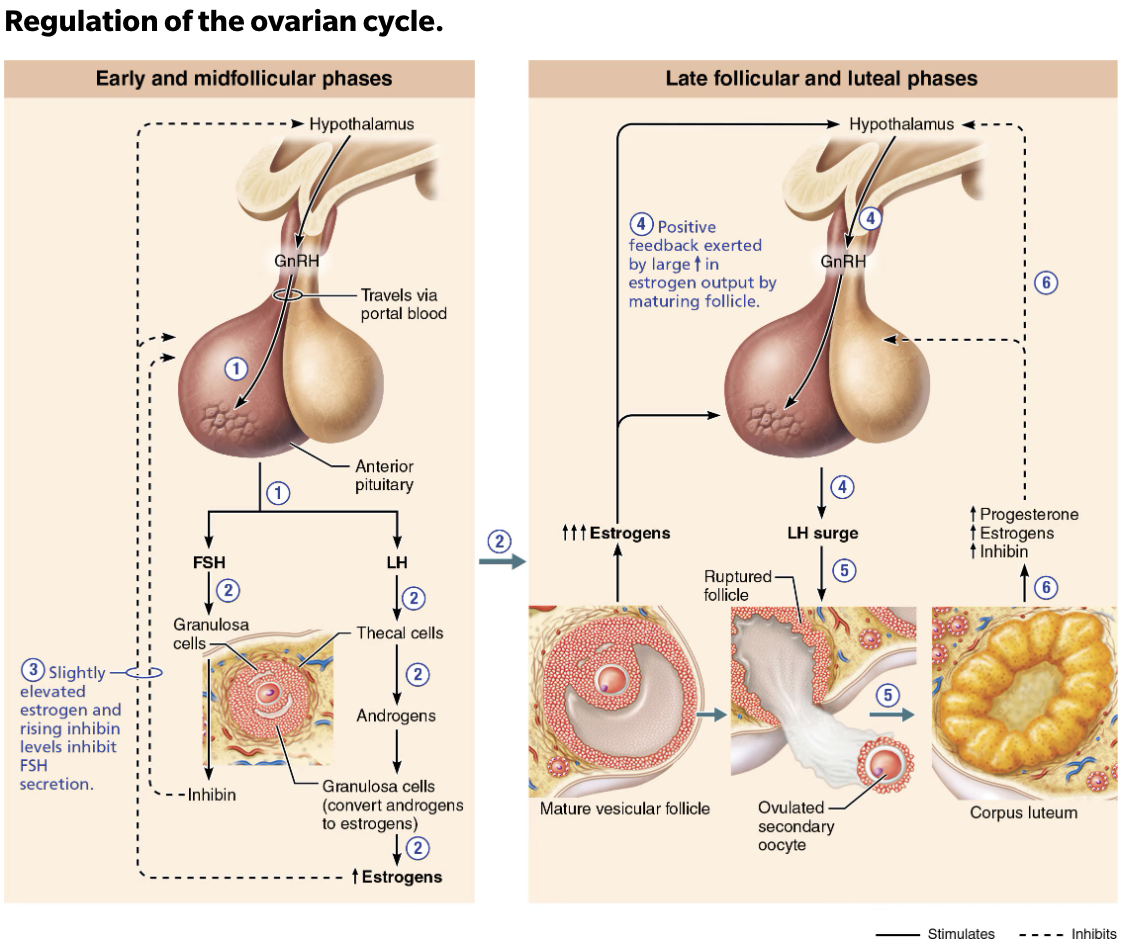
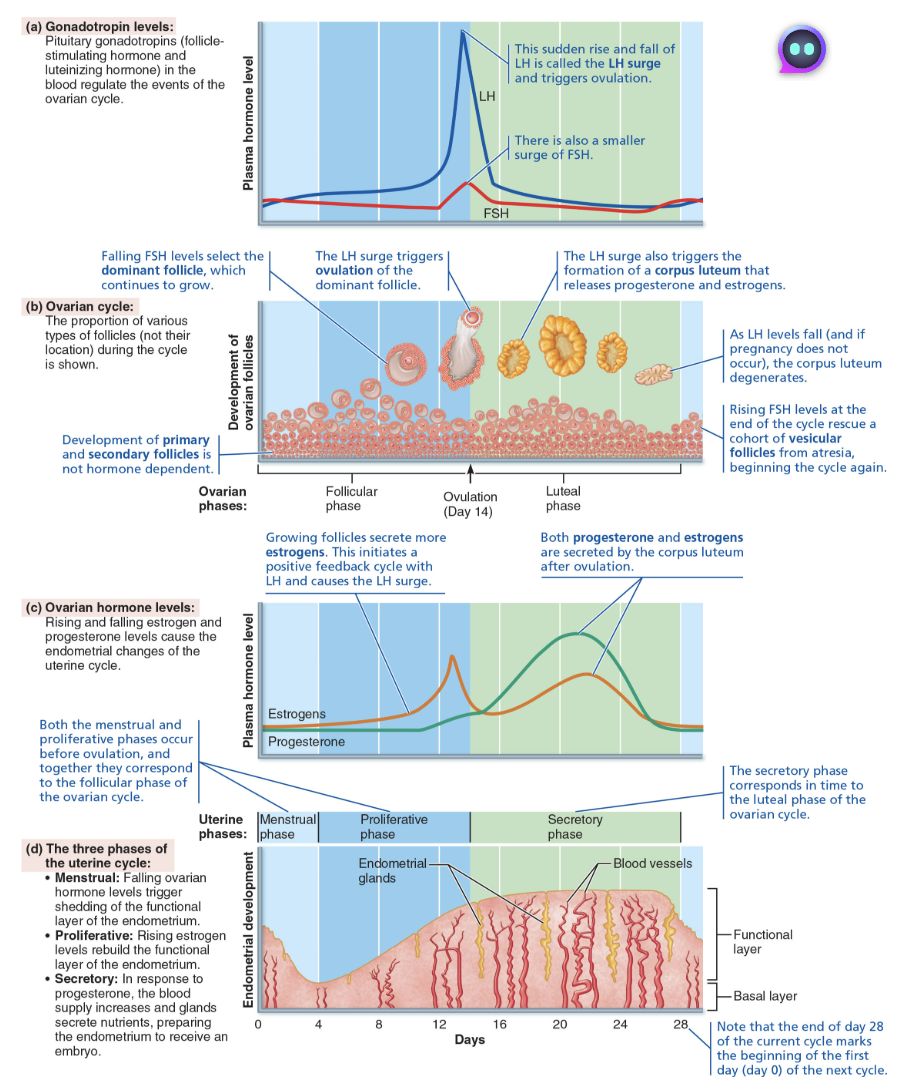
  1. Days 1-5: Menstrual phase

    • Ovarian hormones are at lowest levels

    • Gonadotropin levels are beginning to rise

    • Stratum functionalis detaches from uterine wall and is shed

    • By day 5, growing ovarian follicles start to produce more estrogen

  2. Days 6-14: Proliferative (preovulatory) phase

    • Rising estrogen levels prompt generation of new stratum functionalis layer

      • As layer thickens, glands enlarge, and arteries increase in number

    • Estrogen also increases synthesis of progesterone receptors in endometrium

    • Thins out normally normally thick, sticky cervical mucus to facilitate sperm passage

    • Ovulation occurs at end of proliferative phase on day 14

  3. Days 15-28: Secretory (postovulatory) phase

    • Phase that is most consistent in duration

    • Endometrium prepares for embryo to implant

    • Rising progesterone levels from corpus luteum prompt:

      1. Functional layer to become a secretory mucosa

      2. Endometrial glands to enlarge and secrete nutrients into uterine cavity

      3. Thickened mucus to form cervical mucus plug that blocks entry of more sperm, pathogens, or debris

    • If fertilization does not occur:

      1. Corpus luteum degenerates toward end of secretory phase; progesterone levels fall

      2. Causes arteries to kink and spasm

      3. Endometrial cells die, and glands regress

      4. Arteries constrict again, then relax and open wide, causing a rush of blood into weakened capillary beds

      5. Blood vessels fragment, and functional layer sloughes off

    • Uterine cycle starts all over again on first day of menstruation
<ol><li><p>Days 1-5: <strong>Menstrual</strong> <strong>phase</strong> </p><ul><li><p><mark data-color="red" style="background-color: red; color: inherit;">Ovarian hormones are at lowest levels </mark></p></li><li><p><strong><mark data-color="green" style="background-color: green; color: inherit;">Gonadotropin levels</mark></strong><mark data-color="green" style="background-color: green; color: inherit;"> are beginning to rise </mark></p></li><li><p><span style="color: purple;"><strong>Stratum functionalis</strong></span> detaches from uterine wall and is <span style="color: red;"><strong>shed</strong></span> </p></li><li><p>By day 5, growing ovarian follicles start to <span style="color: green;"><strong>produce more estrogen</strong></span> </p></li></ul></li><li><p>Days 6-14: <strong>Proliferative</strong> (preovulatory) <strong>phase</strong></p><ul><li><p><mark data-color="green" style="background-color: green; color: inherit;">Rising </mark><strong><mark data-color="green" style="background-color: green; color: inherit;">estrogen</mark></strong><mark data-color="green" style="background-color: green; color: inherit;"> levels</mark> prompt generation of <em><u>new</u></em> <span style="color: purple;"><strong>stratum functionalis layer </strong></span></p><ul><li><p>As layer thickens, glands enlarge, and arteries increase in number </p></li></ul></li><li><p><strong><mark data-color="green" style="background-color: green; color: inherit;">Estrogen</mark></strong><mark data-color="green" style="background-color: green; color: inherit;"> also increases synthesis of </mark><strong><mark data-color="green" style="background-color: green; color: inherit;">progesterone</mark></strong><mark data-color="green" style="background-color: green; color: inherit;"> </mark><strong><mark data-color="green" style="background-color: green; color: inherit;">receptors</mark></strong><mark data-color="green" style="background-color: green; color: inherit;"> in endometrium </mark></p></li><li><p>Thins out normally normally thick, sticky cervical mucus to facilitate sperm passage </p></li><li><p><span style="color: blue;"><strong>Ovulation</strong> occurs at end of proliferative phase on day 14 </span></p></li></ul></li><li><p>Days 15-28: <strong>Secretory</strong> (postovulatory) <strong>phase</strong></p><ul><li><p>Phase that is most consistent in duration </p></li><li><p>Endometrium prepares for embryo to implant </p></li><li><p><strong><mark data-color="green" style="background-color: green; color: inherit;">Rising progesterone</mark></strong><mark data-color="green" style="background-color: green; color: inherit;"> levels from corpus luteum prompt: </mark></p><ol><li><p>Functional layer to become a secretory mucosa </p></li><li><p>Endometrial glands to enlarge and secrete nutrients into uterine cavity </p></li><li><p>Thickened mucus to form cervical mucus plug that blocks entry of more sperm, pathogens, or debris </p></li></ol></li><li><p><mark data-color="red" style="background-color: red; color: inherit;">If fertilization does not occur: </mark></p><ol><li><p>Corpus luteum degenerates toward end of secretory phase; <strong>progesterone levels fall </strong></p></li><li><p>Causes arteries to kink and spasm </p></li><li><p>Endometrial cells die, and glands regress</p></li><li><p>Arteries constrict again, then relax and open wide, causing a rush of blood into weakened capillary beds </p></li><li><p>Blood vessels fragment, and functional layer sloughes off</p></li></ol></li><li><p>Uterine cycle starts all over again on first day of menstruation </p></li></ul></li></ol><p></p>
7
New cards

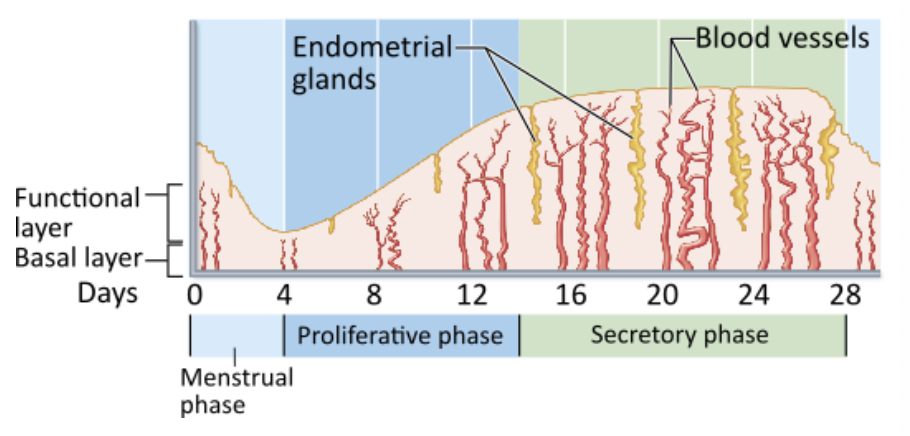
What event coincides with the transition from the proliferative phase to the secretory phase?

→ Ovulation occurs

  • Ovulation of the oocyte from the ovary occurs at around day 14 of the cycle, just as the uterine proliferative phase ends and the secretory phase begins.
<p><strong>→ Ovulation occurs</strong></p><ul><li><p>Ovulation of the oocyte from the ovary occurs at around day 14 of the cycle, just as the uterine proliferative phase ends and the secretory phase begins.</p></li></ul><p></p>
8
New cards

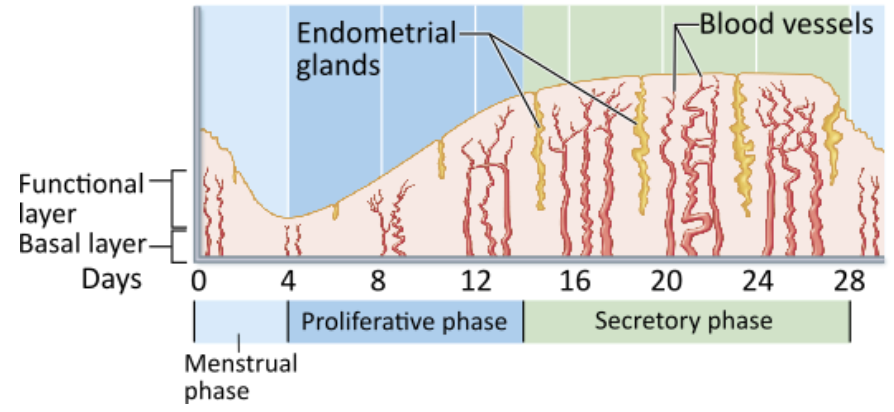
During what phase of the female's uterine cycle is the uterine lining shed?

Menstrual phase

  • The functional layer of the endometrium is shed during days 1 through 5 of the uterine cycle, a process called menses or menstruation
<p><strong>→ </strong><span><strong><span>Menstrual phase</span></strong></span></p><ul><li><p>The functional layer of the endometrium is shed during days 1 through 5 of the uterine cycle, a process called <em>menses </em>or <em>menstruation</em></p></li></ul><p></p>
9
New cards

Explain Effect and Cause of Amenorrhea

  • EFFECT

    • Cessation of menstruation

  • CAUSE

    • Extremely strenuous physical activity can delay menarche in girls and disrupt normal menstrual cycle in adult women

10
New cards

Explain Cause and Effect of Homeostatic Imbalance of Adipose cells

  • CAUSE

    • Female athletes have little body fat; adipose cells are needed to convert adrenal androgens to estrogens

    • Also, leptin plays role in female puberty → informs hypothalamus if energy stores are sufficient to support reproduction

  • EFFECT

    • If they are not, reproductive cycles are shut down

11
New cards

Effects of Estrogens

  1. Promote oogenesis and follicle growth in ovary

  2. Exert anabolic effect on female reproductive tract

  3. Support rapid short-lived growth spurts at puberty

  4. Cause the epiphyses of the long bones to close during growth spurts in puberty

  5. Induce secondary sex characteristics

    • Growth of breasts

    • Increased deposit of subcutaneous fat (hips and breast)

    • Widening and lightening of pelvis

  6. Metabolic effects

    • Maintains low total blood cholesterol and high HDL levels

    • Facilitates calcium uptake

12
New cards

Effects of Progesterones

  1. Works with estrogen to establish and regulate uterine cycle

  2. Promotes changes in cervical mucus

  3. Effects of placental progesterone during pregnancy

    • Inhibits uterine motility

    • Helps prepare breasts for lactation