2 Daniel Raymer book
 Call Kai
 Learn
Learn Practice Test
 Spaced Repetition
 Match
Match Flashcards
1/38

There's no tags or description
Looks like no tags are added yet.
Name | Mastery | Learn | Test | Matching | Spaced | Call with Kai |
|---|
No analytics yet
Send a link to your students to track their progress
39 Terms
leading-edge sweep
the angle of concern in supersonic flight. To reduce drag, it is common to sweep the leading edge behind the Mach cone. The sweep of the quarter-chord line is the sweep most related to subsonic flight
0.25C for subsonic and 0.4C for supersonic
Wing aerodynamic center
approximately by the square root of an increase in aspect ratio (when wing area and Swet/Sref are held constant). On the other hand, the wing weight also increases with increasing aspect ratio, by about the same factor.
the maximum subsonic L/D of an aircraft increases
Due to the reduced effective angle of attack at the tips, a lower-aspect-ratio wing will stall at a higher angle of attack than a higher-aspect-ratio wing
Another effect of changing aspect ratio is a change in stalling angle.
Oblique wing
combination of forward and aft swept wing. Has lower wave drag
stability
Wing sweep improves
dihedral effect In fact, it is frequently necessary to use zero or negative dihedral on a swept wing to avoid excessive stability.
A swept wing has a natural
when the lift is distributed in an elliptical fashion
minimum drag due to lift, or "induced" drag, occurs
Geometric twist
is the actual change in airfoil angle of incidence. usually measured with respect to the root airfoil.
" the twist angle changes in proportion to the distance from the root airfoil.
If a wing has "linear twist,
"Aerodynamic twist"
is the angle between the zero-lift angle of an airfoil and the zero-lift angle of the root airfoil. If the identical airfoil is used from root to tip, the aerodynamic twist is the same as the geometric twist
Wing incidence angle
is chosen to minimize drag at some operating condition, usually cruise. The incidence angle is chosen such that when the wing is at the correct angle of attack for the selected design condition, the fuselage is at the angle of attack for minimum drag
1 deg of effective dihedral.
Roughly speaking, 10 deg of sweep provides about
negative dihedral effect, requiring an increased geometric dihedral in order to retain natural directional stability
For a forward swept wing, the sweep angle produces a
effective dihedral, with the greatest effect provided by a high wing. This is frequently, and incorrectly, explained as a pendulum effect (keel effect)
the position of the wing on the fuselage has an influence on the
Dutch roll
excessive dihedral effect produces ______ a repeated side-to-side motion involving yaw and roll. To counter a _____ tendency, the vertical tail area must be increased, which increases weight and drag.
greatly lower wing weight. However, external struts add substantially to the drag.
For low-speed aircraft, external struts can be used to
less drag impact will be seen if the strut disturbs the airflow on the lower surface of the wing than if the strut is above the wing, as would be necessary for a strut-brace, low wing
Since roughly two-thirds of the lift is contributed by the upper surface of the wing, it follows that
the lowest drag. High- and low-wing arrangements must use fairings to attain acceptable interference drag with a circular fuselage
If the fuselage is roughly circular and fairings are not used, the mid-wing arrangement provides
the fuselage must be placed farther off the ground than for a high-wing aircraft. While this adds to the landing-gear weight, it also provides greater fuselage ground clearance. This reduces the aft-fuselage upsweep needed to attain the required takeoff angle of attack. The lesser aft-fuselage upsweep reduces drag.
To provide adequate engine and propeller clearance,
the trailing-edge of the wing tip, so an aft-swept wing tip, with a greater trailing edge span, tends to have lower drag. However, the aft-swept wing tip tends to increase the wing torsional loads.
The sweep of the wing tip also affects the drag. The tip vortex tends to be located approximately at
Gap
the vertical distance between the two wings
Span ratio
the ratio between the shorter wing and the longer wing
Stagger
the longitudinal offset of the two wings relative to each other.
Decalage
the relative angle of incidence between the two wings of a biplane.
Trim
refers to the generation of a lift force that, by acting through some tail moment arm about the center of gravity, balances some other moment produced by the aircraft
2-3 deg to balance the wing pitching moment
An aft horizontal tail typically has a negative incidence angle of about
the T-tail allows a smaller vertical tail. The T-tail lifts the horizontal tail clear of the wing wake and propwash, which makes it more efficient and hence allows reducing its size. This also reduces buffet on the horizontal tail, which reduces fatigue for both the structure and the pilot.
Due to end-plate effect,
H-tail
serves to hide the hot engine nozzles from heatseeking missiles when viewed from an angle off the rear of the aircraft.
ruddervators
also produce a rolling moment toward the left-in opposition to the desired direction of turn, an action called "adverse roll-yaw coupling."
Adverse
meaning roll direction is opposite of yaw direction
Canards
were used by the Wright brothers as a way of ensuring adequate control power, but fell out of favor due to the difficulty of providing sufficient stability (pitch characteristics)
the rotation must be stopped and the sideslip angle reduced, or the aircraft will immediately enter another spin. This requires adequate rudder control even at the high angles of attack seen in the spin. At least 1/3 of the rudder should be unblanketed.
the dorsal fin improves tail effectiveness at high angles of sideslip by creating a vortex that attaches to the vertical tail. This tends to prevent the high angles of sideslip seen in spins, and augments rudder control in the spin. The ventral tail also tends to prevent high sideslip, and has the extra advantage of being where it cannot be blanketed by the wing wake. Ventral tails are also used to avoid lateral instability in high-speed flight.
Spin recovery
keelson
Another major structural element used to carry fuselage bending loads is the "_____." This is like the keel on a boat, and is a large beam placed at the bottom of the fuselage as shown in Fig. 8. 7. A _____ is frequently used to carry the fuselage bending loads through the portion of the lower fuselage which is cut up by the wheel wells.
efficient the propeller will be
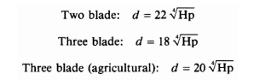
The larger the propeller diameter, the more
propeller tip speed, which should be kept below sonic speed.
The limitation on length is the
πnd/60
n = rotational rate (rpm) obtained from engine data
d =diameter
Vtip-static =
√(Vtip2 + V2)
Vtip-helical =
Explore top notes

