arthropods and mollusks bio quiz
0.0(0)
Studied by 4 people Call Kai
 Learn
Learn Practice Test
 Spaced Repetition
 Match
Match Flashcards
 Knowt Play
Card Sorting
1/46

Earn XP
Description and Tags
Last updated 3:29 AM on 3/28/23
Name | Mastery | Learn | Test | Matching | Spaced | Call with Kai |
|---|
No analytics yet
Send a link to your students to track their progress
47 Terms
1
New cards
most successful phylum on the planet
arthropoda
2
New cards
segmented bodies, tough exoskeleton, jointed appendages
body plan of arthropods
3
New cards
arthropods phylum name
arthropodan
4
New cards
molting that occurs in young animals, necessary for a crustacean to increase in size (exoskeleton does not grow) underlying epidermis secretes cuticle
ecdysis
5
New cards
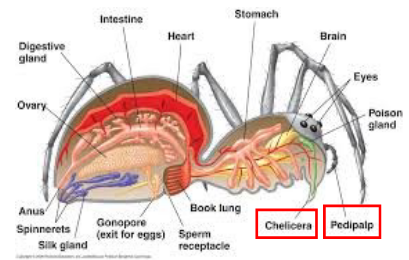
subphylum of anthropods
* Ancient group
* No mandibles or antennae
* 2 tagma and six pairs of cephaloothroracic appendages
* 1 pair of chelicerae (define subphylum)
* 1 pair of pedipalps
* 4 pairs of walking legs
* Ancient group
* No mandibles or antennae
* 2 tagma and six pairs of cephaloothroracic appendages
* 1 pair of chelicerae (define subphylum)
* 1 pair of pedipalps
* 4 pairs of walking legs
chelicerta
6
New cards
body plan of chelicerta
7
New cards
spiders, scorpions, ticks, mites, harvestmen are all part of what class
Class Arachnida
8
New cards
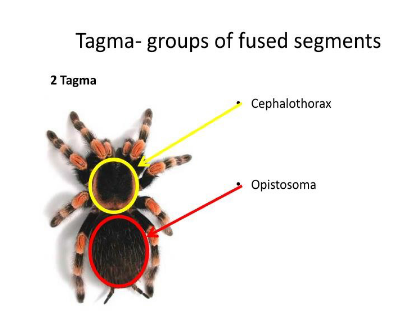
body plan of a arachnida (spider)
9
New cards
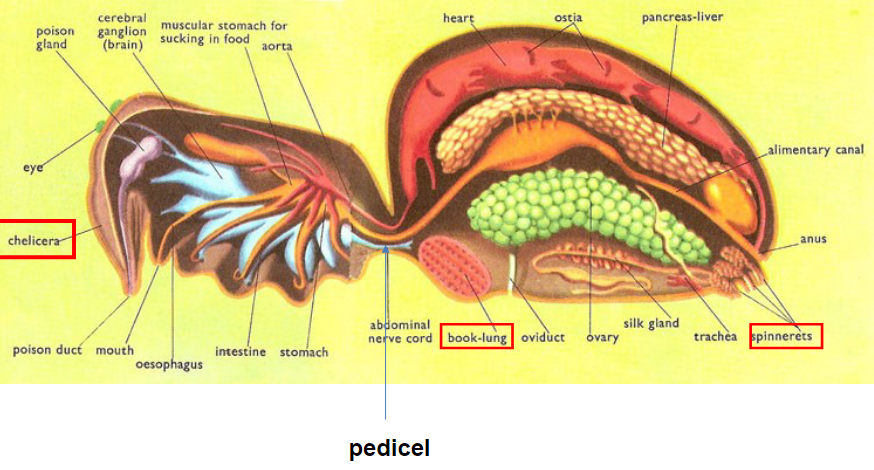
what order is all predaceous, have chelicerae that function as fangs, cephalorthorax and abdomen joined by thin pedicel and use web spinning to trap prey
order araneae
10
New cards
body plan of an araneae
11
New cards
all predaceous, pedipalps tp capture prey, chelicerae to rip apart prey, well developed young with maternal care
scorpions
12
New cards
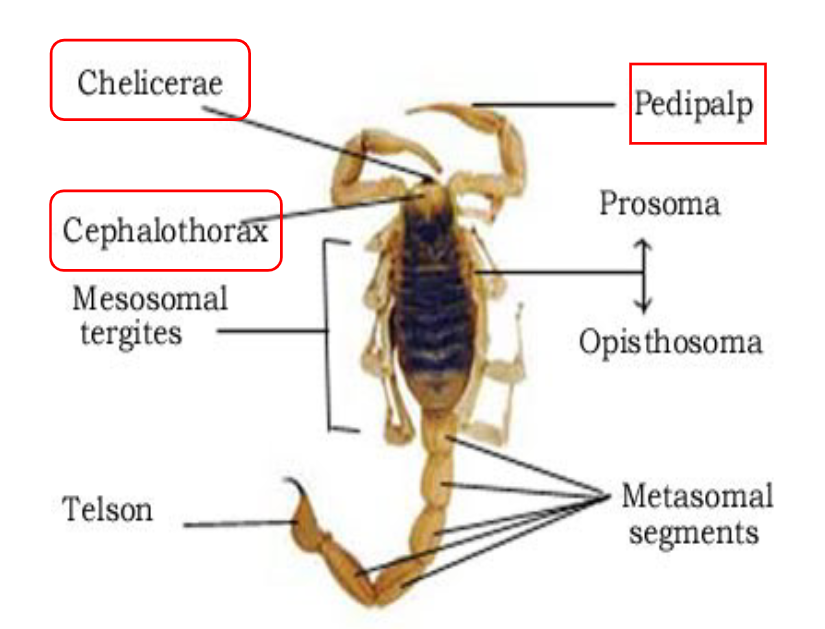
scorpion body planShort cephalothorax (has appendages), abdomen (pre-abdomen and post-abdomen with stinging apparatus)
scorpion body plan
13
New cards
ticks and mites are part of what order
order acari
14
New cards
has cephalothorax and abdomen completely fused, mouth parts on capitulum, some are free living while others are not, transmit diseases and cause economic harm
order acari
15
New cards
what class are centipedes apart of
class chilopod
16
New cards
what class are predators, each segment contains one pair of legs, dorsoventrally flattened, maxillipeds on first segment are modified to venom claws, pairs of eyes consist of group of ocelli
class chilopods
17
New cards
what class are millipedes apart of
class diplopoda
18
New cards
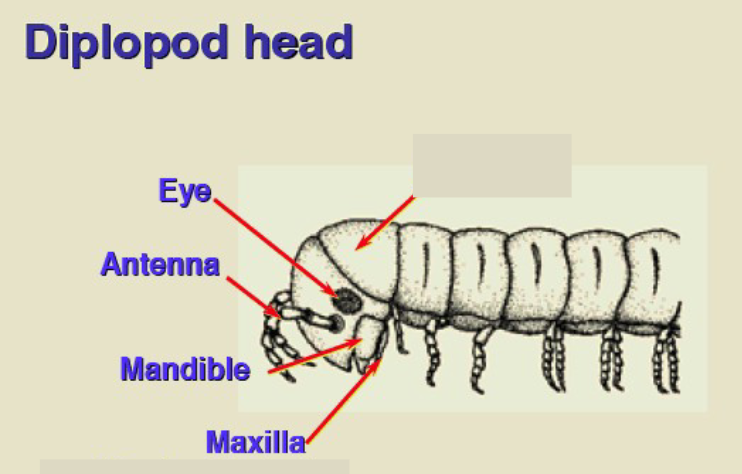
Cylindrical bodies, 4 thoracic segments 1 pair of legs, Abdominal segments 2 pairs of legs
class diplopoda (millipedes) body plan
19
New cards
what subphylum has the general nature of a crustacean and includes lobsters, crayfish, shrimp, crabs, water fleas, copepods, and barnacles
subphylum crustacea
20
New cards
what is the distinguishing characteristic of crustaceans
two pairs of antennae
21
New cards
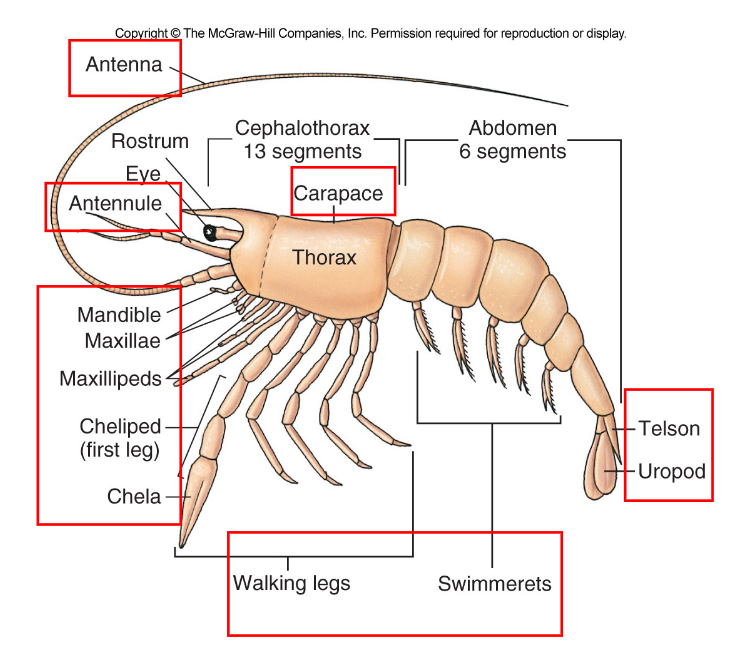
* Head also has a pair of mandibles and 3 pairs of maxillae
* One pair of appendages on each of the additional segments
* Some segments may lack appendages
* All appendages except perhaps first antennae are biramous
* Primitive crustaceans may have up to 60 segments: derived crustaceans have fewer
* Tagmata are usually head, thorax, and abdomen
* In most one or more thoracic segments are fused with the head as a cephalothorax
* Dorsal covering is the carapace
* May cover most of body or just cephalothorax
\
* One pair of appendages on each of the additional segments
* Some segments may lack appendages
* All appendages except perhaps first antennae are biramous
* Primitive crustaceans may have up to 60 segments: derived crustaceans have fewer
* Tagmata are usually head, thorax, and abdomen
* In most one or more thoracic segments are fused with the head as a cephalothorax
* Dorsal covering is the carapace
* May cover most of body or just cephalothorax
\
body plan of subphylum crustacea
22
New cards
* Swimmerets or abdominal appendages retain biramous conditions
* Have evolved a wide variety of walking legs, mouthparts, swimmerets etc.. Form modification of the basic biramous appendage, some have lost 1 branch and are uniramous
* The first pair of walking legs is a cheliped with strong claw or chela for defense
* 1st pair of swimmerets in male called gonopods used in copulation
* Telson and uropod are last pair of appendages used for backwards movements and protection for eggs or young on swimmerets
appendages of crustacea
23
New cards
* Many forms can shift from one type of feeding to another, but they all use the same fundamental mouthparts
* Hold and crush food, mandibles and maxillae shred food and place it I mouth, cheliped serves in food capture
* Suspension feeders generate water currents in order to feed
* Predators consume larvae, worms, crustaceans, snails and fishes
* Predators consume larvae, worms, crustaceans, snails and fishes
* Scavengers eat dead animal and plant matter
feeding habits in crustacea
24
New cards
* The gills of crustaceans vary in shape
* Smaller crustaceans breathe through their general body surface
* Larger crustaceans use featherlike gills for gas exchange
respiratory system in crustacea
25
New cards
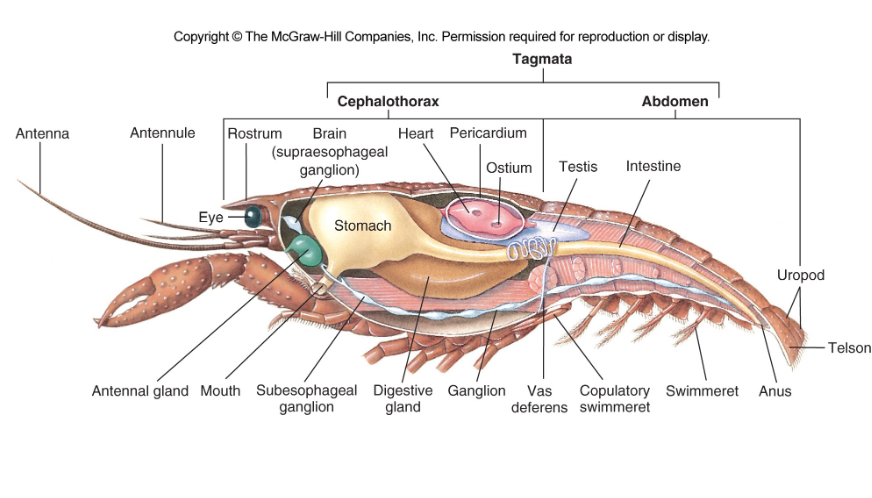
* Antennal or maxillary glands
* Waste products are mostly ammonia with some urea and uric acid
* Some wastes diffuse though gills as well as antennal gland
* paired glands located in the head
excretory and osmoregulatory organs in crustacea
26
New cards
what circulatory system Depends less on heartbeats and more on movement of organs and limbs to circulate blood
found in crustacea
Hemocyanin and/or hemoglobin are respiratory pigments
found in crustacea
Hemocyanin and/or hemoglobin are respiratory pigments
open circulatory system
27
New cards
what class is Most numerous and diverse group, has 3 pairs of legs and 2 pairs of wings on thoracic segments, has a Wide variety of habitats but few are marine, has Success due to cuticular exoskeleton and ability to fly
class insect
28
New cards
* Determined by mouthparts- chewing or sucking
* Phytophagous
* Plant juices
* Saprophagous
* Dead animals
* Parasites
* Host survives
* Parasitoids
* Host dies
feeding in insects
29
New cards
* Tubular heart
* Hemolymph- distributes hormones and nutrients
circulation in insects
30
New cards
* Tracheal system directly to cells
* Uses concentration gradient
* Spiracles- tracheae (cuticle) - no tracheoles (no cuticle)
respiratory in insects
31
New cards
* Sight
* Compound eye: composed by ommatidia
* Ocelli
sensory organ in insects
32
New cards
* Separate sexes
* Internal fertilization
* Various fertilization
* Various courtship behavior
* Usually lay legs
* Often specific habitats
reproduction in insects
33
New cards
* Holometabolous
* Complete metamorphosis
* 88% of insects
* Egg- larva- pupa(chrysalis) - adult
* Hemimetabolous
* Incomplete metamorphosis
* Egg-nymph- adult
* Nymphs often different habitat than adult
metamorphous and growth in insects
34
New cards
* Subject of many studies
* Can have complex and highly structured social groups
* Others temporary and uncoordinated
social behavior in insects
35
New cards
* Produce
* Pollination of crops
* Honey and beeswax
* Silk
* Predators on destructive insects
* Clean up of dead material
* Destroy plants causing economic losses
* Carriers of diseases
* Blood-sucking or biting species
* Destruction of property
insects and human welfare
36
New cards
what phylum evolved in the ocean and most groups have remained there
phylum Mollusca
37
New cards
what mollusk is known as an invasive pest
overtakes habitat and doesn’t let anything grow
overtakes habitat and doesn’t let anything grow
zebra mussels (dreissena polymorpha)
38
New cards
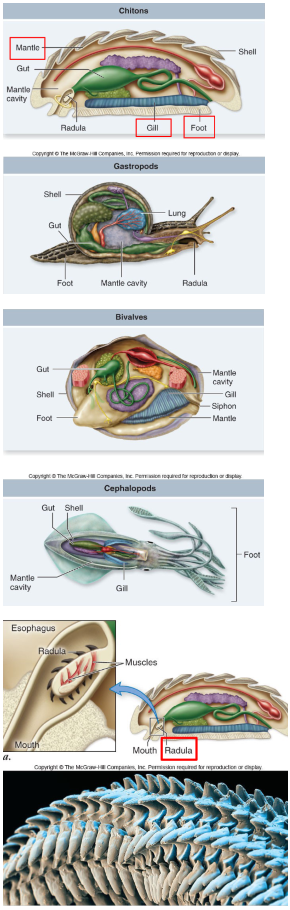
* Mollusks are bilaterally symmetrical
* Characterized by a reduced coelom surrounding the heart and excretory organs
* The digestive, excretory and reproductive organs are contracted in a visceral mass
* Mollusks may have a differentiated head at the anterior end of the body
* Mantle= a thick epidermis that covers the dorsal side of the body
* Forms a cavity which houses the respiratory organs (gills) and the openings of excretory, reproductive and digestive organs
* The muscular foot of a mollusk is adapted for locomotion, attachment, food capture
* Or a combination of all
mollusk body plan
39
New cards
a special excretory structures that remove nitrogenous wastes in mollusks
nephridia
40
New cards
a cilia lined opening in nephridia
nephrostomies
41
New cards
what is the only mollusk that doesn’t have an open circulatory system
cephalopods
42
New cards
* Most mollusks have distinct male and female individuals
* Most engage in externa; fertilization
* Trochophores: free-swimming larval stage
* Only in bivalves and snails
mollusk reproduction
43
New cards
what are the four classes of mollusks
1. Polyplacophora
2. Gastropod
3. Bivalvia
4. Cephalopoda
44
New cards
which mollusk class is
* Marine mollusks that have oval bodies with eight overlapping dorsal calcareous plates
* Body is not segmented under the plates
* Most chitons are grazing herbivores
\
* Marine mollusks that have oval bodies with eight overlapping dorsal calcareous plates
* Body is not segmented under the plates
* Most chitons are grazing herbivores
\
class polypacophora (chitons)
45
New cards
which mollusk class is
* A primary Marine group
* Heads typically have pairs of tentacles with eyes at the ends
* During embryological development, gastropods undergo
* Torsion- mantle cavity and anus are moved from the posterior to the front
* Coiling- spiral winding of the shell
* A primary Marine group
* Heads typically have pairs of tentacles with eyes at the ends
* During embryological development, gastropods undergo
* Torsion- mantle cavity and anus are moved from the posterior to the front
* Coiling- spiral winding of the shell
class gastropod (snails and slugs)
46
New cards
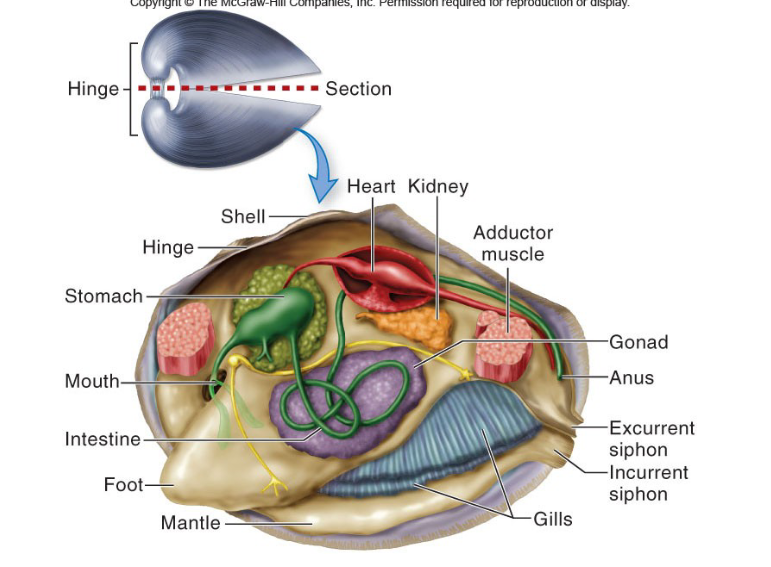
which mollusk class is
* Includes clams, scallops, mussels, oysters and others
* Have two lateral (right and left) shells (valves) hinged together dorsally
* Most are sessile filter-feeders
* Water circulation is mediated by siphons and rhythmic beating of cilia on gills
* Includes clams, scallops, mussels, oysters and others
* Have two lateral (right and left) shells (valves) hinged together dorsally
* Most are sessile filter-feeders
* Water circulation is mediated by siphons and rhythmic beating of cilia on gills
class bivalvia (bivalves)
47
New cards
which mollusk class is
* Active marine predator
* Foot has evolved into series of arms equipped with suction cups
* Squids have 10, octopuses have 8, and nautiluses have 80-90
* Have highly developed nervous systems
* Exhibit complex patterns of behavior and a high level of intelligence
* Active marine predator
* Foot has evolved into series of arms equipped with suction cups
* Squids have 10, octopuses have 8, and nautiluses have 80-90
* Have highly developed nervous systems
* Exhibit complex patterns of behavior and a high level of intelligence
class Cephalopoda

