Immunology (BIOL 318) Lectures 10 + 11
 Call Kai
 Learn
Learn Practice Test
 Spaced Repetition
 Match
Match Flashcards
 Knowt Play
1/51

Earn XP
Description and Tags
Antigen presentation and MHC
Name | Mastery | Learn | Test | Matching | Spaced | Call with Kai |
|---|
No analytics yet
Send a link to your students to track their progress
52 Terms
_____ can only detect antigens presented to them, as opposed to _____, which can also detect free antigens
T cells; B cells
CD4+ T cells recognize ________ antigens, while CD8+ T cells recognize ________ antigens
Exogenous; endogenous
Under what conditions and antibodies bind to antigens?
Intact
On the surface of microbes or infected host cells
Free, without being presented by MHC
Do antibodies bind the entire antibody or just an epitope?
Epitope
Characteristics of antigens recognized by T cells
Linear and small peptide from the antigen
Cell-associated antigens
Presented by APCs
T cells recognize antigens in…
The lymph nodes
Costimulators
Molecules that assist in the activation of naive T cells to effector T cells
B7 family of costimulators
Ligands expressed on the surface of APCs that bind to receptors on naive T cells
Responsible for “step 2” of T cell activation
APCs include…
Dendritic cells, macrophages, and B cells
What is “step 1” of T cell activation?
Antigen recognition, which occurs when the TCR of a naive T cell binds to an antigen presented by MHC
B7-1 (CD80)
Constimulator on APC surface
Binds to CD28 on T cell surface
B7-2 (CD86)
Costimulator on APC surface
Binds to CTLA-4 on T cell surface
B7-H1 (PDL1)
Costimulator on APC surface
Binds to PD1 on T cell surface
Costimulator and MHC II expression in APCs is increased by…
IFN-γ
IL-4
CD40-CD40L interaction
CD40-CD40L interaction effect
Activates APCs to express more costimulators and cytokines
CD40L is a ligand on activate T cells, which binds to CD40 (a receptor) on APCs
Expression of MHC II in dendritic cells is increased by…
IFN-γ
Signals from TLRs
Expression of MHC II in macrophages is increased by…
IFN-γ
Expression of MHC II in B cells is increased by…
IL-4
Antigen receptor cross-linking
Expression of costimulators in dendritic cells is increased by…
CD40-CD40L interaction
IFN-γ
Expression of costimulators in macrophages is increased by…
CD40-CD40L interaction
IFN-γ
Expression of costimulators in B cells is increased by…
CD40-CD40L interaction
Antigen receptor cross-linking
Goal of tissue-resident dendritic cell
Endocytose microbes
Process internalized antigens to be presented on MHC
Goal of activated dendritic cell
Migrate to lymph nodes
Present antigens to T cells using MHC
CCR7
GPCR on dendritic cells and T cells
Binds to CCL19 & CCL21 (chemokines)
Stimulates migration to lymph nodes
Stimulates higher expression of MHC II and costimulators in dendritic cells
cDC1s are a type of specialized dentritic cell (conventional dendritic cell 1) that coross presents specifically to…
Naive CD8+ T cells
_____ activate macrophages
Th1 cells (a subset of CD4+ T cells)
What happens when a macrophage is activated by a helpter T cell?
It kills the microbes that it has already ingested prior
T-cell dependent antibody production
B cells internalize antigens + present peptides derived from them to helper T cells
Where do memory B cells loiter?
Spleen
Bone marrow
A small amount can be found in tissues
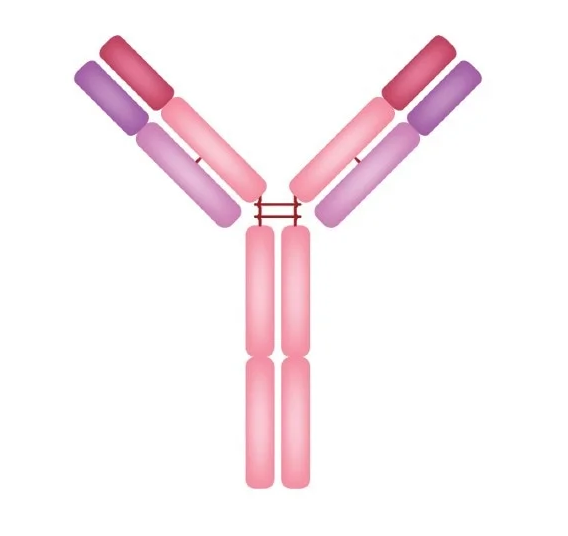
What type of antibody is this? (Hint: looks similar to some others, but this is the most abundant in the plasma out of those)
IgG
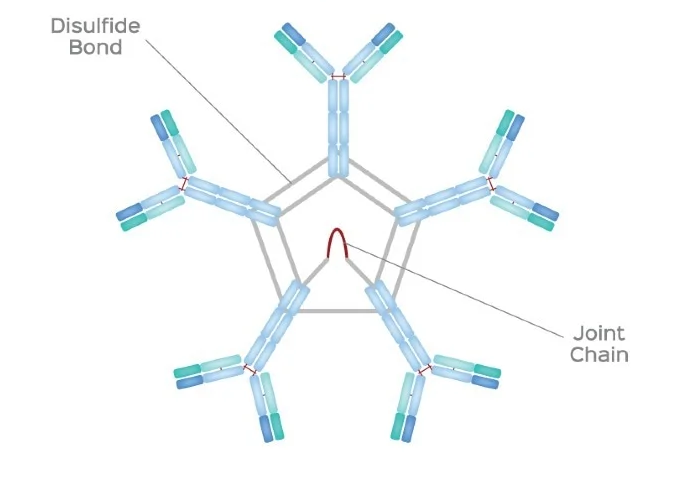
What type of antibody is this?
IgM
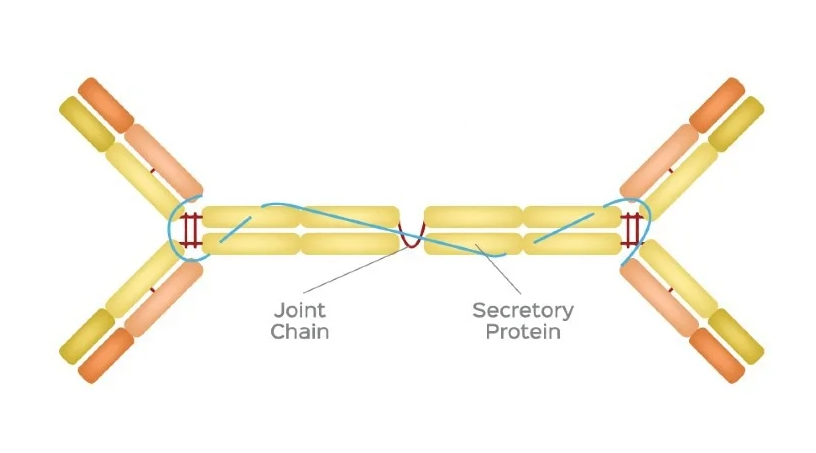
What type of antibody is this?
IgA
MHC class I molecules in humans are encoded by:
HLA-A, HLA-B, HLA-C
MHC class I molecules in humans include:
HLA-DP, HLA-DQ, HLA-DR
The structure of HLA is similar to…
Immunolglobulins
Which class of MHC can bind to a more diverse set of epitopes, and why?
MHC II
The peptide binding cleft is composed of two separate pieces, whle MHC I has a peptide binding cleft composed of one continuous piece
MHC I has ___ transmembrane region(s)
One
MHC II has ___ transmembrane region(s)
Two
MHC I is expressed by…
All nucleated cells
MHC II is expressed by…
APCs and thymic epithelial cells
The MHC locus is located on chromosome…
6p
Viral proteins are chopped up into smaller peptides by ____ in the _____ (MHC I expression)
Proteosomes; cytoplasm
Viral/pathogenic peptides enter the _____ through ______ (MHC I expression)
ER; TAP (Transorter associated with Antigen Processing)
Viral/pathogenic peptides are bound to MHC I in the ___ before being transported to the ____
ER; Golgi
The MHC I antigen complex is transported from the Golgi to the _______ in an ________
Plasma membrane; exocytic vesicle
Internalized proteins are processed in _________ (MHC II expression)
Endosomal/lysosomal vesicles
MHC II is synthesized in the _____ before being transported to the ____
ER; Golgi
The processed peptides bind to MHC II in ______ before being expressed on the cell surface
Lysosomes
Positive selection of T cell location
Cortex (edge) of the thalamus
Negative selection of T cell location
Medulla (middle) of the thymus
CCR9
Receptor expressed by newly synthesized T cells
Interacts with CCL25 (expressed in thymus)
Causes T cells to migrate to the thymus
After positive and negative selection in the thymus, _____ expression on T cells in downregulated
CCR9

