Learning and memory
 Call Kai
 Learn
Learn Practice Test
 Spaced Repetition
 Match
Match Flashcards
 Knowt Play
1/46

There's no tags or description
Looks like no tags are added yet.
Name | Mastery | Learn | Test | Matching | Spaced | Call with Kai |
|---|
No analytics yet
Send a link to your students to track their progress
47 Terms
What is memory?
the changes in the nervous system that support the acquisition, retention and retrieval of information about the world and life experience
What is memory for?
support behavioural adaptation to the world we live in
enable sensible choices
avoid repeating actions with negative consequences
prepare for the future
What is the reductionist explanation for the physical nature of memory?
modification due to a stimulus
memories are engrams
set of neurons that form a trace of what you’re learning
combination of activated neurons firing together
Richard Semon
Where are memory traces located?
Karl Lashley
local vs distributed
argued due to experiments that show when you section/lesion area probbaly not localised
What is evidence against the local storage of memories?
Grandma cell
depending on modality - may be more and less specialised circuits
Useful study on engrams??
rodent in shock context, using optics/lasers
stimulation in different context
causally manipulating reinduces state
DONT KNOW WHO - TUTORIAL
How can a memory be represented by neural activity?
Hebb
cell assembly hypothesis
cells that fire together wire together
How are new memories formed if the pool of neurons is roughly stable?
the Hebbian plasticity theory of learning
metabolic change takes place when two cells repeatedly firing together or near enough to excite the other, efficiency increases
Diagram for memories
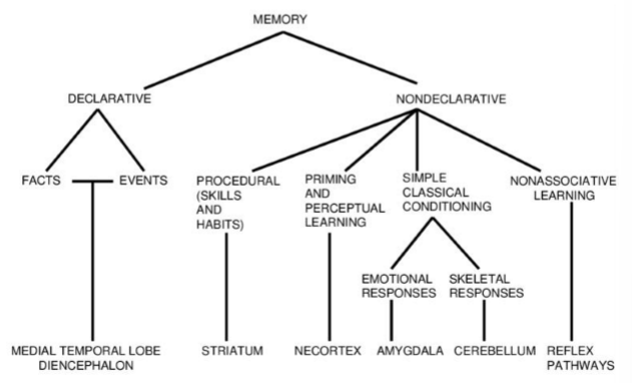
What is evidence for the hippocampus being a key brain circuit for memory of places and events?
HM
anterograde amnesia
retrograde amnesia
What does HM still having access to some memories suggest?
transfer model
memories shift away from hippo over time
or multiple trace theory
hippo always involved if episodic
What are various behavioural tasks to study learning and memory in animals?
fear conditioning box
barnes maze
watermaze
T maze
8-arm radial maze
Y maze
How might we be able to uncover the neural pathways of learning and memory?
look at the laminar organisation of the hippocampus circuit
What are 4 main areas of the hippocampus?
CA1, CA2, CA3, dentate gyrus
Which area receives info from both entorhinal cortices?
CA1
maybe how memory is mapped within
How may we be able to identify the building blocks of a memory ‘engram’?
use Immediate Early Genes
class of genes that are rapidly and transiently activated in response to signalling cascases
eg transcription factor c-Fos
establish causality and demonstrate that these neurons are active
How can we use neuronal tagging to do this and who?
Xu Liu et al, 2012
if neuron gets active, express protein c-Fos
design transgenic approach that allows to tag with a molecular the neurons that have expressed c-Fos
manipulate with light
shock rat and they will express opsin
then don’t shock but have laser and they will still freeze -reinducing state
How can you assess electrophysiological activity of single neurons vs neuronal populations?
patch and intracellular electrodes
can measure amplitude of synaptic currents and slope of synaptic potential
extracellular electrodes
measure local field potentials
can extract amplitude, freq etc
look at first spike when about to enter or leave to know where are in space
Examples of the many ways information caan be represented in the hippocampal network?
local field potentials
spike trains
How can individual neurons represent information during active behaviour?
using a rate code
AP = information
firing rate - binary or graded response
What is an example of a rate code?
discovery of place cells in hippocampus of rodents
O’Keefe and Dostrovsky (1971)
What does the hippocampal population provide?
map like representation of the whole environment
if one neuron reponds the most in specific location then gradually less in surrounds then combination of the neural firing can map environment
What does short timescale coactivation of multiple neurons form?
cell assemblies
What can neuronal spiking activity be related to?
various network oscillations
How to define an oscillation?
repetitive variation of a variable in magnitude or position around a central value (often a point of equilibrium) or between two or more different states
What are biological rhythms like in respect to oscillations?
rarely strictly periodic and usually non stationary
often fluctuate irregularly over time and their individual cycles not truly regular
What is phase assignment for neuronal spiking?
allows temporal coding for information representation
the timing of an AP can carry info
in respect to the ongoing phase of an oscillation
can determine relative timing between cells in neuronal circuits
What pattern was shown in Dupret’s lab on neural oscillations while exploring and while asleep?
neural oscillations have temporally structured neuronal spiking correlates
same patterns shown when asleep as when awake showing memory strengthened in sleep
What did Wilson and McNaughton (1994) show?
waking firing patterns are replayed during offline ripples in the hippocampus
look at rippled to see high frequency then look at time lock to see if neurons coactivated
when active together during running, active together when sleep
What is the replay?
time compressed?
most important?
More evidence for hippocampal activity correlating with memory processing during offline and online episodes?
O’Neill et al (2010)
How else might memory be stored?
synaptic plasticity
What is an example of synaptic level LTP?
hippocampal CA1 glutamatergic synapse as a cellular model
NMDA and AMP tong term potentiation
What are the two ways we see activity-dependent changes in CA3-to-CA1 synaptic strength?
long term potentiation
Bliss and Lomo (1973)
long term depression
Ito and Kano (1982)
What are the two ways we can see molecule-by-molecule dissection of signalling pathways for synaptic plasticity?
pharmological blockade
eg APV to selectively block NMDA receptors
transgenic manipulation
CRISPR-based genetic deletion of CaMKII protein
these show how memory can be affected when long term potentiation is stopped
What did Silva et al (1992) - my study look at?
LTP studied as mechanism for hippocampus dependent learning and memory but evidence still incomplete
Mutated mice - hippocampus is deficient in LTP but maintains intact postsynaptic mechanisms
Inhibiting NMDAR function also disrupts synaptic function so might alter information processing
Pharmacological studies have implicated the CaMKII holoenzyme in the induction of LTP in hippocampus
Mutant mice shown CA1 hippocampal region exhibit little to no LTP although postsynaptic transmission appears normal
Impaired in performing a task that requires learning the multiple spatial relations among a hidden proximal object and visible objects in surrounding distal environment
Mutant mice deficient in LTP in the CA1 region of hippocampus therefore likely that this deficit in LTP is responsible for the impairment in spatial memory
Another study = Song-Hai Shi et al (1999)
What can LTP induce?
structural remodelling of synapses and formation of new contacts
strengthens - mayb for memory
Toni et al (1999)
General conclusion from lecture?
info can be represented many different ways
different ways of looking at building blocks of memory
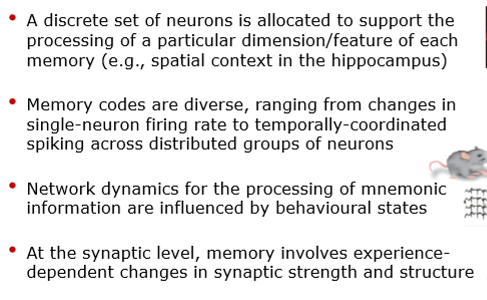
What other type of plasticity can take place at non-synaptic sites?
neuronal intrinsic plasticity
involves enduring changes in the number, distribution or activation of various ion channels central to a neurons intrinsic excitability affects the flow of information within a neuron by following the course of synaptic inputs from the dendrite to the axon terminal and impacts on the threshold for synaptic changes
What did Moyer et al, 1996 show?
learning-related intrinsic palsticity of hippocampal neurons
animal given air puff with a tone which makes eye blink response
tone then eventually elicited eye blink response itself
CA1 neurons recorded before learning, 24 hours after and 14 days after
found reduction in the hypepolarisation potential soon after initial learning allowing neurons to fire more spikes in a burst avoiding the typical spike freq adaptation
does that mean faster refraction period?
not seen in naive or recordings 14 days later
intrinisc mechanism to allow neurons to remember the pairing
How is memory thought to be stored?
after learning there is a unique pattern or ratio of activity in the neurons
it is a distributed memory with no single neuron representing
means graceful degredation leads to representations blending together
What is the anatomy of the hippocampus like?
two thin sheets of neurons folded onto each other
dentate gyrus and Ammons horn
Ammons hoen has 4 divisions
including CA1 and CA3
Who found that brief and high frequency electrical stimulation of the perforant path synapses of the dentate gyrus produced LTP?
Bliss and Lomo (1973)
Differences with spike timing-dependent plasticity for LTP and LTD?
LTP can result when the EPSP caused by synaptic glutamate release precedes an AP in the postsynaptic neuron
LTD can result instead when EPSP causes by glutamate release follows a postsynaptic AP
What is synaptic tagging?
Memory formation appears to initially involve rapid modifications of existing synaptic proteins
What did Didi’s study look at?
synaptic modification threshold
mice raised in light or dark and their response to light later
found those raised in dark if in light for 2 days then respond same as the light ones
2 days of light cancelled out whole life of dark