(Exam 3) Pt. 4 Respiratory System Structure & Function
 Call Kai
 Learn
Learn Practice Test
 Spaced Repetition
 Match
Match Flashcards
 Knowt Play
1/27

There's no tags or description
Looks like no tags are added yet.
Name | Mastery | Learn | Test | Matching | Spaced | Call with Kai |
|---|
No analytics yet
Send a link to your students to track their progress
28 Terms
Purpose of respiratory system:
[….]
Ventilation
Exchange of O2 and CO2 in the lungs
[….]
O2 utilization and CO2 production by the tissues
Break down food stuff to synthesize ADP aerobically
purpose of the respiratory system during exercise
Gas exchange between the [….]
Regulation of […] during exercise
Pulmonary respiration
Cellular respiration
environment and the body
acid-based balance
Respiratory system-big picture:
Ventilation
Mechanical process of moving air into and out of lungs
inspiratory muscles need to […]
the main muscle is the […] muscle
when we breathe in; we want to decrease [….] pressure
Intra thoracic pressure must fall below atmospheric pressure
Atmospheric pressure is [….], because gas is moving in from an area of higher pressure to an area of lower pressure.
How do we do that by expanding lung volume.
increase the volume intrathoracic pressure drops, your atmosphere of pressure; allows airs come into the lungs.
Diffusion
random movement of molecules from an area of […] concentration to an area of […] concentration
contract
diaphragm
intra-thoracic
constant
high
lower
Exchange of respiratory gases between the atmosphere and the cells:
Process 1:
Pulmonary ventilation
movement of respiratory gases between the atmosphere and the lungs and specifically the gas exchange region of the lungs (Alveolar region)
Exchange of respiratory gases between the atmosphere and the cells:
Process 2:
Alveolar gas exchange:
Deoxygenated blood
heart pumps deoxygenated blood from right ventricle to go to the lungs through pulmonary veins
pulmonary arteries carries oxygenated blood
blood reaches the lungs and the alveoli; blood will drop-off CO2 and receive oxygen; It will become oxygenated.
Exchange of respiratory gases between the atmosphere and the cells:
Process 3:
Gas transport:
then it will be […] so we have systemic circulation, gas transport
blood includes […]
transported
oxygenated and CO2
Exchange of respiratory gases between the atmosphere and the cells:
Process 4:
Systemic gas exchange:
we have gas exchange between […[
what happens at […]; blood will drop off oxygen molecules, so the […] will receive oxygen, and it will drop off CO2
Deoxygenated blood will return to the heart on […] side of the heart and will send blood back to […] and […].
bloodstream, cells and different tissues
capillary bed
tissue
right
lungs
repeat the processes.
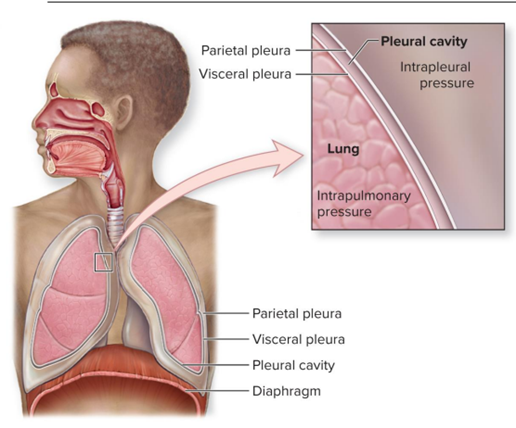
Lungs are enclosed by a set of membranes called pleura
Pleura has 2 layers:
[….] pleura:
Lines the outer surface of the lung
[…] pleura:
That lines the thoracic lung
between the layers we have […]:
within it we have pleura fluid that acts at a lubricant that reduces friction between between the visceral and parietal.
Visceral
Parietal
pleural cavity
The Conducting Zone:
Air enters the [….] from the pharynx
For gas to enter or leave the trachea, it must pass though the […]
The trachea branches into two primary […] (right and left)
The bronchial tree branches several more times before reaching the bronchioles (small branches of the bronchial tree)
It […] the air as it moves to the lung.
The bronchioles branch several more times before they become the […] leading to the alveolar sacs and respiratory zone of the lung.
trachea
epiglottis
bronchi
filters and humidifies
alveolar ducts
The Conducting Zone:
epiglottis:
epiglottis is [….[
connected to the [….[
main function of epiglottis:
tissue made of [….]
it folds back over the glottis when we swallow and then prevents liquid or food from going in the [….].
Prevents liquid and food from going to the lungs
cartilaginous blood
thyroid cartilages
cartilage flap
respiratory system
The respiratory zone:
Alveolar ducts and alveoli:
Each lung has about 150 million alveoli:
region of the lungs where [….] takes place
Extensive network of […] surrounds each alveolus:
Capillaries drop off […] and pick up […]
[…] tissue surrounds each alveolus:
maintains the shape and position of each alveolus during inhalation and exhalation
maintain shape and provides structural support.
gas exchange
capillaries
carbon dioxide
oxygen
Elastic
Gas exchange across alveolar wall into capillaries:
Pulmonary arteries transport CO2 to the […] capillaries
[…] leaves the capillaries and enters the alveolar sacs
[…] leaves the alveolar sacs and enters the capillaries
O2 enters the […] and returns to the heart to be pumped to all parts of the body
alveolar
CO2
O2
pulmonary veins
Mechanics of breathing:
Pressure in the atmosphere is […]; we know that gas is moved from an area of high pressure to an area of low pressure.
constant
Mechanics of breathing:
Pressure differences between intrapulmonary pressure and atmospheric pressure
To bring air into our lungs, we need to […] intra-thoracic pressure
The pressure must fall below the […] pressure.
Increase pressure by […] volume.
decrease
atmospheric
increasing
Mechanics of breathing:
Inspiration occurs when volume of lung [….]
o Create […] intrathoracic pressure
o Increase anterior-posterior, lateral, & vertical diameters and volume
o Using […] , intercostals (other accessory muscles)
o Diaphragm will contract and move down and at the same time the […] elevate the rib cage. So, we expand thoracic volume.
o It allows air to come in.
increases
negative
Diaphragm
external intercostal
Mechanics of breathing:
Expiration occurs when volume of lung […]
Breathing out the diaphragm will […], the internal intercostals […] the rib cage, and we now increase in intra thoracic volume.
And that increases intrathoracic pressure above atmospheric pressure.
Movement of the chest wall resulting in lung volume changes occurs due to […]
decreases
relax and it moves out
depress
contraction of respiratory muscles
Respiratory Muscles and Pulmonary Ventilation:
Diaphragm
[….] (lowers) to cause inhalation
[…] (raises) to cause exhalation
External intercostals
Elevate the ribs to aid in […]
Internal intercostals
Depress the ribs to aid in [….]
Contracts
Relaxes
inhalation
exhalation
Airway resistance:
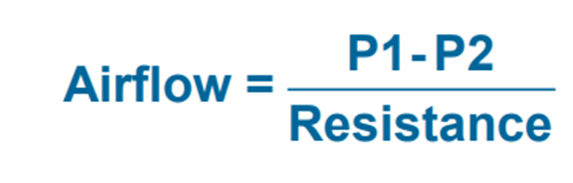
Airflow depends on:
Pressure difference between two ends of airway
Resistance of airways
Airway resistance is influenced by the […] of the airway
[…] airways increase resistance to flow
[…]diameter the greater the resistance.
diameter
Smaller
Smaller
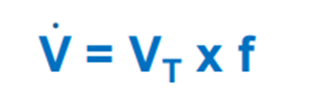
Pulmonary ventilation:
Pulmonary ventilation = movement of gas into and out of the lungs
V = volume of gas
Dot (. ) over V means per unit of time (usually per minute)
Alveolar ventilation:
Pulmonary Ventilation includes both […]
Dead space ventilation (VD) refers to the portion of tidal volume (VT ) that does not reach the […]
Alveolar ventilation (VA) refers to the portion of tidal volume that reaches the [….]
dead space and alveolar ventilation
alveolar compartment
Spirometry used to measure lung volumes:
- Forced expiratory volume during the […]:
o Volume of air that an individual can forcibly expel during the first second following maximal inhalation.
- […] (FVC):
o Total volume of air that an individual can exhale during a forced breath.
§ Total volume of air that the induvial can exhale during forced breath.
first second (FEV1)
Forced vital capacity
Partial pressure of gases:
- […]
o The total pressure of a gas mixture is equal to the sum of the pressure that each gas would exert independently.

Dalton’s Law
Diffusion of gases:
[…] law of diffusion
Describes what VO2 is
The rate of gas transfer (V gas) is proportional to:
the […]
the diffusion […]of the gas (i.e., how easily a molecule diffuses)
the difference in the partial pressure of the gas on the two sides of the tissue
inversely proportional to the […]
Fick’ s
tissue area
coefficient
thickness.
O2 and CO2 transport in blood:
99% of O2 is transported bound to […]
o [….]: Hb bound to O2
o […]: Hb not bound to O2
Amount of O2 that can be transported per unit volume of blood is dependent on the Hb concentration
o Each gram of Hb can transport 1.34 ml O2
o Oxygen content of blood (100% Hb saturation)**
Males: 150 g Hb/L blood
o 200 ml
Females: 130 g Hb/L blood
o 174.2 ml
hemoglobin (Hb)
Oxyhemoglobin
Deoxyhemoglobin
Oxyhemoglobin dissociation curve:
- Deoxyhemoglobin + O2 « Oxyhemoglobin
- Direction of reaction depends on
o […] of the blood
o Affinity between Hb and O2
- At the lung
o [….] = formation of oxyhemoglobin
- At the tissues
o[….] = release of O2 to tissues
PO2
High PO2
Low PO2
Effect of pH, temperature on oxyhemoglobin dissociation curve:
- pH
o Decreased pH […] Hb-O2 affinity
o Favors […] of O2 to the tissues
- Temperature
o […] blood temperature lowers Hb-O2 affinity
o Favors […] of O2 to the tissues
lowers
unloading
Increased
unloading
O2 transport in the muscle:
- We have [….] in blood stream, but not muscle in muscle we have […].
- Myoglobin (Mb)
o Shuttles O2 from the cell membrane to the mitochondria
- Mb has a […] affinity for O2 than hemoglobin
o Binds O2 at a very low PO2
o Allow Mb to store O2
§ Buffers muscle O2 needs at onset of exercise until cardiopulmonary system increases O2 delivery to muscle.
hemoglobin
myoglobin
higher
CO2 transport in blood:
- CO2 transported in blood in three ways
o Dissolved in […] (10%)
o Bound to […] (20%)
o […] (70%)
o When CO2 mixed with water it forms carbonic acids and carbonic acids clean itself into hydrogen ion and bicarbonate.

plasma
Hb
Bicarbonate
Ventilation and acid-base balance:
- Increased […] in blood or body fluids increases hydrogen ion accumulation, which decreases pH.
- Removal of […] from blood or body fluids decreases hydrogen ion concentration, while increases pH.
- […] ventilation results in CO2 exhalation
o Reduces H+ concentration, ↑pH
- […] ventilation results in buildup of CO2
o Increases H+ concentration, ↓pH
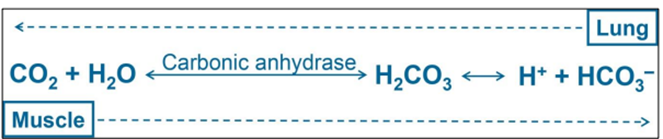
CO2 (2x)
Increased
Decreased
Explore top notes

