College Biology I: Chapter 6-9
 Studied by 2 people
 Call Kai
 Learn
Learn Practice Test
 Spaced Repetition
 Match
Match Flashcards
 Knowt Play
1/43

Earn XP
Description and Tags
Campbell Textbook, Cellular Respiration Focused
Name | Mastery | Learn | Test | Matching | Spaced | Call with Kai |
|---|
No analytics yet
Send a link to your students to track their progress
44 Terms
What molecule does glycolysis begin with?
6-carbon ring glucose
Glucose is a criminal on the run. We need to add a __________ officer to put a chain on glucose from one side to prevent its escape!
phosphate (takes energy ATP > ADP)
Who do we call to alert the phosphate officer about the glucose criminal on the run?
hexokinase
hexo - add phosphate on the 6th carbon
kinase - enzyme that adds or removes a phosphate officer
Now the phosphate officer has put a chain on the glucose on the run and the people in town have decided to give them their own unique combo name called ___________
glucose-6-phosphate (G6P)
glucose molecule with phosphate attached on the 6th carbon
The glucose-6-phosphate criminal is acting up still in his chamber! We need to give him the appropriate punishment by turning him into a __________.
5-carbon ring pentagon, same chemical formula different arrangement
In order to punish the glucose-6-phosphate, we need an appropriate tool to mold the bad bad molecule called the ___________, with parts of the name of the criminal molecule in the tool.
phosphoglucoisomerase
phosphogluco- denotes the molecule being altered
isomerase, isomers are different arrangements of the same molecule
The glucose-6-phosphate feels like his name no longer matched him and his once beautiful shape, he needs a change. Instead of holding a 6-carbon ring, he has been beaten to a 5-carbon ring so now he calls himself_____________, “f” for five.
fructose-6-phosphate
“f” for five
6-phosphate denotes the phosphate officer remains on the 6th carbon
Now after suffering defeat, the fructose-6-phosphate grows more rampant, stomping around in the cell. The phosphate officer decides that it’s time to call a friend for help, adding another ____________ officer to the opposite end of the molecule.
phosphate to the 1st carbon, takes energy (ATP > ADP)
In order to call the second officer, the phosphate officer has to use ___________.
phosphofructokinase
fructo- denotes the now 5 carbon ring
kinase- enzyme that adds or subtracts phosphate
Now chained by phosphate officers on both sides, the criminal has transformed into ___________.
fructose-1-6-biphosphate (F1,6BP)
phosphate on the 1st and 6th carbon
The criminal (F1,6BP) needs to learn his lesson. Now with phosphate officers on both sides, he can no longer run. Time to _________ in half using __________!
CHOP in half, using aldolase “AAAHHH don’t” says the criminal
The criminal has been split into two, but the cut was not clean. It has resulted in __________ and _________.
DHAP (dihydroxyacetone phosphate) & G3P (glyceraldehyde-3-phosphate)
G3P seems like the cleaner cut. We want to shape DHAP just like that. Let’s clean and give DHAP a “trim” using _____________.
triose phosphate isomerase
“trim” = triose
Both molecules are now __________.
G3P
Energy payoff cycle: all the hard work that the phosphate officers did are about to payoff in a little bit.
onto step 6
There are currently 2 criminal G3P molecules. We need more surveillance. We need to call more phosphate officers to guard both sides of each molecule. This time we need a _________ officer, ___________ for each criminal!
add phosphate officer to each of the G3P and introduce a SUPER OFFICER NADH to each molecule
To call more officers we need to use _________ _________ ____________
triose phosphate dehydrogenase
triose = after the “trim”
phosphate = another officer added
dehydrogenase = the NADH SUPER OFFICERS come with a H taken from the G3P
With more guards than ever, the criminal molecules G3P turn into _____________
1,3-Bisphosphoglycerate (1,3-BPG)
phosphate on the 1st and 3rd carbon
bisphospho- two phosphate officers in total
glycerate-sugar
After some time in prison, the 2 1,3-BPG molecules PAID their DEBTS to one of the PHOSPHATE OFFICERS by using energy to do chores, the PHOSPHATE OFFICERS LET THEM GO on one side after seeing their improved performance. They did work using ____________ and gained 2 brownie points.
phosphoglycerokinase
phospho- pertaining to the phosphate officer
glycero- sugar molecule
kinase- removal or addition of phosphate, ENERGY released (2 ATP)
After showing improvement, the 2 1-3-Biphosphoglycerate turn into _____________, their changed selves.
3-Phosphoglycerate (3PG)
phosphate officer at the 1st carbon left
3 carbon molecule
phosphoglycerate remains
The one phosphate officer remaining decides to patrol both ends of the 3-phosphoglycerate and switches sides! He uses a scooter named _____________ to get from one side to another causing him to “CHANGE” sides.
phosphoglyceromutase
phosphoglycero- roots from previous
mutase- change, shift
The phosphate officer is no longer on the 3rd carbon and switches to patrol the _______ carbon.
2nd
The 3PG molecule is now named __________
2-Phosphoglycerate (2PG)
After years and years of surveillance and schooling, the 2 PG molecules have learned to be kind. They take a nice shower to wash off their sins and dry themselves, losing __________ to the environment. They write “NO to crime” using a whiteboard called _________.
H2O released, enolase
The 2 PG becomes now become PEPpy kids, transformed into _____________.
Phosphoenolpyruvate (PEP)
phospho - phosphate
enol - root from enolase
pyruvate - final product
Finally, the PEP kids get to graduate school and become ___________ graduates through ___________program! They are more than excited and release their energy by running around.
pyruvates + 2 ATP, pyruvate kinase
Final Products of Glycolysis
2 net ATP
2 pyruvate (3-carbon molecules)
2 NADH carriers
2 H2O
Next step:
pyruvate oxidation
The newly graduated pyruvates need to take a BREATHER so they release _____________.
CO2, turning from a 3-carbon molecule to a 2-carbon molecule called acetyl
the acetyl group becomes oxidized and lose electrons donating them to ___________.
NAD+ turning the electron carrier into NADH
Now the acetyl group is ready to meet new friends and join with ____________ for the start of their new Krebs Cycle Friendship Class.
Coenzyme A
Next step: Citric Acid Cycle is also called
Krebs Cycle
Where does the Citric Acid Cycle happen?
matrix
Acetyl enters the cycle with the help of her friend Coenzyme A. Acetyl and Coenzyme A later on have a fight and Coenzyme A leaves the Acetyl. Acetyl joins hands with ___________(product from the end of the cycle) forming citrate/citric acid.
oxaloacetate
Acetyl (2-carbon) and OAA (4-carbon) are now best friends and are bonded in every life to form ____________.
citric acid (6-carbon)
In every life Acetyl and OAA join together, get broken down step by step by life’s hard challenges, charge up their social batteries, then reunite
charging up NAD+ and FADH from oxidizing citric acid (6-carbon molecule)
End products of Citric Acid Cycle (both acetyl groups):
4 CO₂
6 NADH
2 FADH₂
2 ATP
Next Step: Electron Transport Chain
bus drivers (electron carriers) drop off the H+ children INSIDE the school
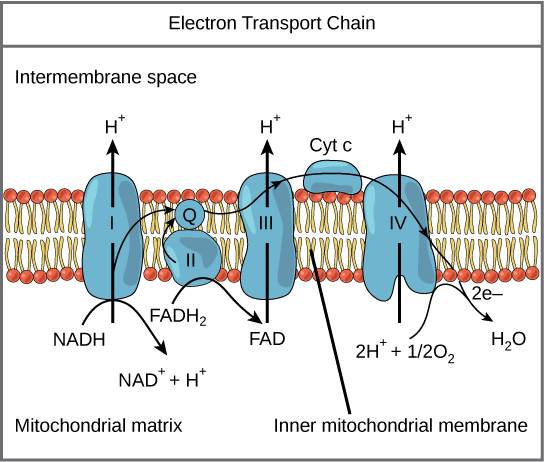
after lunch, the H+ children are so excited to go to the playground for recess and ride __________ __________to the other side
integral proteins
Now there is a high concentration of __________ in the ___________ _________(playground).
H+ children in the intermembrane space
The H+ kids are exhausted and then smell a delicious scent from inside the school. They are ATTRACTED by ___________ molecules that have a strong pull on them because of its electronegativity.
O2
They rush back in for the sweet snack but have to line up to go in one door: ___________ __________.
ATP Synthase
The H+ children join with the O2 inside the school and become ___________.
H2O
What is the final electron acceptor?
O2
 Note
Note  Flashcards (27)