UTA Immunology (BIOL 3312) Exam 2 with Dr. Charles
 Call Kai
 Learn
Learn Practice Test
 Spaced Repetition
 Match
Match Flashcards
 Knowt Play
1/50

There's no tags or description
Looks like no tags are added yet.
Name | Mastery | Learn | Test | Matching | Spaced | Call with Kai |
|---|
No analytics yet
Send a link to your students to track their progress
51 Terms
B cell development in the bone marrow is guided by _____________ _________, which maintain contact with pro-B and pre-B cells and secrete the cytokines needed to drive their development.
stromal cells
B cell maturation in secondary lymphoid tissues is guided by ______________ _____________ ___________, which secrete the cytokine CXCL13 that triggers the final changes in gene expression needed for maturation.
follicular dendritic cells
What triggers B cells to produce different antibodies with the same high-affinity binding site during isotype switching?
TFH cells secrete cytokines that guide isotype switching based on the nature of infection.
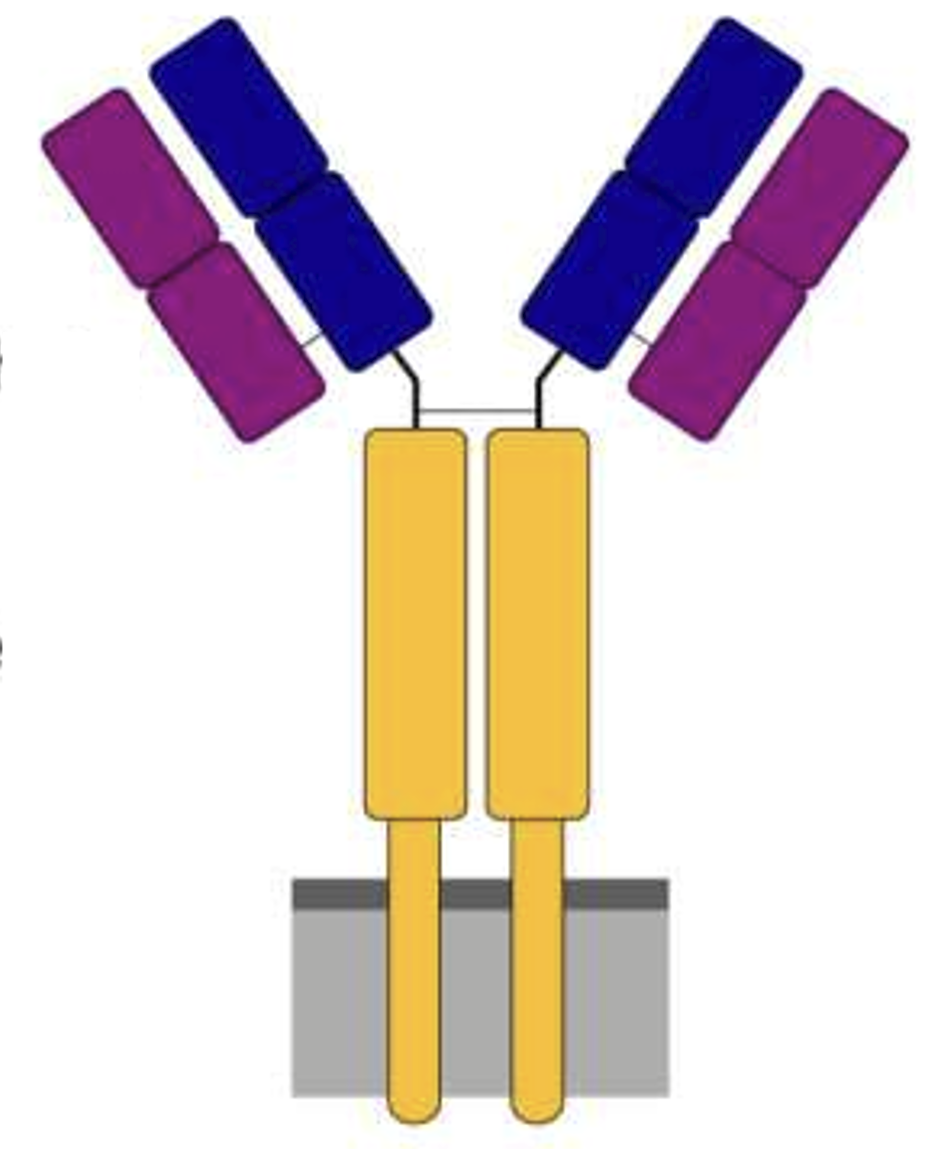
Which of the following are structural components of the B cell receptor (BCR)? Select all that apply.
transmembrane region
light chain
variable regions
heavy chain
IgD
mediates inflammation by sensitizing basophils to release histamine and heparin
IgM (pentameric)
first antibody secreted during intital exposure to an antigen; potent activator of complement
IgG
several subclasses that bind and neutralize antigens, some act as opsonins, can cross the placenta
IgA
secreted across epithelium into mucosal tissues and also sweat, tears, saliva, breast milk; neutralizes antigens
IgE
mediates inflammation by sensitizing mast cells and basophils to release histamine and heparin
B cells act as antigen-presenting cells to newly formed TFH cells in secondary lymphoid tissues after the B cells have processed antigens from which cell types? Select all that apply.
subcapsular macrophages
follicular dendritic cells
Put the types of B cells in order from the shortest to the longest lifespans.
Shortest lifespan
pro-B cells
immature anergic B cells
plasma cells
memory B cells
Longest lifespan
Phase 1: repertoire assembly
creating B cells with a diverse receptors
Phase 2: negative selection
inactivating or eliminating self-reactive B cells
Phase 3: positive selection
promoting maturation of a small group of immature B cells
Phase 4: searching for infection
mature naïve B cells recirculatre between blood and lymph
Phase 5: finding infection
antigen binding to B cell receptors activates B cells, inducing clonal expansion and clonal selection
Phase 6: attacking infection
differentiated plasma cells release antibodies with high-binding affinity for an antigen, memory B cells are retained in circulation
True or False: T cell-independent B cell activation does not produce memory B cells.
True
During B cell repertoire assembly, there are two checkpoints.
The first checkpoint occurs after the _____________ stage, assessing for productive heavy chain arrangements.
pro-B cell
During B cell repertoire assembly, there are two checkpoints.
The second checkpoint occurs after the _____________ stage, assessing for productive light chain arrangements.
pre-B cell
________________ selection occurs in the bone marrow. This process removes _____________ B cells, leaving only _______________ B cells to enter the blood.
Negative ; self-reactive ; self-tolerant
Both B cells and T cells undergo positive and negative selection to ensure that lymphocytes recognize pathogenic or abnormal antigens while being tolerant of self-antigens.
In T cell development, ____________ selection identifies double-positive thymocytes that recognize self-MHC and induces their survival.
positive
Both B cells and T cells undergo positive and negative selection to ensure that lymphocytes recognize pathogenic or abnormal antigens while being tolerant of self-antigens.
In T cell development, ___________ selection identifies single-positive thymocytes that bind to self-MHC too strongly and eliminates them.
negative
When bacteria infect the skin, myeloid dendritic cells engulf and process the antigen as they enter a ___________.
draining lymph node
Antigens and pathogens in the blood enter the _____________ where they encounter myeloid dendritic cells and macrophages for phagocytosis and antigen-processing.
spleen
True or False: Involution of the thymus is responsible for a large decrease in circulating mature T cells, leading to immunosenescence.
False
Antigen binding to myeloid dendritic cell receptors causes a change in gene expression, including ____________, a receptor for CCL21.
CCR7
Expressing this receptor allows the dendritic cell to perform ____________ to enter a secondary lymphoid tissue and complete activation.
chemotaxis
Both B cells and T cells are produced in the bone marrow and arise from lymphoid progenitor cells.
B cell maturation takes place in the ____________ while T cell maturation takes place in the _____________.
bone marrow ; thymus
Activated CD8 cells will differentiate into ______________
T effector cells that use ____________ to trigger in target cells.
cytotoxic ; cytotoxins ; apoptosis
dendritic cells
display self-peptide : MHC to single positive thymocytes during negative selection
thymic stromal cells
maintain direct contact via Notch : ligand signaling, directing development of T cells including positive selection
macrophages
phagocytize immature T cells that were selected to die via apoptosis
In both B cells and T cells, ______________ tolerance removes self-reactive lymphocytes in primary lymphoid tissues while ______________ tolerance removes self-reactive lymphocytes in the blood.
central ; peripheral
Autocrine release and binding of ___ to ___ induces T-cell proliferation and differentiation of activated T cells.
IL-2 ; the high-affinity IL-2 receptor
Treg
suppression of active immune effector cells
TH17
enhance neutrophil responses
TH1
activate macrophages
TH2
active immune effector cells to respond to parasitic infections
TFH
activate B cells to induce humoral immune responses
How do immune complexes help prevent hemolytic disease of the newborn, and what is the role of RhoGAM in this process?
RhoGAM contains anti-Rh antibodies that create immune complexes with fetal Rh+ RBCs, engaging inhibitory Fc receptors on maternal B cells to prevent activation.
Which statement best describes the role of long-lived plasma cells in maintaining steady-state antibody levels?
Long-lived plasma cells continuously secrete antibodies, providing baseline protection without requiring repeated antigen exposure.
Which statement best describes the distribution of different memory T cell populations in the body?
Tissue-resident memory T cells are found in peripheral tissues, such as the skin and mucosa, where they provide localized immunity.
Which type of vaccine uses pathogenic subunits and adjuvants, and why are these components included?
Conjugate or subunit vaccines use subunits of the pathogen along with adjuvants to enhance the immune response and increase the durability of immunity.
Which of the following best describes the difference between effector cells during a primary and secondary immune response?
The secondary immune response produces effector cells more rapidly and in greater numbers than the primary immune response.
Why are vaccines generally more effective in treating pathogens that produce acute infections?
Pathogens that cause acute infections typically do not mutate rapidly, making it easier for vaccines to provide long-lasting immunity.
How does mTORC1 expression and asymmetric cell division influence naïve T cell activation and differentiation?
Asymmetric cell division leads to differential mTORC1 expression, generating distinct daughter cells that contribute to both effector and memory T cell populations.
Which inhibitory receptor on naïve B cells plays a role in regulating the primary immune response, and what is its function?
FcγRIIB; it inhibits B cell activation when immune complexes bind, helping to prevent excessive immune responses.
Why are memory T cells more easily activated than naïve T cells?
Memory T cells require less co-stimulation than naïve T cells and express CD45RO, which enhances TCR signaling.
Which of the following classifications correctly describe the type of immunity a baby receives from breastfeeding?
passive immunity
naturally acquired immunity

