AP Biology - CELL SIGNALING ASSESSMENT
 Studied by 0 people
 Call Kai
 Learn
Learn Practice Test
 Spaced Repetition
 Match
Match Flashcards
 Knowt Play
1/67

There's no tags or description
Looks like no tags are added yet.
Name | Mastery | Learn | Test | Matching | Spaced | Call with Kai |
|---|
No analytics yet
Send a link to your students to track their progress
68 Terms
(Intro to Cell Communication) What “topics” do cells (unicellular and multicellular) need to discuss?
Anything that increases survivability and mating!
FOOD
REPRODUCTION (Signaling Molecules: Ex. Pheromones → found in animals, can only be detected by same species b/c animals don’t date but must still attract a mate)
CELL DIVISION / MITOSIS (to heal injured tissue, for growth, to maintain SA:V)
DETECT ANTIGENS
DIFFERENTIATION (stem cells during development)
CHANGES IN METABOLISM → FIGHT OR FLIGHT RESPONSE (adrenaline / epinephrine)
TURN “ON” TRANSCRIPTION FACTORS FOR GENE EXPRESSION
CELL DEATH (APOPTOSIS)
(Intro to Cell Communication) Explain CHEMOTAXIS.
+ Taxis → toward a favorable stimulus
- Taxis → away from a dangerous stimulus
(Intro to Cell Communication) Communication Systems evolved to respond to stimuli (changes in the environment). Explain the COMMUNICATION SYSTEM along with its SIGNALING MOLECULE/LIGAND.
NERVOUS → Neurotransmitter (electrical impulses → neurons "fire" by depolarized)
ENDOCRINE → Hormones (insulin/glucagon (water soluble), steroids (testosterone, estrogen, which are lipid soluble))
IMMUNE → Antibodies/Glycoprotein (recognition of antigens)
(Intro to Cell Communication) All ligands require ________ _________ in order to respond!
specific receptors
(Intro to Cell Communication) Cells can only respond to ligands if…
…they have the specific receptor!
Every single cell has to have an insulin receptor…
Your heart/lungs/liver has receptors for Adrenaline/Epinephrine for FIGHT or FLIGHT!
(Cell Signaling & Communication (NOTES)) *Cell Signaling and Communication*
Cell communication is essential for all organisms. Common subjects of cell “conversation” are sex and food. Unicellular organisms use signals to relay _____________ or ____________ ___________ (locate food and find mates).
environmental
reproductive information
(Cell Signaling & Communication (NOTES)) *Cell Signaling and Communication*
What is QUORUM SENSING?
Quorum sensing is a cell-to-cell communication process that bacteria use to coordinate gene expression based on their population density.
(Cell Signaling & Communication (NOTES)) *Cell Signaling and Communication*
What are AUTO INDUCERS?
Bacteria release and detect signaling molecules called autoinducers, which accumulate in the environment as the bacterial population grows. Once a threshold concentration of autoinducers is reached, they bind to specific receptors, triggering changes in gene expression that allow the bacterial community to behave collectively.
(Cell Signaling & Communication (NOTES)) *Cell Signaling and Communication*
Explain the role of biofilms.
Example: The concentration of signaling molecules allows bacteria to sense local population density. The formation of a biofilms (like on your teeth!) composed of bacteria is initiated by signaling molecules, which allows them to sense the density of local cells. Collectively, they derive nutrition from the surface.
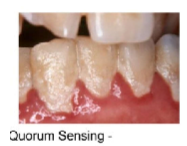
(Cell Signaling & Communication (NOTES)) Sexual Reproduction in Yeast
Explain SEXUAL REPRODUCTION IN YEAST.
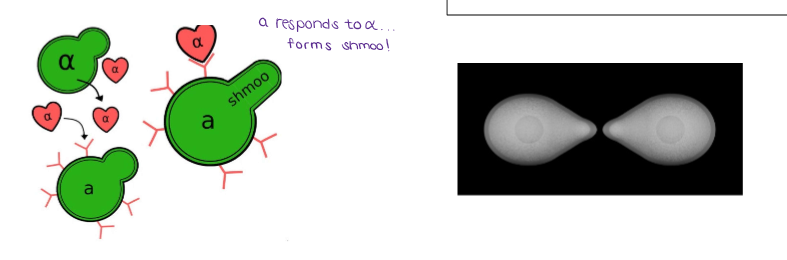
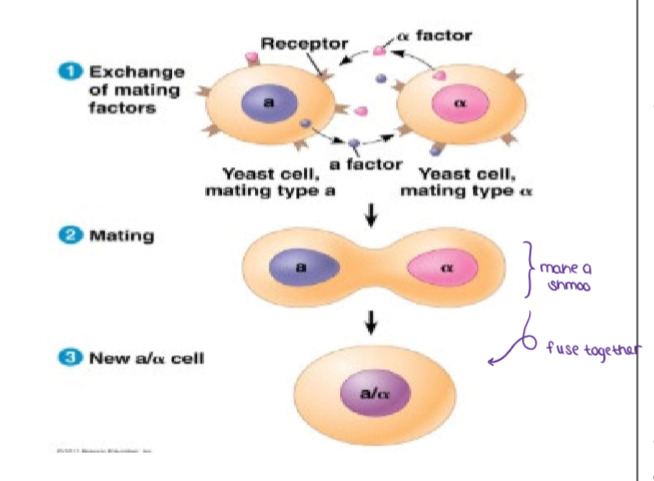
Yeast exists as haploid cells of either a or α type.
Each type secretes specific mating pheromones:
a cells produce a-factor, which attracts α cells.
α cells produce α-factor, which attracts a cells.
These pheromones induce shmoo formation, where cells extend toward each other.
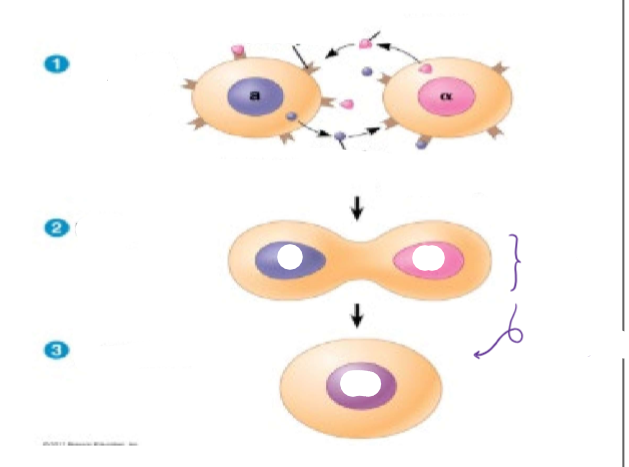
(Cell Signaling & Communication (NOTES)) Sexual Reproduction in Yeast
Label the diagram of the a/α formation.
(Cell Signaling & Communication (NOTES)) *Cell Signaling and Communication*
In multicellular organisms, cell communication allows for the ___________ ___ ____________ __ ___________ ______ (from embryo to adult form)!
development and coordination of specialized cells

(Cell Signaling & Communication (NOTES)) *Cell Signaling and Communication*
Name the SYSTEMS that maintain communication throughout an animal’s life!
Endocrine System
Nervous System
Immune System
(Cell Signaling & Communication (NOTES)) *Cell Signaling and Communication*
Intracellular (signals from within)/Extracellular signals control the crucial activities of cells such as…
CELL DIVISION
DIFFERENTIATION
METABOLISM
GENE EXPRESSION
(Cell Signaling & Communication (NOTES)) *Cell Signaling and Communication*
Studies of cell signaling are helping to answer some of the most important questions in biology and medicine — in areas ranging from embryological development to hormone action to the development of cancer and other kinds of disease. The signals received by cells, whether originating from another cell or from some change in the organism’s physical surroundings, take various forms…
MECHANORECEPTOR: responds to movement/pressure/touch
PHOTORECEPTOR: responds to light
CHEMORECEPTOR: responds to chemicals
THERMORECEPTOR: responds to change in temperature
PAIN RECEPTOR: responds to tissue damage
(Cell Signaling & Communication (NOTES)) Cells most often communicate with each other using chemical signals.
Chemical signals include: HORMONES
(Ex. insulin, testosterone) Produced in one tissue, then travels through the bloodstream, and interacts with certain cells to change cell activity. (ENDOCRINE SYSTEM)
(Cell Signaling & Communication (NOTES)) Cells most often communicate with each other using chemical signals.
Chemical signals include: NEUROTRANSMITTERS
(Ex. dopamine) Released by one nerve cell (neuron), travels a very short distance to adjacent neuron, and stimulates nerve cell activity. (NERVOUS SYSTEM)
(Cell Signaling & Communication (NOTES)) Cells most often communicate with each other using chemical signals.
Chemical signals include: CYTOKINES (INTERFERON) & HISTAMINE
chemicals released by the immune system
when Histamine detects a ligand, like pollen (which acts as an antigen), histamine triggers the allergy symptoms to get rid of the antigens (blowing your nose, water eyes, etc.)
(Cell Signaling & Communication (NOTES)) *Cell Signaling and Communication*
The process by which a cell’s surface is converted to a specific cellular response is called a ______ ____________ _______ (The same set of cell-signaling mechanisms of cellular regulation shows up in diverse species, additional evidence for the evolutionary relatedness of all life.).
signal transduction pathway
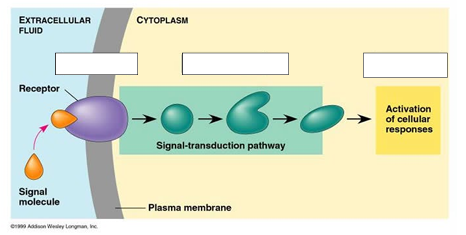
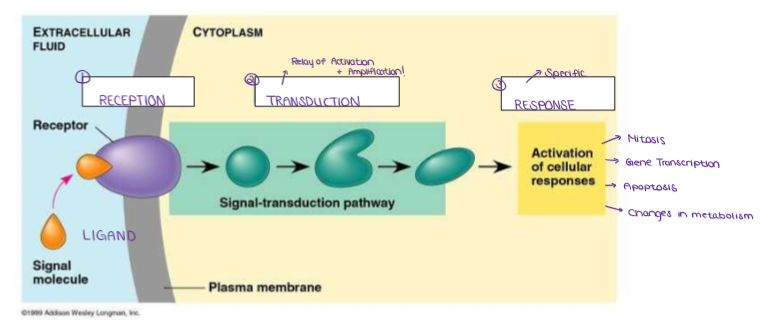
RECEPTION: get message
TRANSDUCTION: relay message
RESPONSE: act on message (cell i, transcription of genes, etc.)
(Cell Signaling & Communication (NOTES)) Endocrine Glands
Describe the GONADS (REPRODUCTIVE ORGANS).
(male) TESTES → testosterone (steroid (lipid soluble) → can diffuse through phospholipid bilayer)
(female) OVARIES → estrogen (steroid (lipid soluble) → can diffuse through phospholipid bilayer)
(Cell Signaling & Communication (NOTES)) Endocrine Glands
Describe the THYROID GLAND.
Makes thyroxine (every cell has to have a receptor for it)
Controls metabolism
(Cell Signaling & Communication (NOTES)) Endocrine Glands
Describe the PITUITARY GLAND (in brain).
MASTER glands
makes ADH (anti-diuretic hormone → for osmoregulation), growth hormone, oxytocin (in love, relationships, hugs, uterus contracts during birth → mom’s brain is flooded w/ oxytocin after birth to help w/ bonding)
(Cell Signaling & Communication (NOTES)) Endocrine Glands
Describe the PANCREAS.
Makes insulin (lowers blood sugar after a meal) and glucagon (increases blood sugar when you skip a meal, released from liver!
Antagonistic Hormones (have opposing effects)
(Cell Signaling & Communication (NOTES)) Endocrine Glands
Describe the ADRENAL GLAND (on top of the kidney).
Makes adrenaline
(Cell Signaling & Communication (NOTES)) DIRECT, LOCAL, and LONG DISTANCE SIGNALING
In multicellular organisms, cell communication may be close together or far apart, and signaling molecules are used to target other cells. What is DIRECT SIGNALING?
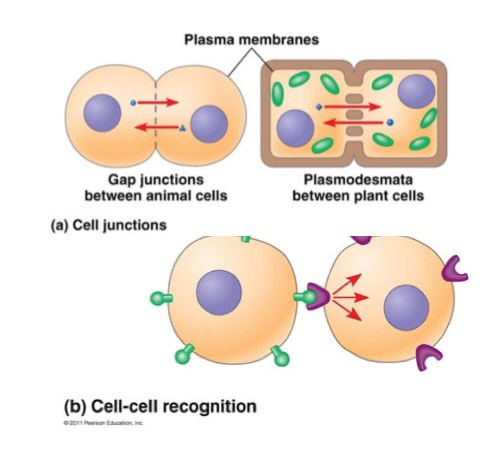
Direct Contact of cells (like cell junctions)
Cell-cell recognition using cell-surface molecules (uses glycoproteins & receptors!) (like in embryonic development & immune responses)
(Cell Signaling & Communication (NOTES)) DIRECT, LOCAL, and LONG DISTANCE SIGNALING
In multicellular organisms, cell communication may be close together or far apart, and signaling molecules are used to target other cells. What is LOCAL SIGNALING?
Autocrine signaling
Paracrine signaling
Synaptic Signaling
(Cell Signaling & Communication (NOTES)) DIRECT, LOCAL, and LONG DISTANCE SIGNALING
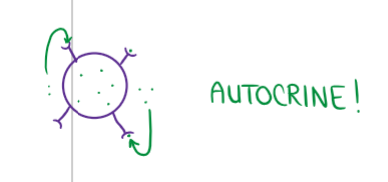
LOCAL SIGNALING: What is AUTOCRINE SIGNALING?
a cell makes a chemical and uses it on itself
(Cell Signaling & Communication (NOTES)) DIRECT, LOCAL, and LONG DISTANCE SIGNALING
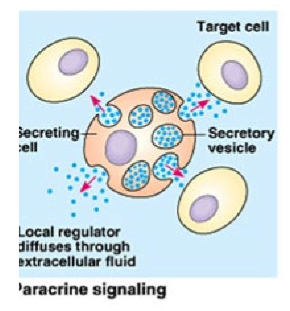
LOCAL SIGNALING: What is PARACRINE SIGNALING?
(“para” = beside)
messenger molecules are secreted by a signaling cell and these chemicals or local regulators travel short distances and stimulate nearby target cells
Examples:
Growth factors that stimulate neighboring cells to grow and divide
Nitric Oxide (NO) causes local vasodilation
Cytokines (interferon) during immune responses signal local cells (They stimulate the movement of cells towards sites of inflammation infection and trauma.)
(Cell Signaling & Communication (NOTES)) DIRECT, LOCAL, and LONG DISTANCE SIGNALING
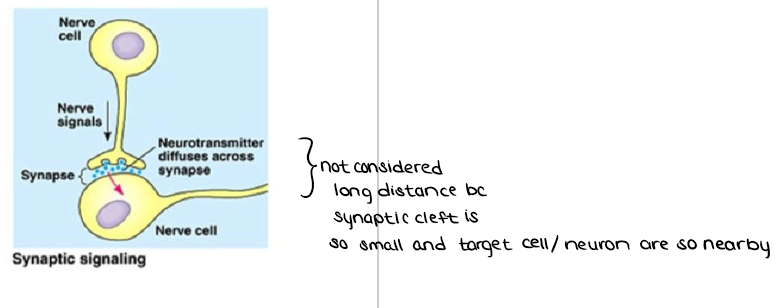
LOCAL SIGNALING: What is SYNAPTIC SIGNALING?
occurs in the animal nervous system
An electrical signal along a nerve cell triggers the secretion of neurotransmitter molecules which, when reaching its target cell, triggers a response
(Cell Signaling & Communication (NOTES)) DIRECT, LOCAL, and LONG DISTANCE SIGNALING
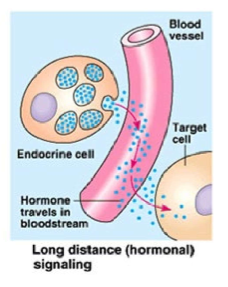
In multicellular organisms, cell communication may be close together or far apart, and signaling molecules are used to target other cells. What is LONG DISTANCE SIGNALING?
Includes: Endocrine signaling
Hormones → Secreted chemicals formed in specialized cells used for long-distance signaling (travel via the circulator system in the bloodstream to target organs and cells)
(Cell Signaling & Communication (NOTES)) What happens when a cell encounters a secreted signaling molecule? What are the three stages?
Signal Transduction Pathway
reception, transduction, and response
(Cell Signaling & Communication (NOTES)) Signal Transduction Pathway
Label the three stages of cell signaling.
(Cell Signaling & Communication (NOTES)) Signal Transduction Pathway
What is a LIGAND?
term used for a specific molecule binding to a receptor
**All signal transduction signals are caused by SPECIFIC ligands.**
(Cell Signaling & Communication (NOTES)) Signal Transduction Pathway
What is RECEPTION?
A LIGAND binds to a receptor protein, activating the receptor, causing it to change shape. This triggers the intracellular pathways!
(Cell Signaling & Communication (NOTES)) Signal Transduction Pathway
What does ALLOSTERIC mean?
any protein that can change shape
(Cell Signaling & Communication (NOTES)) Signal Transduction Pathway
What is TRANSDUCTION?
Converts the signal to a form that can bring about a cellular response and AMPLIFIES IT.
(Protein phosphorylation, second messengers)
(Essentially, transduction acts as the “relay race” of cell signaling, ensuring that an external message is properly transmitted and amplified inside the cell.)
(Cell Signaling & Communication (NOTES)) Signal Transduction Pathway
What is RESPONSE?
The transduced signal triggers a SPECIFIC CELLULAR RESPONSE & AMPLIFY IT!
Responses May Include:
Changes in metabolism (like after eating a meal or even the fight or flight response)
Activation of transcription factors (in order transcribe & translate specific genes)
Cell division
Differentiation of cells during embryonic development
Turning on or off a specific enzyme
Apoptosis (programmed cell death)
Production of antibodies (an immune response to an antigen)
(Cell Signaling & Communication (NOTES)) TYPES OF RECEPTION
All receptors allosteric proteins that _______ _____ in response to a ______!
CHANGES SHAPE
signal
(Cell Signaling & Communication (NOTES)) TYPES OF RECEPTION
Most signal receptors are ________________ _______ _________: These membrane proteins are for _____________ _______ that cannot enter the cell. Including:
_________________________
_________________________
_________________________
Plasma-Membrane Protein Receptors
water-soluble ligands
G-Protein Coupled Receptors
Tyrosine-kinase receptors
Ion gated channel receptors (Ligand-Gated ion channel)
(Cell Signaling & Communication (NOTES)) TYPES OF RECEPTION
What are G-PROTEIN-LINKED RECEPTORS?
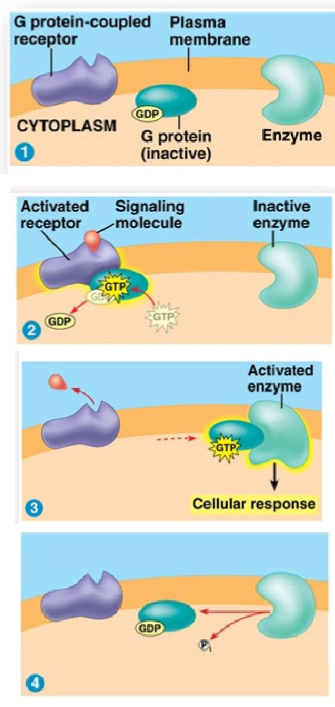
This is a plasma-membrane receptor that works with the help of a protein called a G protein and (usually) an enzyme. All three proteins remain attached to the plasma membrane.
In the absence of the extracellular signal molecule specific for the receptor, all three proteins are in inactive form.
(Cell Signaling & Communication (NOTES)) TYPES OF RECEPTION
How do you ACTIVATE and DEACTIVATE G-PROTEIN-LINKED RECEPTORS?
The signal molecule binds to the receptor protein, causing the receptor to change shape & activate.
The inactive G protein moves along the membrane and binds to the receptor. A molecule of GTP replaces the GDP, activating the G protein!
The activated G protein moves along the membrane & binds to and activates the enzyme which triggers the cellular response.
To deactivate, the GTP on the G protein is hydrolyzed back into GDP (“off” form).
(Cell Signaling & Communication (NOTES)) TYPES OF RECEPTION
What are examples of SIGNALING PATHWAYS that use G-PROTEINS?
Many hormone receptors (glucagon)
Many neurotransmitters (dopamine, serotonin)
Sensory reception in humans (smell, taste (sweet, bitter, umami), light)
Other applications:
Many bacterial infections (botulism, cholera, etc.) produce toxins that interfere with G-proteins, leading to disease symptoms
As many as 60% of all medicines sold today act by influencing G-protein pathways
(Cell Signaling & Communication (NOTES)) TYPES OF RECEPTION
Subunits of G-PROTEIN (_____, ____, _____) move to activate other proteins.
alpha, beta, gamma
(Cell Signaling & Communication (NOTES)) TYPES OF RECEPTION
Other HORMONES (classic GPCR/G-PROTEIN COUPLE RECEPTOR LIGANDS) include…
Epinephrine (adrenaline)
Antidiuretic hormone
Acetylcholine for heart rate control & smooth muscle contraction
Prostaglandins --> these cause inflammation, pain and fever (AND IBUPROFIN (like Advil) BLOCKS THESE RECEPTORS to reduce inflammation!)
(Cell Signaling & Communication (NOTES)) TYPES OF RECEPTION
What are TYROSINE-KINASE RECEPTORS?
These receptors activate several different signal-transduction pathways at once, helping regulate such complicated functions as cell reproduction (cell divisions). Inappropriate activation of these receptors/undeactivated receptors can lead to uncontrolled cell growth — cancer! (treatment = something that blocks the receptor)
Examples of ligands that activate tyrosine-kinase receptors: Growth factors, Insulin
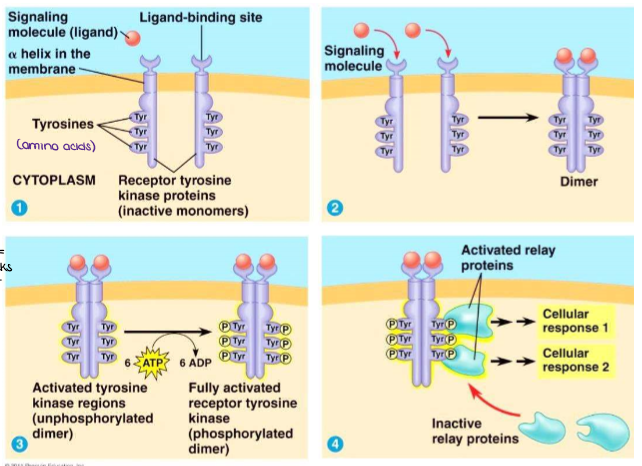
(Cell Signaling & Communication (NOTES)) TYPES OF RECEPTION
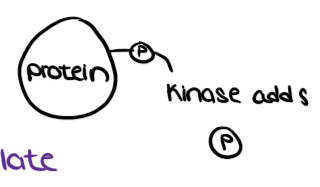
What are KINASE PROTEINS?
enzyme proteins that transfer phosphate groups (from ATP) to a protein in order to activate the protein
(Cell Signaling & Communication (NOTES)) TYPES OF RECEPTION
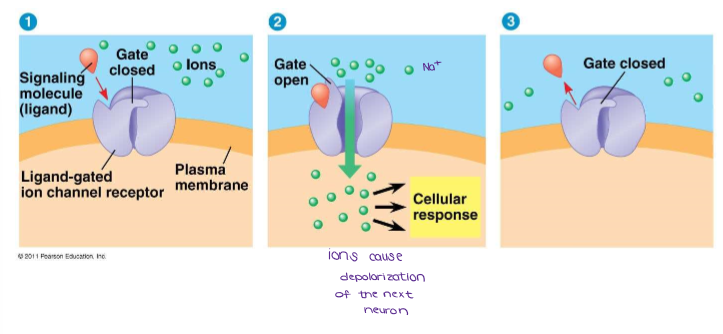
What are ION-CHANNEL RECEPTORS/LIGAND GATED ION CHANNELS?
Some membrane receptors of chemical signals are: Ligand-gated ion channels. These channels are protein pores in the plasma membrane that open or close in response to the binding of a chemical signal, allowing or blocking the flow of specific ions, such as Na+ or Ca2+ into the cell. Often the change in the concentration of a particular ion inside the cell directly affects cell function.
*Ligand-gated ion channels are particularly important in the NERVOUS SYSTEM.*
(Ions flowing into a neuron will cause depolarization, or activation of the cell.)
(Cell Signaling & Communication (NOTES)) INTRACELLULAR RECEPTION
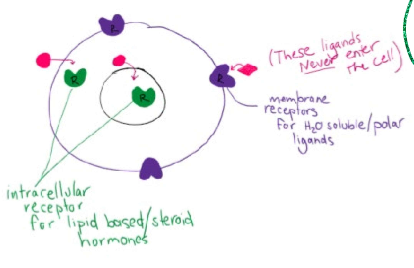
What are INTRACELLULAR RECEPTORS?
found in the cytoplasm, or even the nucleus
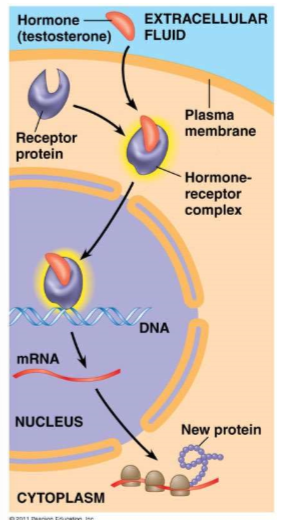
These receptors are for lipid soluble ligands (like steroid hormones w/ cholesterol base → cortisone, reproductive hormones: estrogen, progesterone, testosterone) that easily diffuse into the cell
LIPID SOLUBLE (hydrophobic) ligands attach to receptors that are INSIDE the cell
(Cell Signaling & Communication (NOTES)) INTRACELLULAR RECEPTION
Explain the role of the STEROID HORMONE.
A steroid hormone is LIPID-SOLUBLE and can easily diffuse through the membrane. Only target cells will have the appropriate intracellular receptor - so this is still a very specific signal!
When a steroid hormone attaches to the intracellular receptor, the complex travels to the nucleus and attaches to specific sequences on DNA.
This, in turn activates the gene that needs to be transcribed and translated directly!
This is one of the many ways in which gene expression is regulated!
(Cell Signaling & Communication (NOTES)) INTRACELLULAR RECEPTION
What is a TRANSCRIPTION FACTOR?
A transcription factor is a protein that binds to specific DNA sequences to regulate the transcription of genetic information from DNA to messenger RNA (mRNA). These proteins play a critical role in controlling gene expression.
(Cell Signaling & Communication (NOTES)) Signal-Transduction Pathways
What are SIGNAL-TRANSDUCTION PATHWAYS?
Transduction pathways are multistep pathways where cells convert the extracellular signal into an intracellular response.
(Cell Signaling & Communication (NOTES)) Signal-Transduction Pathways
This series of activation can be accomplished by…
Protein phosphorylation cascades or
2nd Messenger activation (followed by phosphorylation cascades)
(Cell Signaling & Communication (NOTES)) Signal-Transduction Pathways
What is SIGNAL AMPLIFICATION?
Transduction is the stage in cell signaling that greatly amplifies the signal.
Once one signal-activated receptor activates a protein, that protein activates another, and so on. It can be thought of as a domino effect.
(Cell Signaling & Communication (NOTES)) Signal-Transduction Pathways
What is PROTEIN PHOSPHORYLATION?
a common mode of regulation and signal transduction in cells
This activity is regulated by PROTEIN KINASES
(Cell Signaling & Communication (NOTES)) Signal-Transduction Pathways
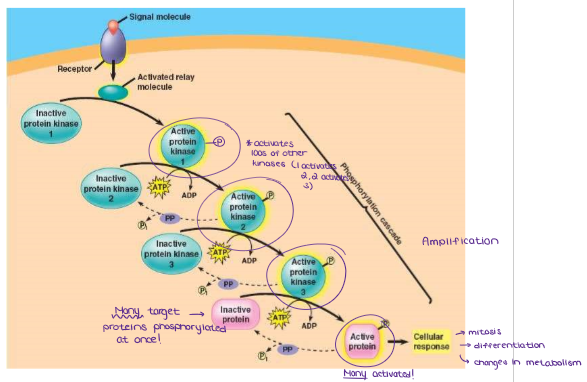
What is a PHOSPHORYLATION CASCADE?
A signaling pathway begins when a signal molecule binds to a membrane receptor. The receptor then activates a relay molecule, which activates a protein kinase (1). Active protein kinase 1 transfers a phosphate from ATP to an inactive molecule of another protein kinase molecule (2), thus activating this second kinase. In turn, active protein kinase 2 catalyzes the phosphorylation (and activation) of protein kinase 3. Finally, active protein kinase 3 phosphorylates a protein that brings about the cell’s final response to the signal.
The result of a phosphorylation cascade is a large number of activated molecules at the end of the pathway. That is, a very small number of extracellular signal molecules can produce a major cellular response.
(Cell Signaling & Communication (NOTES)) Signal-Transduction Pathways
Phosphorylation Cascade: How are PROTEIN KINASE MOLECULES INACTIVATED?
Protein kinase molecules are inactivated by the removal of the phosphate group (DEPHOSPHORYLATION) by enzymes called PHOSPHATES. This makes the protein kinases available for reuse.

(Cell Signaling & Communication (NOTES)) Second Messenger Activation
What are SECOND MESSENGERS?
small, nonprotein, water-soluble molecules or ions that relay a signal to the interior of a cell
key components of signaling pathways
participate in pathways initiated by both G-protein-linked receptors and tyrosine-kinase receptors
(Cell Signaling & Communication (NOTES)) Second Messenger Activation
What is a MAJOR ADVANTAGE of SECOND MESSENGERS?
they are both small and water-soluble, allowing them to readily spread throughout the cell by diffusion → this allows a fast amplified response!
(Cell Signaling & Communication (NOTES)) Second Messenger Activation
What are FIRST MESSENGERS?
The extracellular signal molecule that binds to the membrane receptor is a pathway’s “first messenger.”
ligands
(Cell Signaling & Communication (NOTES)) Second Messenger Activation
The most widely used second messengers are…
cyclic AMP (cAMP → adenine), cGMP (cyclic GMP → guanine)
calcium ions Ca2+
IP3 (Inositol triphosphate)
(Cell Signaling & Communication (NOTES)) Second Messenger Activation
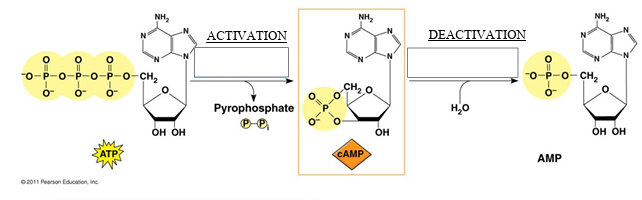
Label the ACTIVATION and DEACTIVATION of the 2nd messenger.
(Cell Signaling & Communication (NOTES)) Second Messenger Activation
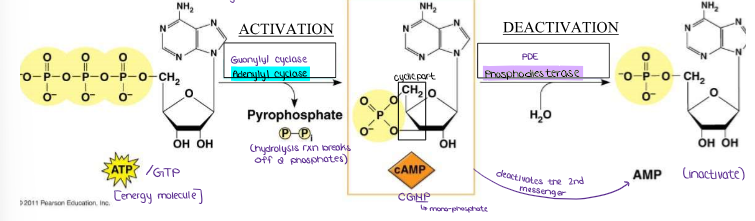
Following the activation of the 2nd messengers, a series of ______ ______________ _________ occur! To stop/deactivate the second messengers, _________________ changes cAMP back to AMP.
protein phosphorylation reactions
phosphodiesterase
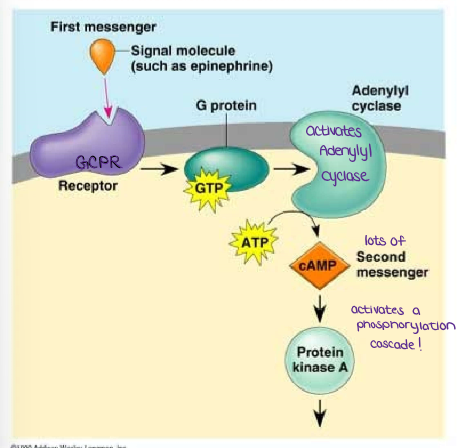
(Cell Signaling & Communication (NOTES)) Second Messenger Activation
What is The Role of Phosphodiesterase (PDE)?
PDE is an enzyme responsible for breaking down cAMP into AMP, thereby stopping the cAMP signaling pathway. This deactivation turns off the effects triggered by PKA.
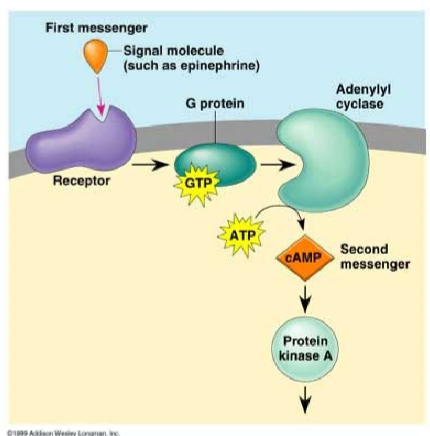
(Cell Signaling & Communication (NOTES)) Second Messenger Activation
Sometimes, we need medications that will actually PROLONG a Cellular Response. One example of a signal transduction pathway we would medically want to prolong is the Insulin signaling pathway. In patients with Type 2 diabetes, prolonging or enhancing this pathway is beneficial to improve glucose uptake by cells and reduce blood sugar levels. Hypothesize mechanisms that would PROLONG a response in the cell.
Increasing the ligand molecule OUTSIDE the cell
Block the enzymes that inactivate the 2nd messengers (phosphodiesterase)
Block phosphatases from inactivating protein kinases.
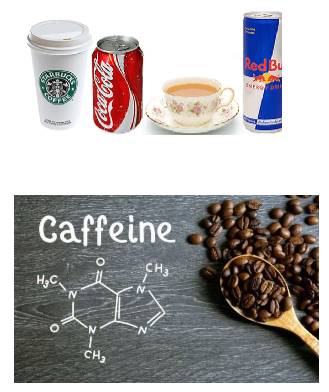
Caffeine
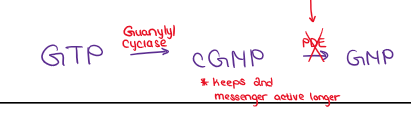
(Cell Signaling & Communication (NOTES)) Second Messenger Activation
How does CAFFEINE work in PROLONGING a response in the cell?
It works by blocking phosphodiesterase (PDE), preventing the breakdown of cAMP. This leads to prolonged effects of cAMP, resulting in increased energy, alertness, and readiness for action. These effects are why caffeine is commonly used to boost mental and physical performance.
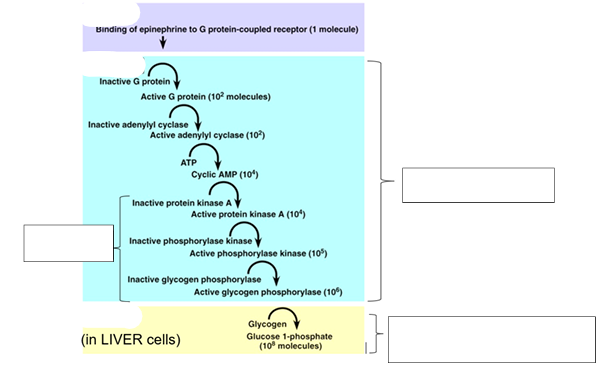
(Cell Signaling & Communication (NOTES)) Let’s look at how the FIGHT OR FLIGH PATHWAY works!
Label the diagram.
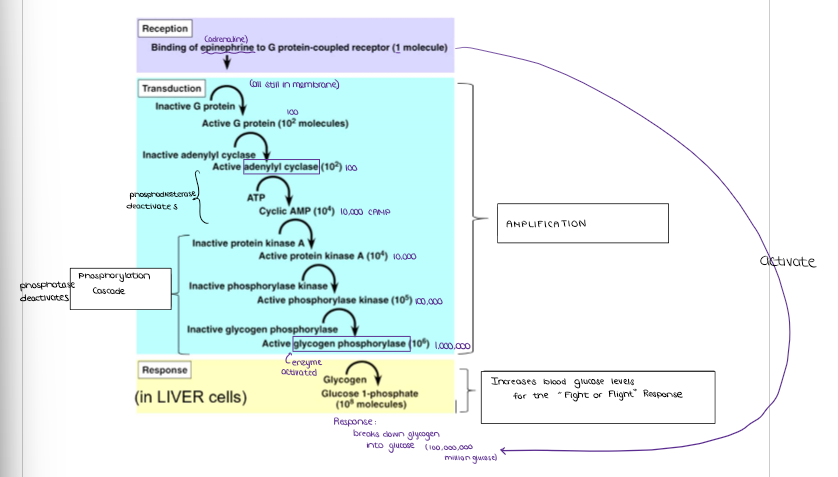
(Cell Signaling & Communication (NOTES)) Let’s look at how the FIGHT OR FLIGH PATHWAY works!
All cells that have receptors for the SAME ligand will respond, but they ___ ____ _________ ______!
may have different actions
(Cell Signaling & Communication (NOTES)) Let’s look at how the FIGHT OR FLIGH PATHWAY works!
Epinephrine also acts on…
Heart → increase heart rate/circulate
Blood vessels → vasodilation
Lungs/Bronchioles → increases in respiration
 Note
Note  Flashcards (20)