OCEAN 2001: Module Based Questions
 Studied by 0 people
 Call Kai
 Learn
Learn Practice Test
 Spaced Repetition
 Match
Match Flashcards
 Knowt Play
1/19

There's no tags or description
Looks like no tags are added yet.
Name | Mastery | Learn | Test | Matching | Spaced | Call with Kai |
|---|
No analytics yet
Send a link to your students to track their progress
20 Terms
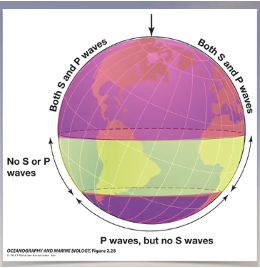
Describe how seismic shadow zones reveals the presence of a liquid core in the Earth
Seismic shadow zones: zones of the Earth where seismic waves are not detected
Northern hemisphere: detect both S and P waves
Northernmost Southern hemisphere: detect to S or P waves
Southernmost Southern hemisphere: detect P, but no S waves
S Wave Shadow Zone: during an earthquake incident, energy is propagated down into the planet. Any energy which does not encounter any liquid core makes it back out to the surface, however, the energy which did reach that roadblock is stopped in the middle, and there is no energy “exit wound”. The waves stop, because S waves cannot propagate through liquids
What results from this phenomenon is an S wave shadow zone
P Wave Shadow Zone: during an earthquake incident, energy is propagated down into the planet. Any energy which does not encounter any liquid core makes it back out to the surface, as well, energy which did reach the core is propagated through, though refracted (bent) inwards. This is indicative of the fact that the inner core has a lower viscosity than the outer layer, which points us towards its liquid state. They come out the other side, refract again, and makes it back out to the surface
The energy moving through the inner liquid core moves slower than when its going through the solid mantle.
The first refraction between the outer core to the liquid inner core, and then the second refraction between the liquid inner core, and solid inner core back out to the liquid inner core, and finally to the solid outer core reveal the solid state of the very inside of the earth.
Therefore, the difference in S and P shadow zones was best explained by invoking the liquid outer, inner core.
Describe the criticisms of Wegener’s mechanisms for continental drift
Wegner mainly faced criticism because the mechanisms he proposed for why continents move around were not solid. The mechanisms were: CTCG
Centrifugal force
Proposal: A continent on top of the earth would feel the centrifugal force and spin outwards down towards the equator, thus causing the continents to move to lower latitudes
Criticism: proposed force is way too weak to effectively drag a continent across the Earth!
Tidal forces
Proposal: The Earth’s gravitational attraction to the moon and sun result in the rise and fall of ocean levels. Wegner proposed that tides would be capable of pulling continents.
Criticism: proposed force is way too weak to effectively drag a continent across the Earth!
Continents moved through deformable ocean basins
1. Proposal: He supposed that the bottom of the ocean was of a plastic consistency (like toothpaste), and the continents got pulled through the plastic material, deforming the basin along the way
2. Criticism: the ocean basins are floored by solid, rigid basalts. This is evident wherever the seafloor comes up to the surface (hotspot)
Geopolitics also a great source of criticism against his ideas
Wegner was a German scientist, publishing his work in the early 20th century. By the nature of WWI, which pitted the Germans against some of the leading countries for scientific discoveries/thought.
Distinguish continental margins and plate boundaries
Continental margins: the underwater transition zone where thick continental crust meets thin oceanic crust, comprising the gently sloping continental shelf, the steeper continental slope, and the continental rise, which leads to the deep ocean floor
Passive continental margin: Halifax is an example
Active continental margin: BC is an example
Plate boundaries: the zones where the Earth's large, moving tectonic plates meet. These boundaries are where most of Earth's significant geological activity, such as earthquakes, volcanoes, and the formation of mountains and trenches, occurs.
Classify sediments based on size
Smallest to largest
Clay: 4 µm
Silts: 4-62 µm
Sand: 63 µm- 2 mm
Granule
Pebble
Cobble
Boulder
Distinguish ionic, covalent and hydrogen bonds
Ionic: involve gain and loss of electrons
Weaker than covalent bonds
Covalent: involve the sharing of electrons
Stronger than ionic bonds
Hydrogen: created via polarisation of ends, where the – oxygen is attracted to the + hydrogen
Makes water “sticky”
H bonds even more organized in ice, which leads to a hexagonal pattern, and the ability to expand and float
Connect residence time of salts to salt proportions in sea water.
Frenchy’s Metaphor: 3 of the same shirts are brought the store each day
Most popular: shark sweater
Middle: Band tee
Least popular: Hawaiian tee
Day 1: shark hoodie sells, leaving only band and Hawaiian tee
Day 2: one of each is added, shark sweater is bought
Day 3: one of each is added, shark sweater and band tee are bought
Day 4: one of each is added, shark sweater and band tee are bought
Day 5: one of each is added, shark sweater and band tees are bought
Day 6: one of each is added, and all 3 types are bought
Day 7: one of each is added, and all 3 types are bought
Day 7: one of each is added, and all 3 types are bought
We have reached the steady state!
Inputs = outputs
Proportions remain constant
Shirts are more concentrated in the store because they are not removed immediately
Connection to ocean:
Bi/carbonate and calcium are two of the big ions in relative proportion in river water
Chloride and sodium are two of the big ions in relative proportion in sea water
Chloride and sodium are like the hibiscus tees, they just hang around and are not removed from the ocean. Therefore, their concentration builds up
Residence time: longer residence time means slower removal and higher concentration
Therefore, it makes sense that chloride and sodium have the longest residence times
Explain the effect of temperature on the density of fresh water.
Density of freshwater dependent on temperature
At higher temperatures, density increases with decreasing temperature
At lower temperatures, density decreases with decreasing temperature
This means there is a maximum density, which occurs at 3.98oC
Maximum density depends on hydrogen bonding
Higher temperatures → less H bonds
Lower temperature → more H bonds
More H bonds means water molecules move in closer together, and the same amount of mass is taken up in a smaller volume = higher density
As temperature approaches 0, the H bonding takes on a hexagonal shape rather than tetrahedral, which takes up more volume (lesser density)
When water freezes it has a dramatic drop in density (nearly 10%)
Due to hexagonal bonds taking up less volume, and therefore being less dense
This means that ice floats, since the solid phase is less dense than the liquid phase
Identify the primary light-attenuating constituents in sea water
Attenuation = absorption + scattering of light
Optical constituents = objects/substances that interact with light
Absorbing constituents:
Water
Algal particles
Non-algal particles
CDOM (colour dissolved organic matter)
Scattering constituents:
Water
Algal particles
Non-agal particles
Bubbles
Relate the atmospheric pressure gradient to air flow
Differential pressure: air flows in response to differences in air pressure
Air flows away from high pressure zones
Air flows towards low pressure zones
High pressure at sea surface
Air flows out
Low pressure at sea surface
Air flows in
Explain the formation of pressure cells
Pressure cells form from uneven heating of the Earth by the sun, creating rising warm air (low pressure) and sinking cool air (high pressure),
this drives global circulation patterns like Hadley, Ferrel, and Polar cells, influencing winds and weather as air flows from highs to lows, deflected by Earth's rotation (Coriolis effect)
Describe the El Niño Southern Oscillation
“El Niño”: the boy child, due to the fact that this phenomenon shows up in the warmer waters off the coast of South America around Christmas time, the coming of the boy child.
As a natural phenomenon, El Niño years’ experience:
Weaker trade winds, causing warm water to flow back east (Pacific coast)
Low atmospheric pressure follows, causing it to be dryer in Indonesia and Australia, and wetter in the middle of the Pacific
ENSO: El Niño Southern Oscillation
Warming of sea surface temperatures off the coast of South America
Describe the mechanisms and locations of deepwater formation.
Densest waters are: cold (0 - 5oC), high salinity (35 ppt)
Therefore, we want to look the surface of the ocean where it is cold, and salty enough to make this deepwater
Coldest waters found in the Arctic, and Antarctica
35ppt salinity waters found in Antarctica, and Greenland
Putting the info together, the ideal environment for deepwater formation is the Southern Ocean, and the North Atlantic
Not North Pacific, as it is too fresh
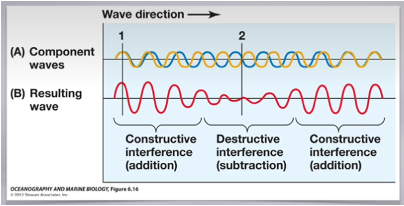
Describe the effects of wave interference.
Waves of different wavelengths combine to create the sea surface
Constructive interference: crests line up to create an extra high resulting wave/sea surface, and extra low troughs
destructive interference: crest of one wave lines up with trough of another, therefore resulting in a flattened wave/sea surface
Wave inference creates wave groups/sets, which move slower than the waves that create them
Group velocity= ½ (average wave 1 + wave 2 velocity)
Describe wave breaking.
Waves break because the wavelength shrinks as the wave height grows to a point where eventually they become unstable
Occurs when the water depth = 1.3 x the height of the wave
How the wave breaks depends mainly on the slope of the sea bed
Gently sloping sea floor → spilling breakers
Moderately sloping sea floor → plunging breakers
Rapidly sloping sea floor → collapsing breakers, or surging breakers
SPCS
Describe the controls on propagation speed of tsunamis.
Tsunamis are low wavelength and low amplitude waves caused by large movements on the seafloor
Celerity:
Deep water wave celerity= √L
Shallow water wave celerity= √D
Tsunamis are shallow water waves
Therefore, they are slower in shallower water
Wavelength decreases
Height increases
Due to mid-ocean ridges, the wave heights get higher over the shallower parts of the ocean
Relate strength of tide producing force to position on the Earth
What we know: 2 tides per day (in most places), each 12 hours and 25 minutes apart
How is this connected to the phases of the moon?
Tides arise from gravitational attraction between bodies
Strength of gravity depends on mass of the bodies
Magnitude of the force of gravity depends on the product of the masses
M is inversely proportional to the square of separation distance
Double the distance between 2 objects, force of gravity goes down by a factor of 4
The side of the Earth near the moon experiences greater gravitational attraction
Side on the Earth farthest from the moon experiences less attraction
To find the tide producing force we must get a vector sum of gravitational & centrifugal force
What results is 2 tidal bulges
One bulge “pulled” towards the moon
One bulge “spun” away from the moon
Therefore, high tides occur whenever the earth rotates under those bulges
Relate tidal mixing and water temperature
Tides move the entire water column
Tidal flow near the bed experiences frictional resistance
Therefore, there is an increase in speed as you move further away from the bottom (this is called shear)
Shear causes turbulent mixing, limited to bottom boundary layer
If the water is shallow enough, the bottom boundary layer is the surface of the water, therefore mixing goes all the way to the top
Colder nearshore water
Tidal mixing brings cold water, and nutrients from below up to the surface
REWATCH VIDEO
Relate nutrient limitation to sinking and stratification
In general, the deep ocean (not the intertidal zone we mainly interact with) suffers from nutrient limitation
Life of a phytoplankton…
Surface:
Primary production (usually via phytoplankton) converts nutrients into organic matter
Sinking:
Stressed phytoplankton die and sink to ocean floor
Stratification:
As the phytoplankton sinks, the freshly organic N and P nutrients go back into inorganic form
Therefore, at the surface of the ocean there is lots of light, but low nutrients, and at the bottom of the ocean the ocean there is low light, and lots of nutrients.
So, we have a nutrient limited ocean due to particles sinking, and removing nutrients from the surface ocean
Stratification limits upwards mixing of nutrients back to the surface ocean
Describe the importance of diazotrophs to marine nutrient cycles
a. Diazotrophs convert N2 into a biologically usable NH3 ammonia form, thus effectively providing “new” nitrogen to the ecosystem
b. Nitrogen fixation
Identify the 3 domains of life
a. Bacteria
prokaryotes
b. Archaea
prokaryotes
c. Eukarya
eukaryotes
 Note
Note  Flashcards (32)