Kidney topics
 Studied by 0 people
 Call with Kai
 Learn
Learn Practice Test
 Spaced Repetition
 Match
Match Flashcards
 Knowt Play
1/25

There's no tags or description
Looks like no tags are added yet.
Name | Mastery | Learn | Test | Matching | Spaced | Call with Kai |
|---|
No analytics yet
Send a link to your students to track their progress
26 Terms
Where are the kidneys found?
Humans have two kidneys in the abdomen where the right kidney sits slightly lower.
How does blood travel in and out of the kidney?
Blood enters the kidney via the renal artery which is connected to the aorta. Then blood passes through the kidney it leaves via the renal vein and returns to the vena cava.
What happens to urea?
Urea is filtered out of the blood and is transferred to urine which leaves each kidney by the ureter which carriers it to the bladder which the urine is stored before being released by the urethra.
How many nephrons does each kidney have?
Each kidney has around a million nephrons
The enormous surface area of the kidney filters 125cm cubed of fluid per minute
99% of water is reabsorbed so we produce around 1cm cubed of urine per minute.
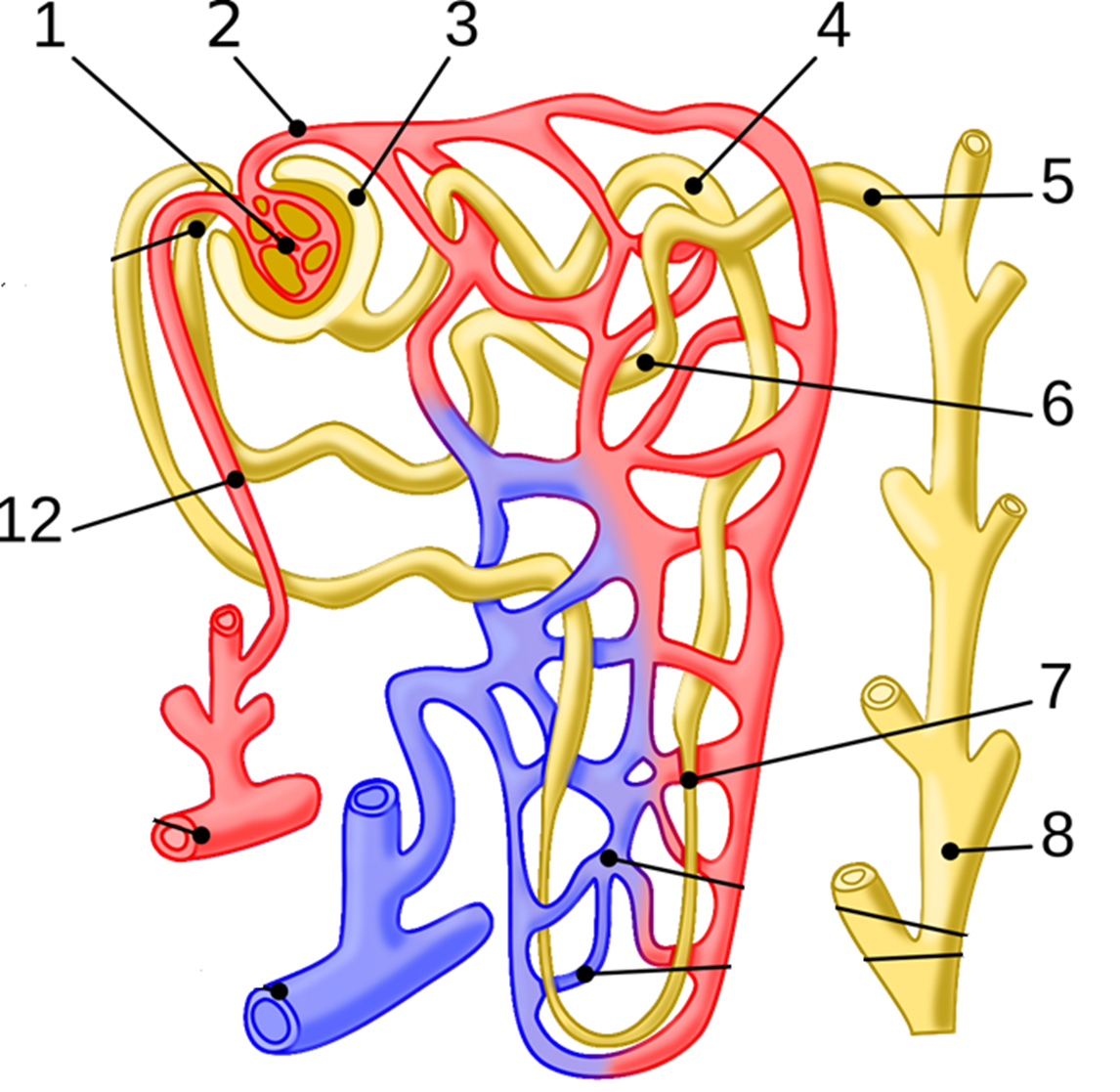
Label the nephron structure
•1. Glomerulus,
•2. Efferent arteriole,
•3. Bowman’s capsule,
•4. Proximal convoluted tubule,
•5. Cortical collecting duct,
•6. Distal convoluted tubule,
•7. Loop of Henle,
•8. Collecting duct,
•12. Afferent arteriole
Functions of the kidney are?
Ultrafiltration- formation of glomerular filtrate
Reabsorption of glucose and water by proximal convoluted tube
Maintaining a gradient of sodium ions in the medulla by the loop of Henle
Reabsorption of water by the distal convoluted tube and collecting ducts.
What is the role of the proximal convoluted tubule?
In the proximal convoluted tubule useful molecules are reabsorbed back into the blood capillary by selective absorption.
What remains in the blood in ultrafiltration?
Red blood cells
Platelets
Most plasma proteins
These are too large to move out of the blood so remain in it
How do small molecules exit the blood?
There are small pores or gaps between the endothelial cells of the capillary
This means that small molecules such as amino acids and glucose are able to exit the blood
Also between the capillary endothelial cells and the podocytes there is a layer of collagen and other proteins called the basement membrane which small molecules can pass through but large molecules can not.
Podocytes also have small gaps between pedicels which only small molecules can pass through.
Why is there high hydrostatic pressure in the glomerulus?
This is because the afflerent (remember as affluent so rich and has lots) arteriole has a larger lumen than the efferent arteriole so more blood can enter the capillary than is able to leave.
Describe ultrafiltration
Blood enters the glomerulus via the afferent arteriole.
Due to the high level of hydrostatic pressure in the glomerulus it causes small molecules such as amino acids, glucose and urea to be forced out of the blood into the bowman’s capsule.
Whilst the larger molecules such as red blood cells remain in the blood and exit via the efferent arteriole.
Where does most selective reabsorption occur?
Around 80% of filtrate reabsorption takes place in the proximal convoluted tube.
The molecules absorbed are useful molecules used by cells such as glucose, amino acids and water.
How does selective reabsorption take place?
Firstly sodium ions are actively transported out of the epithelial cells lining the proximal convoluted tube into the blood stream through active transport using ATP.
This causes sodium ions to move down a concentration gradient from the cytoplasm of the cells into the epithelial cells lining the proximal (remember as proximus caesar what a wonderful day) convoluted tube through facilitated diffusion.
When this occurs the sodium ions enter through carrier proteins which are all specific to sodium ions entering the cells along with a specific other molecule such as glucose which enters these epithelial cells through co-transport.
Then once useful molecules such as glucose are in the epithelial cells they diffuse into the blood stream
How is water reabsorbed?
Water is reabsorbed by osmosis
What happens with urea?
Urea is not reabsorbed and remains in the proximal convoluted tubule
Then it is converted to urine and is transported to the bladder via the ureter and is excreted by the urethra.
What is urine composed of?
Urine is composed of a mixture of substances dissolved in water.
It should not contain useful molecules such as proteins or glucose or amino acids or vitamins.
What are the useful molecules reabsorbed by the blood in selective reabsorption?
Glucose, Amino acids, Water and Vitamins.
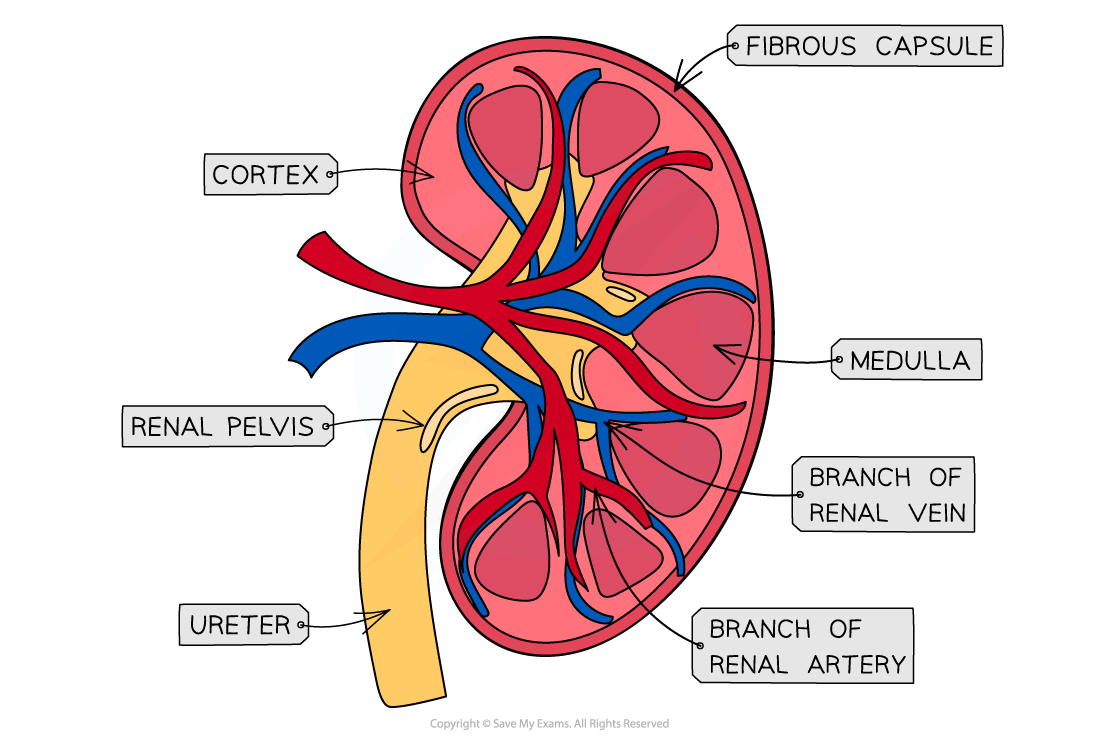
Label the regions of the kidney?
What is the role of the loop of Henle?
To reduce the water potential of the tissue in the medulla
What happens when the fluid moves down the collecting duct?
Water moves from the fluid into the medulla by osmosis
This water is reabsorbed back into the blood allowing us to cause concentrated urine
A reduced water potential in the medulla due to the loop of Henle allows this.
How does the loop of Henle reduce the water potential in the medulla?
Fluid moves down the thin walled and very permeable to water descending limb.
Then the fluid moves up the thick walled and impermeable to water ascending limb.
As the fluid moves up the ascending limb sodium and chloride ions are pumped out of the fluid via active transport using ATP provided by mitochondria in the cells of the ascending limb.
This causes a high concentration of sodium ions and chloride ions in the medulla which reduces the water potential
What is the adaptation of the loop of Henle?
Initially when the fluid moves down the descending limb it has the same water potential as the blood relatively high
However due to the walls being very permeable to water, water moves out of the descending limb into the medulla.
This water moves via osmosis into the blood and is carried away.
This means at the bottom of the loop the fluid is a concentrated solution which due to being so high it causes sodium ions and chloride ions to move into the medulla through diffusion.
This means that the transfer of sodium ions and chloride ions in the ascending limb is more efficient due to the descending limb
What is the adaptation to increase efficiency of sodium and chloride ion transfer called?
The counter current multiplier
What does the counter current multiplier allow?
Humans to produce a small volume of concentrated urine
How are kangaroo rats adapted to their environment?
The loops of Henle in kangaroo rats are extremely long allowing kangaroo rats to produce an extremely low water potential in their medulla
This means that the majority of water can be reabsorbed meaning they’re adapted to their arid environments.
What is the role of the distilled convoluted tube?
This is later on after the loop of Henle
It causes ADH to bind to receptors on the membrane
This activates a G protein that activates phosphorylase which catalyses the synthesis of cAMP
cAMP causes synthesis of aquaporins
Aquaporins are inserted into membrane via exocytosis
Then water moves into the bloodstream via osmosis as water potential is lower than the distal convoluted tubule
 Note
Note  Flashcards (51)