Animal Behavior Exam 3
 Call Kai
 Learn
Learn Practice Test
 Spaced Repetition
 Match
Match Flashcards
 Knowt Play
1/58

There's no tags or description
Looks like no tags are added yet.
Name | Mastery | Learn | Test | Matching | Spaced | Call with Kai |
|---|
No analytics yet
Send a link to your students to track their progress
59 Terms
Costs to parental care
limited time, energy, future reproduction, amount of care (divided among offspring)
relatedness =
proportion of alleles shared with another individual due to descent
what is the relatedness, r, for: identical twin or clone
1
what is the relatedness, r, for: random member of population
0
what is the relatedness, r, for: parent-offspring
0.5
what is the relatedness, r, for: sibling-sibling
0.5
What is the “Parent Offspring Conflict”? Offspring side
offspring values itself twice as much as parent does
What is the “Parent Offspring Conflict”? Parent side
Parents should allocate reproductive effort in a way that is optimal RS, even if not optimal for each offspring
Hatch asynchrony: In many birds, parents lay eggs ___
separated by a couple days, giving older siblings an advantage
sibling competition: ___ influences parental care
relative condition
ex where relative condition influenced parental care. Coot experiment.
parents of chicks half dyed orange, half dyed black preferred feeding the orange chicks
Why is parental care female biased?
physiological investment, assured maternity, males opportunity cost
Male opportunity cost:
could be getting more mates to inc fitness (instead of offering parental care)
Male opportunity cost ex (frog)
males spend more time guarding a larger clutch
Uncertain paternity: what did the blue footed boobies do after being removed when their female is fertile?
males killed the first egg laid by her once back
Uncertain paternity: bluegill example
males defend eggs less if they see a sneaker male in the environment (thus are less sure that the eggs are their kids)
indeterminate growth
adults can keep growing throughout life
should males or females get bigger w indeterminate growth
female fecundity increases more with large body size
Parental care is more costly for ___
females bc it stops them growing to larger size
how do male water bugs assure paternity?
frequent mating between egg laying
What does intraspecific brood parasitism mean
same species
hormones and parental care experiment (rats)
childless rats injected with prolactin and steroids exhibit greater maternal behavior than controls
hormones and parental care experiment (birds)
an artificial egg in a nest stimulates prolactin and development of brood patch
Learning
A change in behavior based on experience and environmental influence
innate behavior
occurs without previous experience
Habituation
learn to stop reacting to harmless stimulus
Classical conditioning
learn to associate a new stimulus with an existing behavior
Classical conditioning examples
Pavlov’s dogs, damselfish predator alarm
Operant conditioning
increase/decrease behavior based on outcomes (trial and error learning)
Classical conditioning examples
rats detect mines, rescue dogs
Operant conditioning and fitness: Bumblebees
bumblebees innately prefer blue flowers but will learn to prefer yellow if nectar only in yellow
example of how animals have evolved to learn some things / ignore others
insect eating bats learn to avoid food associated with toxin, vampire bats don’t
memory and caching example: Jays
jays more reliant on caching have better spatial memory
memory and caching example: chickadees
birds in harsher environments cache more and have better spatial memory
learning ability and fitness: budgies
after watching an unpreferred male solve a puzzle for food, females switch mate choice to smarter male
learning example: indigo buntings
babies learn the constellations to orient south for migration
Learning example: sparrow songs
babies have to hear their song in critical period and hear themselves practice
learning example: prarie dogs
young prarie dogs learn to be vigilant from watching adults (shows social learning)
local enhancement is when animals ___ as an indicator that there’s food there
use presence of other individuals foraging
public information is when animals ___ as an indicator of where to forage
see how successful other individuals are at foraging
Social influences: foraging, fish example. If no food information, the fish will ___
go to where there are more fish
Social influences: foraging, fish example. If yes food information, the fish will ___
go to the most food, regardless of what others do
Social influences: foraging, osprey example. Ospreys will ___
follow if neighbor got a schooling fish
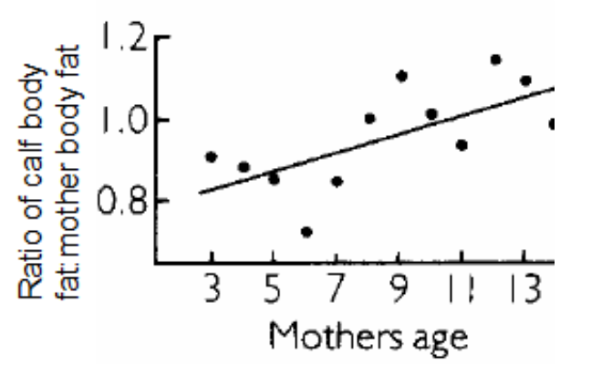
what does this graph tell us about the relationship of maternal age to parental investment?
mothers invest more in offspring as they age
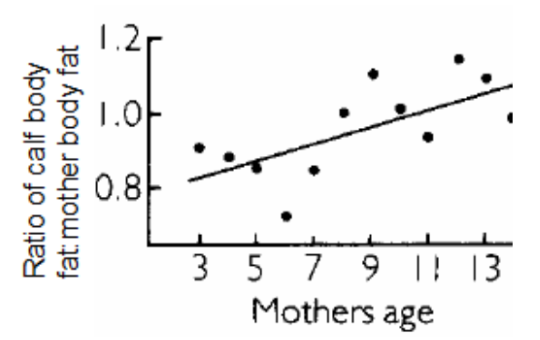
Why does mothers giving birth to more fit children as they age make sense in terms of the cost-benefit analysis of parental investment?
as female age, their likely future reproduction decreases because they’re going to die soon, so it makes sense to invest more in current offspring rather than save resources / avoid risk for future offsrping
Why is there parent-offspring conflict over the level of parental care provided to offspring? a) why parents would want to limit parental care at all
parental care comes at a fitness cost: increased care now decreases future reproduction
Why is there parent-offspring conflict over the level of parental care provided to offspring? b) why offspring would want to limit parental care
offspring want parents to keep reproducing because their siblings represent indirect fitness. If a parent invested so much in one kid that there were no siblings, this might reduce the offsprings’ fitness.
Why is there parent-offspring conflict over the level of parental care provided to offspring? c) why these limits are not the same.
to the parent, all offspring are equal: r = 0.5. But to the offspring, itself is worth twice as much as siblings (1 vs 0.5). Thus it is selected to seek twice as much care as mom is selected to give. this is the zone of conflict
3 reasons that a host bird species might raise the offspring of a brood parasite. 1.
bird is too small to lift egg out of nest, so only way to avoid raising kid would be to re-nest, and the cost of re-nesting is too high
3 reasons that a host bird species might raise the offspring of a brood parasite. 2.
deceptive communication: some brood parasites use visual and auditory signals to appear like host offspring, mom doesn’t know she’s raising parasites
3 reasons that a host bird species might raise the offspring of a brood parasite. 3.
Mafia hypothesis: parasite will destroy nest and kill host kids if host doesn’t raise parasite offspring
Birdsong learning is a classic example of the interaction between genes and environment to produce behavior. list two reasons from the studies discussed in class that demonstrate a genetic contribution to bird song learning
developmental critical period for learning, all birds will try to sing something, the species-specific template for song
Birdsong learning is a classic example of the interaction between genes and environment to produce behavior. list two reasons that demonstrate an environmental contribution to birdsong learning
birds need to hear the song to sing it correctly, they will learn only the songs they hear, they have to hear themselves practice to learn correctly
definition of teaching, 3 parts
experienced individual modifies its behavior only in the presence of pupil, behavior is costly for teacher, pupil learns more quickly than would on own
Social influences on learning: teaching, White-tailed Ptarmigan ex
mom will drop high protein food on ground to show chicks, chicks of moms that called more had better diets
definition of culture for animal behavior
learned behavior passed on to others
culture example: Japanese Macaque monkey
one monkey learned how to wash sand off sweet potatoes, other monkeys copied, behavior spread for generations
culture example: different groups of chimps
different populations show different learned behaviors (ex, this group does termite fishing, this group cracks nuts with rocks)
Culture example: bird milk stealers
in populations where a bird figured out how to open milk, behavior spread rapidly because others learned too

