[FUNAV] M1 (P3): Air Transportation (Air Commerce Act - Economic Functions of the CAB)
 Studied by 1 person
 Call Kai
 Learn
Learn Practice Test
 Spaced Repetition
 Match
Match Flashcards
 Knowt Play
1/29

There's no tags or description
Looks like no tags are added yet.
Name | Mastery | Learn | Test | Matching | Spaced | Call with Kai |
|---|
No analytics yet
Send a link to your students to track their progress
30 Terms
The Air Commerce Act of 1926
imposed on the secretary of commerce and the Department of Commerce the duty of promoting and fostering the development of commercial aviation in the United States
Stabilize civil or commercial aviation in such a way as to
attract adequate capital to the fledgling industry
Provide it with the assistance and legal basis
necessary for its development
Establish the federal government’s role in the
development of civil air transportation
[The Air Commerce Act of 1926]
The objective of the Air Commerce Act was to: (3)
Department of Commerce
Secretary of Treasury
Secretary of Labor
[The Air Commerce Act of 1926]
Several different governmental agencies or departments regulated air transport:
July 1927
[The Air Commerce Act of 1926]
In ______, a director of aeronautics was appointed, who was in charge of the work of the Department of Commerce in the administration of the Air Commerce Act
Division of Air Navigation
Division of Air Regulation
[The Air Commerce Act of 1926]
An administrative order of the secretary of commerce provided for the establishment of the Bureau of Air Commerce in 1934: (2)
McNary–Watres Act
[Additional Air Mail Acts]
The Air Mail Act of 1930, known as the _____, was passed by Congress on April 29, 1930
The Air Mail Act of 1930
[Additional Air Mail Acts]
known as the McNary–Watres Act, was passed by Congress on April 29, 1930
The Air Mail Act of 1930: McNary–Watres Act
[Additional Air Mail Acts]
It provided the postmaster general with unlimited control over the air mail route system
The Air Mail Act of 1930: McNary–Watres Act
[Additional Air Mail Acts]
The postmaster general could now extend or consolidate routes if he thought it would serve the public interest
February 1934
[Additional Air Mail Acts]
In ______, the postmaster general annulled all domestic air mail contracts, and the transportation of the mail was assigned temporarily to the Air Corps of the U.S.
This action was taken because the postmaster general had evidence that there was a conspiracy to defeat competitive bidding
Black– McKellar Act
[Additional Air Mail Acts]
The Air Mail Act of 1934, passed on June 12 and known as the _____, provided temporary contracts regulated by the Interstate Commerce Commission (ICC)
The Air Mail Act of 1934: Black– McKellar Act
[Additional Air Mail Acts]
The act separated the manufacturing companies from connections with airlines and forbade interlocking directorates, overlapping interests, and mutual stock holdings
Air mail contractors
Fixed-base operators
[Additional Air Mail Acts]
By 1938, two general categories of “air carriers” had developed: (2)
Air mail contractors
[Additional Air Mail Acts]
Flew over established routes; Transported persons, property, and mail
Air mail contractors
[Additional Air Mail Acts]
Private airlines hired by the government to carry and deliver airmail, helping launch early commercial aviation.
Fixed-base operators
[Additional Air Mail Acts]
Companies at airports that provide services like fueling, maintenance, training, and aircraft storage for pilots and airplanes.
Fixed-base operators
[Additional Air Mail Acts]
Persons operating airports, Flying schools, Crop-dusting services
President Roosevelt
[The Civil Aeronautics Act of 1938]
On June 23, 1938, the Civil Aeronautics Act was approved by _____.
The Civil Aeronautics Act of 1938
The act placed all the functions of aid to and regulation of aviation and air transportation within one administrative agency consisting of three partly autonomous bodies
A five-member Civil Aeronautics Authority (CAA)
A three-member Air Safety Board
An administrator
[The Civil Aeronautics Act of 1938]
The act placed all the functions of aid to and regulation of aviation and air transportation within one administrative agency consisting of three partly autonomous bodies: (3)
Civil Aeronautics Authority
[The Civil Aeronautics Act of 1938]
Quasi-judicial and legislative functions related to economic and safety regulations
Air Safety Board
[The Civil Aeronautics Act of 1938]
Quasi-independent body created for the purpose of investigating and analyzing accidents
Administrator
[The Civil Aeronautics Act of 1938]
Performed purely executive functions related to the development, operation, and administration of air navigation facilities, as well as promotional work in aviation
Civil Aeronautics Board (CAB)
[The Civil Aeronautics Act of 1938]
Under several reorganization plans in 1940, the Air Safety Board was abolished and its functions transferred to the five-member Civil Aeronautics Authority, which was re-designated the ________.
executive agency
[The Civil Aeronautics Act of 1938]
The FAA, successor to the CAA, was not assigned to any executive department, but was considered an “_______” as opposed to an independent regulatory commission
No one could engage in the business of public air transportation unless authorized to do so by a “certificate of public convenience and necessity” issued by the CAB
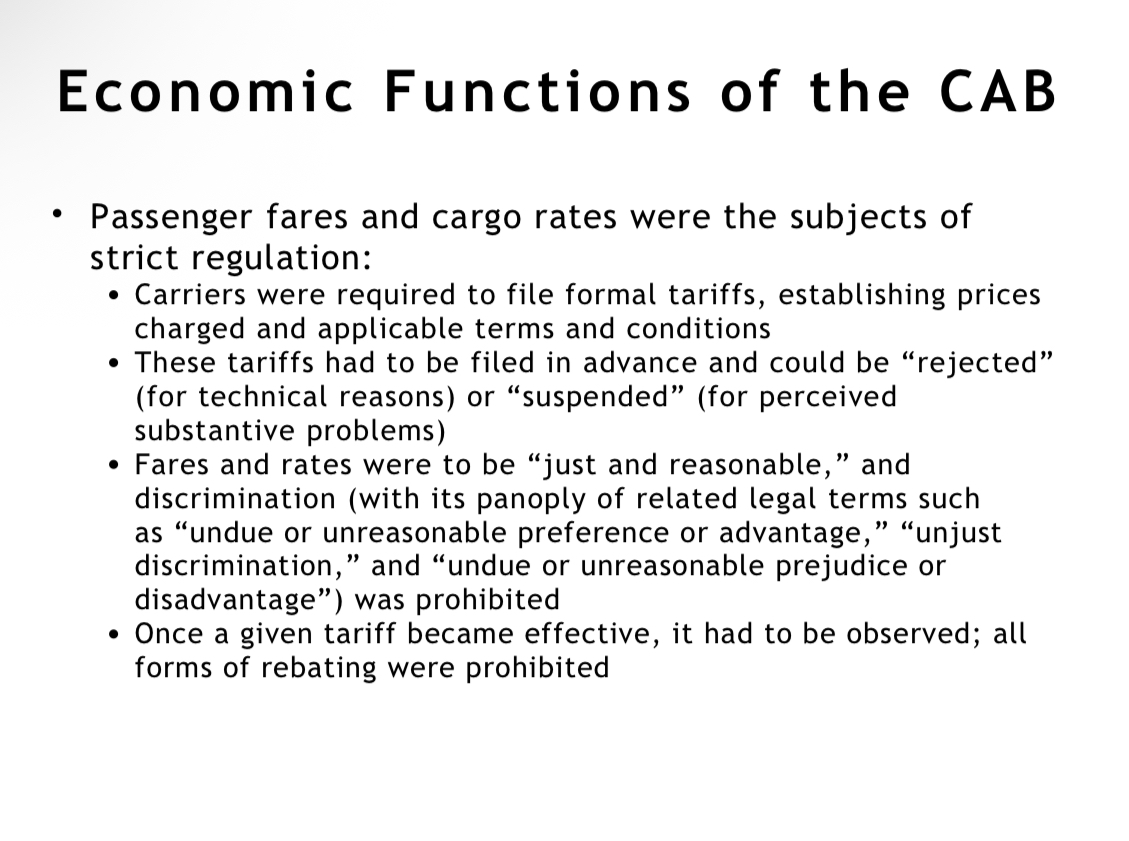
[Economic Functions of the CAB]
The broad language of the Declaration of Policy left the CAB with considerable discretion The licensing system was simple in concept:
The International Air Transport Association (IATA)
[Economic Functions of the CAB]
The CAB had to share authority over international rates with foreign government:
_____________ served as platform for meetings and rate agreements.
O
Civil Aeronautics Board (CAB)
also established rates to be paid airlines by the Post Office Department for the carriage of U.S. mail, both domestic and international
Agreements
[Economic Functions of the CAB]
_____ between air carriers had to be filed with the CAB, whose approval was required for certain specified interlocking relationships and for air transport-related mergers, consolidations, and acquisitions of control
CAB approval of such agreements granted immunity from the general antitrust laws.
 Note
Note  Flashcards (29)