L4: Descending inputs

0.0(0)
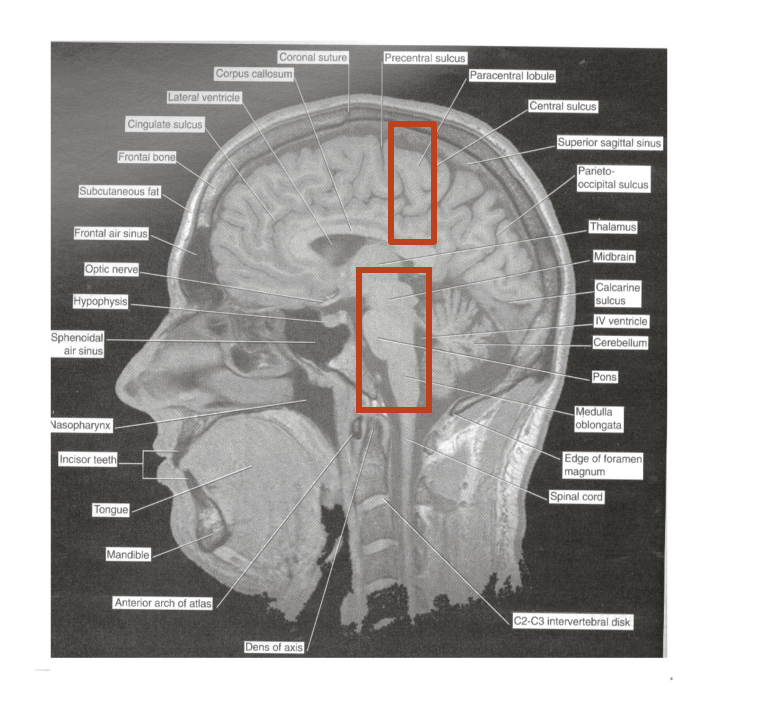
studied byStudied by 0 people
call kaiCall Kai
learnLearn
examPractice Test
spaced repetitionSpaced Repetition
heart puzzleMatch
flashcardsFlashcards
GameKnowt Play
Card Sorting

1/57

encourage image

There's no tags or description

Looks like no tags are added yet.

Last updated 11:53 PM on 2/11/26
Name
Mastery
Learn
Test
Matching
Spaced
Call with Kai

No analytics yet

Send a link to your students to track their progress

58 Terms

1
New cards

Why are inputs from higher centres (descending inputs) needed

  • For goal-directed movements

    • move with purpose

  • the spinal cord on its own produces feedforward→ which only predicts→ and can get this wrong

  • note: these are not two separate components!→ it forms a heterachy!
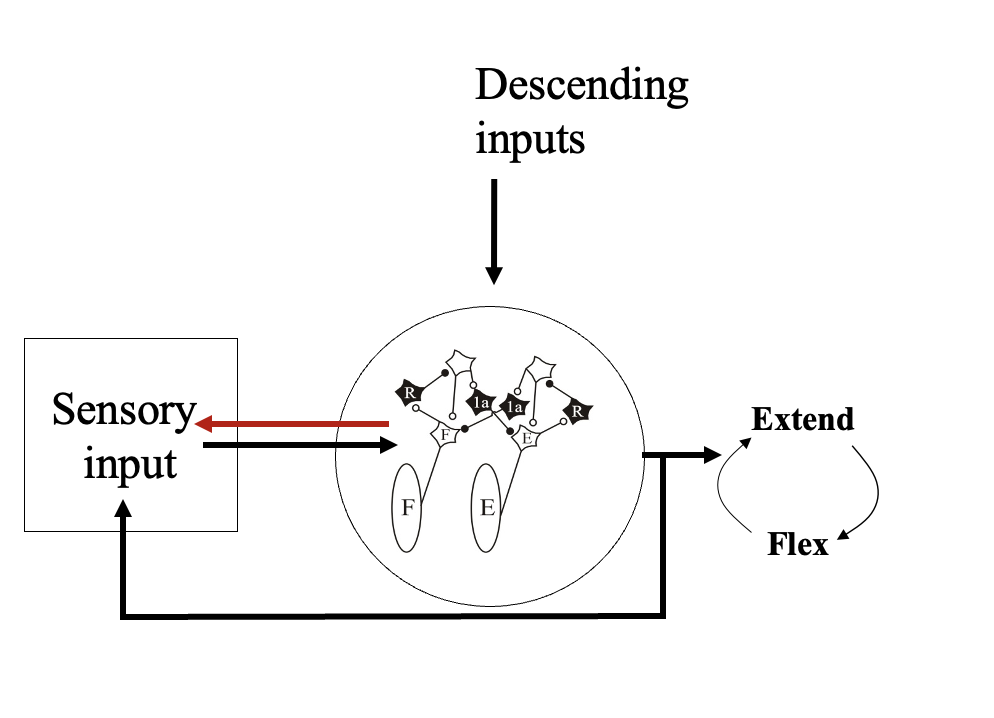
<ul><li><p>For goal-directed movements</p><ul><li><p>move with purpose</p></li></ul></li><li><p>the spinal cord on its own produces feedforward→ which only predicts→ and can get this wrong</p></li><li><p><em>note: these are not two separate components!→ it forms a heterachy!</em></p></li></ul><p></p>
2
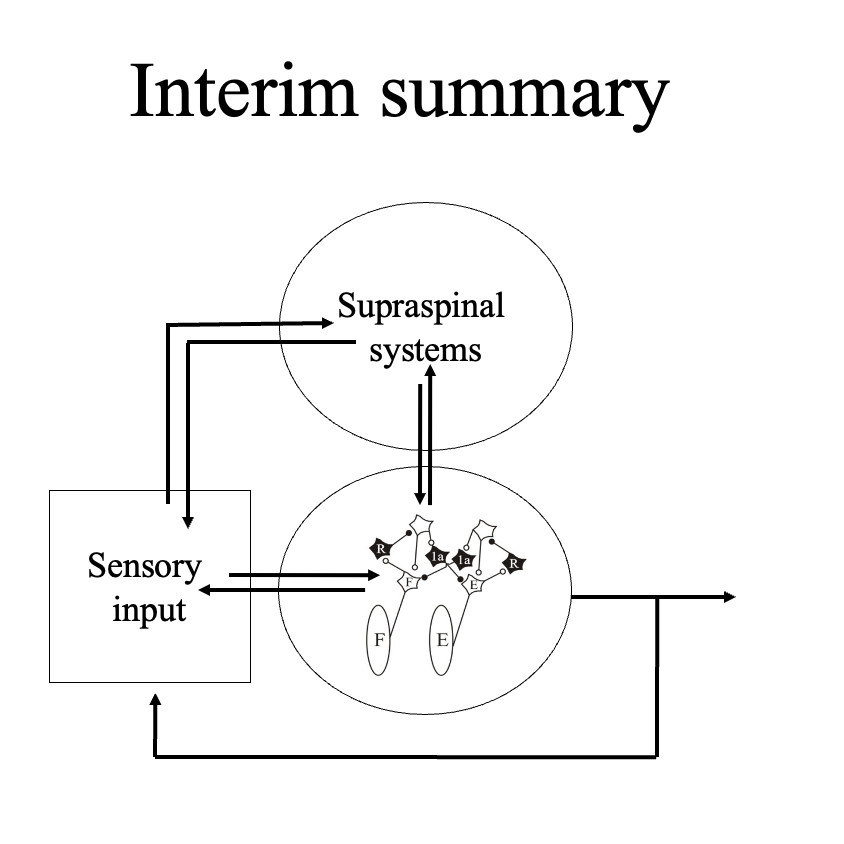
New cards

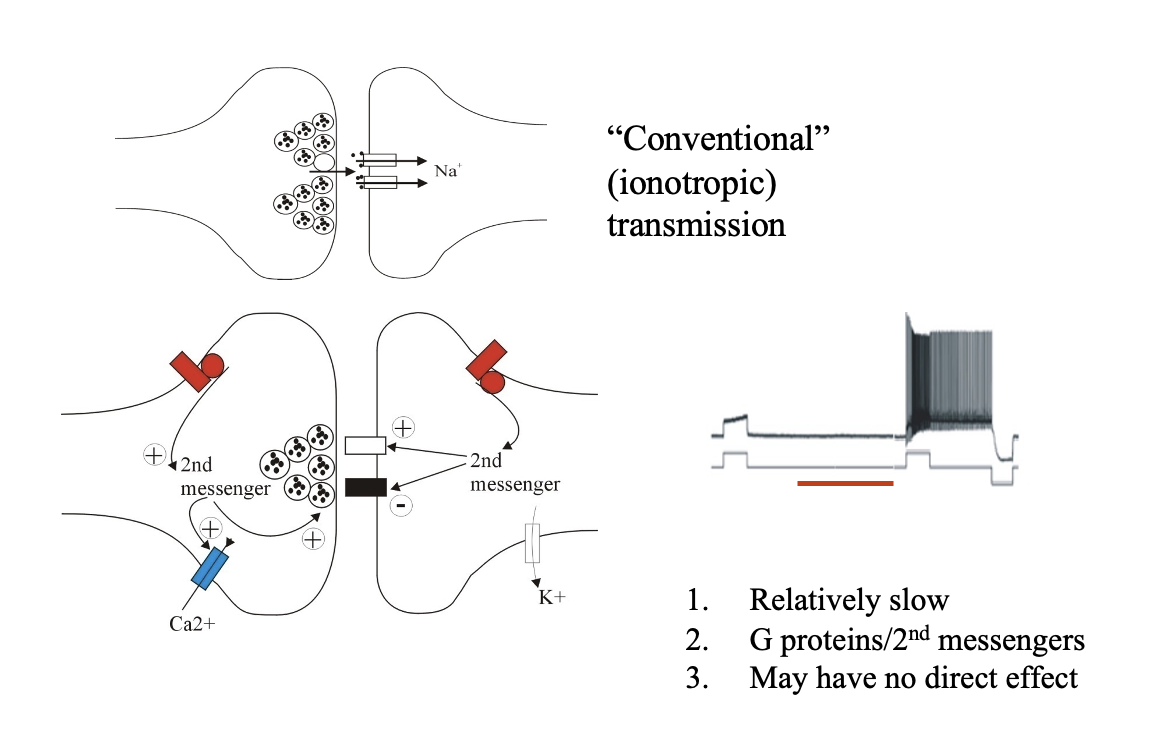
Two places these inputs are from

  1. Cortical motor areas (motor cortex

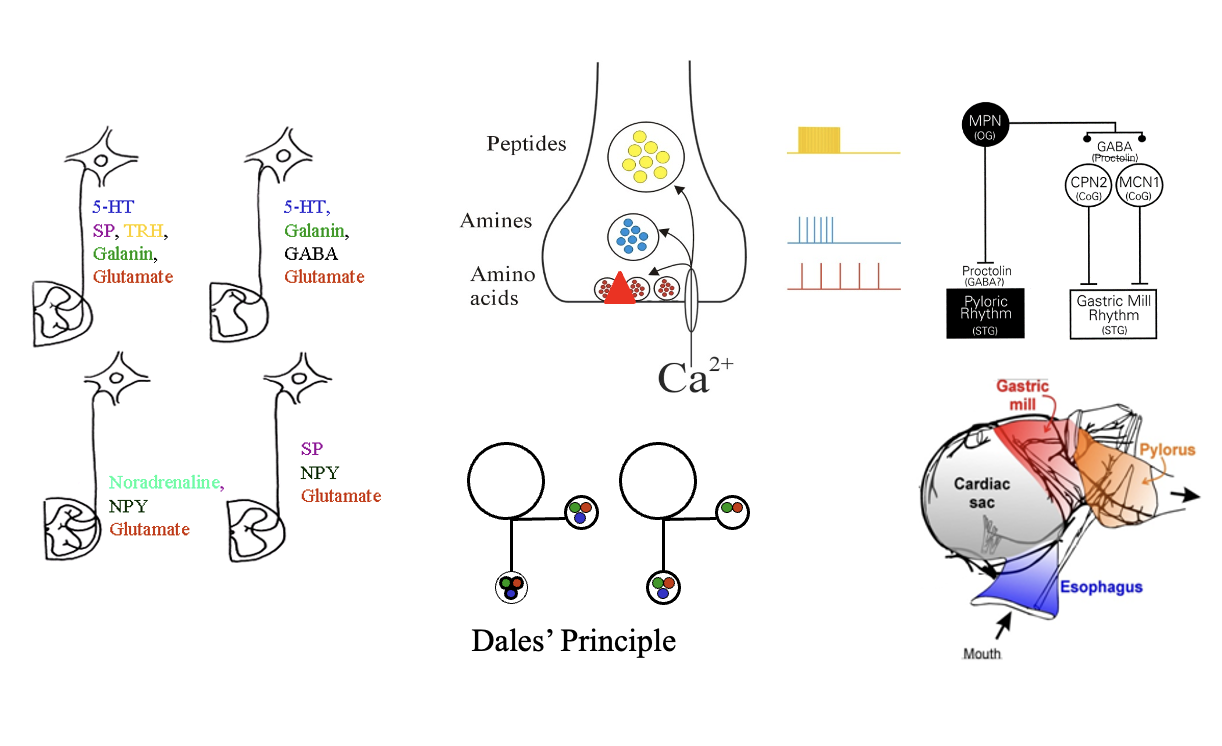
  2. Brain stem (pre motor area)

<ol><li><p>Cortical motor areas (motor cortex</p></li><li><p>Brain stem (pre motor area)</p></li></ol><p></p>
3
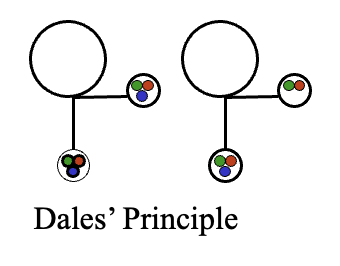
New cards

How are these descending commands integrated with spinal circuits

  1. project to the brain stem and spinal cord

  2. connect to spinal interneurons

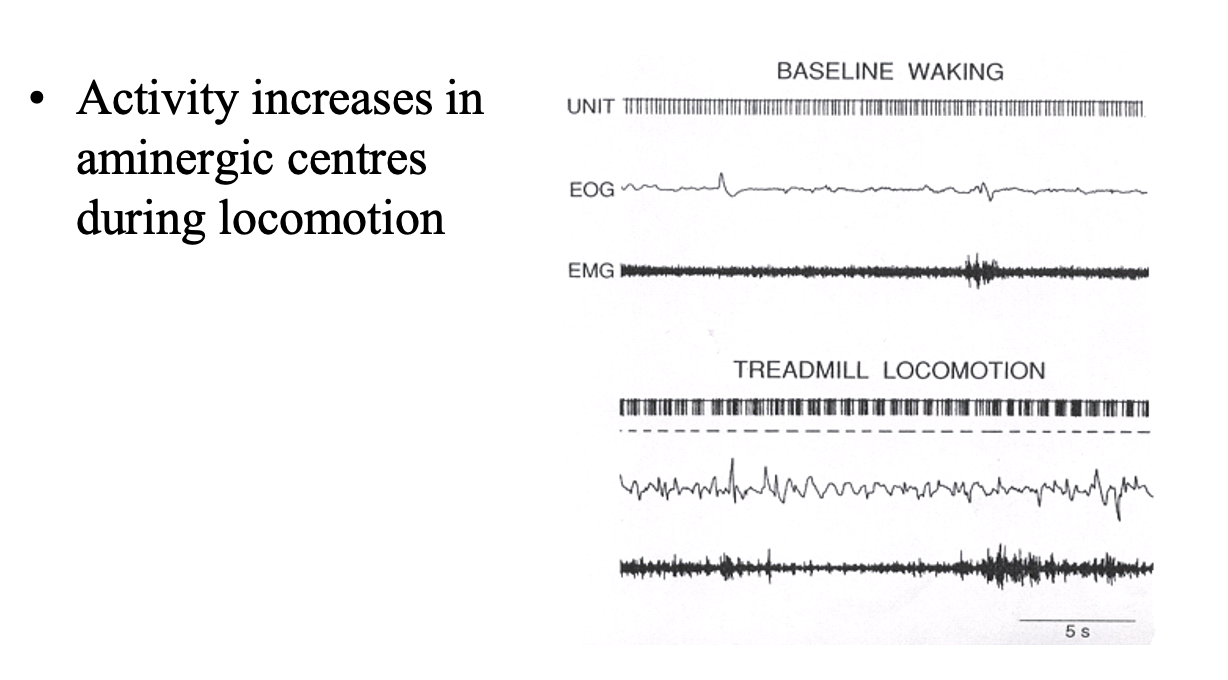
  3. to motor neurons

4
New cards

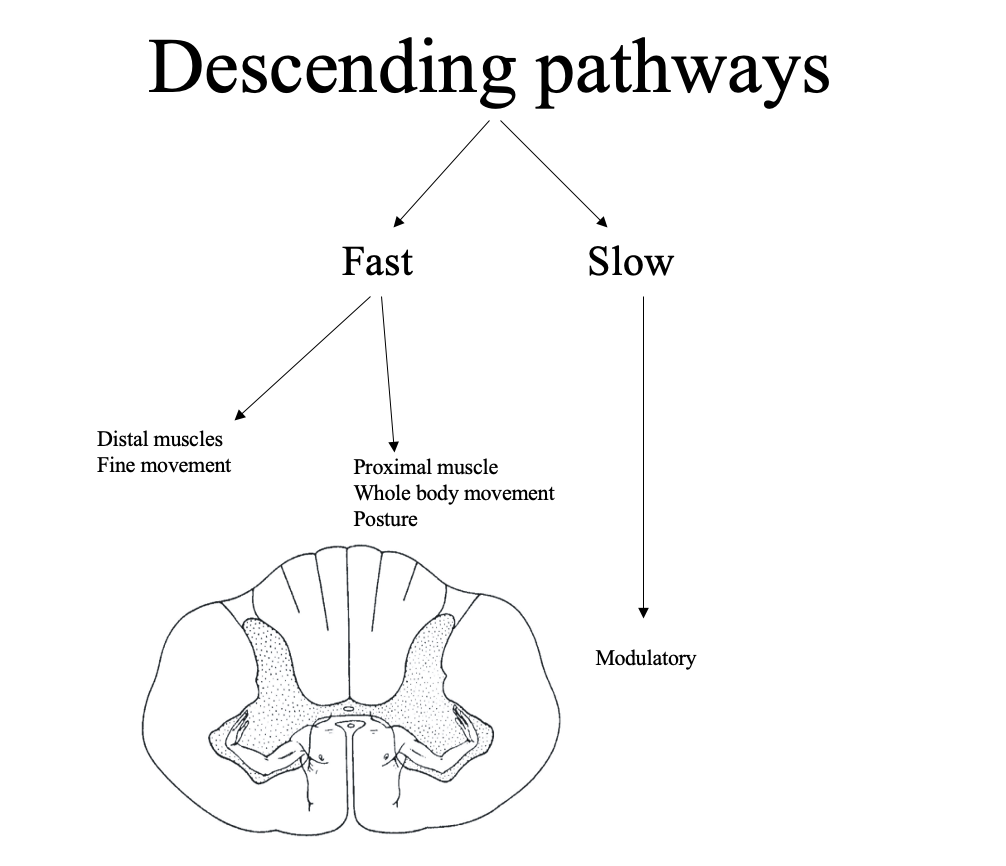
Two types of descending pathways

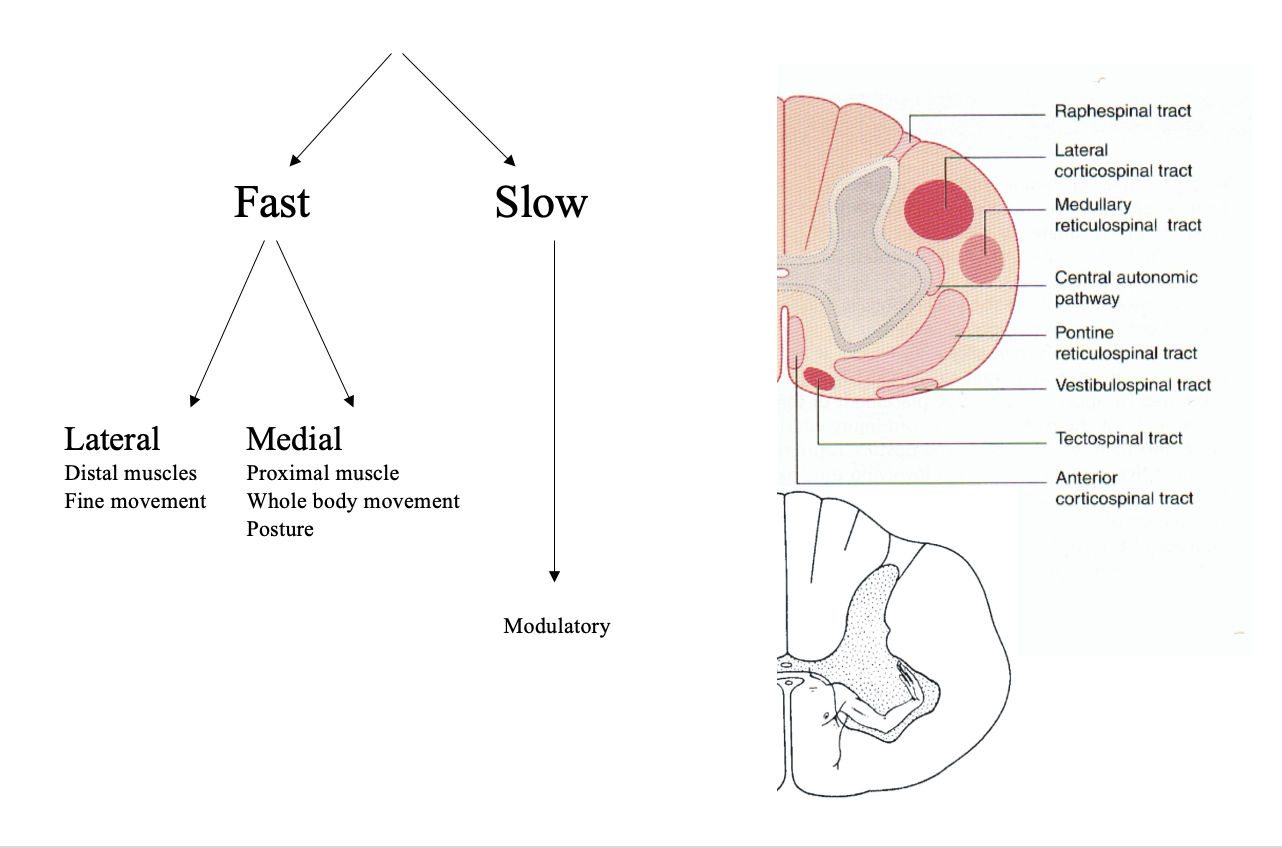
  1. Fast pathways→

    • instantaneous activation

    • control specific aspects of on going movements and motor neurone timing

  2. Slow pathways→

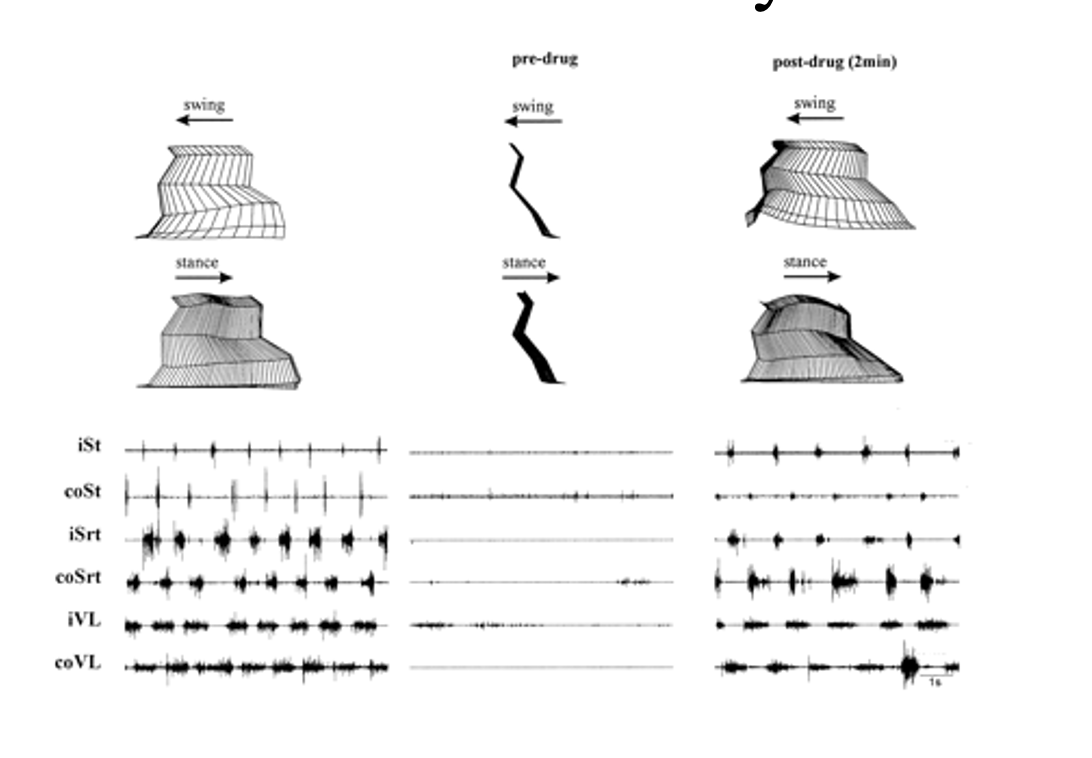
    • More constant and longer lasting

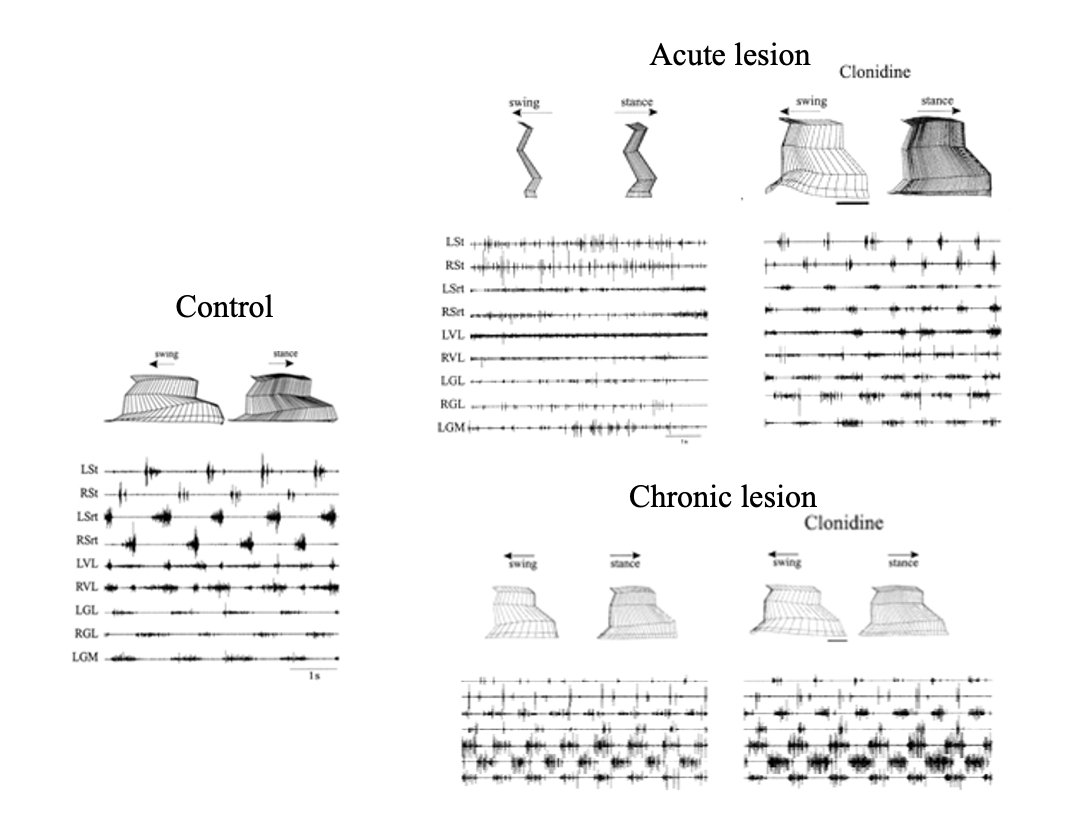
    • Uses amines and neuropeptides

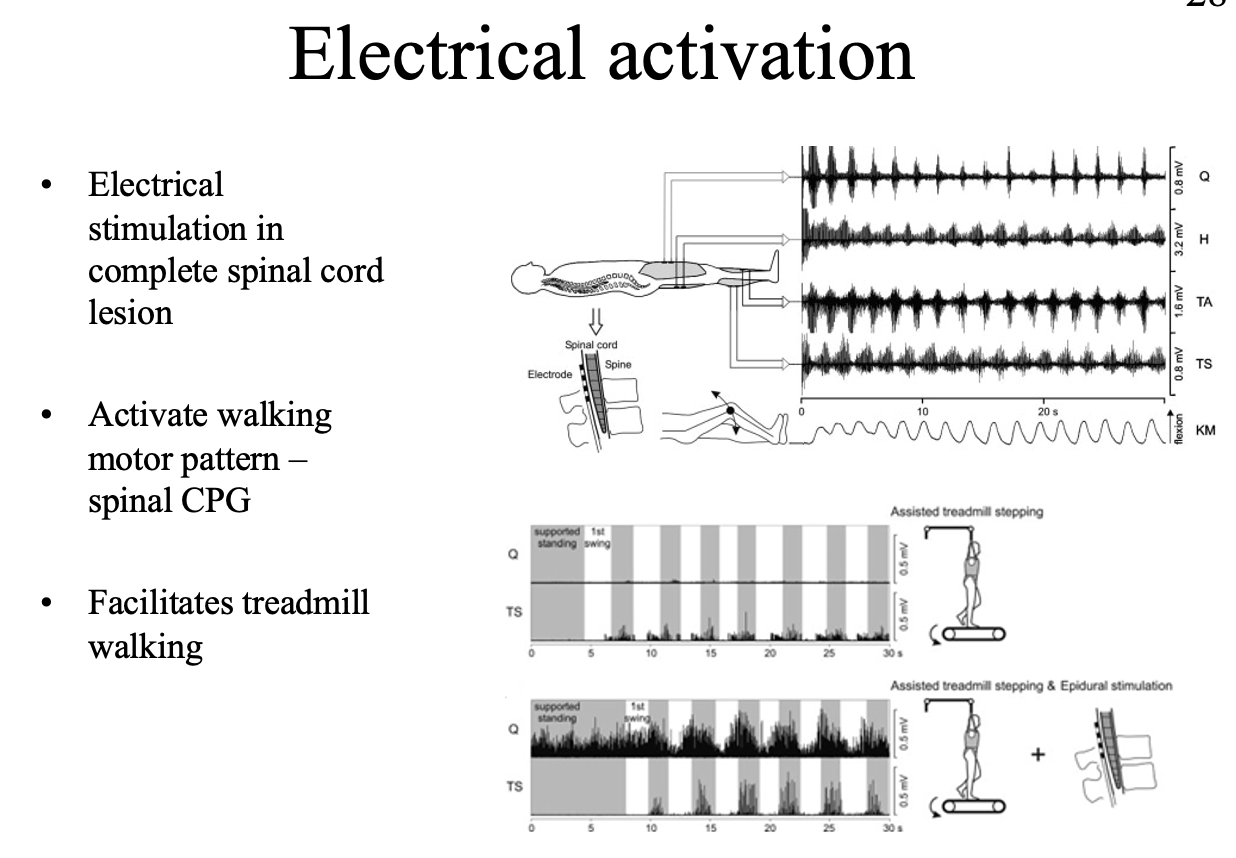
    • to modulate spinal and motor systems

<ol><li><p>Fast pathways→ </p><ul><li><p><strong>instantaneous activation</strong></p></li><li><p>control <strong>specific</strong> aspects of on going movements and motor neurone timing</p></li></ul></li><li><p>Slow pathways→</p><ul><li><p><strong>More constant and longer lasting</strong></p></li><li><p>Uses amines and neuropeptides</p></li><li><p><strong>to modulate</strong> spinal and motor systems</p></li></ul></li></ol><p></p>
5
New cards

Fast pathways are split via spatial differences

  1. Medial

    • Proximal muscle

    • whole body movements

      • posture

  2. Lateral

    • Distal muscles

    • movements of extremities

    • Fine movements

note: proximal distal rule from L2
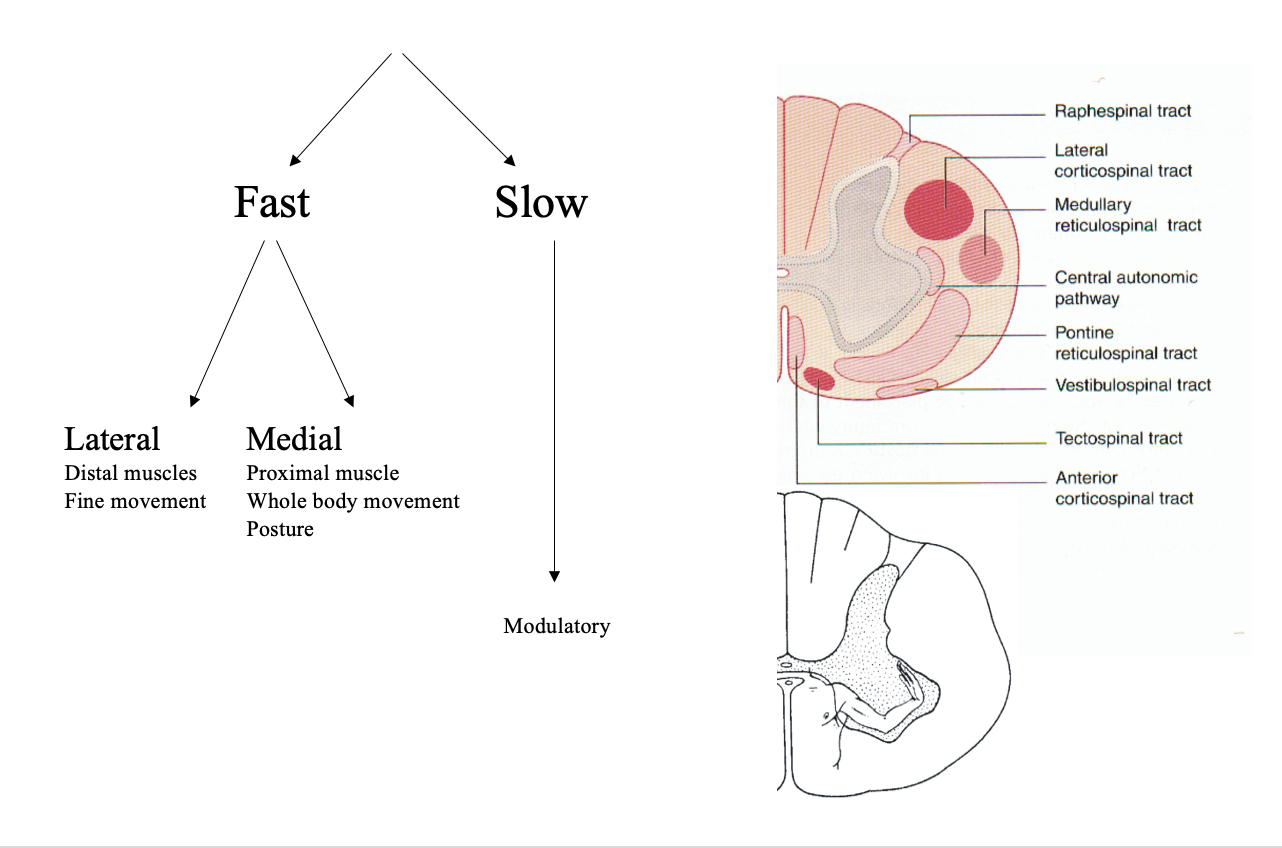
<ol><li><p>Medial</p><ul><li><p>Proximal muscle</p></li><li><p>whole body movements</p><ul><li><p>posture</p></li></ul></li></ul></li><li><p>Lateral</p><ul><li><p>Distal muscles</p></li><li><p>movements of extremities</p></li><li><p>Fine movements</p></li></ul></li></ol><p><em>note: proximal distal rule from L2</em></p><p></p>
6
New cards
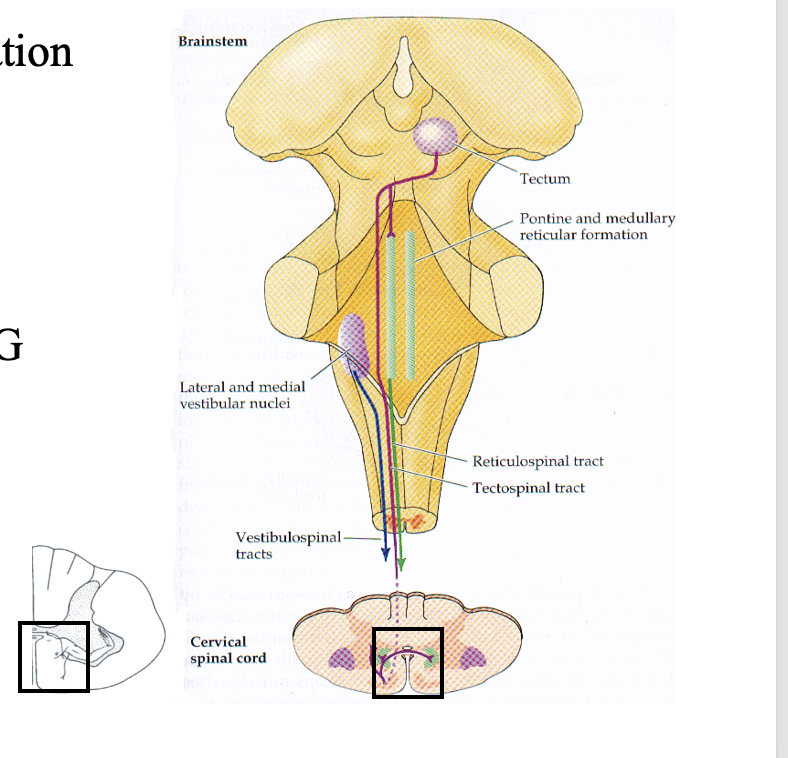
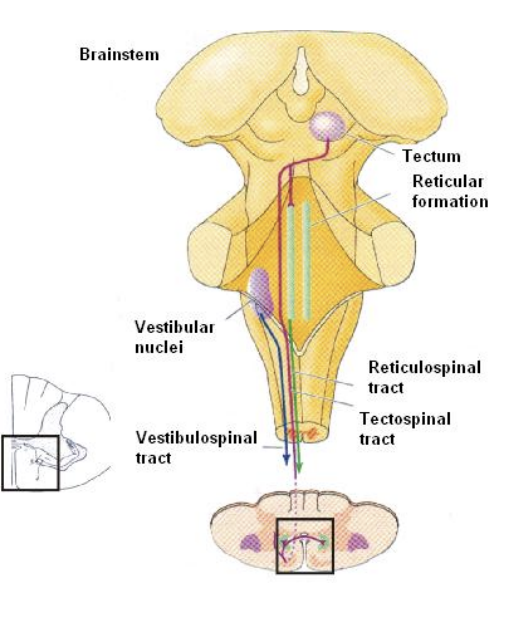
  1. Medical brain stem pathways

  1. Vestibulospinal: postural control, maintaining equilibrium and has projections to limb extensor (antigravity) muscles
    • 2 pathways

  2. Tectospinal: orientation (head and eye movements) to sound and objects

  3. Reticulospinal: orientation and CPG activation

    • several brainstem tracts

<ol><li><p><strong>Vestibulospinal</strong>: postural control, maintaining equilibrium and has projections to limb extensor (antigravity) muscles</p><ul><li><p>2 pathways</p></li></ul></li><li><p><strong>Tectospinal</strong>: orientation (head and eye movements) to sound and objects</p></li><li><p><strong>Reticulospinal</strong>: orientation and CPG activation</p><ul><li><p>several brainstem tracts</p></li></ul></li></ol><p></p>
7
New cards
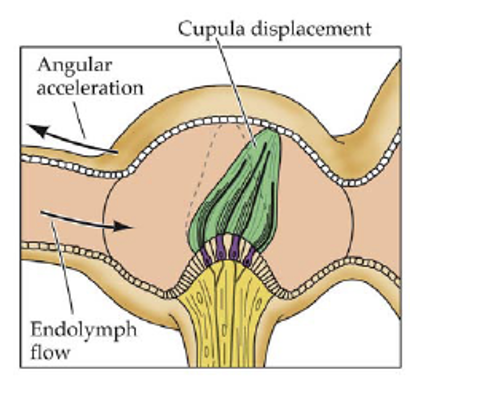
  1. Vestibulospinal system

  • process information from the vestibular

    • found in the ear

    • Cupula in semi-circular canals:

      • filled with endolymph and modified hair cells in jelly-like substance

  • posture and balance

  • has projections to limb extensor (antigravity) muscles

<ul><li><p>process information from the vestibular</p><ul><li><p>found in the ear</p></li><li><p>Cupula in semi-circular canals:</p><ul><li><p>filled with endolymph and modified hair cells in jelly-like substance</p></li></ul></li></ul></li><li><p>posture and balance</p></li><li><p>has projections to limb extensor (antigravity) muscles</p></li></ul><p></p>
8
New cards
  1. How does this help control posture and balance

  1. Move head (voluntary or involuntary)

  2. deflects a couplet

  3. sends a signal

  4. get information of movement from the head

  5. sent to motor system to matai the posture

  6. e.g increase your base so you don not fall over

  7. Very accurately and quickly dectects a change in signal

9
New cards
  1. However, if we move the head voluntarily, the signal is still picked up. How is the reflex movement to maintain balance stopped in this case?

  1. Feed-forward command to shut it down?→ but cannot be sure the prediction is correct

  2. Solution: internal feedback (need to check this!)

    1. Send efferent copy of the signal back to the muscle

    2. calculates how much sensory input (re-afferent) is needed

    3. finds the correct signal

    4. adjusts posture as needed

its is not known has it does these calculations
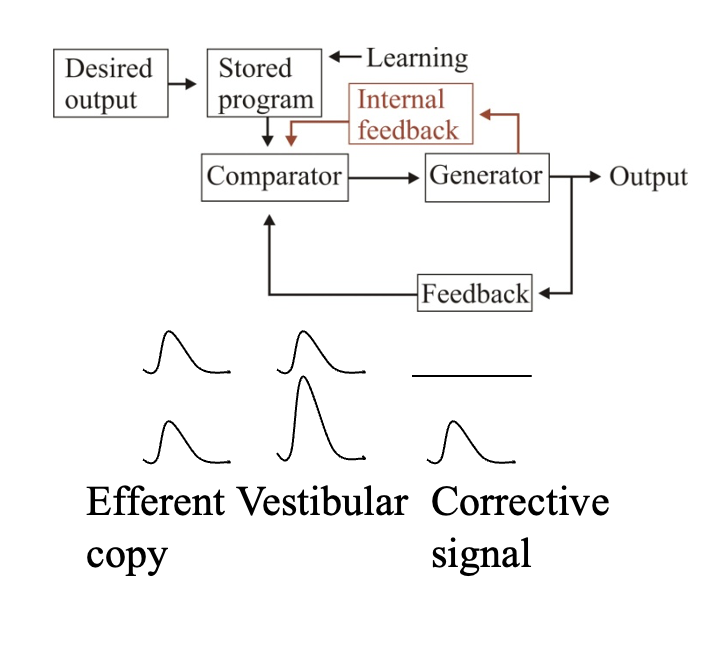
<ol><li><p>Feed-forward command to shut it down?→ <strong>but</strong> cannot be sure the prediction is correct</p></li><li><p>Solution: <strong>internal feedback</strong> (need to check this!)</p><ol><li><p>Send efferent copy of the signal back to the muscle</p></li><li><p>calculates how much sensory input (re-afferent) is needed</p></li><li><p>finds the correct signal</p></li><li><p>adjusts posture as needed</p></li></ol></li></ol><p><em>its is not known has it does these calculations</em></p><p></p>
10
New cards
  1. Tectospinal system: strucuture

Coordinates head and eye movements (to sensory stimuli)

Has four bodies:

  • 2 inferior colliculi→ integrate auditory, spatial and sensory data

  • 2 superior colliculi→ direct behavioural responses to sensory stimuli
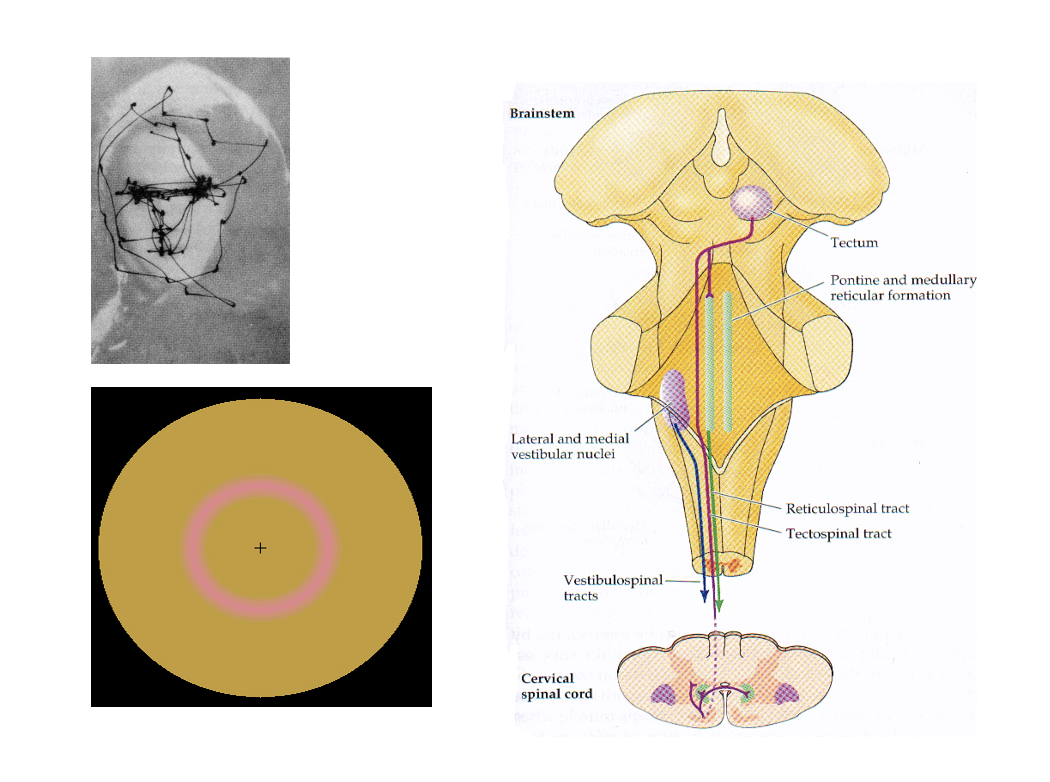
<p><strong>Coordinates head and eye movements (to sensory stimuli)</strong></p><p>Has four bodies:</p><ul><li><p>2 inferior colliculi→ integrate auditory, spatial and sensory data</p></li><li><p>2 superior colliculi→ direct behavioural responses to sensory stimuli</p></li></ul><p></p>
11
New cards
  1. What does the superior colliculus do

  1. Eye movements→ direct how we e.g scan faces in a particular way

  2. Involuntary saccadic eye movements→ need to move constantly other wise the photoreceptors adapt
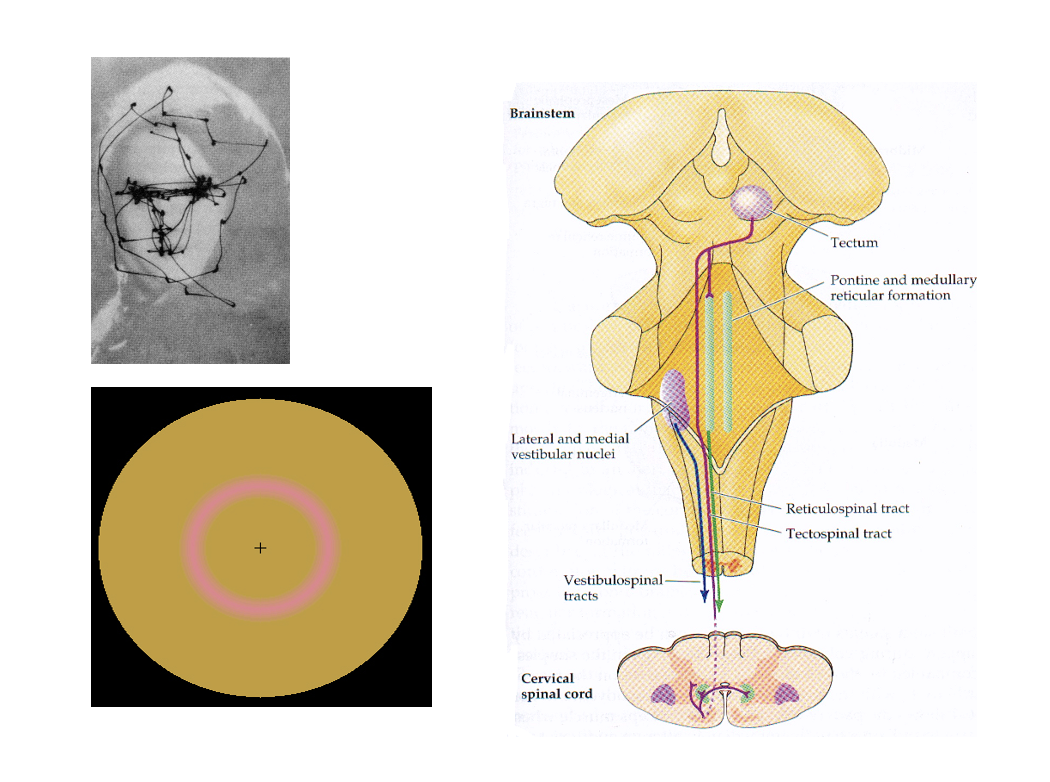
<ol><li><p>Eye movements→ direct how we e.g scan faces in a particular way</p></li><li><p>Involuntary saccadic eye movements→ need to move constantly other wise the photoreceptors adapt</p></li></ol><p></p>
12
New cards
  1. Why are these eye movements needed

Allows to orientate head and eye movements to sensory stimuli

  • Linking the auditory and visual space around you

Example:

  1. when hear or something catches your eye at night

  2. superior colliculus will guide your eye, head or even trunk towards the stimulus (i.e can control the whole motor system to orientate)

  3. so you can get more info as to what it is (can foveate)

  4. and build up the sensory map around you

13
New cards
  1. Reticulospinal pathway: what involved in

  1. general body orientation

  2. simple motor patterns

    • EVIDENCE: pathway activates spinal CPG circuits (see later with cat)
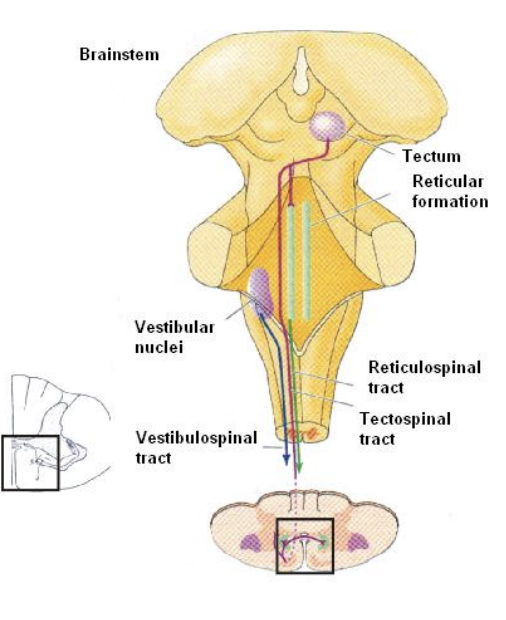
<ol><li><p>general body orientation</p></li><li><p>simple motor patterns</p><ul><li><p>EVIDENCE: pathway activates spinal CPG circuits (see later with cat)</p></li></ul></li></ol><p></p>
14
New cards

Where do reticulospinal neurons receive inputs from

  1. motor cortex

  2. cerebellum

<ol><li><p>motor cortex</p></li><li><p>cerebellum</p></li></ol><p></p>
15
New cards

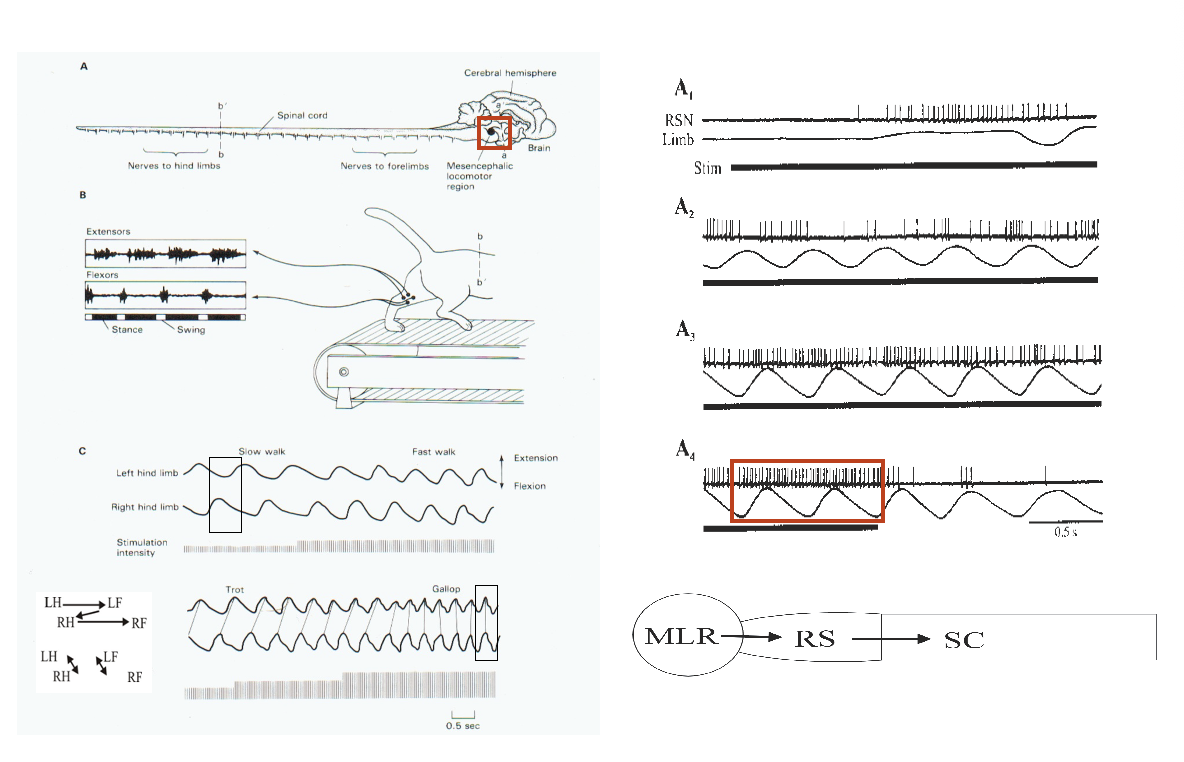
Descending pathways activate spinal motor systems: Shik and Orlovsky experiment with cat

Procedure:

  • electrical stimulation of midbrain of cat

  • elicit locomotion

Results

  • Low stimulation→ walking

  • Increased→ trotting

  • Further→ galloping

Conclusion:

  • region stimulated→ Mesencephalic locomotor region (MLR)
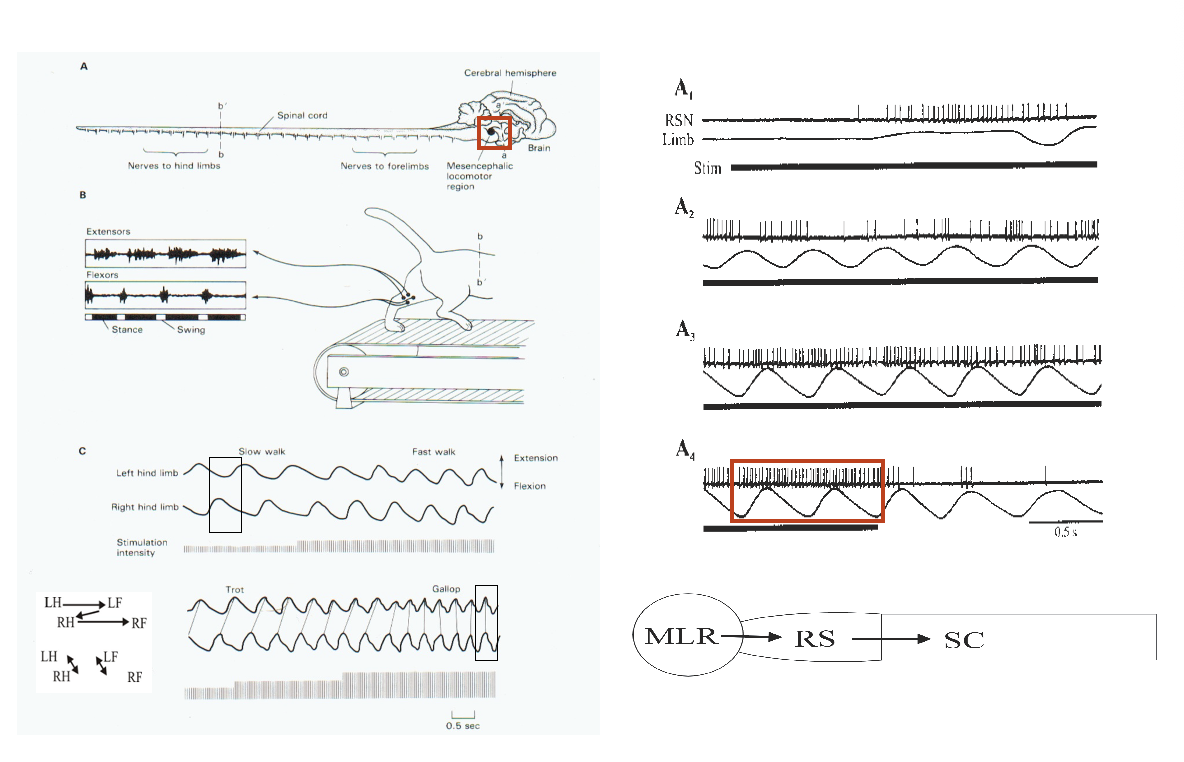
<p>Procedure:</p><ul><li><p>electrical stimulation of midbrain of cat</p></li><li><p>elicit locomotion</p></li></ul><p>Results</p><ul><li><p>Low stimulation→ walking</p></li><li><p>Increased→ trotting</p></li><li><p>Further→ galloping</p></li></ul><p>Conclusion:</p><ul><li><p>region stimulated→ <strong>Mesencephalic locomotor region (MLR)</strong></p></li></ul><p></p>
16
New cards

What does the MLR do

  • activates the reticulospinal system

    • → switch on movements

  • THEREFORE: the descending systems allow the brain to modulate spinal locomotor networks (and their sensory inputs)

    • so that the output is appropriate for particular tasks

  • analogous structures have been found in other vertebrate systems
<ul><li><p>activates the <strong>reticulospinal</strong> system</p><ul><li><p>→ switch on movements</p></li></ul></li><li><p>THEREFORE: the descending systems allow the brain to <strong>modulate</strong> spinal locomotor networks (and their sensory inputs)</p><ul><li><p>so that the output is <strong>appropriate for particular tasks</strong></p></li></ul></li><li><p><em>analogous structures have been found in other vertebrate systems</em></p></li></ul><p></p>
17
New cards

Why is the CPG involved in this response?

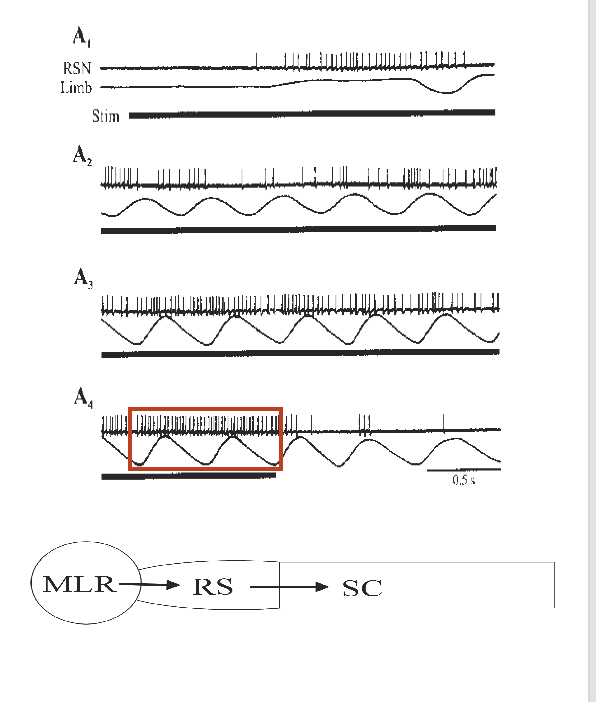
  1. The MLR just sends a continuous train of AP at at constant frequency

  2. this cannot coordinate the cycle of flex/extensor movement

  3. This signal is just to switch on CPG

  4. CPG interprets this signal as a command to generate a motor output

    • e.g the freq of action potentials

  5. (e.g walking or running)

  6. THEREFORE: the coordination of the basic output id done by spinal cord CPG
<ol><li><p>The MLR just sends a continuous train of AP at at constant frequency</p></li><li><p>this cannot coordinate the cycle of flex/extensor movement</p></li><li><p>This signal is just to <strong>switch on</strong> CPG</p></li><li><p>CPG <strong>interprets</strong> this signal as a command to generate a motor output</p><ul><li><p>e.g the freq of action potentials</p></li></ul></li><li><p>(e.g walking or running)</p></li><li><p>THEREFORE: the <strong>coordination</strong> of the basic output id done by spinal cord CPG</p></li></ol><p></p>
18
New cards

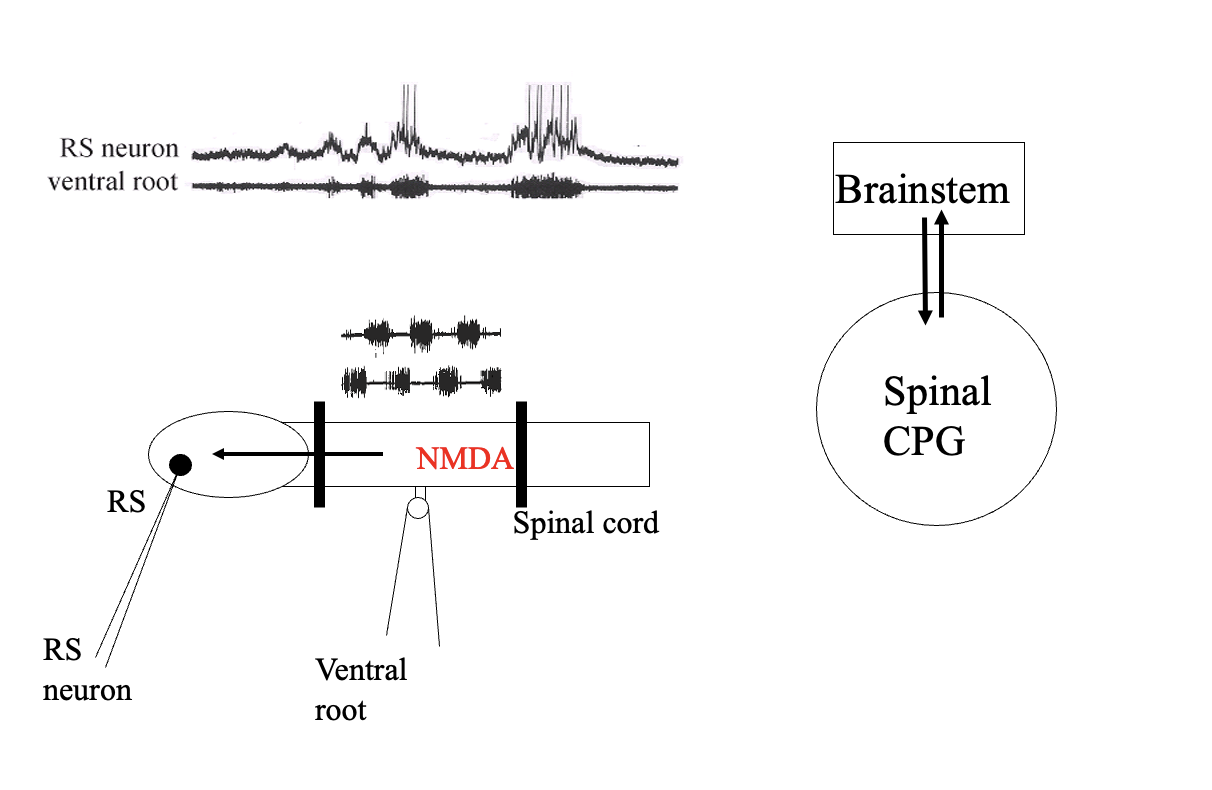
Not only is there signal from brain-stem to spinal cord, but there is input from spinal cord→ brainstem Example of 2 way interaction (HETERARCHY)

→Brainstem motor centres send inputs to but also inputs from the spinal cord

note:

  • another example of this (already seen in last lecture:

    • spinal CPG and sensory inputs

    • e.g golgi tendon organ reflex reversal (input to and from the spinal cord)

19
New cards

How was this (spinal cord→ brain stem) input found out?

Procedure:

  1. evoke fictive locomotion in spinal cord

  2. put barrier to stop connection to the brain

  3. record from the neruon in the reticulospinal system

Result:

  • Neurons also gets depolarised

Conclusion:

  • two way interaction

  • sends a signal BACK to brainstem

THEREFORE: evidence of heterarchy
<p><strong>Procedure: </strong></p><ol><li><p>evoke fictive locomotion in spinal cord</p></li><li><p>put barrier to stop connection to the brain</p></li><li><p>record from the neruon in the <strong>reticulospinal system</strong></p></li></ol><p><strong>Result:</strong></p><ul><li><p>Neurons <strong>also</strong> gets depolarised</p></li></ul><p><strong>Conclusion:</strong></p><ul><li><p>two way interaction</p></li><li><p>sends a signal BACK to brainstem</p></li></ul><p><strong>THEREFORE: evidence of heterarchy</strong></p><p></p>
20
New cards
  1. LATERAL brain stem pathways

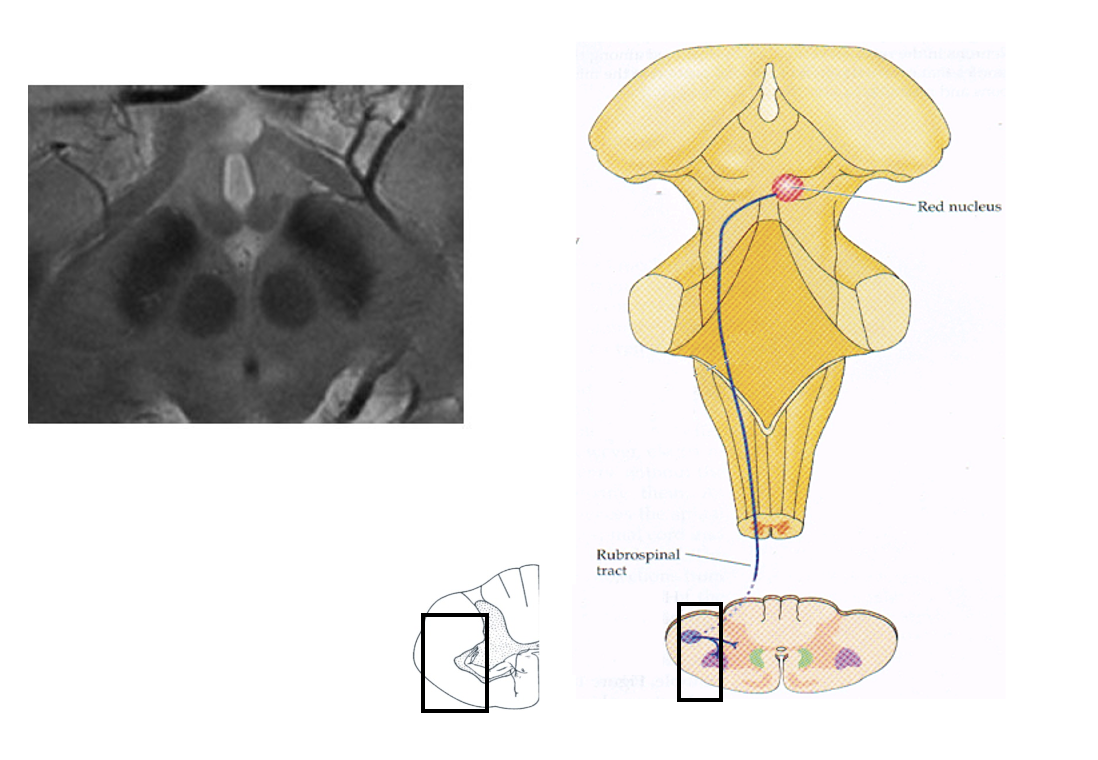
  1. Rubrospinal

  2. Corticospinal

<ol><li><p>Rubrospinal</p></li><li><p>Corticospinal</p></li></ol><p></p>
21
New cards
  1. Rubrospinal tract: where does it come from (hint at name)

  • from the red nucleus

  • which crosses over and goes to the lateral regions of the oppsite side of the spinal cord

  • in lower vertebrates

<ul><li><p>from the red nucleus</p></li><li><p>which crosses over and goes to the lateral regions of the oppsite side of the spinal cord </p></li><li><p>in lower vertebrates</p></li></ul><p></p>
22
New cards
  1. Rubrospinal tract: controls what in mammals

  1. reaching

  2. limb movements

23
New cards

Inputs of the rubrospinal tract

  1. Some direct inputs from motor neurons

    • esp. in primates

  2. Motor cortex

  3. Cerebellum

24
New cards

Rubrospinal tract in humans?

  • replaced by the corticospinal tract

  • Instead: the red nucleus mainly sends inputs to the cerebellum

    • not the spinal cord

25
New cards
  1. Corticospinal pathway→two pathways

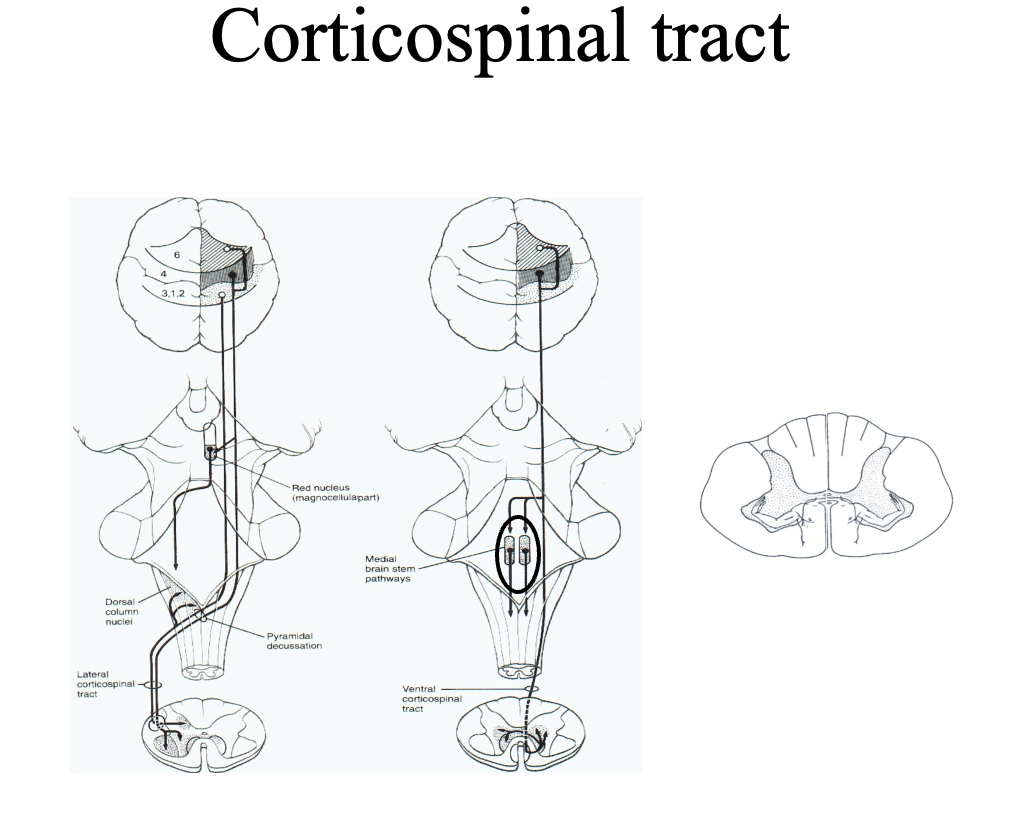
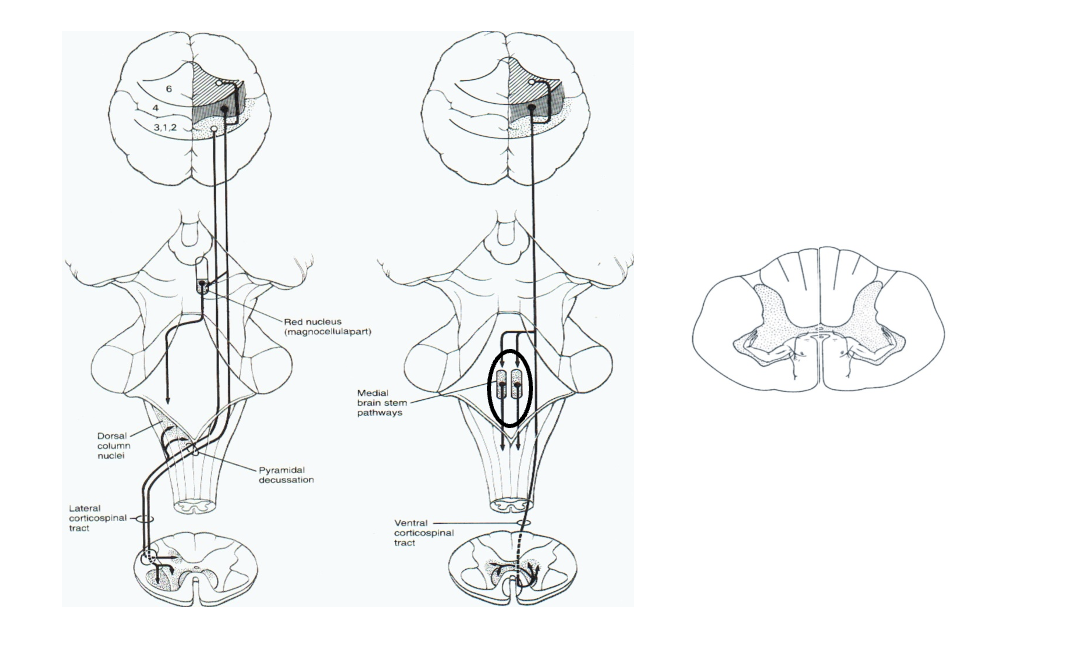
The most important descending pathway in mammals

  1. Large lateral pathway (left) (80% of fibres)

    • crosses the brain stem

  2. Smaller ventromedial pathway (right) (20% of fibres)

    • uncrossed

<p><strong>The most important descending pathway in mammals</strong></p><ol><li><p><strong>Large lateral pathway </strong>(left) (80% of fibres)</p><ul><li><p>crosses the brain stem</p></li></ul></li><li><p><strong>Smaller ventromedial pathway</strong> (right) (20% of fibres)</p><ul><li><p>uncrossed</p></li></ul></li></ol><p></p>
26
New cards

What do corticospinal lesions cause

(e.g from stroke)

  1. Initially→ muscle weakness and loss of reflexes

  2. With time→ subsequent spasticity

    • why: reflects changes in sensory processing over time due to loss of descending regulation
<p>(e.g from stroke)</p><ol><li><p>Initially→ muscle weakness and loss of reflexes</p></li><li><p>With time→ subsequent <strong>spasticity</strong></p><ul><li><p>why: reflects changes in sensory processing over time due to <strong>loss </strong>of descending regulation</p></li></ul></li></ol><p></p>
27
New cards

Comparative anatomy of corticospinal tract

Show how corticospinal tract has changed during evolution

  1. Rodents→ tract terminates in dorsal (sensory) areas

  2. Cat/dogs→ terminate in intermediate zone

  3. monkey→ some direct connections to motor neurons appear

  4. Humans→ inputs to motor neurons are widespread in humans
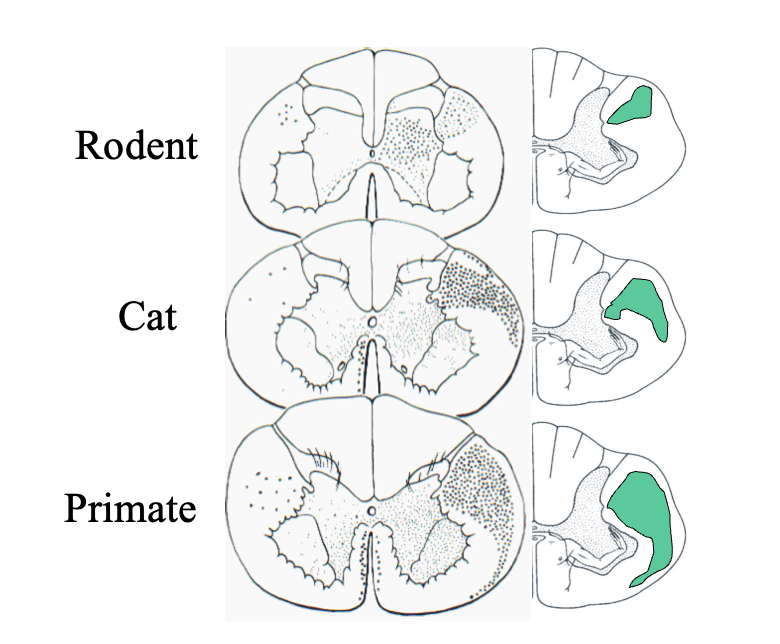
<p><em>Show how corticospinal tract has changed during evolution</em></p><ol><li><p><strong>Rodents</strong>→ tract terminates in dorsal (sensory) areas</p></li><li><p><strong>Cat/dogs</strong>→ terminate in intermediate zone</p></li><li><p><strong>monkey</strong>→ some direct connections to motor neurons appear</p></li><li><p><strong>Humans</strong>→ inputs to motor neurons are widespread in humans</p></li></ol><p></p>
28
New cards

Therefore→ we emphasise the heteracrhy

  • cortical areas are involved in direct execution of motor system
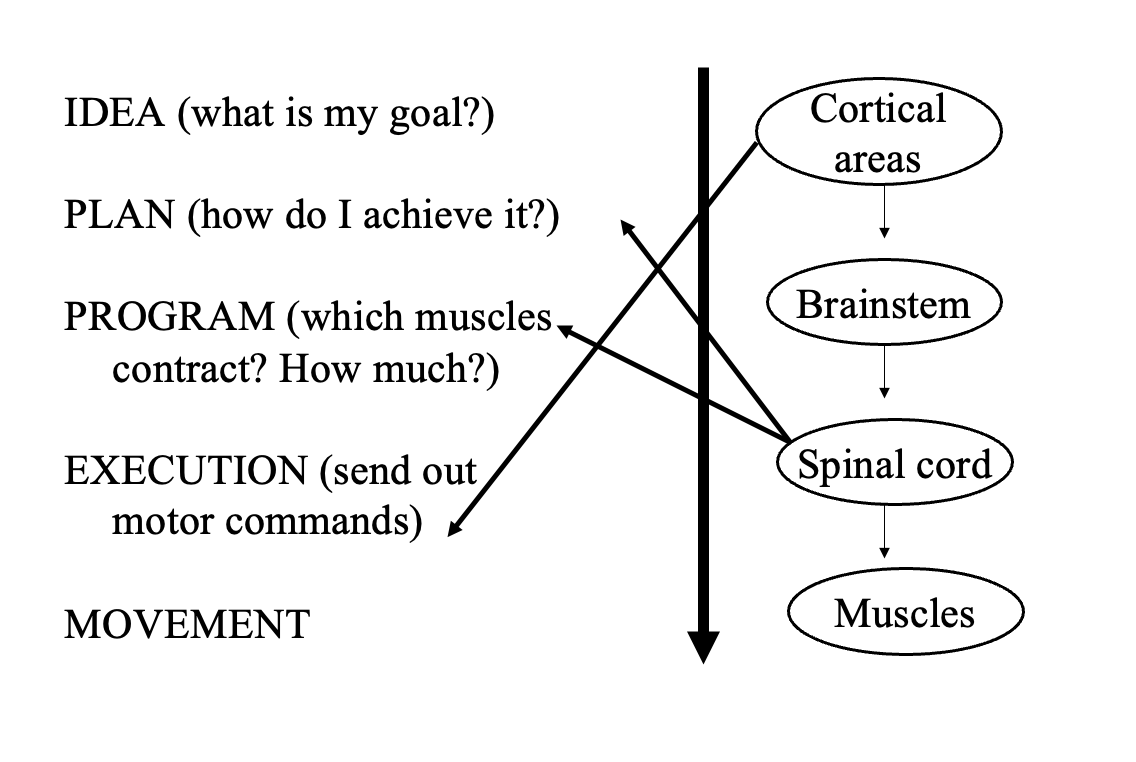
<ul><li><p>cortical areas are involved in direct execution of motor system</p></li></ul><p></p>
29
New cards

Descending pathways can also influence (what is this comparable to)

Development of spinal systems

(this is comparable to the effects of vision from L1→ where vision helps the development of the motor system and vise versa)

30
New cards

At what age do the direct projections from motor cortex to motor eurons begin to mature

  • At 9 months

  • About the same time that manipulative skills begin to develop

    • These manipulatve skills between children of 7-8 months can be compared to stroke patients who have lsot corticospinal inputs

31
New cards

Investigating descending regulation of inputs: receptive fields of nociceptive afferents and conclusion: EVIDENCE that inputs influence development

Procedure:

  • Rats with spinal cord transected so just goes to dorsal

  • either in

    • neonates (right)

    • (acute) adults (left)

Results:

  • receptive fields of nocicepetic afferent are increased in neonates compared to (acute( adults

Conclusion:

  • receptive fields are regulated during development by descending pathways
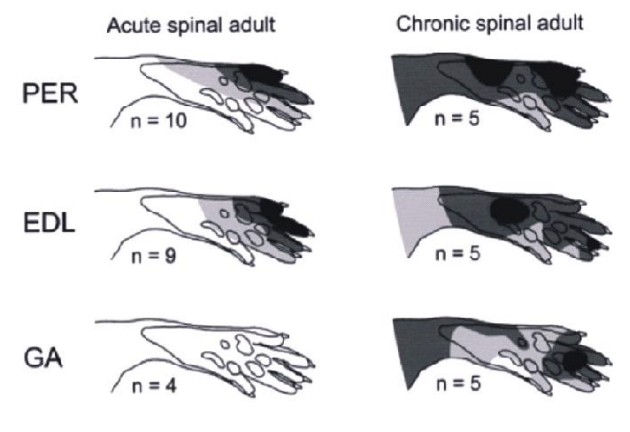
<p><strong>Procedure</strong>:</p><ul><li><p>Rats with spinal cord transected  so just goes to dorsal</p></li><li><p>either in </p><ul><li><p>neonates (right)</p></li><li><p>(acute) adults (left)</p></li></ul></li></ul><p><strong>Results</strong>:</p><ul><li><p>receptive fields of nocicepetic afferent are <strong>increased</strong> in neonates compared to (acute( adults</p></li></ul><p><strong>Conclusion:</strong></p><ul><li><p>receptive fields are regulated during <strong>development by descending pathways</strong></p></li></ul><p></p>
32
New cards

What was also found in this experiment (neonate vs adult)

Direction of limb movement in response to nociceptive stimuli also differs in normal adult rats vs rates subjected after birth

  • Adult normal→ direction is away from nociceptive stimulus

  • Adult transected→ direction inappropriate towards the nociceptive stimulus

  • Neontatal transection→ prevents normal shaping of flexion withdrawal reflexes by descending inputs
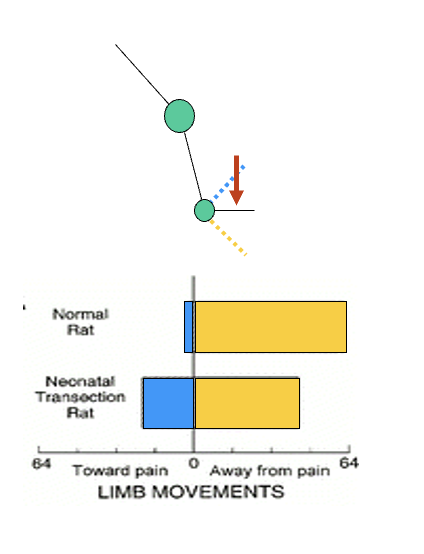
<p>Direction of limb movement in response to nociceptive stimuli <strong>also</strong> differs in normal adult rats vs rates subjected after birth</p><ul><li><p><strong>Adult normal</strong>→ direction is away from nociceptive stimulus</p></li><li><p><strong>Adult transected</strong>→ direction inappropriate towards the nociceptive stimulus</p></li><li><p><strong>Neontatal transection</strong>→ prevents normal shaping of flexion withdrawal reflexes by descending inputs</p></li></ul><p></p>
33
New cards

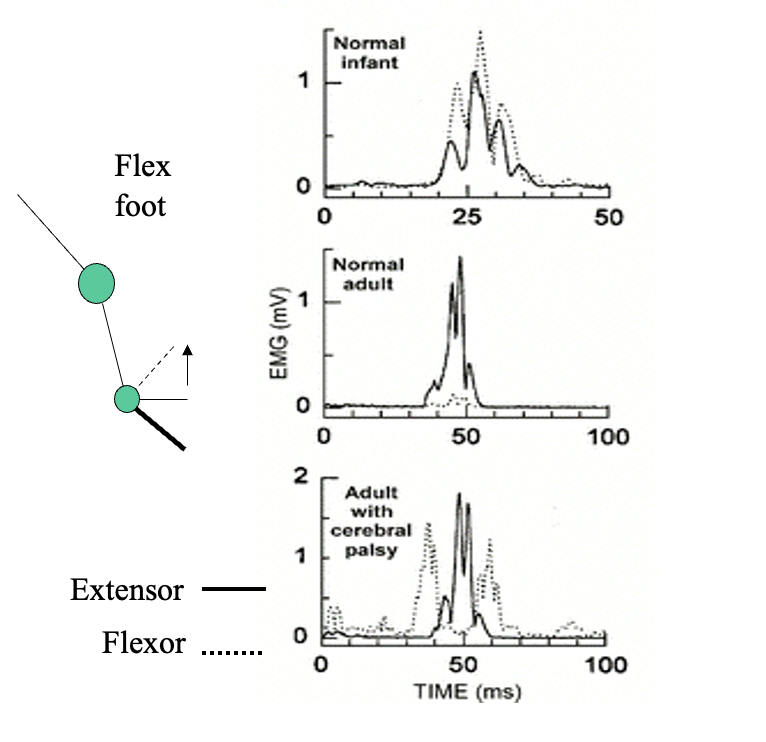
Role of descending inputs in the development of spinal function is also shown in human cerebral palsy

Cerebral palsy→ defects descending systems

  • which are associated with changes in the regulation of spinal reflexes
<p>Cerebral palsy→ defects descending systems</p><ul><li><p>which are associated with changes in the regulation of spinal reflexes</p></li></ul><p></p>
34
New cards

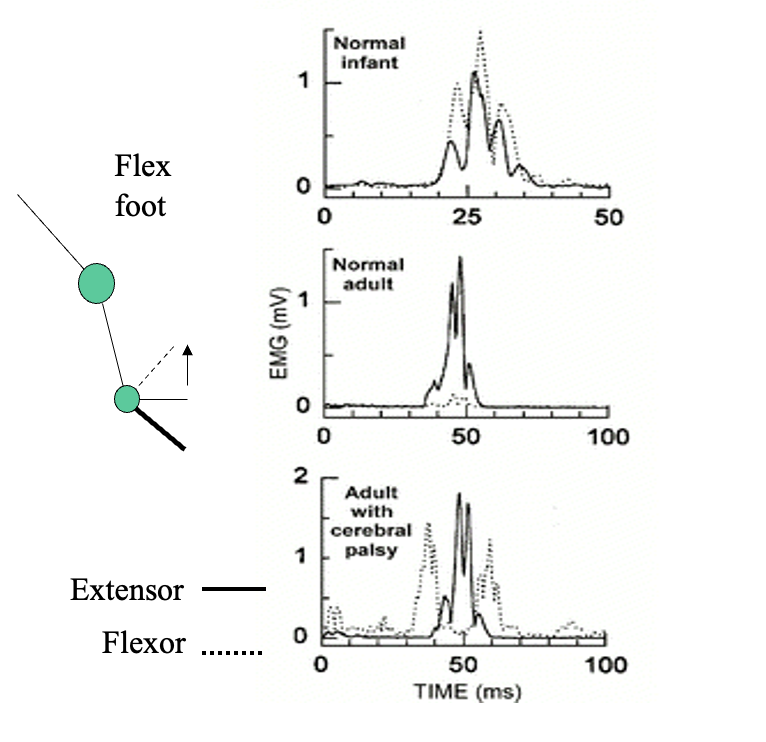
Dorsiflexion differences in normal adult vs infants and adults with cerebral palsy

Dorsiflexion: pushing the foot up

  • Normal foot→ short-latency muscle response: causes reflex contraction of the tibialis anterior (extensor) muscles→ to oppose the movement

  • Cerebral palsy→ Activate flexor and extensor muscles

What does this suggest: role for descending inputs in regulating the development of mature spinal function
<p>Dorsiflexion: pushing the foot up</p><ul><li><p><strong>Normal foot</strong>→ short-latency muscle response: <strong>causes reflex contraction </strong>of the tibialis anterior (extensor) muscles→ to <strong>oppose</strong> the movement</p></li><li><p><strong>Cerebral palsy→ Activate flexor and extensor muscles</strong></p></li></ul><p></p><p>What does this suggest: <strong>role for descending inputs </strong>in regulating the <strong>development</strong> of <strong>mature</strong> spinal function</p>
35
New cards

Overall what do the fast pathways show us (in terms of hertarchy)

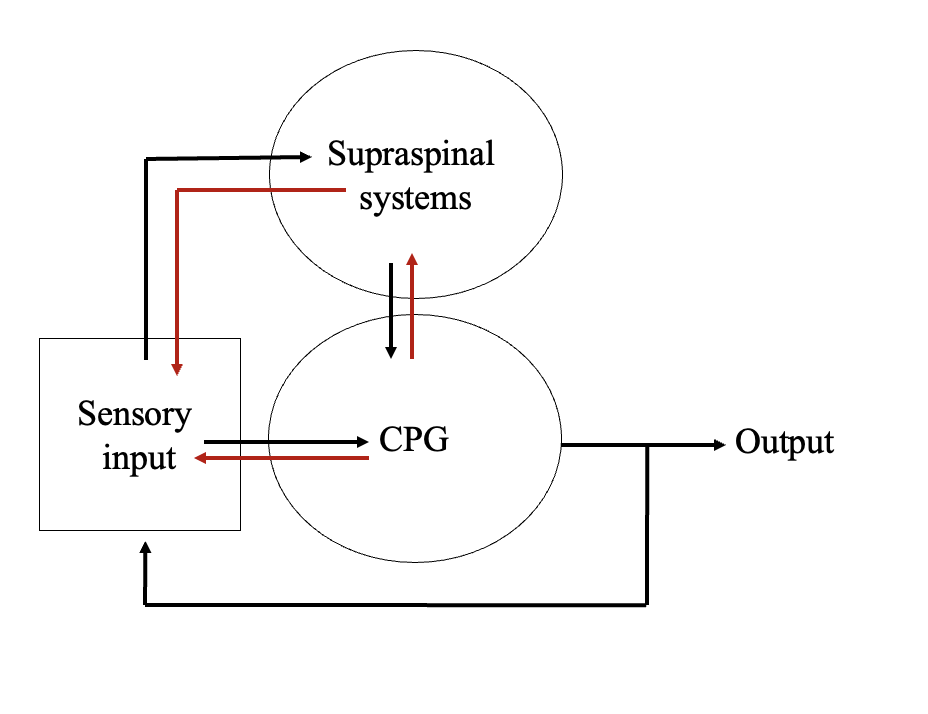
  • Supraspinal ← → Sensory input

  • Supraspinal ← → CPG

  • Sensory input← → CPG

<ul><li><p>Supraspinal ← → Sensory input</p></li><li><p>Supraspinal ← → CPG</p></li><li><p>Sensory input← → CPG</p></li></ul><p></p>
36
New cards
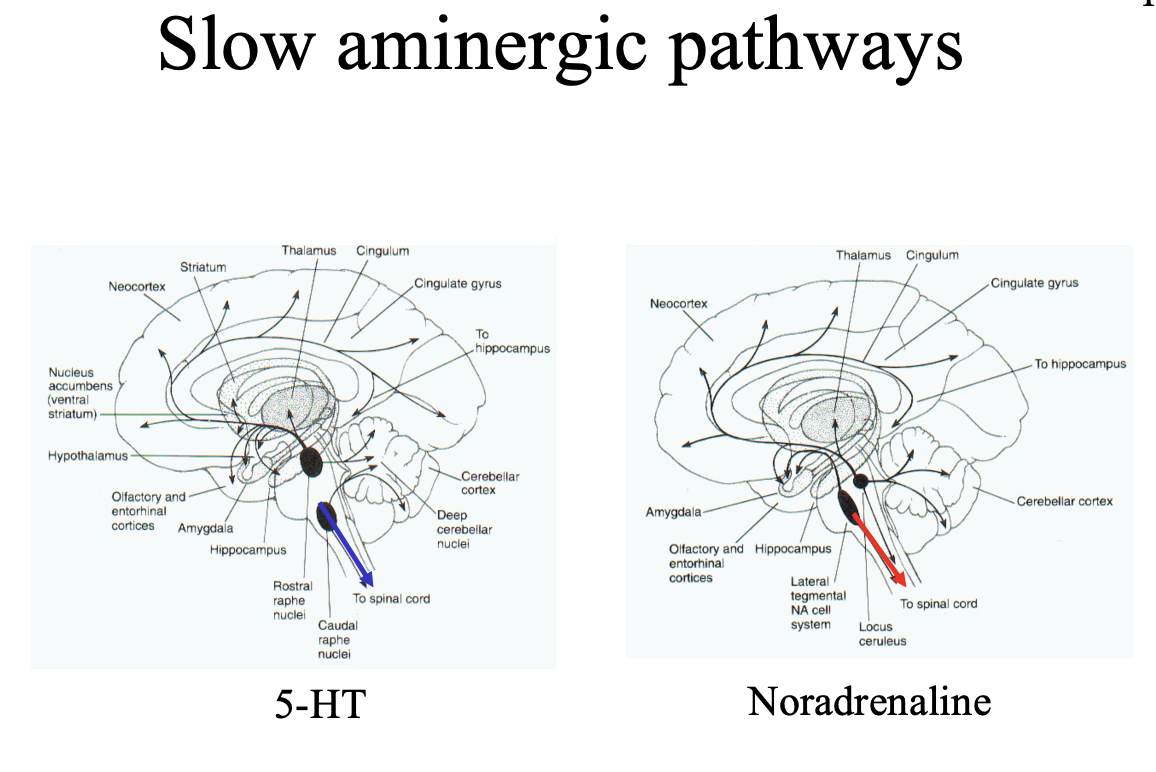
<p>SLOW decesning pathways: what designates slow vs fast pathways</p>

SLOW decesning pathways: what designates slow vs fast pathways

  • the relative speed of onset of their effects and duration of action

  • Largely reflected in synaptic transmission:

    • Ionotropic→ fast

    • Metabotropic→ slow

37
New cards

Characteristic of slow pathways

  • does not affect directly

  • create longer lasting modulatory responses
38
New cards
<p>Slow pathways NTs and Neuropeptides</p>

Slow pathways NTs and Neuropeptides

  1. Predominantly→ Aminergic

    • 5-HT from Raphe nucleus

    • NA from locus coeruleus

  2. Some use neuro peptides:

    • Substance P

    • galanin

    • thyrotophin-releasing hormone

    • NA

    • neuropeptide Y

<ol><li><p><strong>Predominantly→ Aminergic</strong></p><ul><li><p>5-HT from Raphe nucleus</p></li><li><p>NA from locus coeruleus</p></li></ul></li><li><p><strong>Some use neuro peptides:</strong></p><ul><li><p>Substance P</p></li><li><p>galanin</p></li><li><p>thyrotophin-releasing hormone</p></li><li><p>NA</p></li><li><p>neuropeptide Y</p></li></ul></li></ol><p></p>
39
New cards

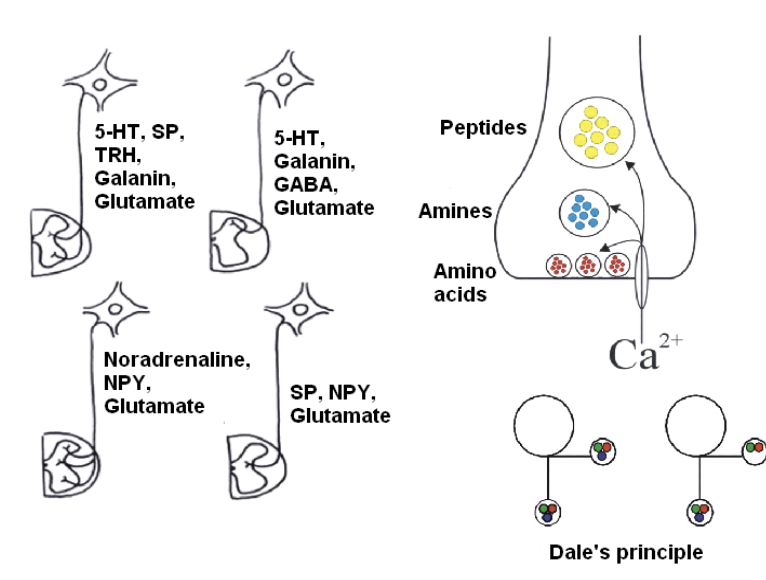
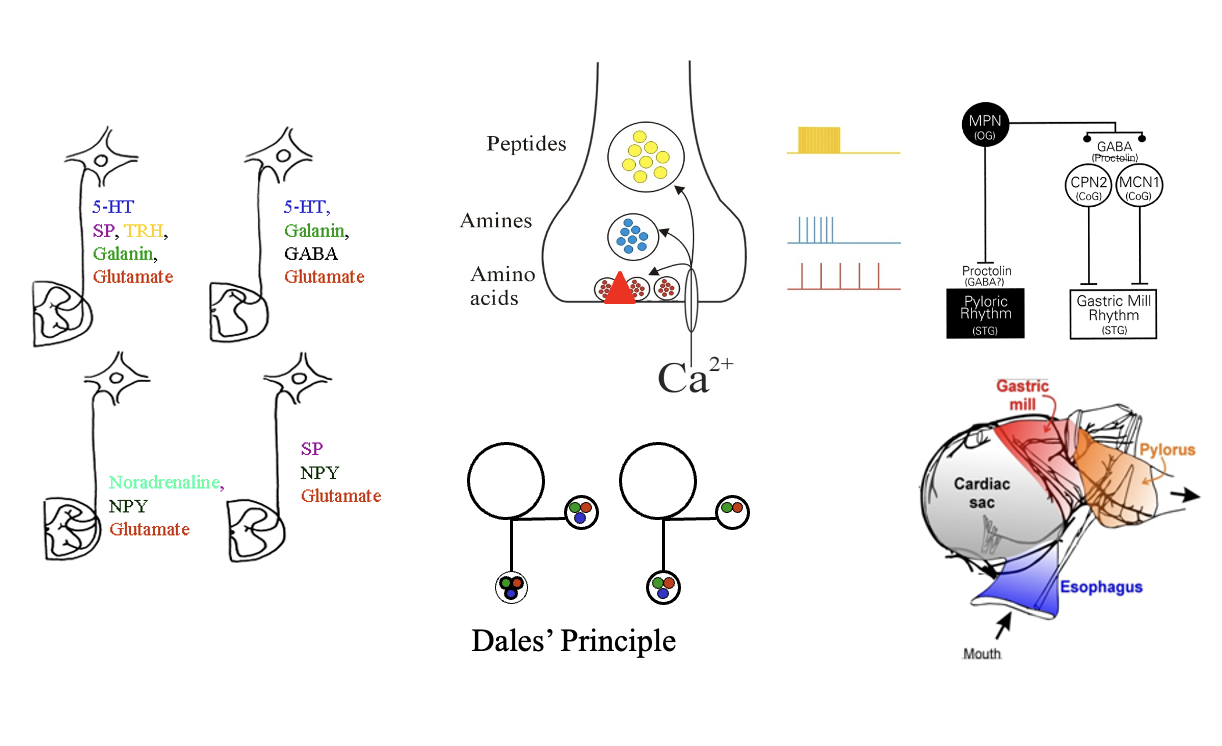
Slow pathways showed evidence for co-localisation of transmitters

  • loads of transmitters in one neuron

  • if single neuron is stimulated→ can release more than one transmitter

  • single neurons can co-localise and release multiple vescicles
<ul><li><p>loads of transmitters in one neuron</p></li><li><p>if single neuron is stimulated→ can release more than one transmitter</p></li><li><p>single neurons can co-localise and release multiple vescicles</p></li></ul><p></p>
40
New cards

How are these different NTs/Neuropeptides arranged in the neuron

From closest to terminus towards the axon:

  1. Amino acids (glutamate)

  2. Amines (larger vesicles)

  3. Peptides (substance B)→ larger and even further from the active surface

41
New cards

Their release is dependent on the activity

  • Low Ca2+ freq signal→ only release one closest (amino acids)

  • As increase the freq signal→ the amino and peptides etc are also released too

THEREFORE: Dale’s principle is negatied (that single neuron contains a single transmitter)

  • note: Dale never actually named it (was Eccles in honour of Dale )

  • at one terminal→ can release different NTs
<ul><li><p>Low <strong>Ca2+</strong> freq signal→ only release one closest (amino acids)</p></li><li><p>As increase the freq signal→ the amino and peptides etc are also released too</p></li></ul><p>THEREFORE: Dale’s principle is negatied (that single neuron contains a single transmitter)</p><ul><li><p><em>note</em>: Dale never actually named it (was Eccles in honour of Dale )</p></li></ul><ul><li><p>at one terminal→ can release different NTs</p></li></ul><p></p>
42
New cards

Eccles then changed the principle

  • the same transmitters would be found at all branches of a neuron

  • not that a neurone release only one transmitter

  • HOWEVER: there have been some exceptions to this
<ul><li><p>the same transmitters would be found at all branches of a neuron</p></li><li><p>not that a neurone release only one transmitter</p></li><li><p>HOWEVER: there have been some exceptions to this</p></li></ul><p></p>
43
New cards

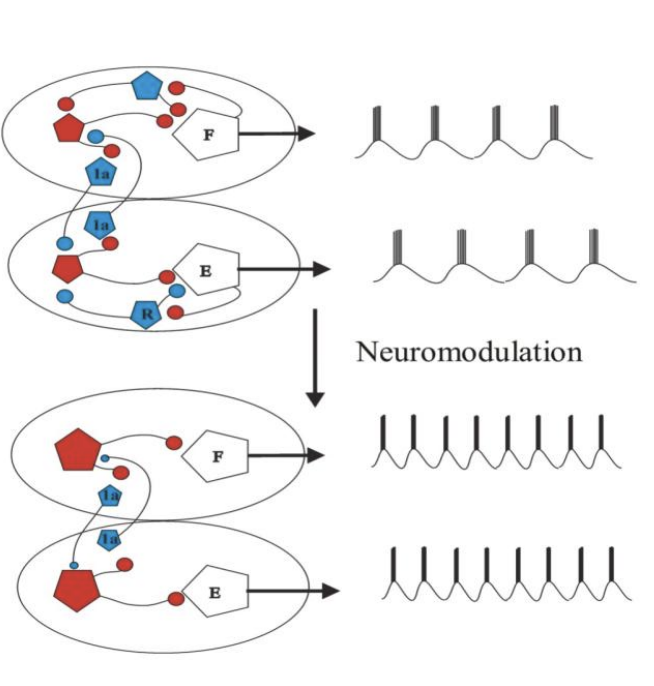
Amines and peptides act via

  • G-protein-coupled receptors

  • intracellular pathways

  • → Alter cellular and synaptic properties of spinal cord neurons

    • i.e locomotoer CPG or sensory inputs

This is Neuromodulation
<ul><li><p>G-protein-coupled receptors</p></li><li><p>intracellular pathways</p></li><li><p>→ Alter cellular and synaptic properties of spinal cord neurons</p><ul><li><p>i.e locomotoer CPG or sensory inputs</p></li></ul></li></ul><p><strong>This is Neuromodulation</strong></p><p></p>
44
New cards

Example of neuromodulation: 5-HT

  • 5-HT converts a cell that is silent in response to a depolarising input

  • positive current injected into the cell

  • to one generating a high frequency train of action potentials

    • ‘plateau potential’

<ul><li><p>5-HT converts a cell that is silent in response to a depolarising input </p></li><li><p>positive current injected into the cell</p></li><li><p>to one generating a high frequency train of action potentials</p><ul><li><p>‘plateau potential’</p></li></ul></li></ul><p></p>
45
New cards

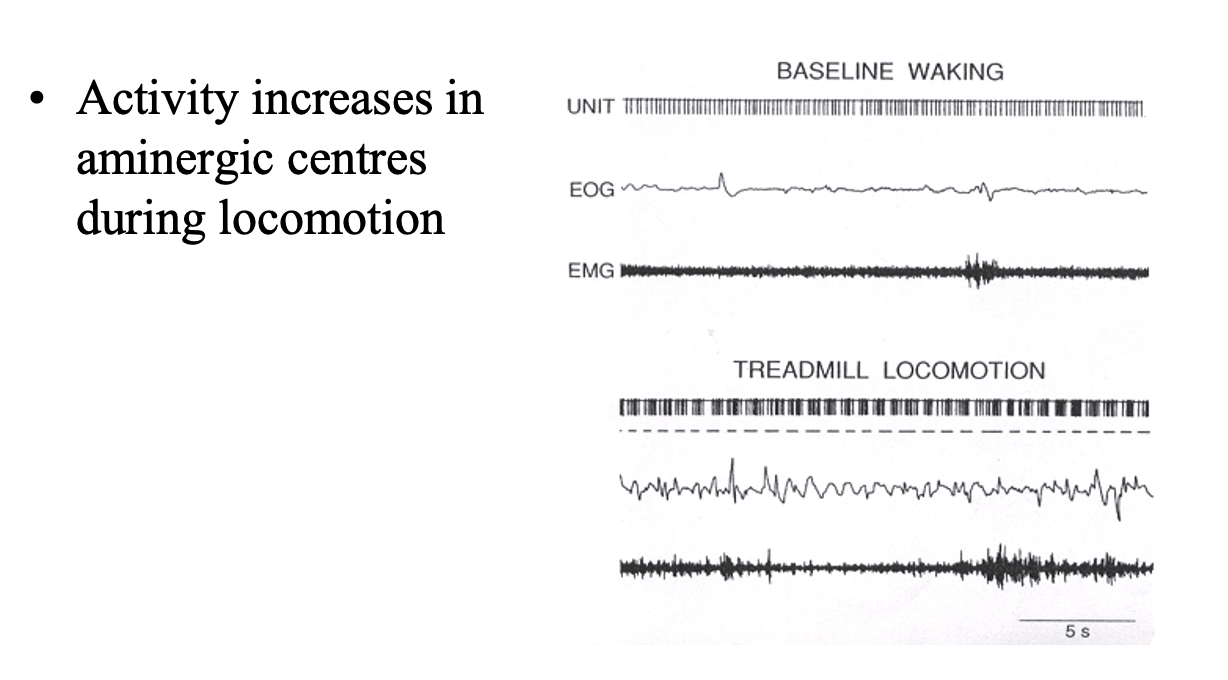
Descending modulatory pathways are activated when

During locomotion

  • degree of activity increases as the demands of the task increase

  1. At rest→ Raphe neurons fire tonically at low frequency

  2. During locomotion→ high freq burst of APs develop (this is most effective in releasing amines and neuropeptides)
<p><strong>During locomotion</strong></p><ul><li><p>degree of activity increases as the demands of the task increase</p></li></ul><ol><li><p><strong>At rest→ </strong> Raphe neurons fire tonically at low frequency</p></li><li><p><strong>During locomotion</strong>→ high freq burst of APs develop (this is most effective in releasing amines and neuropeptides)</p></li></ol><p></p>
46
New cards

Modulatory effects of transmitters released by slow descending pathways on the activity in spinal CPGs have been studied using

Fictive locomotion:

Procedure:

  • add NMDA to switch spinal cord on

  • Add whatever transmitter you are interested in

Results:

  1. 5-HT→ slows the locomotor activity in the lamprey locomotor CPG

    • (the network was activated by the glutamate receptor agonist NMDA applied to the isolated spinal cord)

  2. substance P (neuropeptide)→ increase the freq of network activity and better coordinated

Therefore this shows:

  • descending systems can use transmitter systems that act on the locomotor network to very the output of the locomotor CPG
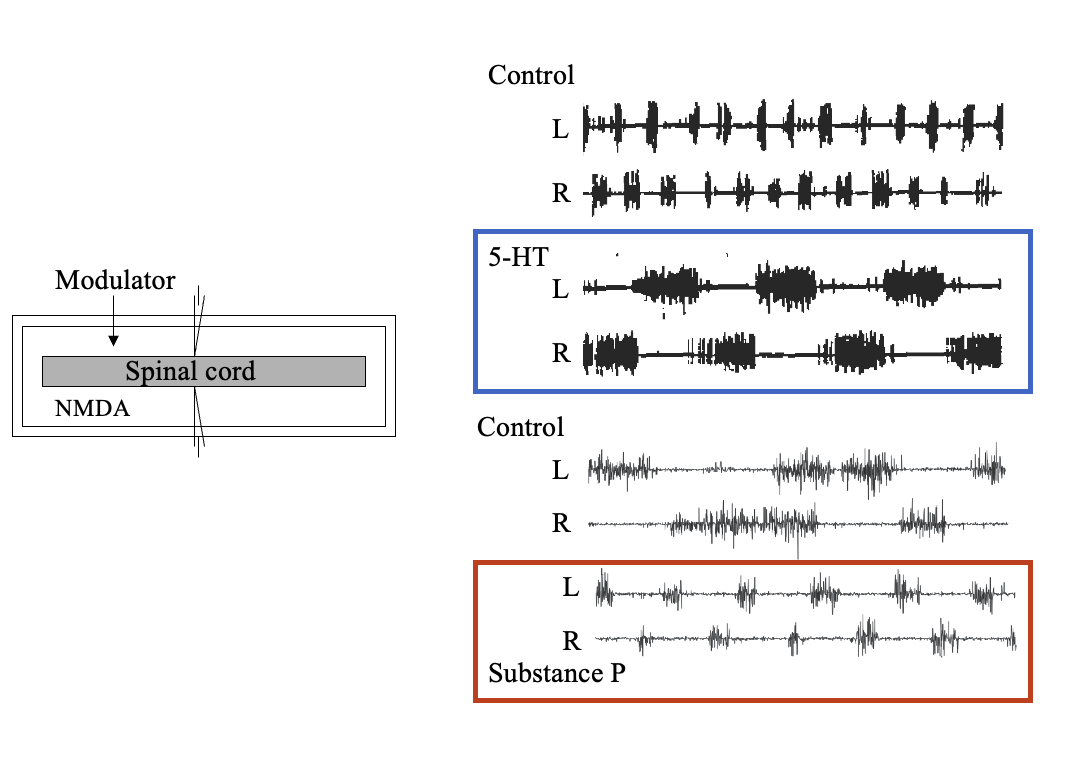
<p><strong>Fictive locomotion</strong>:</p><p>Procedure:</p><ul><li><p>add NMDA to switch spinal cord on</p></li><li><p>Add whatever transmitter you are interested in</p></li></ul><p>Results:</p><ol><li><p><strong>5-HT</strong>→ slows the locomotor activity in the lamprey locomotor CPG</p><ul><li><p>(the network was activated by the glutamate receptor agonist NMDA applied to the isolated spinal cord)</p></li></ul></li><li><p><strong>substance P </strong>(neuropeptide)→ increase the freq of network activity <strong>and</strong> better coordinated</p></li></ol><p><strong>Therefore this shows:</strong></p><ul><li><p>descending systems can use transmitter systems that act on the locomotor network to very the <strong>output</strong> of the locomotor CPG</p></li></ul><p></p>
47
New cards

How is this modulation happening?

  • Modulatory transmitters and their receptors alter the properties of neurons in the spinal CPG to functionally recoonfigure the CPG:

    • Altering different tpyes of neurons

    • THEREFORE→ alters the motor output

<ul><li><p>Modulatory transmitters and their receptors alter the properties of neurons in the spinal CPG to <strong>functionally recoonfigure</strong> the CPG:</p><ul><li><p><strong>Altering different tpyes of neurons</strong></p></li><li><p>THEREFORE→ alters the motor output</p></li></ul></li></ul><p></p>
48
New cards

How are a large number of spinal motor patterns from a single hard-wired network provided

  1. larger number of transmitters in descending pathways

  2. different types of receptors that they act on (over 30 5-HT receptors)
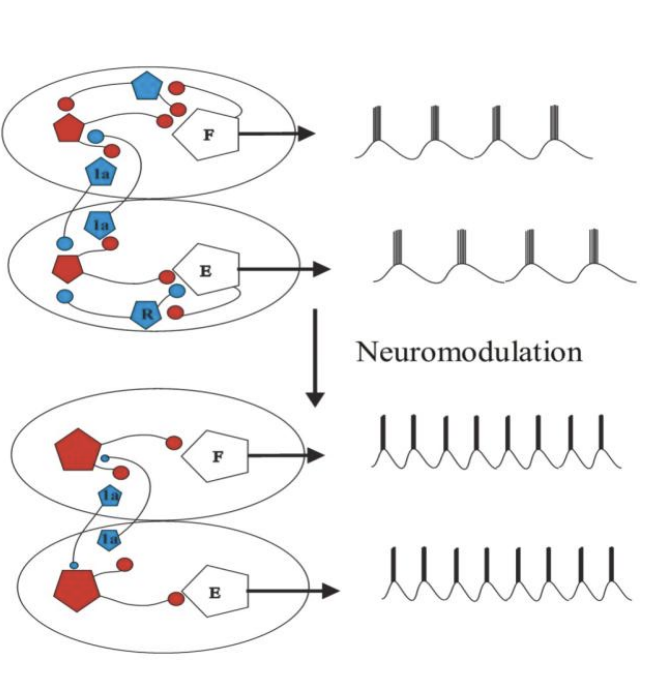
<ol><li><p>larger number of transmitters in descending pathways</p></li><li><p>different types of receptors that they act on (over 30 5-HT receptors)</p></li></ol><p></p>
49
New cards

How do spinal cord injury show the role of descending inputs to the spinal cord

  • injury→ paralysis and other dysfunction (spasticity, chronic pain etc)

  • where the descending inputs have been lost

  • therefore: shows how descending inputs are needed to activate and modulate locomotor activity

    • therefore: to treat spinal cord injury→ need to attempt to restore these inputs
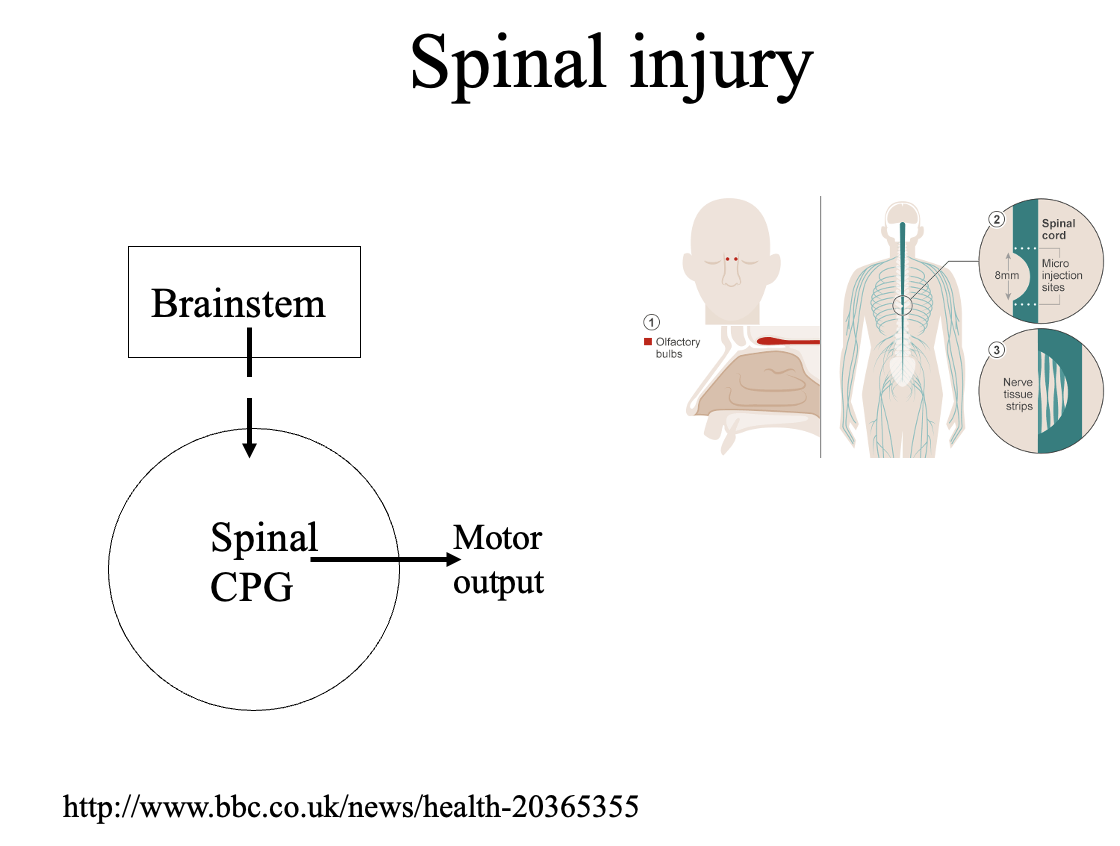
<ul><li><p>injury→ paralysis and other dysfunction (spasticity, chronic pain etc)</p></li><li><p>where the descending inputs have been lost</p></li><li><p>therefore: shows how descending inputs are needed to <strong>activate</strong> and <strong>modulate</strong> locomotor activity</p><ul><li><p>therefore: to treat spinal cord injury→ need to attempt to restore these inputs</p></li></ul></li></ul><p></p>
50
New cards

Effective treatment→ making axons grow?

  • neurons can regrow

  • however→ they are inhibited (we do not know why)

  • need to find inhibitory factors and switch them off

    • e.g Olfactory neurons re-grow when they are made from the nasal epithelium down a permissive pathway

    • cells that allow the axons to grow→ chiefing cells?

    • can transplant these in and see what happens

  • some evidence for this but not been translated to effective treatment so far

51
New cards

What happens to the locomotor networks in the spinal cord below the lesion site

  • not lost after injury

  • but the lack the input needed for their activation and modulation

52
New cards

Therefore this suggested some therapeutic options:

  • the role of drugs in activating (e.g glutamte) or modulating (5-HT) locomotor CPGs

  • suggests that drugs that mimic effects of transmitters released naturally from descending neurons could help compensate for the effects of spinal injury
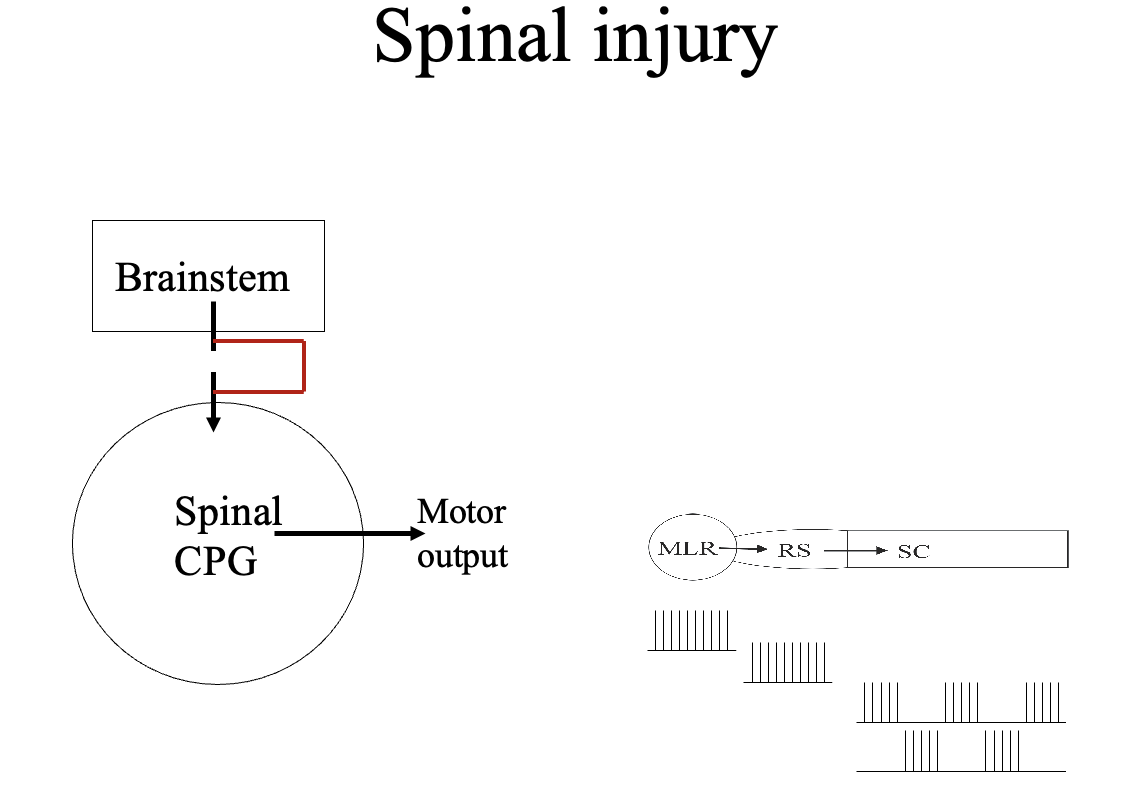
<ul><li><p>the role of drugs in activating (e.g glutamte) or modulating (5-HT) locomotor CPGs </p></li><li><p>suggests that drugs that mimic effects of transmitters released naturally from descending neurons <strong>could help compensate</strong> for the effects of spinal injury</p></li></ul><p></p>
53
New cards

Results: using 5-HT or glutamte agonist as therapy

  • in cats→ improve locomotor performance

    • sifure shows movement of the limbs and muscle activity in an intact animals

    • with receptor complete spinal lesion and in the same lesioned cat 2 min after applying noradrenergic agonist clonidine

    • RESULT→ dramatically improved the locomotor pattern

  • BUT→pharmological approaches have had mixed success
<ul><li><p>in cats→ <strong>improve</strong> locomotor performance </p><ul><li><p>sifure shows movement of the limbs and muscle activity in an intact animals</p></li><li><p>with receptor complete spinal lesion and in the same lesioned cat 2 min after applying noradrenergic agonist clonidine</p></li><li><p>RESULT→ dramatically improved the locomotor pattern</p></li></ul></li><li><p>BUT→pharmological approaches have had mixed success</p></li></ul><p></p>
54
New cards

There is considerable variability in drug effects depending on

  1. extent of injury

  2. time after injury→ Chlonidine is only effective soon after a spinal lesion (acute vs chronic lesions)

  3. Reliable experimetntal effects may not be translated to the clinic
<ol><li><p>extent of injury</p></li><li><p>time after injury→ Chlonidine is only effective soon after a spinal lesion (acute vs chronic lesions)</p></li><li><p>Reliable experimetntal effects may not be translated to the clinic</p></li></ol><p></p>
55
New cards

What else can be used as a treatment?

Electrical stimulation:

  • stimulation to substitude for descending inputs

  • BUT→ to generate actual locomotion some connection to the brain is needed
<p><strong>Electrical stimulation:</strong></p><ul><li><p>stimulation to substitude for descending inputs</p></li><li><p>BUT→ to generate actual locomotion <strong>some connection</strong> to the brain is needed</p></li></ul><p></p>
56
New cards

Therefore what does this suggest is needed for therapy

  • combination of

    • regeneration with pharmalogical and electrical stimulation and locomotor traning tailored to the specific needs of individuals

57
New cards

Overall why is is so difficult to get these threapies to work

Heterachy network:

  • cannot just dump in a load of stem cells/ NTs etc

  • complex network that has to be re-wired

58
New cards

Summary of descending inputs

  1. Descending pathways convey supraspinal signals to spinal CPGs to influence the development and function of spinal networks.

  2. Ventromedial systems are principally concerned with control of proximal muscles.

  3. Dorsolateral systems are principally concerned with control of distal muscles.

  4. Slow pathways have global modulatory effects.
<ol><li><p>Descending pathways convey supraspinal signals to spinal CPGs to influence the development and function of spinal networks. </p></li><li><p>Ventromedial systems are principally concerned with control of proximal muscles. </p></li><li><p>Dorsolateral systems are principally concerned with control of distal muscles. </p></li><li><p>Slow pathways have global modulatory effects.</p></li></ol><p></p>