NUR235 Cardiovascular (Peripheral)
 Call Kai
 Learn
Learn Practice Test
 Spaced Repetition
 Match
Match Flashcards
 Knowt Play
1/47

There's no tags or description
Looks like no tags are added yet.
Name | Mastery | Learn | Test | Matching | Spaced | Call with Kai |
|---|
No analytics yet
Send a link to your students to track their progress
48 Terms
Which type of blood vessel is assessed via pulse?
Arteries.
Do arteries have a thick or thin Tunica Media?
Thick.
Do veins have a thick or thin Tunica Media?
Thin.
True or False?
Arteries are high-pressure, requiring a thick Tunia Media to withstand pressure.
True.
True or False?
Veins are low-pressure and contain valves, preventing backup of blood.
True.
Know Tunica Externa, Media, Intima.
Know Tunica Externa, Media, Intima.
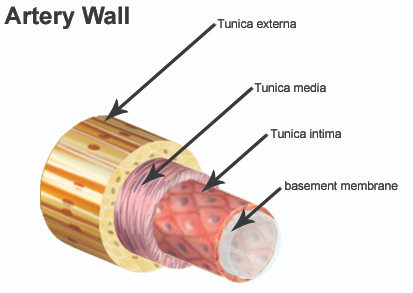
What two (2) structures make up the Tunica Intima?
(1) Basement membrane, and (2) Endothelium.
True or False?
Arteries do not have valves, and rely on pressure to keep blood flowing in the right direction.
True.
True or False?
Arteries have thicker muscular walls to withstand pressure.
True.
What are three (3) types of arteries?
(1) Elastic, (2) Muscular, and (3) Arterioles.
True or False?
Veins have thin walls and can often be injured, leading to varicose veins or vein disease.
True.
What are four (4) types of veins?
(1) Deep veins, (2) Superficial veins, (3) Pulmonary veins, and (4) Systemic veins.
What are three (3) assessment techniques of the peripheral nervous system?
(1) Interview, (2) Inspection, and (3) Palpation.
Know how to collect subjective data for this system.
Know types of questions the nurse will ask pertaining to this system? Know questions related to:
(1) Present health conditions, (2) Past health history, Family (3) history, (4) Lifestyle, etc.
What three (3) things does the nurse inspect on the upper extremities?
(1) Edema,
(2) Venous pattern,
(3) Skin tone.
What are three (3) unexpected findings of skin tone?
(1) Pallor, (2) Erythema, and (3) Cyanosis.
What four (4) things does the nurse inspect on the lower extremities?
(1) Skin tone,
(2) Hair distribution,
(3) Edema,
(4) Lesions.
True or False?
Arterial insufficiency presents as pallor when elevated and cyanosis + rubor when dependent.
True.
True or False?
Loss of hair on legs suggests arterial insufficiency.
True.
What are four (4) characteristics of arterial ulcers?
(1) Located at the end of toes, (2) Regular, even wound border, (3) Pain at rest, and (4) Pedal pulse absent.
What are five (5) characteristics of venous ulcers?
(1) Located at medial/lateral ankle, (2) Irregular, flat wound border, (3) No report of pain at rest, and (4) Pedal pulse present.
What three (3) things does the nurse palpate on the upper extremities?
(1) Temperature, (2) Radial pulse, (3) Capillary refill.
True or False?
Cool temperature suggests arterial insufficiency.
True.
True or False?
Absent radial pulse suggests arterial occlusion.
True.
True or False?
Capillary refill of >2-3 seconds suggests vasoconstriction, decreased CO, shock, arterial occlusion, or hypothermia.
True.
What four (4) things does the nurse palpate on the lower extremities?
(1) Temperature, (2) Sensation, (3) Edema, and (4) Pedal pulse.
True or False?
Increased warmth may suggest thrombophlebitis.
True.
What three (3) things is the nurse assessing when checking pulse?
(1) Rate, (2) Rythym, and (3) Apmplitude.
If a peripheral pulse is not palpable, what is the nurse's next action?
Reposition, use doppler, mark skin if pulse is found.
What is an Allen's test?
A method of gauging the flow of blood in the hands used to determine adequate collateral blood flow in the hand by evaluating the patency of the radial and ulnar arteries.
How does the nurse perform an Allen's test?
Firmly press on both the ulnar and radial artery at the same time, occluding bloodflow, release ulnar artery.
How does the nurse assess pitting edema? What measurement is used? How is it documented?
How does the nurse assess pitting edema? What measurement is used? How is it documented?
What is Virchow's Triad?
Assessment for risk of thrombosis (venous thrombus).
What three (3) factors increase the risk of developing a venous thrombus?
(1) Hypercoagulability,
(2) Venous stasis,
(3) Vessel wall trauma/injury.
What is an arterial occlusion?
When blood cannot get to an extremity.
What are seven (7) risk factors for arterial occlusion?
(1) Smoking tobacco, (2) Hyperlipidemia, (3) HTN, (4) DM, (5) Sedentary lifestyle, (6) Males, (7) Ages 50+.
What are nine (9) manifestations of arterial occlusion?
(1) Unilateral: (1) Pain, (2) Pulselessness, (3) Pallor, (4) Polar, (5) Paresthesia, (6) Paralysis, (7) Swelling, (8) Ischemic aching, (9) Pain relieved at rest.
What are six (6) nursing priorities for arterial occlusion?
(1) Assess and promote circulation and perfusion, (2) Monitor S/S of 6 P's, (3) Check distal pulses, (4) Assess capillary refill, (5) Monitor skin colour/temperature, and (6) Manage pain.
What is a venous thrombus?
Blood cannot get back to heart from extremity.
What are __ () risks for developing a venous thrombus?
(1) Virchow's Triad, (2) Cigarette smoking, (3) Dehydration, (4) Recovery from surgery, (5) Lower extremity fraactures, (6) Females, (7) Pregnancy, (8) Prolonged standing/immobility, (9) Sedentary lifestyle, (10) Obesity, (11) Older age.
What are the manifestations of venous thrombus?
(1) Asymptomatic,
(2) Aching pain,
(3) Erythema over area of thrombus,
(4) Brown pigment + ulcers at ankles IF CHRONIC.
What are __ () nursing priorities for venous thrombus?
(1) Assess circulation and perfusion, (2) Monitor for S/S of venous occlusion, (3) Prevent clot propagations and complications, (4) Monitor for S/S of pulmonary embolism, (5) Avoid massaging affected area, (6) Manage pain and discomfort.
True or False?
ARTERIAL = DEPENDENT
VENOUS = ELEVATE
True.
True or False?
ARTERIAL insufficiency = COOL
VENOUS insufficiency = WARM
True.
True or False?
ARTERIAL = NONE
VENOUS = PRESENT
True.
True or False?
ARTERIAL = Ulcers on TOES
VENOUS = Ulcers on ANKLES
True.
True or False?
ARTERIAL = RELIEVED with REST
VENOUS = RELIEVED by ELEVATION
True.
True or False?
ARTERIAL = DEEP
VENOUS = SUPERFICIAL
True.

