BI108 Cell Membranes
 Call Kai
 Learn
Learn Practice Test
 Spaced Repetition
 Match
Match Flashcards
 Knowt Play
1/15

There's no tags or description
Looks like no tags are added yet.
Name | Mastery | Learn | Test | Matching | Spaced | Call with Kai |
|---|
No analytics yet
Send a link to your students to track their progress
16 Terms
Fluid mosaic model
describes the cell membrane as a dynamic, flexible bilayer of phospholipids with embedded proteins, cholesterol, and carbohydrates
Transmembrane protein
protein that spans the lipid bilayer of a cell membrane; amphipathic
Peripheral membrane protein
protein found on the inner or outer surface of a cell membrane
Integral membrane protein
protein embedded into the lipid bilayer of cell membranes, with parts exposed in both the internal and external cellular compartments
Anchored membrane protein
hydrophobic lipid; proteins that are covalently attached to lipids embedded into biological membranes
Membrane fluidity
the viscosity and flexibility of the lipid bilayer, allowing lipids and proteins to move laterally
Selective permeability
allowing hydrophobic and small nonpolar molecules to pass directly while restricting ions and large polar molecule
Transport proteins
integral membrane proteins that act as a channel for specific ions or molecules
Membrane permeability
the ability of a lipid bilayer or cell membrane to control the passage of substances, such as molecules, ions, and water, into and out of the cell
Diffusion
the spontaneous movement of atoms, ions, and molecules from areas of HIGHER concentration to areas of LOWER concentration
Concentration gradient
difference in concentration; occurs without the input of energy
Entropy
the tendency of a system to tend toward a state of greater randomness or disorder
Osmosis
water will move across the membrane from areas of HIGH water concentration to areas of LOW water concentration
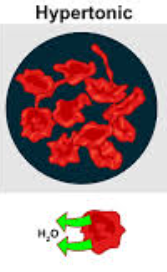
Hypertonic
higher solute concentration; cell will shrink
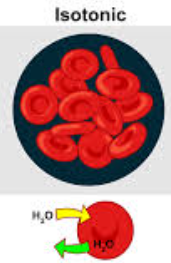
Isotonic
equal solute concentrations; no net movement of water
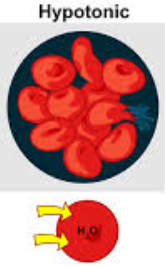
Hypotonic
lower solute concentration; cell will burst (“lyse”)
Explore top notes

